
Nootropics for Work After 45: What the Adult Trials Actually Tested
The ads promise a sharper workday. The trials behind the ingredients are more specific than that: who took part, how old they were, and what was actually measured. Here is what they found, and what to read on a label.
Quick answer
Some nootropic ingredients have trials in adults near your age. Bacopa has a 12-week trial in adults aged 40 to 70: less stress and fatigue, but no better test scores. Lion’s mane was tested mostly in younger adults, and phosphatidylserine in a small trial of adults 35 to 65. Two caffeine-free formulas with these ingredients are below.
You still work, and you are still good at it. But the afternoon meeting takes more out of you than it used to, and the name of the client, or the figure you knew by heart last quarter, now takes a beat longer to arrive. Then an ad shows up promising a sharper, faster workday in a capsule, and it sounds like it was written for you.
You have been around long enough to ask the next question: sharper according to whom? A study in twenty-year-old students answers a different question from yours. So does a study in people with a diagnosis. What you want to know is simpler — which of these ingredients were actually tried in adults like you, and what happened.
That is what this page sets out, one ingredient at a time, with what each trial measured and in whom.
Further down, we look at two caffeine-free formulas built on these ingredients: NeuroPrime and NovuBrain+ — each with a money-back guarantee.
What Should “Tested In Adults” Mean?
The phrase should mean that a nootropic, a supplement sold to support focus, memory or mental energy, was tried in people like you. The word covers very different ingredients, so the useful question is never whether nootropics work. It is what a specific ingredient was tested for. Four details decide whether a trial speaks to you.
Who took part. Age matters, and so does health. A trial in healthy adults under 45 and a trial in people with a diagnosed memory disorder are both real research, but neither describes a 52-year-old who is still working and noticing small changes.
What was measured. Some trials measure test scores, such as how many words people recall. Others measure how people feel: stress, fatigue, mood. Others measure speed on a single task. A result on one is not a result on the others.
How long. A single dose tested an hour later answers a different question from twelve weeks of daily use. The ingredients below are taken daily, so the longer trials matter most.
Against what. A placebo group is what lets researchers separate the ingredient from the simple effect of trying something new. Every trial below had one.
What Helps Focus At Work First?
Before any supplement, three everyday levers have public health guidance behind them. They cost nothing, and they work alongside anything else you decide to do.
Sleep. The CDC recommends 7 or more hours a night for adults up to 60, and 7 to 9 hours from 61 to 64. It notes that enough sleep can improve attention and memory, so that you perform daily activities better. Its tips include regular sleep and wake times, and skipping caffeine in the afternoon and evening.
Movement. The CDC recommends 150 minutes of moderate activity a week for adults, which can be as little as 22 minutes a day. It says regular physical activity can help keep thinking, learning and judgment skills sharp as you age, and can help you sleep better.
Caffeine, used on purpose. The FDA cites 400 milligrams a day — about two to three 12-ounce cups of coffee — as an amount not generally associated with negative effects for most adults, and lists what too much can bring: a faster heart rate, palpitations, higher blood pressure, trouble sleeping, jitters and headaches. Sensitivity varies with medicines and health conditions. If the afternoon is where focus fades, our guide to afternoon brain fog at work covers what to try before another cup.
What Did The Adult Trials Find, Ingredient By Ingredient?
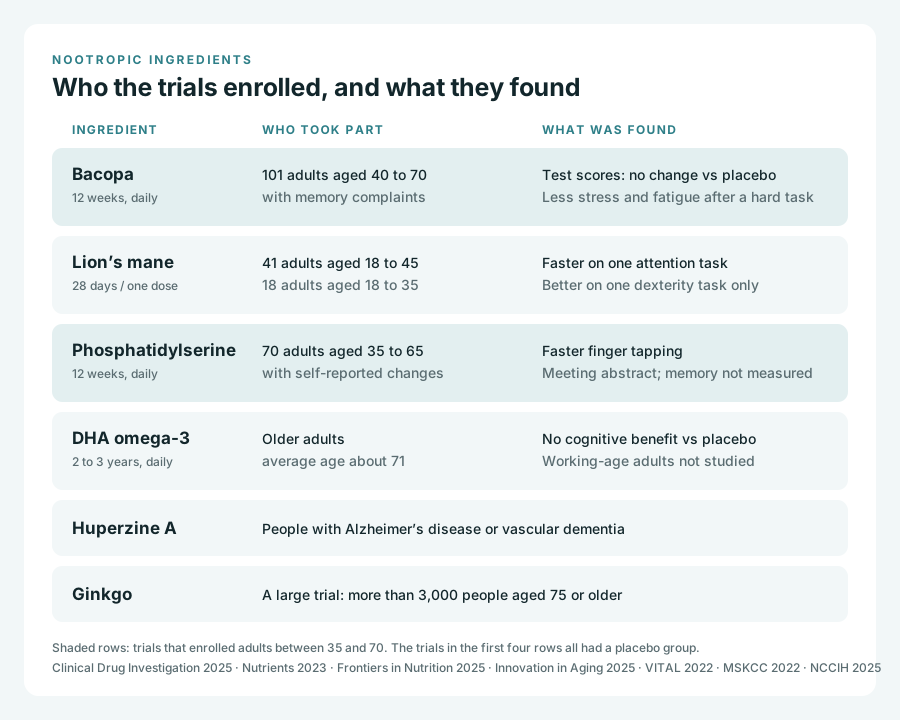
The ingredients in the two formulas below show narrow results: a signal on one or two measures for some, no benefit for others, and studies in other groups for the rest. For each one, here is who the trials enrolled, what they measured, and what they found, including results that showed no effect.
Bacopa — the one trial in your age group
Bacopa is a plant from Ayurvedic tradition, and it has the trial that comes closest to the reader of this page. In 2025, Clinical Drug Investigation published a randomized, double-blind, placebo-controlled trial in 101 adults aged 40 to 70 who reported memory problems. They took 300 mg of bacopa extract or a placebo every day for 12 weeks; 87 completed it.
The main measures were computer tests of verbal learning, attention and working memory, and on those there was no difference from placebo. The bacopa group did report greater reductions in stress reactivity, and less fatigue and stress after a mentally demanding task. Bacopa was generally well tolerated; digestive complaints and headaches were reported more often than with placebo. For a working adult, that is the honest shape of the answer: a signal on how a hard day feels, not a higher score. Our guide to bacopa alone or in a formula goes further into it.
Lion’s mane — tested mostly in younger adults
Lion’s mane is an edible mushroom. A 2023 pilot trial in Nutrients gave 1.8 grams a day or a placebo to 41 healthy adults aged 18 to 45, with an average age of 26, for 28 days. An hour after the first dose, the lion’s mane group was faster on one attention task, and after 28 days there was a trend toward lower stress that did not quite reach statistical significance. Other measures showed no benefit, and the authors describe the findings as tentative, given the small group.
A 2025 study in Frontiers in Nutrition gave a single 3-gram dose to 18 adults aged 18 to 35. Performance improved on one hand-dexterity task at 90 minutes, with no overall change in thinking or mood. Neither study enrolled adults over 45. Our comparison of lion’s mane and bacopa covers how the two differ.
Phosphatidylserine — a small trial in working-age adults
Phosphatidylserine is a phospholipid, one of the building blocks of cell membranes, and it is concentrated in the brain. A trial published in 2025 as a meeting abstract in Innovation in Aging gave 300 mg a day of a marine phosphatidylserine, or a placebo, to 70 adults aged 35 to 65 — average age 50 — who reported changes in their thinking. After 12 weeks, the phosphatidylserine group was faster on a finger-tapping test of motor speed, and no adverse events were observed. Memory was not one of the measures. A meeting abstract is a short report, not a full peer-reviewed paper, so it is a first look rather than a settled answer. Our guide to phosphatidylserine or fish oil covers its research in older adults.
DHA omega-3 — studied at older ages
DHA is the omega-3 fat found in fish oil. The largest relevant trial, VITAL, gave 1 gram of marine omega-3 a day, 840 mg of EPA and DHA combined, to older adults with an average age of about 71, for two to three years. It found no cognitive benefit over placebo in that group. It did not study working-age adults.
Huperzine A and ginkgo — studied in other groups
Huperzine A slows the enzyme that breaks down acetylcholine, a messenger involved in memory. The human studies Memorial Sloan Kettering describes were in people with Alzheimer’s disease or vascular dementia. For ginkgo, the large trial described by the NIH’s National Center for Complementary and Integrative Health enrolled more than 3,000 people aged 75 or older. Both have real research behind them; the studies described there were simply in different groups from the reader of this page.
And as with every finished formula sold this way, neither formula below has a published trial on its exact combination. The evidence above is evidence about ingredients.
What Should You Check On The Label Before You Buy?
The research above turns into four quick checks you can run on any nootropic, at your desk, in a few minutes.
- Caffeine, under any name. The FDA requires added caffeine to appear in the ingredient list. Plants that contain it, such as green tea, guarana or yerba mate, appear under their plant names. Our guide to taking a stimulant-free nootropic every day covers what that label does and does not tell you.
- Which ingredients have trials, and in whom. Match the names on the label to the section above. An ingredient tested in adults like you is a different starting point from one tested in another group.
- Whether amounts are published. Some labels print the amount of each ingredient; many do not. Where they are printed, you can set them beside the trials.
- Time to judge it. The daily-use trials in working-age adults here ran 4 to 12 weeks. A guarantee that covers that window lets you decide on what you noticed, not on a promise.
Two formulas on this site are built on these ingredients, and both are described by their makers as free of caffeine or stimulants. NeuroPrime is a liquid taken as one drop a day, built on nine botanicals that include bacopa, lion’s mane and ginkgo; the maker describes it as stimulant-free, and the guarantee runs 365 days. NovuBrain+ is two capsules with breakfast, pairing bacopa with huperzine A and phosphatidylserine with DHA omega-3, plus L-glutamine, DMAE and vitamin B12; the maker describes it as caffeine-free, it is sold as a one-time purchase, and the guarantee runs 60 days. Neither publishes the amount of each ingredient, which the full reviews explain.
Two formulas worth a closer look
Two caffeine-free formulas built on trial-tested ingredients
Both are built on ingredients that have been through placebo-controlled trials in adults, with no caffeine to plan the working day around — and each comes with a money-back guarantee.
NeuroPrime
Drops
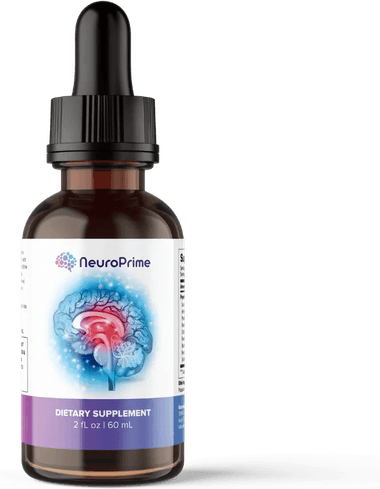
One drop a day, stirred into a morning drink, built on nine botanicals that include bacopa and lion’s mane — the two ingredients here with placebo-controlled trials in adults — plus ginkgo.
- Readers who want no extra capsule in the workday
- Anyone who wants a full year to decide
Covered by a 365-day money-back guarantee
Before you start · Worth raising with your prescriber if you take a blood thinner, thyroid medication or a sedative.
See NeuroPrime on the official siteRead our NeuroPrime review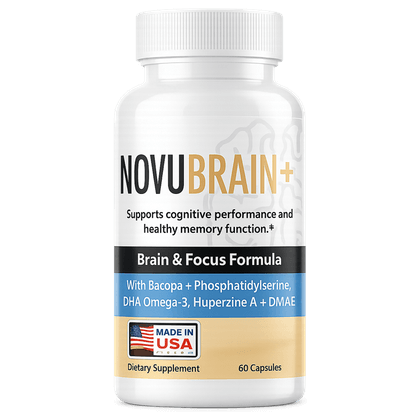
NovuBrain+
Capsules
Two caffeine-free capsules with breakfast, pairing bacopa with huperzine A and phosphatidylserine with DHA omega-3 — two ingredients here with trials in adults under 70.
- Readers who want several studied compounds in one routine
- Anyone avoiding caffeine and auto-ship
Covered by a 60-day money-back guarantee
Before you start · Huperzine A is worth naming if you take a beta-blocker, a calcium channel blocker or a prescription memory medicine.
See NovuBrain+ on the official siteRead our NovuBrain+ reviewListed in no particular order. We publish no scores or rankings.
Who Should Check Before Starting?
Anyone who takes one of the medicines below should ask first, because no caffeine does not mean no interactions. Take the bottle, or a photo of the label, to your pharmacist or doctor if any of these apply:
- You take a beta-blocker or a calcium channel blocker. Memorial Sloan Kettering notes that huperzine A may lower heart rate alongside these medicines, and lists a slow heartbeat, nausea, dizziness and insomnia among its side effects.
- You take a prescription memory medicine, such as donepezil, galantamine or rivastigmine, or a medicine that blocks dopamine, such as some antipsychotics. Memorial Sloan Kettering advises against combining these with huperzine A.
- You take a blood thinner such as warfarin. Ask before any new supplement; our guide for readers on a blood thinner lists the questions to bring.
- You take thyroid medication or a sedative. The reviews of NeuroPrime and NovuBrain+ both flag bacopa as the ingredient to mention with thyroid medication, and the NeuroPrime review also names sedatives.
Not a complete list. Never stop, reduce or change a prescription to make room for a supplement.
When Should You See A Doctor?
See a doctor if the forgetting at work is getting worse month over month, if colleagues or family have started to notice it, or if it began suddenly; that is a conversation for an appointment rather than a supplement question. Small lapses under pressure are common, and a long week or a short night explains many of them.
And if you notice something new after starting a supplement, such as a change in your heartbeat, dizziness, or stomach trouble that does not settle, tell your doctor or pharmacist.
Ready to compare? Go back to the two formulas above, or read the full reviews of NeuroPrime and NovuBrain+.
Frequently asked
Do nootropics work for adults over 45?
It depends on the ingredient and on what was measured. The clearest trial in this age group gave 300 mg of bacopa a day for 12 weeks to adults aged 40 to 70 with memory complaints. Test scores for learning, attention and working memory did not change more than with placebo, but the bacopa group reported less stress reactivity and less fatigue after a demanding task. Judge any formula over 4 to 12 weeks, not days.
Which nootropic ingredients have clinical trials in adults?
Bacopa has a 2025 placebo-controlled trial in adults aged 40 to 70. Lion’s mane has small trials, mostly in adults under 45. Phosphatidylserine has a 2025 trial in adults aged 35 to 65, so far published only as a meeting abstract, which measured speed on a finger-tapping test. Huperzine A and ginkgo were studied mainly in older groups or in people with a diagnosis.
Is there a caffeine-free nootropic for work?
Yes. Many focus formulas contain no caffeine and are built on ingredients studied over weeks of daily use rather than felt within the hour. Read the full ingredient list: the FDA requires added caffeine to be listed, and plants that contain it, such as green tea or guarana, appear under their plant names.
How long does a nootropic take to work?
The trials in working-age adults described here ran from a single dose to 12 weeks, and the formulas below are meant to be taken daily. The honest window to judge a stimulant-free formula is 4 to 12 weeks. A guarantee that runs longer than that gives you time to decide.
Can I take a nootropic with my medications?
Take the bottle, or a photo of the label, to your pharmacist or doctor first. Memorial Sloan Kettering lists interactions for huperzine A with prescription memory medicines, beta-blockers, calcium channel blockers and medicines that block dopamine. Never stop or change a prescription to make room for a supplement.
References
- The Effects of a Bacopa monnieri Extract (Bacumen®) on Cognition, Stress, and Fatigue in Healthy Adults: A Randomized, Double-Blind, Placebo-Controlled Trial — Clinical Drug Investigation — 2025
- The Acute and Chronic Effects of Lion’s Mane Mushroom Supplementation on Cognitive Function, Stress and Mood in Young Adults: A Double-Blind, Parallel Groups, Pilot Study — Nutrients — 2023
- Acute effects of a standardised extract of Hericium erinaceus (Lion’s Mane mushroom) on cognition and mood in healthy younger adults: a double-blind randomised placebo-controlled study — Frontiers in Nutrition — 2025
- Phosphatidylserine Supplementation on Psychomotor Speed among Healthy Adults with Subjective Cognitive Declines — Innovation in Aging (meeting abstract) — 2025
- Marine n-3 fatty acids and cognitive change among older adults in the VITAL randomized trial — Alzheimer’s & Dementia: Diagnosis, Assessment & Disease Monitoring — 2022
- Huperzia serrata — Memorial Sloan Kettering Cancer Center, About Herbs — 2022
- Ginkgo — NIH National Center for Complementary and Integrative Health — 2025
- Spilling the Beans: How Much Caffeine is Too Much? — U.S. Food and Drug Administration — 2024
- About Sleep — Centers for Disease Control and Prevention — 2024
- Benefits of Physical Activity — Centers for Disease Control and Prevention — 2025
Disclosure
All content is for informational purposes only and is not a substitute for professional medical advice, diagnosis, or treatment. Each product covered is a dietary supplement, not a prescription drug, and statements about it have not been evaluated by the U.S. Food and Drug Administration. Results vary with individual health status, consistency of use, and lifestyle. This page contains affiliate links — if you buy through them we may earn a small commission at no additional cost to you. Read our disclosure and our editorial policy.