
Taking a Stimulant-Free Nootropic Every Day: What to Check First
No caffeine is a good start, but it is not the whole answer. Here is what the reference sources report about daily use, ingredient by ingredient, what to check with your medicines, and two formulas made without stimulants.
Quick answer
Stimulant-free means no caffeine or similar stimulant in the formula, not that it is free of side effects or interactions. Check the label for caffeine, bring a list of everything you take to your pharmacist, start one product at a time and judge it over 4 to 12 weeks. Two stimulant-free formulas are set out below.
You heard the word on a podcast, or a colleague mentioned it over lunch: nootropics. Something to keep you sharp through the afternoon meeting without a fourth coffee. It sounded reasonable. Then you looked closer, and the questions started.
Is a nootropic just a stimulant with a nicer name? And if it is something you would take every working day, for months, what does that do over time — with the blood pressure pill, or whatever else is already in the cabinet? You do not want a buzz. You want to stay good at a job you are good at, without trading one habit for a riskier one.
Those are the right questions. Here is what the reference sources actually say, and what to check before a daily routine starts.
Further down, we look at two stimulant-free formulas: NovuBrain+ and CogniSurge — each with a money-back guarantee.
What Does Stimulant-Free Actually Mean?
A stimulant is the thing you can feel. Caffeine is the familiar one. The FDA lists what too much of it can do: a faster heart rate, palpitations, higher blood pressure, trouble sleeping, anxiety, jitters, an upset stomach and headache. It also notes that people vary widely in how sensitive they are to caffeine and how fast they clear it, and that some medicines and conditions make people more sensitive.
Stimulant-free takes that part out. A formula described this way is not built to be felt within the hour. Its ingredients were studied over weeks of daily use, which is exactly why the everyday-safety question matters more, not less.
You can check the caffeine part yourself. The FDA requires caffeine to appear in the ingredient list when it is added on its own. Plants that contain caffeine naturally, such as green tea or guarana, appear under their plant names instead. Our guide to caffeine-free brain supplements lists the names to look for.
What it does not tell you is how the rest behaves. The FDA notes that it is not authorized to approve dietary supplements for safety and effectiveness before they are marketed, and it advises talking to a doctor, pharmacist or other health care professional before buying or using one. In its guidance on mixing medicines and supplements, it adds that some supplements can change how a medicine is absorbed, broken down or cleared, and that natural does not always mean safe. That is not a reason to avoid a formula. It is the reason to read the rest of this page.
What Should You Check Before Taking A Nootropic Every Day?
Four checks, none of which costs anything, turn a daily supplement from a guess into something you can actually judge.
1. Read the whole ingredient list
Not just the front of the bottle. Look for caffeine and for the plant sources of it, and note which ingredients you do not recognize. Those are the ones to look up, or to ask about.
2. Write one list of everything you take
The FDA suggests bringing a list of all the supplements and medicines you currently take, including the doses and how many times a day you take them, to your health care professional. Include the new formula, and anything over the counter. A pharmacist can check it in a few minutes, and it is the single most useful thing you can do before a daily routine.
3. Start one product at a time
If you begin a new formula the same week you change your coffee, your sleep or another supplement, you will not know what did what. Write down the date you start, and anything unusual in the first weeks — a stomach that is off, a headache, sleep that shifts.
4. Give it the time it was studied for
Stimulant-free ingredients were tested over weeks: the bacopa trials below ran 12 weeks. The honest window to judge a formula like this is 4 to 12 weeks. If what you need is help with the afternoon itself, our guide to afternoon brain fog at work covers the free fixes to try first, from the coffee cutoff to short walking breaks.
What Is The Downside Of Nootropics?
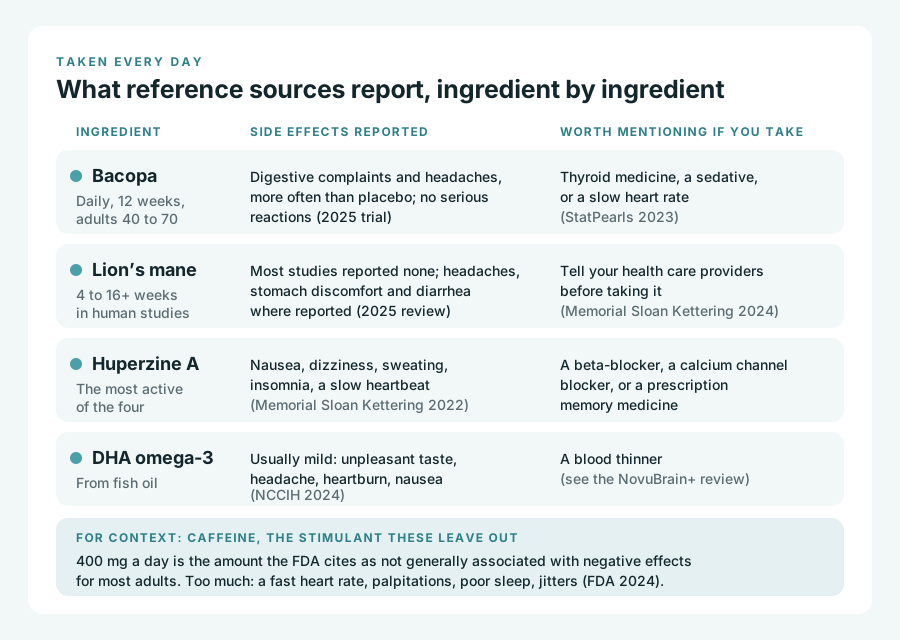
The word nootropic covers very different ingredients, so the everyday-safety question has to be asked one ingredient at a time. Here are four that appear in the formulas below, with what the reference sources report about taking them daily, and what they were tested for.
Bacopa
Bacopa is the most studied plant in this aisle, and it is studied as a daily supplement. A StatPearls review describes it as generally well tolerated, notes that efficacy trials typically ran 12 weeks, and names the most common side effects as stomach and bowel complaints: more frequent stools, nausea and cramps.
The most useful trial for a working adult is recent. In 2025, Clinical Drug Investigation published a randomized, placebo-controlled trial in 101 adults aged 40 to 70 who reported memory and attention problems. They took 300 mg of bacopa extract or a placebo every day for 12 weeks. Bacopa was generally well tolerated, with no serious adverse reactions, although the bacopa group reported side effects more often than the placebo group, mainly digestive complaints and headaches.
What did it do? There was no difference from placebo in verbal learning, attention or working memory. The bacopa group did report greater reductions in stress reactivity, and less fatigue after a mentally demanding task — outcomes the authors say need confirming. For anyone asking whether a nootropic works at work, that is the honest shape of the answer: a modest signal on stress and fatigue, not a sharper score.
Lion’s mane
Lion’s mane is an edible mushroom. A 2025 systematic review in Frontiers in Nutrition gathered its human and laboratory studies. In the human studies that gave it daily, people took between 0.8 and 3 grams a day for periods from 4 weeks to more than 16 weeks, and seven of the ten human studies reported no adverse events. Where side effects were reported, they included headaches, stomach discomfort and diarrhea. The same review concluded that, as a supplement, lion’s mane has so far shown limited effectiveness in clinical trials, which were small and short. Memorial Sloan Kettering notes that abdominal discomfort, nausea and skin rash were reported in a clinical study, and advises telling your health care providers before taking it.
Huperzine A
Huperzine A is the most pharmacologically active ingredient in this group: it slows the enzyme that breaks down acetylcholine, a messenger involved in memory. Memorial Sloan Kettering lists side effects that include nausea, dizziness, sweating, insomnia, excitability and a slow heartbeat, and names the medicines not to combine it with, covered below. That makes it the ingredient to name first when you speak to a pharmacist.
DHA omega-3
DHA is the omega-3 fat found in fish oil. The NIH’s National Center for Complementary and Integrative Health notes that side effects of omega-3 supplements are usually mild: an unpleasant taste, bad breath, headache, and digestive symptoms such as heartburn, nausea and diarrhea.
For the other ingredients these formulas contain, the reviews linked below set out what each was tested for. As with every finished formula sold this way, neither formula below has a published trial on its exact combination; the evidence above is evidence about ingredients.
Which Stimulant-Free Formulas Could Fit A Daily Routine?
Both formulas below are described by their makers as stimulant-free, and each can be judged over the weeks its ingredients were studied for.
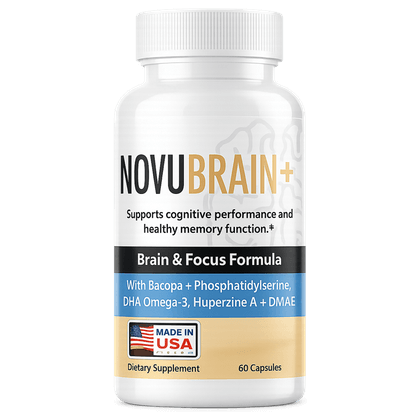
NovuBrain+ is two capsules with breakfast. It pairs bacopa with huperzine A, and phosphatidylserine with DHA omega-3, plus L-glutamine, DMAE and vitamin B12. The maker describes it as caffeine-free and stimulant-free. The sales page publishes no amount for any of the seven compounds. It is sold as a one-time purchase, with no auto-ship and a 60-day guarantee; its comparison page sets it beside buying phosphatidylserine, DHA and huperzine A separately.
CogniSurge is two capsules a day with a glass of water, built on five traditional botanicals: schisandra, gotu kola, shilajit, lion’s mane and bacopa. The maker is explicit that it contains no stimulants, so it can be taken at whatever time of day suits your routine. No amount is published for the five ingredients, and the guarantee runs 365 days; its comparison page sets it beside caffeine, L-theanine and coffee.
Two formulas worth a closer look
Two stimulant-free formulas for a daily routine
Both are described by their makers as stimulant-free, so there is no caffeine to plan the working day around — and each comes with a money-back guarantee.
NovuBrain+
Capsules
Two caffeine-free capsules with breakfast, pairing bacopa with huperzine A and phosphatidylserine with DHA omega-3 — several studied compounds in one morning routine.
- Readers who want several studied compounds in one routine
- Anyone avoiding caffeine and auto-ship
Covered by a 60-day money-back guarantee
Before you start · Huperzine A is worth naming if you take a beta-blocker, a calcium channel blocker or a prescription memory medicine.
See NovuBrain+ on the official siteRead our NovuBrain+ review
CogniSurge
Capsules
Stated by its maker to contain no stimulants, and built on five traditional botanicals including bacopa and lion’s mane, taken as two capsules a day at whatever time suits your routine.
- Readers who want to avoid caffeine
- Anyone who wants a long refund window
Covered by a 365-day money-back guarantee
Before you start · Mention bacopa if you take thyroid medicine or a sedative.
See CogniSurge on the official siteRead our CogniSurge reviewListed in no particular order. We publish no scores or rankings.
Who Should Check Before Starting?
Anyone in one of these situations should take the bottle, or a photo of the label, to a pharmacist or doctor first, because stimulant-free does not mean interaction-free:
- You take a beta-blocker or a calcium channel blocker. Memorial Sloan Kettering notes that huperzine A may lower heart rate with these medicines.
- You take a prescription memory medicine, such as donepezil, galantamine or rivastigmine. Memorial Sloan Kettering notes that huperzine A works by the same mechanism and may increase the risk of side effects. It also lists medicines that block dopamine, such as some antipsychotics.
- You take thyroid hormone, or have a slow heart rate. A StatPearls review notes that bacopa raised thyroid hormone (T4) levels, and that it may worsen bradycardia, a slow heart rate.
- You take a sedative or a sleep medicine. The same StatPearls review describes bacopa as mildly sedating.
The NovuBrain+ review also flags DHA for anyone on a blood thinner. Not a complete list. Never stop, reduce or change a prescription to make room for a supplement.
When Should You See A Doctor?
If you notice something new after starting a supplement — a change in your heartbeat, dizziness, or stomach trouble that does not settle — tell your doctor or pharmacist. The FDA also invites consumers to report problems with a supplement.
And if the forgetting at work is getting worse month over month, or colleagues have started to notice it, that is a conversation for an appointment rather than a supplement question.
Ready to compare? Go back to the two formulas above, or read the full reviews of NovuBrain+ and CogniSurge.
Frequently asked
Are nootropics safe to take every day?
There is no single answer, because the word covers very different ingredients. The FDA does not approve dietary supplements for safety and effectiveness before they are sold, so the useful question is what each ingredient was tested for, for how long, and what side effects were reported. For bacopa, a 2025 trial of daily use for 12 weeks in adults aged 40 to 70 reported no serious reactions, with more digestive complaints and headaches than placebo. Ask your pharmacist about your own medicines first.
What is a stimulant-free nootropic for brain fog?
It is a focus or memory formula without caffeine or other stimulants, usually built on plant extracts or nutrients that were studied over weeks of daily use rather than felt within the hour. Stimulant-free is the maker’s description, so read the ingredient list yourself for caffeine and for plants that contain it, such as green tea or guarana.
Do nootropics for work actually work?
It depends on the ingredient and on what was measured. In a 2025 trial of 101 adults aged 40 to 70 with self-reported memory and attention problems, 300 mg of bacopa a day for 12 weeks did not improve memory or attention scores more than placebo, but the bacopa group reported greater reductions in stress reactivity and less fatigue after a demanding task. Judge any formula over 4 to 12 weeks, not days.
Can I take bacopa every day?
Bacopa is normally studied as a daily supplement: a StatPearls review notes that trials typically ran 12 weeks and describes it as generally well tolerated, with stomach and bowel complaints the most common side effects. It also notes that bacopa raised thyroid hormone (T4) levels and is mildly sedating, so mention it if you take thyroid medicine or a sedative.
Is huperzine A OK to take daily?
Ask your prescriber first if you take any regular medicine. Memorial Sloan Kettering lists side effects that include nausea, dizziness, sweating, insomnia and a slow heartbeat, and advises against combining it with prescription memory medicines such as donepezil, with beta-blockers or calcium channel blockers, and with medicines that block dopamine.
Can I take a nootropic with blood pressure medicine?
Take the bottle or a photo of the label to your pharmacist first. Being stimulant-free removes caffeine from the question, not every interaction: huperzine A may lower heart rate alongside beta-blockers and calcium channel blockers, according to Memorial Sloan Kettering. Never stop or change a prescription to make room for a supplement.
References
- Spilling the Beans: How Much Caffeine is Too Much? — U.S. Food and Drug Administration — 2024
- Information for Consumers on Using Dietary Supplements — U.S. Food and Drug Administration — 2022
- Mixing Medications and Dietary Supplements Can Endanger Your Health — U.S. Food and Drug Administration — 2022
- Bacopa monnieri — StatPearls, NCBI Bookshelf — 2023
- The Effects of a Bacopa monnieri Extract (Bacumen®) on Cognition, Stress, and Fatigue in Healthy Adults: A Randomized, Double-Blind, Placebo-Controlled Trial — Clinical Drug Investigation — 2025
- Benefits, side effects, and uses of Hericium erinaceus as a supplement: a systematic review — Frontiers in Nutrition — 2025
- Lion’s Mane Mushroom — Memorial Sloan Kettering Cancer Center, About Herbs — 2024
- Huperzia serrata — Memorial Sloan Kettering Cancer Center, About Herbs — 2022
- Omega-3 Supplements: What You Need To Know — NIH National Center for Complementary and Integrative Health — 2024
Disclosure
All content is for informational purposes only and is not a substitute for professional medical advice, diagnosis, or treatment. Each product covered is a dietary supplement, not a prescription drug, and statements about it have not been evaluated by the U.S. Food and Drug Administration. Results vary with individual health status, consistency of use, and lifestyle. This page contains affiliate links — if you buy through them we may earn a small commission at no additional cost to you. Read our disclosure and our editorial policy.