
Focus Without the Jitters: Caffeine-Free Memory Supplements for Adults Over 60
If an afternoon coffee now costs you the night, the ingredient list matters as much as the promise on the front. Here is how to spot caffeine on a label, why it can weigh more after 60, and two stimulant-free formulas.
Quick answer
Yes. Some memory formulas are made without stimulants, and two on this site are stated to be stimulant-free. Read the label for caffeine and for plants that contain it, such as guarana, kola nut, yerba maté and green tea. After 60, caffeine late in the day can cost you sleep. Start one supplement at a time. If you want to try one, two stimulant-free formulas are compared below.
You gave up the afternoon coffee a while ago. It was not worth the hours lying awake, or the flutter in your chest that sent you looking for your pulse.
But the afternoons still drift. The thread of a conversation slips, and the page you are reading stops going in. So you look at a focus or memory supplement — and wonder whether it will quietly bring back exactly what you gave up.
It is a fair question, because caffeine does not always appear on a label under its own name. Here is how to find it, why it matters more now, and how to try something new without guessing what caused what.
Further down, we look at two stimulant-free formulas: CogniSurge and MemoVolt — each with a money-back guarantee.
Why Can Caffeine Weigh More After 60?
Sleep is the first reason. The National Institute on Aging notes that older adults need about the same amount of sleep as all adults — seven to nine hours a night — and that insomnia is the most common sleep problem in adults aged 60 and older. Its advice is to avoid caffeine late in the day, because it can keep you awake at night.
Caffeine also stays around. The NIH Office of Dietary Supplements puts its half-life at about 6 hours: half of an afternoon dose can still be in your body by the evening.
The heart is the second. MedlinePlus lists a fast heart rate, anxiety, difficulty sleeping, restlessness and tremors among caffeine’s side effects. It suggests you may want to limit caffeine if you are prone to sleep problems or have problems with fast or irregular heart rhythms. Caffeine is also listed among the causes of heart palpitations.
And medicines are the third. The FDA notes that there is wide variation in how sensitive people are to caffeine and how fast they clear it, and that certain conditions and some medications can make people more sensitive. MedlinePlus adds that many drugs interact with caffeine. If you take any, the FDA suggests asking your health care provider whether you need to limit it.
Supplements add to the picture. The CDC reports that 75.9% of adults aged 60 and older took a dietary supplement in 2021 to 2023, and 56.4% took two or more. Every extra product is one more label to check.
Where Does Caffeine Hide On A Supplement Label?
Caffeine shows up on labels in two ways. The first is easy. The FDA says packaged foods must list caffeine in the ingredient list when it is added as a stand-alone ingredient, and many dietary supplements with caffeine voluntarily state how much they contain.
The second takes a closer look. Some ingredients contain caffeine naturally, and appear under their plant names:
- Guarana. Memorial Sloan Kettering notes its seeds contain caffeine and chemicals like caffeine, and lists insomnia and changes to your heartbeat among reported side effects.
- Kola (or cola) nut. The NIH Office of Dietary Supplements names it, with guarana and yerba maté, as an herbal source that naturally contains caffeine.
- Yerba maté. Memorial Sloan Kettering notes mate contains caffeine, theophylline and theobromine, and lists sleep disruption, palpitations and increased heart rate among its side effects.
- Green tea and green tea extract. The NIH’s complementary health center notes that green tea contains caffeine.
- Green coffee bean extract. The NIH Office of Dietary Supplements notes green coffee beans contain caffeine, although decaffeinated forms are available.
Here is the part that matters for reading a label. The NIH Office of Dietary Supplements, writing about weight-loss products, notes that some labels list only the herbal ingredients and do not declare the amount of caffeine, so people might not realize a product contains it.
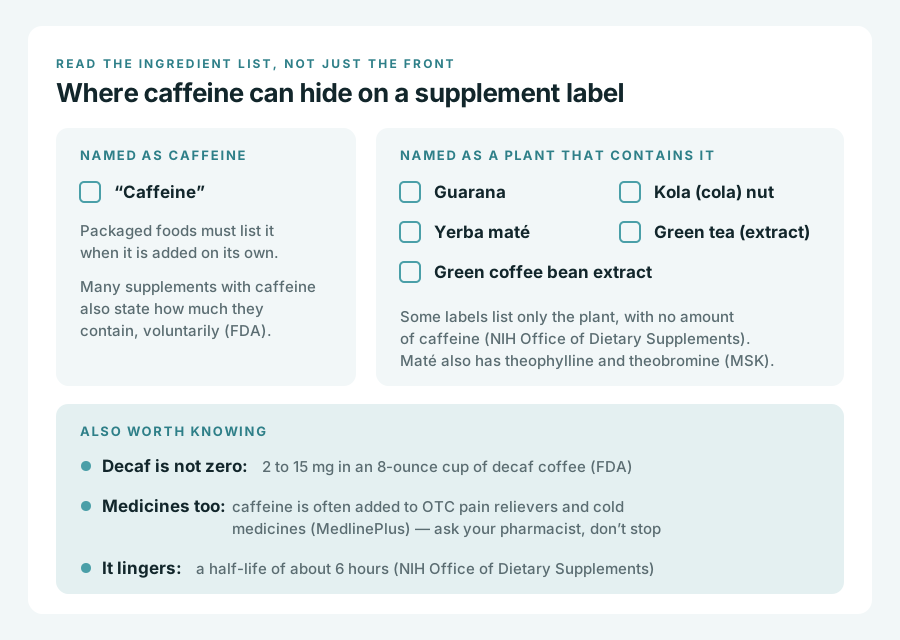
Two more places caffeine turns up. The FDA notes that decaf is not caffeine-free: decaf coffee typically has 2 to 15 milligrams in an 8-ounce cup. And MedlinePlus notes caffeine is often added to over-the-counter pain relievers, diet pills and cold medicines. If you are unsure about a medicine, ask your pharmacist rather than stopping it.
What Were Caffeine-Free Ingredients Studied For?
Their trials mostly measured memory and thinking over weeks of daily use, because a formula without a stimulant is not built to be felt within the hour. Here is what three of them were tested for, and in whom.
Citicoline
A 2021 trial in The Journal of Nutrition gave 100 healthy adults aged 50 to 85 with age-associated memory impairment either 500 mg of citicoline or a placebo daily for 12 weeks. The citicoline group improved more in episodic memory and in an overall memory score. The trial was funded by the company that makes the citicoline used.
Bacopa
A StatPearls review describes bacopa as mildly sedating, with a calming effect. A 2026 network meta-analysis in Phytomedicine pooled 29 randomized trials in 2,107 healthy adults: higher doses improved working memory compared with placebo, lower doses improved delayed memory, and there were no differences in attention or processing speed. In a separate 2025 trial of 101 adults aged 40 to 70 with self-reported memory and attention problems, 300 mg a day for 12 weeks did not improve cognitive scores more than placebo, though stress and fatigue measures improved.
Saffron
A 2024 systematic review in Phytotherapy Research gathered 46 randomized trials lasting 4 to 48 weeks, in healthy people and in people with a range of neurological and psychiatric conditions. Saffron was more effective than placebo for cognition, and it was well tolerated with few side effects. Because the trials mixed healthy people and patients, the result is not specific to healthy adults over 60.
What If Menopause Is Part Of The Picture?
Then the fog may have started well before 60. The Menopause Society reports that 40% to 60% of midlife women notice symptoms such as forgetfulness during the menopause transition, and says the changes are typically mild. Our guide to brain fog after menopause sets out what each supplement was tested for, and whether women past menopause were included.
Caffeine and hot flashes. The Menopause Society notes that some women feel a rapid heartbeat during a hot flash, and that night sweats are hot flashes that happen during sleep. The National Institute on Aging suggests avoiding alcohol, spicy foods and caffeine, which can make menopausal symptoms worse.
Does cutting coffee clear the fog? None of these sources says so directly. What connects the two is sleep: the National Institute on Aging notes that a lack of quality sleep can lead to problems with memory. If coffee seems to make your nights or your hot flashes worse, cutting back is one change you can test, and note in the diary described below.
Ashwagandha. It often turns up in caffeine-free blends. The NIH’s complementary health center says some preparations may help with insomnia and stress, but that there is not enough evidence to know whether it helps cognitive function or menopause. It may be safe for up to 3 months; longer-term safety is not known. Although it is rare, a number of cases link liver injury to ashwagandha supplements. It is not recommended for people with thyroid or autoimmune disorders, and it may interact with thyroid hormone, diabetes and blood pressure medicines, and sedatives. Neither formula below lists it.
Why Start One Supplement At A Time?
If you have already noticed how your body reacts to caffeine, you know the value of changing one thing and watching. The NIH Office of Dietary Supplements advises being alert to the possibility of a bad reaction, especially when taking a new product, and notes that side effects are most likely when people take high doses, take supplements instead of prescribed medicines, or take many different supplements.
So add one new product at a time, and write down the date you start. The National Institute on Aging suggests a sleep diary for a couple of weeks if you have trouble sleeping: when you go to bed, when you wake in the night, and whether you had caffeine that day. The same notebook shows what changed after a new supplement.
Keep expectations realistic, too. The NIH Office of Dietary Supplements notes that the FDA does not determine whether supplements are effective before they are sold. That is why this page sets out what each ingredient was tested for, and in whom, before you choose.
Who Should Check Before Starting?
Anyone in the situations below should check with a doctor or pharmacist first, because caffeine-free does not mean interaction-free. Take the label to your pharmacist or doctor if any of these apply to the formulas below:
- You take thyroid hormone, or have a slow heart rate. A StatPearls review notes bacopa taken with thyroid hormone may lead to too much thyroid hormone, and that bacopa may worsen bradycardia, a slow heart rate.
- You take several medicines broken down by the liver. Memorial Sloan Kettering notes gotu kola affected several liver enzymes that process medicines in lab studies; whether that matters in people has not been determined.
- You take diabetes medicine. The NIH’s complementary health center says herbal supplements such as cinnamon can cause unwanted side effects with conventional diabetes drugs, and that berberine may interact with some medicines.
- You take a blood thinner. Memorial Sloan Kettering notes fucoidan may increase the risk of bleeding with warfarin, and a 2022 review in the Journal of Primary Health Care advises caution with saffron alongside antiplatelet or anticoagulant medicines.
- You take tamoxifen. Memorial Sloan Kettering notes that isoflavones in kudzu may interfere with its effects.
Not a complete list. Never stop, reduce or change a prescription to make room for a supplement.
Which Formulas Are Stated To Be Stimulant-Free?
If you want a daily formula with no caffeine to plan around, two on this site are described by their makers as stimulant-free. CogniSurge is built on five traditional botanicals — schisandra, gotu kola, shilajit, lion’s mane and bacopa — taken as two capsules a day with water, and its comparison page sets it beside caffeine with L-theanine and coffee. MemoVolt is one capsule a day with food, built on ten ingredients including berberine, Ceylon cinnamon, banaba and saffron. Neither publishes the amount of each ingredient, which the full reviews explain.
If menopause is part of your picture, know what these two are and are not. Neither was designed around menopause or tested in women going through it. What they offer on this question is a daily routine with no caffeine in it.
Two formulas worth a closer look
Two stimulant-free formulas
Both are stated by their makers to be stimulant-free, so caffeine is not part of the routine — and each comes with a money-back guarantee.

CogniSurge
Capsules
Stated by its maker to contain no stimulants, and built on five traditional botanicals including bacopa and lion’s mane, taken as two capsules a day at whatever time suits your routine.
- Readers who want to avoid caffeine
- Anyone who wants a long refund window
Covered by a 365-day money-back guarantee
Before you start · Mention bacopa if you take thyroid medicine or a sedative.
See CogniSurge on the official siteRead our CogniSurge review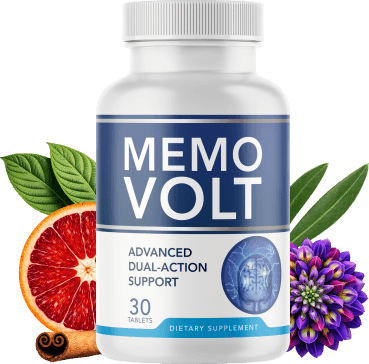
MemoVolt
Capsules
One capsule a day with food, stimulant-free, with saffron — which has human trials on cognition — alongside berberine, Ceylon cinnamon and banaba.
- Anyone who wants one capsule a day
- Readers already watching their blood sugar
Covered by a 60-day money-back guarantee
Before you start · Berberine and cinnamon are worth raising if you take diabetes medicine, and fucoidan if you take a blood thinner.
See MemoVolt on the official siteRead our MemoVolt reviewListed in no particular order. We publish no scores or rankings.
When Should You See A Doctor?
If you have never had heart palpitations before, MedlinePlus advises seeing your provider. Call 911 for palpitations with chest pain, shortness of breath, unusual sweating, dizziness or loss of consciousness.
If you are always sleepy, or find it hard to get enough sleep at night, the National Institute on Aging says it may be time to talk with a doctor. And if memory problems are getting worse, it notes that finding the cause is what determines the best next step.
Ready to compare? Go back to the two formulas above, or read the full reviews of CogniSurge and MemoVolt.
Frequently asked
Is there a caffeine-free focus supplement?
Yes. Some memory and focus formulas are made without stimulants, and a maker will often say so on the label. Check the ingredient list anyway: look for caffeine itself, and for plants that contain it, such as guarana, kola nut, yerba maté, green tea and green coffee bean extract.
What is the best cognitive supplement for seniors?
There is no single answer, and this site does not rank products. A better question is what each ingredient was tested for, and in whom. A stimulant-free formula whose ingredients have human trials is a reasonable place to start, after a word with your pharmacist.
Does green tea extract have caffeine?
Green tea contains caffeine, according to the NIH’s complementary health center. The NIH Office of Dietary Supplements notes that some supplement labels list only an herbal ingredient such as green tea, guarana or yerba maté without stating the amount of caffeine, so people may not realize the product contains it.
Why does caffeine keep me awake more than it used to?
People vary widely in how sensitive they are to caffeine and how fast they clear it, and the FDA notes that certain conditions and some medicines can increase that sensitivity. Caffeine has a half-life of about 6 hours. The National Institute on Aging advises avoiding caffeine late in the day, because it can keep you awake at night.
Can I take a caffeine-free brain supplement with heart or blood pressure medicine?
Ask your doctor or pharmacist first, and bring the bottle. Being caffeine-free removes one question, not all of them: plant ingredients can interact with medicines too. Never stop or change a prescription to make room for a supplement.
Does cutting coffee help menopause brain fog?
No study we found tested that directly. The National Institute on Aging suggests avoiding caffeine because it can make menopausal symptoms worse. Caffeine late in the day can cost you sleep, and poor sleep can affect memory, so it is a change worth testing and writing down.
Does ashwagandha help menopause brain fog?
The evidence is not there yet. The NIH’s complementary health center says some preparations may help with insomnia and stress, but there is not enough evidence on cognitive function or menopause. It is not recommended for people with thyroid or autoimmune disorders, rare cases of liver injury have been linked to it, and it can interact with several medicines, so ask your doctor or pharmacist first.
References
- Sleep and Older Adults — National Institute on Aging — 2025
- Caffeine in the diet — MedlinePlus Medical Encyclopedia — 2025
- Heart palpitations — MedlinePlus Medical Encyclopedia — 2024
- Spilling the Beans: How Much Caffeine is Too Much? — U.S. Food and Drug Administration — 2024
- Dietary Supplements for Weight Loss: Fact Sheet for Health Professionals — NIH Office of Dietary Supplements — 2022
- Green Tea: Usefulness and Safety — NIH National Center for Complementary and Integrative Health — 2025
- Guarana — Memorial Sloan Kettering Cancer Center, About Herbs — 2022
- Mate — Memorial Sloan Kettering Cancer Center, About Herbs — 2022
- Dietary Supplement Use: United States, August 2021–August 2023 — NCHS Data Brief No. 561, CDC — 2026
- Dietary Supplements: What You Need to Know — NIH Office of Dietary Supplements — 2023
- Citicoline and Memory Function in Healthy Older Adults: A Randomized, Double-Blind, Placebo-Controlled Clinical Trial — The Journal of Nutrition — 2021
- Comparative effects of Bacopa monnieri and Ginkgo biloba on cognitive functions: A systematic review and network meta-analysis — Phytomedicine — 2026
- The Effects of a Bacopa monnieri Extract (Bacumen®) on Cognition, Stress, and Fatigue in Healthy Adults: A Randomized, Double-Blind, Placebo-Controlled Trial — Clinical Drug Investigation — 2025
- New horizons for the study of saffron (Crocus sativus L.) and its active ingredients in the management of neurological and psychiatric disorders: A systematic review of clinical evidence and mechanisms — Phytotherapy Research — 2024
- Bacopa monnieri — StatPearls, NCBI Bookshelf — 2023
- Gotu Kola — Memorial Sloan Kettering Cancer Center, About Herbs — 2022
- Diabetes and Dietary Supplements: What You Need To Know — NIH National Center for Complementary and Integrative Health — 2023
- Fucoidan — Memorial Sloan Kettering Cancer Center, About Herbs — 2026
- Saffron — Journal of Primary Health Care — 2022
- Kudzu — Memorial Sloan Kettering Cancer Center, About Herbs — 2022
- Memory Problems, Forgetfulness, and Aging — National Institute on Aging — 2023
- Perimenopause — The Menopause Society — 2025
- Hot Flashes — The Menopause Society — 2025
- Hot Flashes: What Can I Do? — National Institute on Aging — 2021
- Ashwagandha: Usefulness and Safety — NIH National Center for Complementary and Integrative Health — 2023
Disclosure
All content is for informational purposes only and is not a substitute for professional medical advice, diagnosis, or treatment. Each product covered is a dietary supplement, not a prescription drug, and statements about it have not been evaluated by the U.S. Food and Drug Administration. Results vary with individual health status, consistency of use, and lifestyle. This page contains affiliate links — if you buy through them we may earn a small commission at no additional cost to you. Read our disclosure and our editorial policy.