
Phosphatidylserine or Fish Oil: Which One Does Your Memory Need?
Both sit in the membranes of your brain cells, and both are sold for memory. The research behind them is not the same size, and the labels do not tell you the same things. Here is how to tell them apart before you spend.
Quick answer
Phosphatidylserine and omega-3 are both building blocks of brain-cell membranes. Phosphatidylserine has a 2022 meta-analysis showing a positive effect on memory in older adults with cognitive decline, at 100 to 300 mg a day. Omega-3 results are mixed: the largest trial in healthy older adults found no benefit. If you want to try one, two formulas that contain phosphatidylserine are below.
The fish oil in your cupboard was probably bought on a recommendation. Someone said it was good for the heart, or good for the memory, and it was easy to buy. Months later, you are not sure it is doing anything, and the bottle is still there.
Then you read about phosphatidylserine — a word that is hard to say and harder to spell — and the question becomes practical. Two nutrients, both about the same part of the brain, both sold in capsules. Do you need one, the other, or neither?
This guide takes them side by side: what each one is, what the published research measured, and what each label actually lets you check before you pay.
Further down, we look at two formulas that contain phosphatidylserine — NovuBrain+ and Brain C-13 — and at what each of their labels publishes.
What Do Phosphatidylserine And Fish Oil Do In The Brain?
Both are building blocks of the membranes around brain cells. Every brain cell is wrapped in a membrane, and that membrane is made largely of fats called phospholipids. Phosphatidylserine is one of those phospholipids. DHA, the omega-3 that gets the attention for the brain, is a fat those same membranes hold in especially high amounts. The NIH Office of Dietary Supplements puts it plainly: DHA is especially high in the retina, the brain and sperm.
So the two are not rivals in the body. They are different pieces of the same structure, which is also why some formulas include both rather than choosing between them.
Where they differ, for you, is in the evidence behind each one and in what the bottle tells you.
Does Phosphatidylserine Help Memory In Older Adults?
A 2022 meta-analysis pooled nine studies in 961 people and found phosphatidylserine had a positive effect on memory in older adults with cognitive decline. The trials used 100 to 300 mg a day, for six weeks to six months.
Two honest limits sit alongside that. The people studied had cognitive decline, so the result does not transfer automatically to someone who simply misplaces words. And of the nine studies, only five were randomised controlled trials — the rest compared people with themselves before and after, which is a weaker design.
Since that analysis, one 12-month randomised trial in 190 adults with mild cognitive impairment, average age 68, reported better scores on memory and reasoning tests than placebo. Two things are worth knowing about it: the capsules also contained alpha-linolenic acid and ginkgo, so the result belongs to the combination rather than to phosphatidylserine alone, and two of its authors work for the company that makes the product.
What does not exist is a recent trial of phosphatidylserine on its own, at those 100 to 300 mg, in healthy people over 60. The evidence you are buying on is the older body of work summarised above.
Does Omega-3 Help Memory In Older Adults?
Omega-3 has been studied far more, and the results are genuinely mixed.
In healthy older adults, the largest trial found nothing. VITAL tested 1 g of marine omega-3 a day — 840 mg of EPA and DHA combined — in people aged 60 and over, and after two to three years the supplement had not improved cognition compared with placebo.
In people who already have mild cognitive impairment, a 2024 meta-analysis found effects on memory and attention. Its authors rated the strength of that evidence as low, and called for more trials.
The reference sources land in different places, and both are worth reading. The NIH Office of Dietary Supplements concludes that long-chain omega-3 supplementation does not affect cognitive function in healthy older adults or in people with Alzheimer’s disease, and that in people with mild cognitive impairment it may improve attention, processing speed and immediate recall, pending more trials. The NIH complementary health center points to a 2022 review of 33 studies suggesting omega-3s may have a protective effect against cognitive decline in people without Alzheimer’s or dementia, with no effect once the disease is diagnosed.
Two more recent studies fill in the picture. A 2024 trial in 102 adults aged 75 and over gave 1.65 g of omega-3 a day for three years and did not meet its main brain-imaging outcome. A 2025 dose-response review of 58 trials found a modest improvement in memory across adults, while noting the effect was weaker in people over 60 than in younger groups.
Read together, the fair summary is this: omega-3 is a well-studied nutrient with clear roles in the body, and the case for taking it specifically to sharpen an ordinary memory is not settled.
What Can Each Label Tell You?
Each one gives you a different number of amounts to check, and this is the part most people skip.
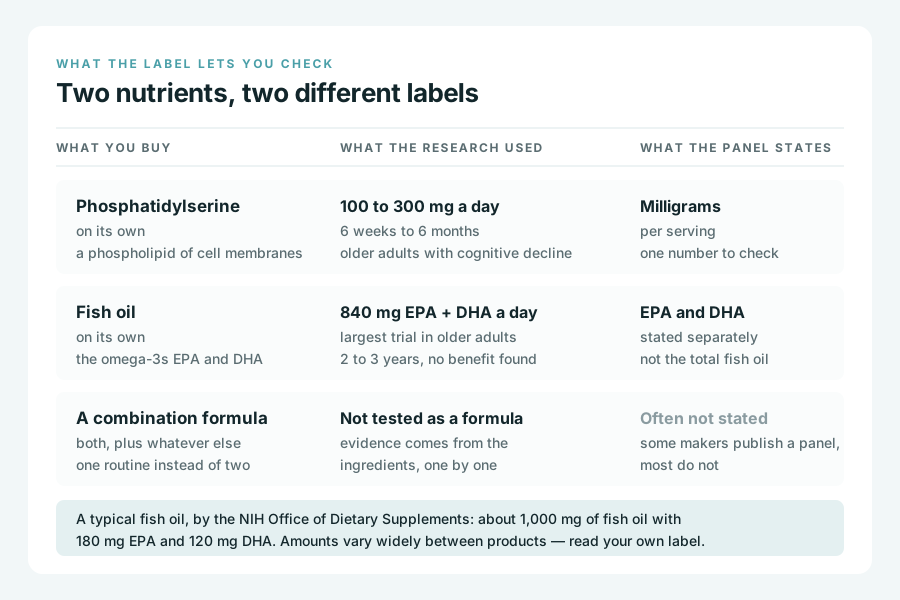
A phosphatidylserine bottle gives you one number. The panel states milligrams per serving, and you can hold it against the 100 to 300 mg the trials used. There is no official recommended intake to compare it with, so that research range is the only yardstick you have.
A fish oil bottle gives you three. The front usually shows the total fish oil, which is not the number that matters. The panel shows EPA and DHA separately, and those are what the trials measured. The NIH Office of Dietary Supplements gives a typical example — about 1,000 mg of fish oil containing 180 mg of EPA and 120 mg of DHA — and notes that formulations vary widely, which is exactly why the label is worth reading. It also notes that the FDA specifies labels should not recommend more than 2 g a day of EPA and DHA, and that supplements providing no more than 5 g a day are considered safe when used as recommended.
A combination formula may give you none. Many formulas that put several compounds in one capsule do not publish an amount for each. That is common in this aisle, and it is the trade-off for taking one bottle instead of two.
Should You Take One Compound Or A Combination?
If you buy a single-ingredient bottle, you can match the amount to the research. A phosphatidylserine capsule states its milligrams, and you can see whether it sits inside the 100 to 300 mg range the trials used. A fish oil states its EPA and DHA, so you can add up what you take.
If you buy a combination, you get both in one routine, along with whatever else is in the bottle. What you give up is the arithmetic, unless the maker publishes amounts. Both of the formulas below contain phosphatidylserine; only one of them publishes how much.
Neither route is the clever one. The question worth asking yourself is the boring one: are you more likely to keep taking two bottles, or one? The research above ran for six weeks to six months, and a routine you keep beats a better-specified one you abandon.
Which Formulas Contain Phosphatidylserine?
Two formulas on this site contain phosphatidylserine, and they sit at opposite ends of the label question. NovuBrain+ pairs phosphatidylserine with DHA omega-3 and adds bacopa and huperzine A, in two capsules a day, with no caffeine and no auto-ship; its sales page does not publish amounts. Brain C-13 publishes a Supplement Facts panel that lists phosphatidylserine 100 mg alongside citicoline 250 mg, bacopa 300 mg, rhodiola 200 mg, turmeric 150 mg and rosemary 100 mg — the low end of the range the trials used, and a number you can check. That panel describes a 60-capsule version, while the bottle shown is 90 capsules at three a day; the full review explains both. Read the panel on the bottle you receive.
Two formulas worth a closer look
Two formulas with phosphatidylserine
Both put the membrane nutrient in a daily routine, each with a money-back guarantee — one adds DHA alongside it, the other publishes the amount.
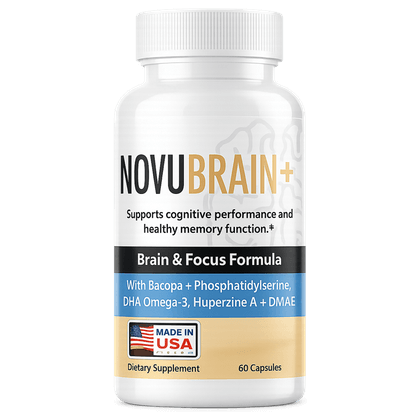
NovuBrain+
Capsules
Phosphatidylserine and DHA omega-3 in the same two capsules, with bacopa and huperzine A alongside. Caffeine-free, and sold as a one-time purchase with no auto-ship.
- Readers who want the membrane pair without buying two bottles
- Two capsules with breakfast
Covered by a 60-day money-back guarantee
Before you start · Huperzine A is worth naming with a prescriber, and DHA if you take a blood thinner.
See NovuBrain+ on the official siteRead our NovuBrain+ review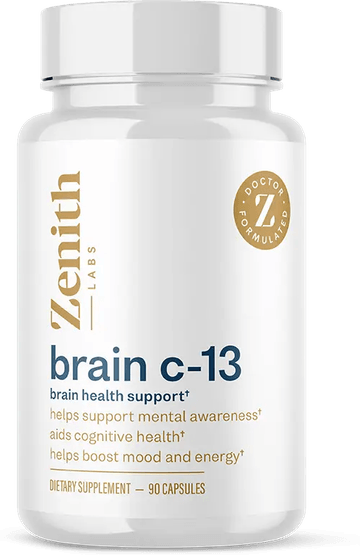
Brain C-13
Capsules
The formula here that publishes a panel: phosphatidylserine 100 mg with citicoline 250 mg, bacopa 300 mg and rhodiola 200 mg, so those amounts can be read against the trials.
- Readers who want to see the milligrams before buying
- Three capsules a day, one with each meal
Covered by a 180-day money-back guarantee
Before you start · The panel lists soy, and turmeric is worth raising if you take a blood thinner.
See Brain C-13 on the official siteRead our Brain C-13 reviewListed in no particular order. We publish no scores or rankings.
Who Should Check Before Starting?
Take the label to your pharmacist if any of these apply:
- You take warfarin or another blood thinner. The NIH Office of Dietary Supplements notes fish oil might prolong clotting times with warfarin, that most research finds 3 to 6 g a day of fish oil does not significantly change anticoagulant status, and that INR should be monitored periodically in people taking both.
- You already take a fish oil and are adding a combination formula. Add the two together rather than counting only the new bottle. The same office notes the FDA specifies labels should not recommend more than 2 g a day of EPA and DHA.
- You have heart disease or a high risk of it. The same fact sheet reports that two large trials of 4 g a day of EPA and DHA over several years found a slight increase in atrial fibrillation in these groups, which is a reason to agree the amount with your doctor rather than decide it alone.
- You avoid soy. Phosphatidylserine in supplements is commonly made from soy, and the label states the source.
Not a complete list. Never stop, reduce or change a prescription to make room for a supplement.
When Should You See A Doctor?
The National Institute on Aging advises talking to a doctor when memory problems are getting worse, when they interfere with everyday activities, or when other people notice them — because finding the cause is what determines the next step. A missing word or a name that arrives late is ordinary.
Neither nutrient on this page prevents, treats or reverses any condition, and no supplement is a substitute for that appointment.
Ready to compare? Go back to the two formulas above, or read the full reviews of NovuBrain+ and Brain C-13.
Frequently asked
Is phosphatidylserine better than fish oil for memory?
Neither has been shown to be better than the other, because they have not been compared head to head in older adults. Phosphatidylserine has a 2022 meta-analysis showing a positive effect on memory in older adults with cognitive decline, at 100 to 300 mg a day. Omega-3 results are mixed: the largest trial in healthy older adults found no cognitive benefit over two to three years.
How much phosphatidylserine should I take?
The published research used 100 to 300 mg a day for six weeks to six months. The Alzheimer’s Drug Discovery Foundation notes that phosphatidylserine from soy has been used in small studies in older people at 100 to 600 mg a day with a good safety profile and no adverse effects reported. There is no official recommended intake, so the amount on a label is the maker’s choice. Ask your pharmacist what fits alongside what you already take.
How do I read EPA and DHA on a fish oil label?
Look past the total fish oil on the front and read the panel, because the two numbers that matter are EPA and DHA per serving. The NIH Office of Dietary Supplements gives a typical example: about 1,000 mg of fish oil containing 180 mg of EPA and 120 mg of DHA, and notes that formulations vary widely, so the label is what tells you the types and amounts. It also notes the FDA specifies that supplement labels should not recommend more than 2 g a day of EPA and DHA.
Can I take both phosphatidylserine and fish oil?
Some formulas combine them, and nothing in the published research says they should not be taken together. What matters more is the total you are taking: if you already take a fish oil, add that amount to whatever a combination formula provides, and take the list to your pharmacist.
What are the side effects of phosphatidylserine?
A 2023 Cognitive Vitality report cited below lists gastrointestinal complaints among the more common adverse events, and notes that in the 2022 meta-analysis cited here, some people left the studies because of dizziness, itching, nausea, gas or vomiting, though the authors could not tell whether phosphatidylserine caused them. The same report mentions slightly lower blood pressure in small trials and says the safety profile is not thoroughly characterized. If you take blood pressure medicine or a blood thinner, or are pregnant, ask your doctor first; the section on who should check before starting covers fish oil.
Who should be careful with fish oil?
Anyone taking warfarin or another anticoagulant should raise it with their prescriber. The NIH Office of Dietary Supplements notes fish oil might prolong clotting times with warfarin, that most research finds 3 to 6 g a day of fish oil does not significantly change anticoagulant status, and that people taking both should have their INR monitored. It also notes that doses of 2 to 15 g a day may increase bleeding time. Side effects are usually mild, and the NIH complementary health center lists unpleasant taste, bad breath, headache, heartburn, nausea and diarrhea.
References
- Effect of phosphatidylserine on cognitive function in the elderly: a systematic review and meta-analysis — Korean Journal of Food Science and Technology — 2022
- Marine n-3 fatty acids and cognitive change among older adults in the VITAL randomized trial — Alzheimer’s & Dementia: Translational Research & Clinical Interventions — 2022
- Effects of vitamins and polyunsaturated fatty acids on cognitive function in older adults with mild cognitive impairment: a meta-analysis of randomized controlled trials — European Journal of Nutrition — 2024
- Omega-3 Fatty Acids: Health Professional Fact Sheet — NIH Office of Dietary Supplements — 2025
- Omega-3 Supplements: What You Need To Know — NIH National Center for Complementary and Integrative Health — 2024
- Effects of a food supplement containing phosphatidylserine on cognitive function in Chinese older adults with mild cognitive impairment: A randomized double-blind, placebo-controlled trial — Journal of Affective Disorders — 2025
- ω-3 PUFA for Secondary Prevention of White Matter Lesions and Neuronal Integrity Breakdown in Older Adults: A Randomized Clinical Trial — JAMA Network Open — 2024
- A systematic review and dose response meta analysis of Omega 3 supplementation on cognitive function — Scientific Reports — 2025
- Phosphatidylserine — Cognitive Vitality report, Alzheimer’s Drug Discovery Foundation — 2023
- Memory Problems, Forgetfulness, and Aging — National Institute on Aging — 2023
Disclosure
All content is for informational purposes only and is not a substitute for professional medical advice, diagnosis, or treatment. Each product covered is a dietary supplement, not a prescription drug, and statements about it have not been evaluated by the U.S. Food and Drug Administration. Results vary with individual health status, consistency of use, and lifestyle. This page contains affiliate links — if you buy through them we may earn a small commission at no additional cost to you. Read our disclosure and our editorial policy.