
Brain C-13 Reviews: The Zenith Labs Supplement and Its Ingredients
A supplement from a named company with an address, a phone number and a published panel — and two ingredient lists that do not line up. Here is what you are actually buying.
Quick answer
Brain C-13 is a capsule supplement from Zenith Labs, a named company with a published address and phone number. Its Supplement Facts panel lists citicoline, bacopa, rhodiola, phosphatidylserine, turmeric and rosemary with amounts — while the sales page names saffron and huperzine A. The guarantee runs 180 days.
Try it with the full 180-day guarantee
It is usually a name that goes first. Someone you have known for years is standing in front of you, and for a second and a half there is nothing — just the space where the name should be. You talk around it. They never notice. You do.
Then it is the reason you walked into the kitchen. Then it is the paragraph you have read three times without owning a word of it. And somewhere along the way you stopped saying it out loud, because spoken it sounds heavier than it feels.
If you have gone looking for something to do about it, you already know what the search returns. You have learned to close the tab, and you were right to.
So this page does the slow, useful thing. It reads the label — and this product gives us more to read than most, along with one thing worth looking at carefully before you decide.
1. What Is Brain C-13?
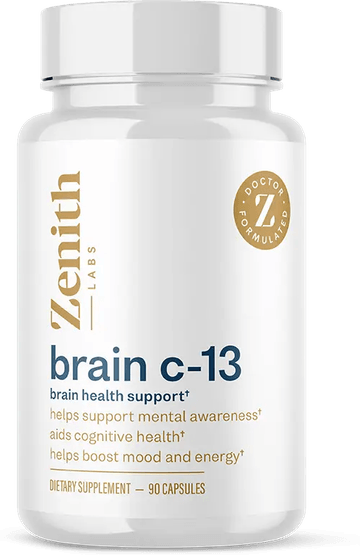
Brain C-13 is a capsule supplement from Zenith Labs, sold through this funnel with ClickBank as the retailer. The first thing worth noticing has nothing to do with the formula: there is a company name on the bottle, a postal address, and a telephone number. In this aisle that is genuinely uncommon, and section four comes back to why it matters more than it sounds.
The maker presents it as doctor-formulated and states that it is made in a facility audited by the FDA and following cGMP standards. That is their description, reported as their claim. The stated regimen is three capsules a day, one with each meal, and a single bottle is sold as a 30-day supply.
2. What Is In Brain C-13?
This is where Brain C-13 stands out, in two ways at once — one of them clearly in its favour, and one that needs a careful eye.
The good part first. Zenith Labs publishes a Supplement Facts panel, with a quantity against every ingredient and the standardisation spelled out. Almost nobody selling direct in this category does that. It is the single most useful document a supplement buyer can be given, and it is published in two places: on this sales page and on the company's own store.
The part that needs a careful eye is that the maker's materials carry two different ingredient lists, and they do not line up.
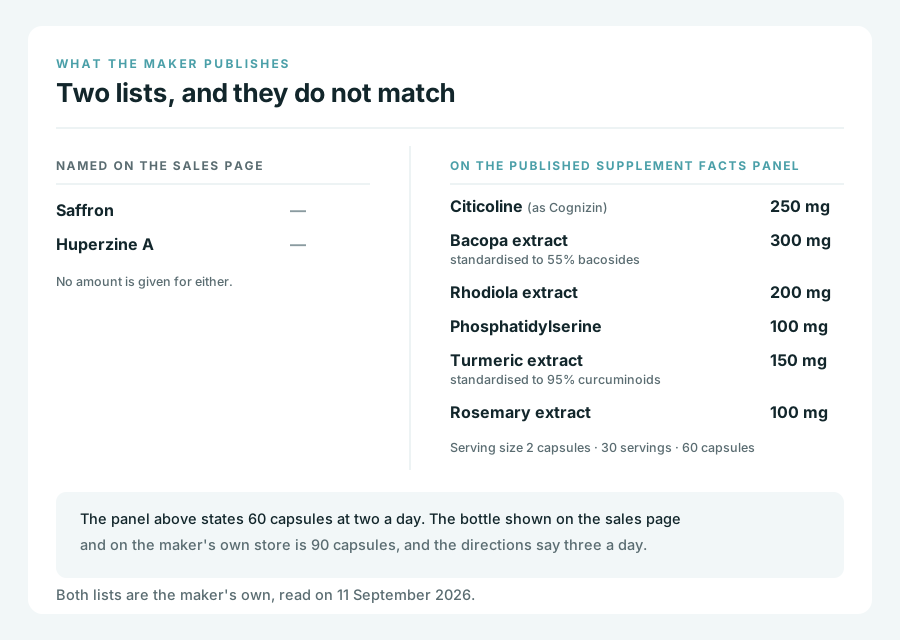
There is a detail that explains the gap without any guesswork. The published panel states 60 capsules, two a day, thirty servings. The bottle pictured on the sales page and on Zenith Labs' own store says 90 capsules, and the directions say three a day. The front of the 90-capsule bottle also carries a line the 60-capsule label does not. The panel, in other words, appears to describe an earlier version of the product.
We are not going to guess at the amounts in the bottle shipping today, because guessing is exactly what this site exists not to do. What we can tell you is what each document says, and what to do about it: read the Supplement Facts panel on the bottle when it arrives. Section seven explains why that is a low-risk thing to do here.
3. What Does The Research Say About The Ingredients In Brain C-13?
Between the two lists, the maker names eight compounds. Several are among the better-studied things in this whole category, so they are worth taking seriously whichever version arrives.
Bacopa — the best-defined of them
Bacopa has been through multiple randomised trials and meta-analyses converging on 300 mg a day over eight to twelve weeks — which is exactly the amount on the published panel, standardised to 55% bacosides. A 2025 trial at that same amount found no greater improvement than placebo, so the field disagrees with itself; but a real body of evidence with real disagreement inside it is more than most ingredients here can claim. Our guide to bacopa after 60 covers timing and side effects.
Citicoline — real trials, and the amount matters
Citicoline as Cognizin has genuine human trials. A 2021 trial in The Journal of Nutrition gave 100 healthy adults aged 50 to 85 with age-associated memory impairment 500 mg a day for twelve weeks and reported improved memory. A separate trial in 148 adults used the same 500 mg for attention. Lower amounts around 250 mg have shown effects on attention in shorter studies. The published panel lists 250 mg. Our guide to citicoline or choline after 60 sets it beside other choline sources.
Phosphatidylserine and rhodiola — modest, and studied
A 2022 meta-analysis found phosphatidylserine had a positive effect on memory in older adults with cognitive decline, across trials using 100 to 300 mg a day for six weeks to six months. Rhodiola's reviews are more cautious: benefits, where they appear, are described as small and outcome-dependent, with the reviewers flagging the quality of the underlying trials.
Turmeric, rosemary, saffron and huperzine A
A 2025 meta-analysis found curcumin improved global cognition, with a curvilinear dose response pointing at around 800 mg a day and benefit appearing only at twenty-four weeks or longer. Saffron has its own systematic reviews on cognition and is one of the better-evidenced botanicals in this aisle. Huperzine A is an acetylcholinesterase inhibitor with real trials, which reviewers consistently note were of poor methodological quality. Rosemary has the thinnest human cognitive literature of the group.
And as with every finished formula sold this way, there is no published trial on any of these combinations — the evidence above is evidence about ingredients.
4. How Is The Brain C-13 Formula Designed?
Here is the thing worth understanding about this product, and it is not an ingredient.
Zenith Labs puts its name, a postal address and a phone number on the label, publishes a Supplement Facts panel with quantities and standardisations, and runs a returns address you can read before you order. You can look up exactly who you are buying from — and in a category where many products are sold through a website alone, that is less common than it should be.
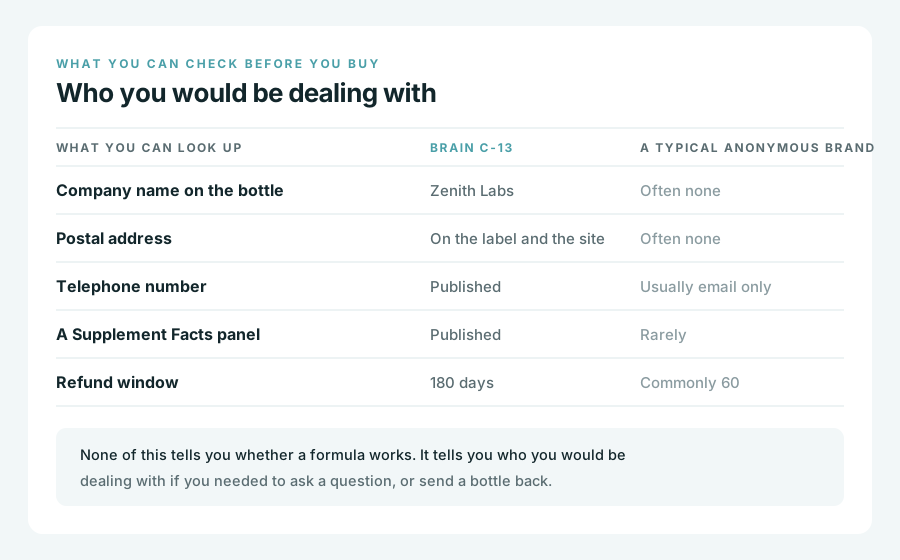
That is worth being precise about, because it is easy to oversell. None of it is evidence that the formula works. A company with a phone number can sell you something ineffective, and an anonymous one can sell you something good. What it changes is everything that happens after you click buy: whether there is someone to ask, and somewhere to send a bottle back.
Which is also what makes the two-list question manageable rather than alarming. You cannot resolve it from outside — but you can resolve it in a week, by reading the panel that arrives, and you are dealing with a seller who publishes a panel at all and gives you six months to change your mind. That combination is rare enough to be the reason this product is worth a closer look.
See Brain C-13 and decide for yourself5. How Do You Take Brain C-13, And When Would You Notice A Change?
The maker's instruction is three capsules a day, one with breakfast, lunch and dinner. Follow whatever the bottle itself states when it arrives, which is the same advice as section two.
On timing, the ingredients answer for themselves. Bacopa's trials ran eight to twelve weeks. The citicoline memory trial ran twelve. The curcumin evidence only reached significance at twenty-four weeks or more. Nothing here acts on the day you take it, and change in this category is the kind you notice looking back rather than in the moment.
That is where the 180-day guarantee stops being a marketing line. Six months is longer than every trial window named on this page, and long enough to give the formula the time its ingredients were actually studied over.
6. What Do Buyers Say About Brain C-13?
Independently verifiable feedback is limited for this product, as it is for most supplements sold direct. This site publishes no score, no star rating and no review count for any product, and we do not reproduce testimonials we cannot stand behind.
What can be said fairly, and without a testimonial: at three capsules a day spread across meals, the practical question is whether the middle dose survives a busy afternoon. A once-daily habit is easier to keep than a three-times-daily one, and that is worth knowing about yourself before committing to months.
What it does well
- A named company with a postal address and a telephone number on the label
- A Supplement Facts panel published with quantities and standardisations, which is rare here
- Bacopa at 300 mg on that panel — the exact amount its trials converged on
- A 180-day guarantee, longer than every trial window cited on this page
- From $1.10 a day at the six-bottle tier
What to know before you buy
- The published panel describes a 60-capsule version; the bottle shown holds 90
- The sales page names saffron and huperzine A, which that panel does not list
- The published panel contains soy, which matters if you avoid it
- Three capsules a day rather than one
- No published trial on any of these combinations
7. How Much Does Brain C-13 Cost, And Is There A Guarantee?
Prices are the manufacturer's list prices at the time of writing and change without notice. We publish what a bottle costs and what a day costs. We do not publish savings claims and we do not reproduce countdown pricing.
| Package | Price per bottle | Per day | Shipping |
|---|---|---|---|
| 2 bottles | $59 per bottle | $1.97 | $9.95, US |
| 3 bottles | $49 per bottle | $1.63 | $9.95, US |
| 6 bottles | $33 per bottle | $1.10 | Free, US |
| Guarantee | 180 days, money back, handled by the manufacturer | ||
Per-day cost uses the maker's own framing of one bottle as a 30-day supply.
Order Now on the official siteThe 180-day guarantee is the term the manufacturer publishes, and they handle it, not us. It is also the practical answer to the question section two raised. You do not have to resolve the two lists before ordering: you can read the panel on the bottle that arrives and, if it is not what you expected, you have six months to act on that. Few purchases in this category give you that much room.
8. Who Is Brain C-13 For?
A question about you rather than about the bottle, so we will answer it that way.
This is likely a good fit if being able to look up the seller matters to you — a name, an address, a phone number, a panel; if you want bacopa at the amount its trials actually used; if three capsules across meals suits your day; and if a six-month window is what makes trying something tolerable.
Look elsewhere, or wait, if you need to know the exact formula before you spend rather than after the bottle arrives — the two lists cannot be reconciled from outside; if you avoid soy, which the published panel contains; or if you take a cholinesterase inhibitor, medicine for glaucoma or heart rhythm, or a blood thinner, in which case take the bottle to your prescriber before the first capsule.
And the case where the answer is neither: if the forgetting has been getting worse month over month, or someone close to you has mentioned it, the next step is an appointment rather than a bottle. No supplement on this site prevents, treats or reverses any condition.
If that sounds like you, see it here
Frequently asked
What is actually in Brain C-13?
The maker publishes two lists. The sales page names saffron and huperzine A, with no amount for either. A Supplement Facts panel, published on both the sales page and Zenith Labs’ own store, lists six different ingredients with amounts: citicoline 250 mg, bacopa 300 mg, rhodiola 200 mg, phosphatidylserine 100 mg, turmeric 150 mg and rosemary 100 mg. That panel states 60 capsules at two a day, while the bottle shown is 90 capsules at three a day — so it appears to describe an earlier version. Read the panel on the bottle you receive.
How many capsules a day, and how long does a bottle last?
The sales page says three capsules a day, one with each meal, and sells a single bottle as a 30-day supply. The bottle shown holds 90 capsules, which is consistent with that. The published panel describes a different arrangement — 60 capsules at two a day — which also works out to 30 days.
How long before most people would notice anything?
Months, not weeks. Bacopa’s trials ran eight to twelve weeks. The citicoline memory trial ran twelve weeks. The curcumin evidence only became significant at twenty-four weeks or longer. Nothing in this category acts on the day you take it, which is where the 180-day guarantee earns its place.
Does Brain C-13 have side effects?
There is no published trial on any version of this formula, so what is known comes from studies of single ingredients. In the 12-week bacopa trial cited below, people taking 300 mg a day — the amount on the published panel — reported more side effects than those on placebo, mainly digestive complaints and headaches, with none serious. The huperzine A review cited below notes that taking too much may cause nausea, diarrhea and muscle cramps. The citicoline and turmeric summaries do not detail side effects. If you are pregnant, take a prescription medicine every day or have surgery coming up, ask your doctor first; see the next question.
Can I take it with my prescription medication?
Ask the person who wrote your prescription first, and take the bottle with you. Two things are worth naming: huperzine A, if the version you receive contains it, inhibits acetylcholinesterase and matters if you take a cholinesterase inhibitor or medicine for glaucoma or heart rhythm; and the published panel lists soy, which matters if you avoid it. Turmeric is worth mentioning if you take a blood thinner.
When should I speak to a doctor instead of trying a supplement?
If the forgetting is getting worse month over month, if other people have started noticing it, if it comes with confusion about time or place, or if it began suddenly, that is a clinical conversation and not a supplement question. Nothing on this page prevents, treats or reverses any condition.
References
- Citicoline and Memory Function in Healthy Older Adults: A Randomized, Double-Blind, Placebo-Controlled Clinical Trial — The Journal of Nutrition — 2021
- The effect of plant active substances on cognitive function in healthy older adults: a systematic review and network meta-analysis of randomized controlled trials — Frontiers in Pharmacology — 2025
- The Effects of a Bacopa monnieri Extract (Bacumen®) on Cognition, Stress, and Fatigue in Healthy Adults: A Randomized, Double-Blind, Placebo-Controlled Trial — Clinical Drug Investigation — 2025
- Effect of phosphatidylserine on cognitive function in the elderly: a systematic review and meta-analysis — 2022
- The effect of curcumin supplementation on cognitive function: an updated systematic review and meta-analysis — Frontiers in Nutrition — 2025
- Huperzine A: a natural acetylcholinesterase inhibitor with multifunctional neuroprotective effects — Beni-Suef University Journal of Basic and Applied Sciences — 2025
Disclosure
All content is for informational purposes only and is not a substitute for professional medical advice, diagnosis, or treatment. Each product covered is a dietary supplement, not a prescription drug, and statements about it have not been evaluated by the U.S. Food and Drug Administration. Results vary with individual health status, consistency of use, and lifestyle. This page contains affiliate links — if you buy through them we may earn a small commission at no additional cost to you. Read our disclosure and our editorial policy.