
Citicoline or Choline After 60: What the Memory Trials Used, Long-Term Safety, and Where Phosphatidylserine Fits
Choline, citicoline and phosphatidylserine sound alike on a label, and they are not the same thing. Here is what each one is, what the research in older adults used, and what is known about taking them for years.
Quick answer
Choline is a nutrient you get from food. Citicoline is a compound the body breaks down into choline and cytidine, and it is the form with a memory trial in healthy adults 50 to 85: 500 mg a day for 12 weeks. Reviews describe it as well tolerated. Phosphatidylserine is a separate membrane fat with its own studies. If you want to try one, two formulas with choline sources and phosphatidylserine are compared below.
You have read the shelf twice now. One bottle says choline. The one next to it says citicoline. A third adds phosphatidylserine, and by then the three words have started to run together.
They are related, but they are not interchangeable. If you are past 60 and a name or a word now takes a moment longer to arrive, it is worth knowing which is which before you pay for any of them — and whether they are something you could sensibly take for years rather than weeks.
This page takes the three in turn: what each one is, what the studies in older adults actually gave people, and what the safety record says about long-term use.
Further down, we look at two formulas with choline sources and phosphatidylserine: Brain C-13 and NeuroZoom — each with a money-back guarantee.
Are Choline, Citicoline And Phosphatidylserine The Same Thing?
No: choline is a nutrient, citicoline is a compound the body makes on the way to its cell membranes, and phosphatidylserine is a membrane fat.
Choline — the nutrient
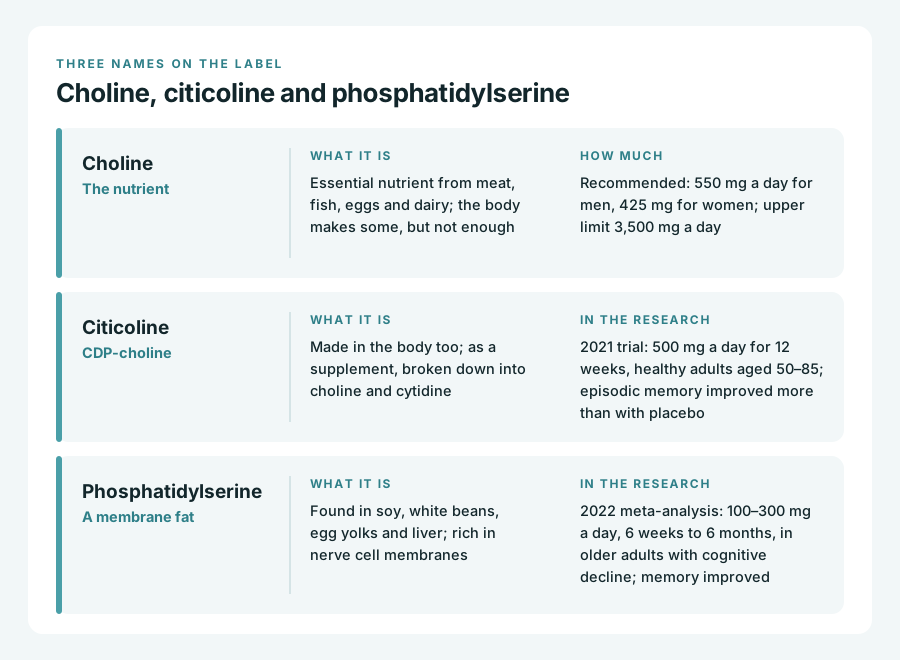
The NIH Office of Dietary Supplements describes choline as an essential nutrient. The body needs it to make acetylcholine, a chemical messenger important for memory, mood and muscle control, and to build the fats that make up cell membranes.
Your liver makes some choline, but not enough to meet your needs, so part of it has to come from food. The main sources are meat, poultry, fish, dairy and eggs; one large hard-boiled egg has about 147 mg. The recommended amount for adults is 550 mg a day for men and 425 mg for women. Most people in the United States eat less than that, although a true deficiency in healthy adults is very rare.
In supplements, choline usually appears as choline bitartrate, phosphatidylcholine or lecithin. The same NIH fact sheet notes that no studies have compared how well the body absorbs choline from these different forms.
Citicoline — a compound the body also makes
Citicoline is short for cytidine-5′-diphosphocholine, also called CDP-choline. The body produces it naturally, as a step on the way to making phosphatidylcholine, one of the main building blocks of cell membranes. Taken as a supplement, a 2020 systematic review in Nutrients explains, it is broken down into cytidine and choline, which nerve cells then use to make those membranes again.
Phosphatidylserine — a membrane fat
Phosphatidylserine is not a form of choline at all. It is a phospholipid — a type of fat — found in foods such as soy, white beans, egg yolks and chicken or beef liver. The Alzheimer’s Drug Discovery Foundation’s 2023 report notes that it is an important part of cell membranes and is especially concentrated in the membranes of nerve cells.
What Did The Memory Research In Older Adults Actually Use?
The main trial in healthy older adults used citicoline, at 500 mg a day for 12 weeks.
Citicoline: one trial in healthy adults 50 to 85
The trial most often cited was published in The Journal of Nutrition in 2021. It enrolled 100 healthy men and women aged 50 to 85 whose memory had slipped in the way that is common with age. Half took 500 mg of citicoline a day and half took a placebo, for 12 weeks.
The results were mixed in a specific way. On the main test, a measure of short-term spatial memory, the citicoline group did not do better than the placebo group. On episodic memory — the kind that holds what happened, and who you met — and on an overall memory score, the citicoline group improved more. The study was sponsored by a company that makes citicoline, and two of the authors worked for it.
That pattern is common in this field. The Alzheimer’s Drug Discovery Foundation’s 2023 report on citicoline notes that many of its studies were partly funded by supplement suppliers, and that most gave 250 to 1,000 mg a day, for up to 12 weeks.
Choline supplements: mixed results
For plain choline, the NIH fact sheet reports that some small randomized trials found better cognitive performance in adults, but that a systematic review of 13 studies found choline supplements did not clearly improve cognition in healthy adults. Studies that simply observed people have linked higher choline intake or blood levels with better memory scores, which shows an association rather than cause.
So, choline or citicoline?
The two sources point the same way. Citicoline is the form that has been tested for memory in healthy older adults. And the Alzheimer’s Drug Discovery Foundation adds that there is no evidence that citicoline offers a significant benefit over getting enough choline from food for long-term brain health. If your diet includes little meat, fish, eggs or dairy, the nutrient itself is the first thing worth checking.
Can You Take Them For Years?
The answer differs for each of the three, and the record is longest for citicoline.
Citicoline
The Alzheimer’s Drug Discovery Foundation describes citicoline as widely used and well tolerated, with few to no adverse effects, even in multi-year trials. It notes that treatment lasting up to three years has shown a safety profile similar to short-term use. Much of that long-term experience comes from trials in people with conditions such as glaucoma or stroke, rather than in healthy older adults.
In the 2021 trial in healthy adults, there were no serious adverse events. Six people taking citicoline and two taking placebo reported mild effects possibly linked to the capsules — such as increased appetite, flatulence, headache and burping — and all were temporary.
Choline
The NIH fact sheet lists an upper limit of 3,500 mg a day for adults, from food and supplements combined. Very high intakes are associated with a fishy body odor, vomiting, heavy sweating, low blood pressure and liver toxicity. For scale, the fact sheet notes that supplements typically contain 10 to 250 mg. It lists no known clinically relevant interactions with medications.
Phosphatidylserine
Here the record is thinner. The Alzheimer’s Drug Discovery Foundation’s 2023 report says phosphatidylserine is thought to be well tolerated, but that its safety profile is not thoroughly characterized. Small trials in older people reported few side effects other than a slight drop in blood pressure; stomach complaints were the most common. Longer, larger studies are not available.
What Does The Research On Phosphatidylserine Show?
A 2022 meta-analysis in the Korean Journal of Food Science and Technology pooled nine studies — five randomized trials and four before-and-after studies — with 961 participants. It found a positive effect on memory in older adults with cognitive decline. The amounts ranged from 100 to 300 mg a day, for six weeks to six months, and the authors reported no major adverse events.
Two details from the Alzheimer’s Drug Discovery Foundation help read that result. Four of the five randomized trials used phosphatidylserine taken from cow brain, a source no longer available. And trials of soy-derived phosphatidylserine in older adults with memory complaints have had varying results; the best designed of them found no effect at 300 or 600 mg a day over 12 weeks.
As for citicoline versus phosphatidylserine, they are not competing versions of one thing. Citicoline supplies building blocks the body uses to make membranes. Phosphatidylserine is one of the membrane fats itself. That is why some formulas combine them, including both on this page.
If you already take several medicines, our memory supplement checklist walks through what to bring to your pharmacist before adding any of these.
What Should You Look For Before You Buy?
If you have decided a formula is worth trying, these are the things to confirm before you order.
- The exact form on the label. Citicoline, choline and phosphatidylserine are different ingredients with different research, so check which one a formula contains.
- An amount per serving. A printed amount lets you and your pharmacist read the label against the research described above.
- Your total choline from every product. The NIH upper limit applies to food and supplements combined, so add up what each label lists.
- A routine and a guarantee that fit 12 weeks. The citicoline trial ran for 12 weeks, so plan to judge any formula over a similar stretch.
Which Formulas Contain Citicoline, Choline Or Phosphatidylserine?
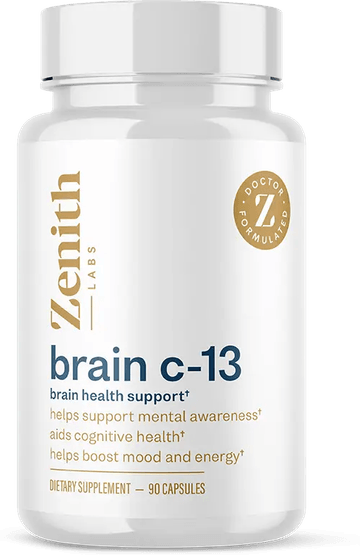
Brain C-13 publishes a Supplement Facts panel that lists citicoline 250 mg and phosphatidylserine 100 mg, alongside bacopa, rhodiola, turmeric and rosemary. The 2021 trial used 500 mg of citicoline a day; the published panel lists 250 mg. As its review explains, that panel describes a 60-capsule bottle at two a day, while the bottle shown holds 90 at three a day, so it appears to describe an earlier version. Read the panel on the bottle you receive.
NeuroZoom names 35 ingredients, including choline and phosphatidylserine, with huperzine A, bacopa and DMAE, on top of a base of everyday vitamins and minerals. No amount is published for any of them. Its comparison page looks at how that base sits beside a daily multivitamin.
Two formulas worth a closer look
Two formulas with choline sources and phosphatidylserine
If you want these nutrients in a single daily formula, these two are built around them — each with a money-back guarantee.
Brain C-13
Capsules
From Zenith Labs, a named company, with a published Supplement Facts panel listing citicoline 250 mg and phosphatidylserine 100 mg, plus bacopa, rhodiola, turmeric and rosemary.
- Readers who want to see amounts on the label
- Anyone who prefers a company they can look up
Covered by a 180-day money-back guarantee
Before you start · Huperzine A, named on the sales page, matters with cholinesterase inhibitors and heart-rate medicines; turmeric with a blood thinner.
See Brain C-13 on the official siteRead our Brain C-13 review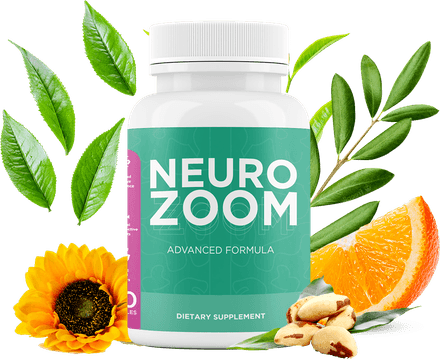
NeuroZoom
Capsules
Choline and phosphatidylserine together with huperzine A, bacopa and DMAE, on a base of about nineteen everyday vitamins and minerals.
- Readers who want vitamins and memory nutrients in one capsule
- Once-a-day routines
Covered by a 60-day money-back guarantee
Before you start · Huperzine A matters with cholinesterase inhibitors and heart-rate medicines. If you already take a multivitamin, compare the two labels.
See NeuroZoom on the official siteRead our NeuroZoom reviewListed in no particular order. We publish no scores or rankings.
Who Should Check Before Starting?
Anyone who takes a prescription should check first, because citicoline, choline and phosphatidylserine rarely come alone. Formulas pair them with other ingredients, and those are often the ones that matter most for your prescriptions. Take the bottle, or a photo of the label, to your pharmacist.
- If you take a cholinesterase inhibitor, such as donepezil, or a medicine that slows the heart rate. Both formulas above name huperzine A. Memorial Sloan Kettering notes it may increase side effects with drugs that work the same way, and may lower heart rate with calcium channel blockers or beta blockers.
- If you take a blood thinner. Brain C-13’s panel lists turmeric, which Memorial Sloan Kettering notes may increase the risk of bleeding with warfarin or other blood thinners.
- If you take thyroid hormone. Both formulas name bacopa, which a StatPearls review notes may lead to too much thyroid hormone when combined with it. NeuroZoom also names iron, and the FDA-approved levothyroxine label says not to take it within 4 hours of iron supplements.
- If you already take a multivitamin, or avoid soy. NeuroZoom’s vitamins and minerals overlap a multivitamin, and Brain C-13’s published panel lists soy.
The FDA advises bringing a list of all your supplements and medicines to every visit. Never stop, reduce or change a prescription to make room for a supplement.
When Should You See A Doctor?
Mayo Clinic advises making an appointment if memory loss affects your daily activities, if it is getting worse, or if a family member or friend is concerned. The National Institute on Aging adds that low vitamin B12, sleep problems and medication side effects can all cause memory problems — and that finding the cause is what points to the right next step.
Ready to compare? Go back to the two formulas above, or read the full reviews of Brain C-13 and NeuroZoom.
Frequently asked
Is it better to take choline or citicoline?
They do different jobs. Choline is an essential nutrient most people get from meat, fish, eggs and dairy, and the NIH notes that most Americans eat less than the recommended amount. Citicoline is a compound the body breaks down into choline and cytidine, and it is the form with a memory trial in healthy adults aged 50 to 85. A 2023 Alzheimer’s Drug Discovery Foundation report adds that there is no evidence citicoline offers a significant long-term benefit over getting enough choline from food.
Can citicoline improve memory?
In one 2021 trial, 100 healthy adults aged 50 to 85 with age-associated memory complaints took 500 mg of citicoline or a placebo for 12 weeks. The citicoline group improved more on episodic memory and on an overall memory score, while the main test, of spatial memory, showed no difference from placebo. The trial was funded by a citicoline maker.
Is citicoline safe for long-term use?
No supplement can be called safe for everyone. What the research shows is that citicoline has been well tolerated: a 2023 Alzheimer’s Drug Discovery Foundation report describes few to no adverse effects, including in trials lasting up to three years, most of them in people with eye or brain conditions. In the 2021 trial in healthy older adults, side effects such as headache and flatulence were mild and passed. Ask your doctor before taking it for the long term.
What is the difference between citicoline and phosphatidylserine?
Citicoline supplies building blocks, choline and cytidine, that the body uses to make cell membranes. Phosphatidylserine is itself a membrane fat, found in soy, white beans, egg yolks and liver, and especially rich in nerve cell membranes. A 2022 meta-analysis found a positive effect on memory in older adults with cognitive decline at 100 to 300 mg a day. Some formulas contain both.
Is alpha-GPC or citicoline better?
They are two different choline compounds, studied in different people. Citicoline’s 2021 memory trial was in healthy adults aged 50 to 85. Alpha-GPC’s research, as summarized by the Alzheimer’s Drug Discovery Foundation in 2020, has been mostly in people with dementia, and that report noted no large, long-term studies of its safety. Neither formula on this page lists alpha-GPC. Your pharmacist can help you weigh either one against what you already take.
Can I take citicoline or choline with my medicines?
Ask your doctor or pharmacist first, and bring the label. The NIH lists no known clinically relevant interactions for choline, but memory formulas usually contain more than one ingredient, and the FDA notes that some supplements can change how a medicine is absorbed, broken down or cleared. Never stop or change a prescription to make room for a supplement.
References
- Choline: Fact Sheet for Health Professionals — NIH Office of Dietary Supplements — 2022
- Citicoline and Memory Function in Healthy Older Adults: A Randomized, Double-Blind, Placebo-Controlled Clinical Trial — The Journal of Nutrition — 2021
- Application of Citicoline in Neurological Disorders: A Systematic Review — Nutrients — 2020
- Citicoline (CDP-choline) — Cognitive Vitality Reports, Alzheimer’s Drug Discovery Foundation — 2023
- Phosphatidylserine — Cognitive Vitality Reports, Alzheimer’s Drug Discovery Foundation — 2023
- Effect of phosphatidylserine on cognitive function in the elderly: A systematic review and meta-analysis — Korean Journal of Food Science and Technology — 2022
- Alpha-GPC (choline alfoscerate) & Your Brain — Cognitive Vitality, Alzheimer’s Drug Discovery Foundation — 2020
- Huperzia serrata (Huperzine A) — Memorial Sloan Kettering Cancer Center, About Herbs — 2022
- Turmeric — Memorial Sloan Kettering Cancer Center, About Herbs — 2026
- Bacopa monnieri — StatPearls, NCBI Bookshelf — 2023
- SYNTHROID (levothyroxine sodium) Prescribing Information — U.S. Food and Drug Administration — 2024
- Mixing Medications and Dietary Supplements Can Endanger Your Health — U.S. Food and Drug Administration — 2022
- Memory loss: 7 tips to improve your memory — Mayo Clinic — 2026
- Memory Problems, Forgetfulness, and Aging — National Institute on Aging — 2023
Disclosure
All content is for informational purposes only and is not a substitute for professional medical advice, diagnosis, or treatment. Each product covered is a dietary supplement, not a prescription drug, and statements about it have not been evaluated by the U.S. Food and Drug Administration. Results vary with individual health status, consistency of use, and lifestyle. This page contains affiliate links — if you buy through them we may earn a small commission at no additional cost to you. Read our disclosure and our editorial policy.