
How NeuroZoom Compares
Roughly half this label is nutrients a multivitamin also contains — which makes the comparison unusually concrete, and the answer more interesting than you might expect.
Quick answer
About half of NeuroZoom is the same nutrients a daily multivitamin contains, and the plain multivitamin has the strongest cognitive trial in this whole category behind it. What NeuroZoom adds is a cholinergic layer a multivitamin does not have. What a multivitamin adds is printed amounts you can check.
Most comparisons in this category set one branded formula against another. This one is different, and more concrete, because of a fact from the review page: roughly half of NeuroZoom is the same everyday nutrients a supermarket multivitamin contains.
That makes the real question unusually clear. Not "does this work", but: what does this bottle give you that a multivitamin does not, and what does a multivitamin give you that this bottle does not?
The Part That Surprises People
Start with the finding, because it reframes everything after it. The most robust cognitive evidence attached to anything on this page does not belong to a proprietary formula. It belongs to the ordinary multivitamin.
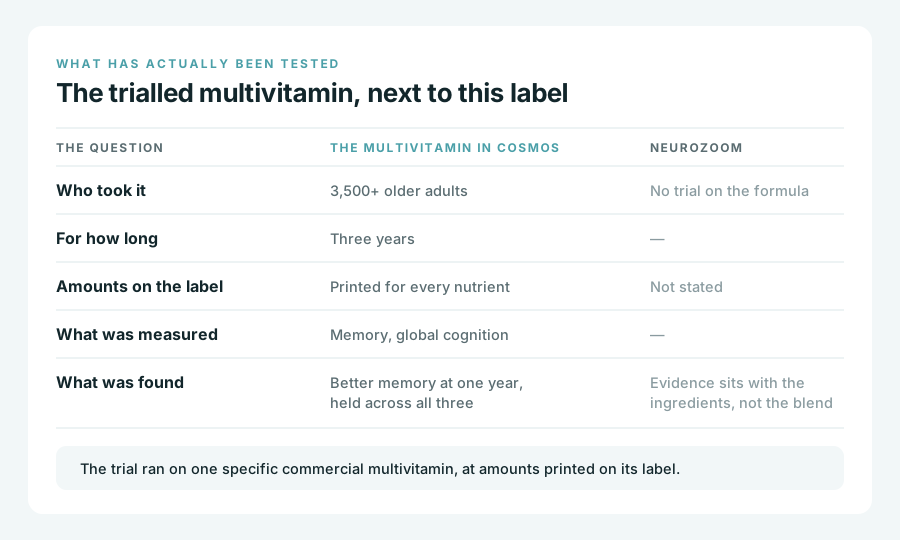
In COSMOS — more than 21,000 participants, followed for around three and a half years — a daily multivitamin-mineral improved memory and global cognition in older adults. The difference was significant at the prespecified one-year point and held across all three years. In the same trial, cocoa extract showed no cognitive effect, which is a good sign that the multivitamin result was not an artefact of the design.
Two honest caveats. The result belongs to one specific commercial multivitamin at amounts printed on its label, not to multivitamins as a concept. And a three-year trial is a long way from a two-month decision.
The Comparison
Read across a row rather than down a column. There is no score here and no order of merit — each cell describes what that option covers.
| Criteria | NeuroZoom | A daily multivitamin | A nootropic stack | Both, bought separately |
|---|---|---|---|---|
 | ||||
| What you get | Micronutrients and a cognitive stack in one capsule | Micronutrients at printed amounts | Cognitive compounds at printed amounts | Both, in two or more bottles |
| Amounts printed on the label | Not stated | Yes, as standard | Usually | Yes, as standard |
| Trial evidence on the exact product | None on this formula | Yes, on a specific commercial product | Depends on the product | On the multivitamin half |
| What that trial measured | — | Memory and global cognition, over three years | Varies by compound | Memory and global cognition |
| Adds up against what you already take | Cannot be checked | Can be checked | Can be checked | Can be checked |
| Bottles in the routine | One | One | One to three | Two or more |
| Typical cost per day | $1.63 to $2.63 | Usually well under $1 | Varies widely | The sum of both |
| Refund window here | 60 days | Varies by seller | Varies by seller | Varies by seller |
| Where to buy | Official site → | Sold everywhere | Sold everywhere | Sold everywhere |
Prices are the maker's list price at the time of writing and change without notice. Every link goes through our own redirect and lands on the maker's official site.
If you take a prescription, ask your prescriber before combining any of these with it. With NeuroZoom, huperzine A is the one to name specifically. With any multivitamin, iron and vitamin K are the usual things to mention.
What NeuroZoom Brings That A Multivitamin Does Not
- A cholinergic layer. Huperzine A, choline, DMAE, bacopa, phosphatidylserine and tyrosine are not in a supermarket multivitamin, and they are the compounds with the mechanism actually aimed at memory rather than at general nutrition.
- One capsule instead of two routines. If you would otherwise buy a multivitamin and a nootropic separately, this collapses them into a single habit — and adherence is the quiet variable in a category whose evidence needs months.
- Six botanical extracts alongside both, which come at no extra decision on your part.
What A Multivitamin Brings That NeuroZoom Does Not
The other side deserves the same care, because this page is not here to talk you into anything.
Printed amounts. Every nutrient on a multivitamin label carries a quantity and a percentage of the daily value. That lets you do the one thing this label does not allow: add it up against everything else you take, and see where you sit against an upper limit.
A trial on the actual product. The COSMOS result attaches to a specific multivitamin you can buy. That is rare enough in this aisle to be worth naming plainly.
And a much lower price. A daily multivitamin generally costs well under a dollar a day. The difference is not a criticism of NeuroZoom — you are buying a second layer that a multivitamin does not contain — but it is a real number in the decision.
Which One Fits Which Situation
- If you take nothing at all today, NeuroZoom is the tidiest single answer here: one capsule covering both a micronutrient base and a cognitive stack.
- If you already take a daily multivitamin, the conversation is about replacing rather than adding, because the two cover a lot of the same ground.
- If you want to verify what you are taking, printed amounts are the only route, and that means buying the layers separately.
- If the cholinergic layer is what you came for — huperzine A, choline, bacopa — a multivitamin does not contain it at all, and no amount of it being well evidenced changes that.
See NeuroZoom on the official site
Frequently asked
Is a plain multivitamin really as well evidenced as this?
On cognition specifically, the multivitamin has the larger trial behind it — and that surprises most people. In COSMOS, a daily multivitamin-mineral improved memory and global cognition in older adults, significant at one year and holding across three. What it does not have is the cholinergic layer: huperzine A, choline, DMAE, bacopa and phosphatidylserine are not in a supermarket multivitamin. So the two are not competing on the same ground.
Should I take NeuroZoom instead of my multivitamin, or as well as?
That is a question for a pharmacist rather than for a review page, and it is worth five minutes of their time. Roughly half of NeuroZoom is nutrients a multivitamin also contains, and because this label publishes no amounts you cannot add the two together on paper. Take both labels in. The point is not that either product is at fault — it is that only someone looking at both can answer it.
Why does a cheap multivitamin have better trial evidence than expensive formulas?
Because somebody funded the trial. COSMOS ran for years across more than 21,000 participants, which is an undertaking that almost never happens for a direct-to-consumer supplement. The absence of a trial on a finished formula is normal in this industry and is not, by itself, a mark against the formula — it tells you where the evidence sits, which is with the ingredients.
Can I take any of these with prescription medication?
Ask your prescriber before combining. With NeuroZoom the ingredient to name specifically is huperzine A, because it inhibits acetylcholinesterase — raise it if you take a cholinesterase inhibitor, a medicine for glaucoma or anything for heart rhythm. With any multivitamin, iron and vitamin K are the usual things to mention.
References
- Multivitamin Supplementation Improves Memory in Older Adults: A Randomized Clinical Trial — American Journal of Clinical Nutrition — 2023
- Effects of cocoa extract and a multivitamin on cognitive function: a randomized clinical trial (COSMOS-Mind) — Alzheimer’s & Dementia — 2023
- Huperzine A: a natural acetylcholinesterase inhibitor with multifunctional neuroprotective effects — Beni-Suef University Journal of Basic and Applied Sciences — 2025
- The effect of plant active substances on cognitive function in healthy older adults: a systematic review and network meta-analysis of randomized controlled trials — Frontiers in Pharmacology — 2025
Disclosure
All content is for informational purposes only and is not a substitute for professional medical advice, diagnosis, or treatment. Each product covered is a dietary supplement, not a prescription drug, and statements about it have not been evaluated by the U.S. Food and Drug Administration. Results vary with individual health status, consistency of use, and lifestyle. This page contains affiliate links — if you buy through them we may earn a small commission at no additional cost to you. Read our disclosure and our editorial policy.