
NeuroZoom Supplement Reviews: Multivitamin Plus Nootropics
Thirty-five ingredients, roughly half of them everyday vitamins and minerals and the rest a cholinergic stack. Here is what you are actually buying.
Quick answer
NeuroZoom is a once-daily capsule with 35 named ingredients: about nineteen everyday vitamins and minerals, eleven nootropic compounds including huperzine A and bacopa, and six botanical extracts. No amount is published for any of them. The guarantee runs 60 days.
Try it with the 60-day guarantee
It starts with a name. Someone you have known for a decade is in front of you, and for a second and a half there is simply a gap where their name should be. You talk around it. They never notice. You do.
Then it is why you came into the room. Then it is a paragraph read three times that still has not landed. And at some point you stopped mentioning it out loud, because said aloud it sounds worse than it feels.
If you have gone looking for something to do about it, you already know what the search returns — pages promising reversal, pages built to worry you into deciding by the third paragraph. You learned to close the tab, and you were right to.
So this page does the slow, useful thing. It reads the label and tells you what is printed and what is not. And with this particular product there is a practical question most reviews never raise, which could matter more to you than anything else here.
1. What Is NeuroZoom?
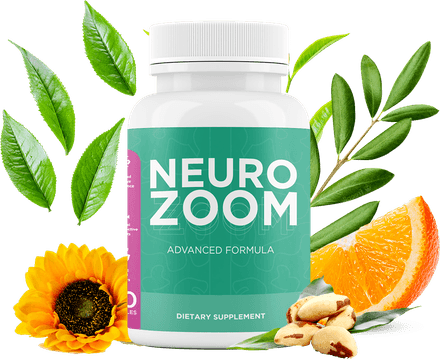
NeuroZoom is a capsule supplement sold direct through the maker's own site, with ClickBank as the retailer handling the transaction and the refunds. The maker describes it as a 35-in-1 formula and states that the ingredients are handled according to the USDA National Organic Program in an FDA-registered and inspected facility.
The story the maker tells runs through fluoride: that fluoride accumulates in the brain and that several of the nutrients here work against its effects. That is their framing, reported as their claim. As section four gets to, it is not the most useful way to understand what is in this bottle.
2. What Is In NeuroZoom?
Thirty-five ingredients is a lot to hold in your head, so we have grouped them by what each thing actually is. That grouping turns out to be the clearest way to see what you would be buying.
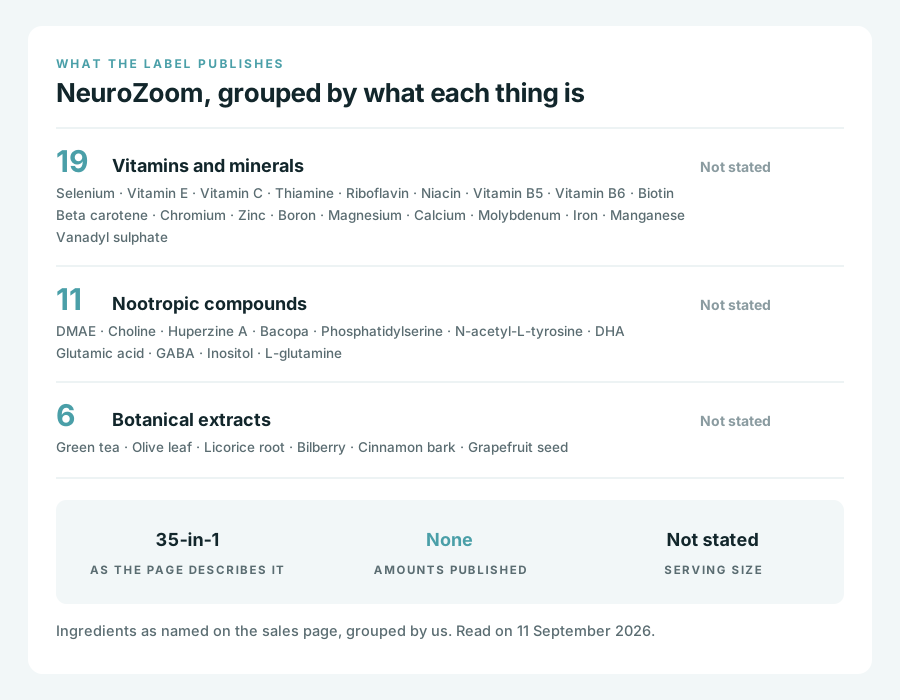
Two gaps to name plainly. No amount is published for any ingredient, and no serving size is stated — the page never says how many capsules a day make a serving. What the maker does state is that one bottle is a one-month supply, and that is what makes a cost per day calculable in section seven.
The missing amounts matter more here than they would on a botanical blend, and for a specific reason. Roughly half this list is vitamins and minerals — selenium, zinc, iron, vitamin E, the B group and a dozen others. Those are nutrients with established daily values, and several carry upper limits as well. With a herb, an unpublished amount mostly means you cannot check it against a trial. With a mineral, it also means you cannot add it up against everything else you already take.
3. What Does The Research Say About The Ingredients In NeuroZoom?
Thirty-five ingredients, and the evidence behind them is very uneven. Taking them by group is more useful than taking them in the order the page lists them.
The micronutrient base — the strongest evidence here, and it may surprise you
The most robust cognitive finding attached to anything in this bottle does not belong to an exotic compound. It belongs to the ordinary multivitamin. In the COSMOS trial — more than 21,000 participants overall, followed for around three and a half years — a daily multivitamin-mineral improved memory and global cognition in older adults, with the difference significant at one year and holding across all three years of follow-up. The same trial found no cognitive benefit from cocoa extract, which tells you the result was not a fluke of the design.
That is a genuinely important finding for anyone reading a page like this, and it is a large, long trial for a supplement to be able to point at. The honest caveat comes in section four.
Huperzine A — the most pharmacologically active thing in the bottle
Huperzine A is an acetylcholinesterase inhibitor: it slows the enzyme that breaks down acetylcholine, which is the same mechanism class as some prescription memory medicines. Reviews of the human trials report benefits on cognitive scales in Alzheimer's populations, with reviewers consistently noting that the quality of the underlying trials was poor. A 2025 review describes it as a natural acetylcholinesterase inhibitor with neuroprotective effects under continuing study.
Two things follow from that, and both are useful. It is a real compound with real activity, not a filler. And it is the ingredient to name specifically when you speak to a prescriber.
Bacopa and phosphatidylserine — real literature, known amounts
Bacopa has been through multiple randomised trials and meta-analyses, converging on 300 mg a day over eight to twelve weeks, though a 2025 trial at that same amount found no greater improvement than placebo. Phosphatidylserine has a smaller but real body of human work on memory in older adults. Both are among the better-studied compounds in this category.
The rest
DMAE, GABA, glutamic acid, inositol and L-glutamine have human literature of varying depth, and for several the cognitive evidence in healthy adults is thin. The six botanical extracts — green tea, olive leaf, licorice, bilberry, cinnamon bark and grapefruit seed — are studied mostly on antioxidant, vascular and metabolic measures. And as with every finished formula sold this way, there is no published trial on this exact combination.
4. How Is The NeuroZoom Formula Designed?
Group the 35 and something becomes obvious that the marketing never frames this way, and it is the most useful thing on this page.
There are effectively two products in this bottle. One is a broad multivitamin-mineral: nineteen everyday nutrients at the kind of breadth you would find in a supermarket multivitamin. The other is a cholinergic nootropic stack: huperzine A to slow the breakdown of acetylcholine, choline and DMAE as precursors for making more of it, plus bacopa, phosphatidylserine and tyrosine around them. Six botanical extracts sit alongside both.
That is a coherent design, and each half rests on something real. The micronutrient half has the COSMOS result behind it. The cholinergic half has decades of pharmacology behind the mechanism. Very few products in this aisle can say that about either half, let alone both.
Where the reasoning stops being established and becomes a hypothesis is the join: whether combining them, at amounts this label does not publish, reproduces what either half achieved on its own. The COSMOS result belongs to a specific commercial multivitamin at amounts printed on its label. Without amounts here, this bottle cannot be lined up against it.
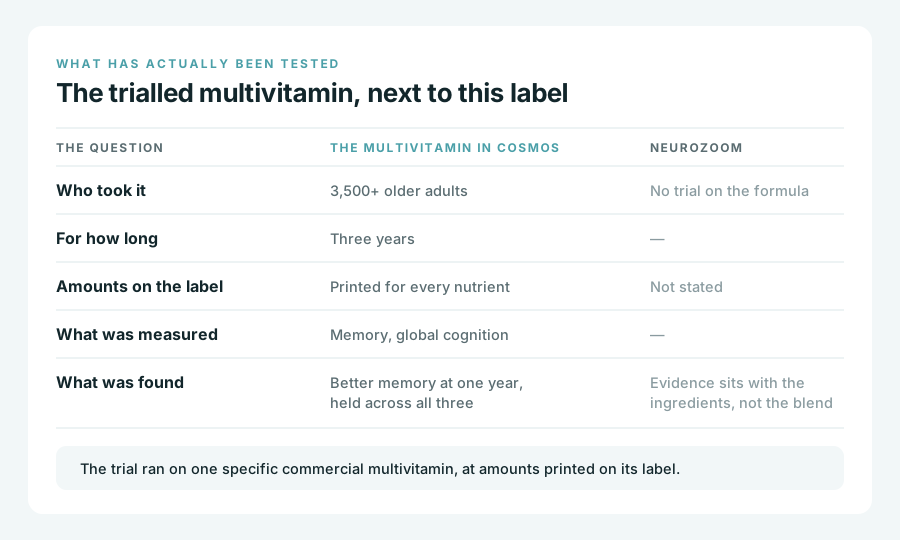
And there is a practical consequence that follows directly, which is the reason this page exists. If you already take a daily multivitamin, this bottle overlaps it. Not vaguely — specifically, across selenium, zinc, iron, vitamin E, the B group and more. Because neither label publishes what you would need, you cannot do that addition on paper. The answer is to take both labels to a pharmacist, which costs nothing and takes five minutes.
Which leaves a clear way to think about it: this formula is at its most coherent for someone who is not already supplementing. If you take nothing today and want both a micronutrient base and a cognitive stack in one capsule, this is built for exactly that. If you already have a multivitamin in the cupboard, the conversation is about replacing rather than adding.
See NeuroZoom and decide for yourself5. How Do You Take NeuroZoom, And When Would You Notice A Change?
The maker does not publish a serving instruction on the page, so we are not going to invent one — follow whatever the bottle itself states when it arrives.
On timing, the evidence answers for itself, and the answer is patience measured in seasons. The multivitamin trial ran three years, with the first significant memory difference appearing at one year. Bacopa's trials ran eight to twelve weeks. Nothing here acts on the day you take it.
That is worth setting honestly against the refund window, which runs 60 days. Two months is enough to tell you whether the capsule suits you and whether the routine fits your day — which are the two things most likely to end an attempt early. Judging the formula itself is a longer project, and worth planning for as one.
6. What Do Buyers Say About NeuroZoom?
Independently verifiable feedback is limited for this product, as it is for most supplements sold direct. The sales page carries testimonials, and states in its own footer that names and identifying details on the site have been changed — so we do not reproduce them here. This site publishes no score, no star rating and no review count for any product.
What can be said fairly, and without a testimonial: for a capsule taken over months, the practical questions are whether the routine survives a busy week and whether the capsule is comfortable to swallow. Both are worth knowing about yourself before committing.
What it does well
- A broad micronutrient base — the one panel in this whole aisle with a large, long, positive randomised trial behind it
- Huperzine A, bacopa and phosphatidylserine: real compounds with real human cognitive research
- Thirty-five ingredients in one capsule rather than several bottles
- No stimulants, so it adds nothing to an afternoon that is already difficult
What to know before you buy
- No amount published for any ingredient, and no serving size stated
- Roughly half the list is nutrients that a daily multivitamin also contains — worth checking the two together
- A 60-day guarantee, and returns are shipped back at the buyer’s expense
- No published trial on this exact combination
- Sold through the maker's own site, with ClickBank as retailer
7. How Much Does NeuroZoom Cost, And Is There A Guarantee?
Prices are the manufacturer's list prices at the time of writing and change without notice. We publish what a bottle costs and what a day costs. We do not publish savings claims and we do not reproduce countdown pricing.
| Package | Price per bottle | Per day | Shipping |
|---|---|---|---|
| 2 bottles | $79 per bottle | $2.63 | Shipping fee applies |
| 3 bottles | $59 per bottle | $1.97 | Free, US |
| 6 bottles | $49 per bottle | $1.63 | Free, US |
| Guarantee | 60 days, money back, handled by the manufacturer | ||
Per-day cost uses the maker's own framing of one bottle as a one-month supply.
Order Now on the official siteOne detail in the refund terms is worth knowing before you order rather than after: the maker asks for unused bottles to be shipped back to a returns address in Florida for a refund to be approved. That is the manufacturer's policy and they administer it, not us, but return postage is a cost worth factoring in.
8. Who Is NeuroZoom For?
A question about you rather than about the bottle, so we will answer it that way.
This is likely a good fit if you are not currently taking a multivitamin and would rather have one capsule than two; if the idea of a micronutrient base plus a cognitive stack in a single routine appeals; and if you can judge something over months rather than weeks.
Look elsewhere, or ask first, if you already take a daily multivitamin — not because the formula is poor, but because you would be doubling up on nutrients neither label quantifies; if you want to verify amounts against published trials before spending; or if you take a cholinesterase inhibitor, medication for glaucoma or anything for heart rhythm, in which case huperzine A is a conversation to have before the first capsule.
And the case where the answer is neither: if the forgetting has been getting worse month over month, or someone close to you has mentioned it, the next step is an appointment rather than a bottle. No supplement on this site prevents, treats or reverses any condition.
If that sounds like you, see it here
Frequently asked
Does NeuroZoom publish how much of each ingredient it contains?
No. The page describes a proprietary 35-in-1 formula and names the ingredients, but publishes no amount for any of them and no serving size. That matters more here than with a botanical blend, because roughly half the list is vitamins and minerals — nutrients that have established daily values and, in several cases, upper limits.
Can I take it alongside my multivitamin?
NeuroZoom contains selenium, zinc, iron, vitamin E, the B vitamins and more than a dozen other nutrients that a daily multivitamin also contains, so the two overlap. Because this label publishes no amounts, that overlap cannot be added up on paper — section four sets out what to do about it.
What is huperzine A, and does it need care?
It is the most pharmacologically active ingredient in the formula. Huperzine A inhibits acetylcholinesterase, the enzyme that breaks down acetylcholine — the same mechanism class as some prescription memory medicines. That is why it has genuine human trials behind it, and also why it is the one ingredient to raise specifically with a prescriber, particularly if you already take a cholinesterase inhibitor, a medicine for glaucoma, or anything for heart rhythm.
How long before most people would notice anything?
Months. The multivitamin trial that this kind of panel rests on ran three years, with the first significant memory difference at one year. Bacopa’s trials ran eight to twelve weeks. Nothing here acts on the day you take it. The refund window runs 60 days, which is worth planning around.
Does NeuroZoom have side effects?
There is no published trial on this exact combination, so what is known comes from studies of single ingredients. In the 12-week bacopa trial cited below, people taking 300 mg a day reported more side effects than those on placebo, mainly digestive complaints and headaches, with none serious. The huperzine A review cited below notes that taking too much may cause nausea, diarrhea and muscle cramps. If you are pregnant, take a prescription medicine every day or have surgery coming up, ask your doctor before the first capsule, and read the huperzine A question above.
Can I take NeuroZoom with my prescription medication?
Ask the doctor who prescribes for you, or your pharmacist, before the first capsule, and take the bottle with you. Huperzine A matters most here (see the huperzine A question above): Memorial Sloan Kettering’s herb database lists interactions with cholinesterase-inhibitor memory medicines such as donepezil, galantamine and rivastigmine, with anticholinergic medicines, with dopamine D2 blockers, and with calcium channel blockers and beta blockers, because huperzine A may lower heart rate. Licorice is also on the label, and the NIH reports interactions between licorice and corticosteroids.
When should I speak to a doctor instead of trying a supplement?
If the forgetting is getting worse month over month, if other people have started noticing it, if it comes with confusion about time or place, or if it began suddenly, that is a clinical conversation and not a supplement question. Nothing on this page prevents, treats or reverses any condition.
References
- Multivitamin Supplementation Improves Memory in Older Adults: A Randomized Clinical Trial — American Journal of Clinical Nutrition — 2023
- Effects of cocoa extract and a multivitamin on cognitive function: a randomized clinical trial (COSMOS-Mind) — Alzheimer’s & Dementia — 2023
- Huperzine A: a natural acetylcholinesterase inhibitor with multifunctional neuroprotective effects — Beni-Suef University Journal of Basic and Applied Sciences — 2025
- The effect of plant active substances on cognitive function in healthy older adults: a systematic review and network meta-analysis of randomized controlled trials — Frontiers in Pharmacology — 2025
- The Effects of a Bacopa monnieri Extract (Bacumen®) on Cognition, Stress, and Fatigue in Healthy Adults: A Randomized, Double-Blind, Placebo-Controlled Trial — Clinical Drug Investigation — 2025
- Huperzia serrata (huperzine A) — About Herbs, Memorial Sloan Kettering Cancer Center — 2022
- Licorice Root — National Center for Complementary and Integrative Health (NIH) — 2025
Disclosure
All content is for informational purposes only and is not a substitute for professional medical advice, diagnosis, or treatment. Each product covered is a dietary supplement, not a prescription drug, and statements about it have not been evaluated by the U.S. Food and Drug Administration. Results vary with individual health status, consistency of use, and lifestyle. This page contains affiliate links — if you buy through them we may earn a small commission at no additional cost to you. Read our disclosure and our editorial policy.