
On Several Medicines? A Memory Supplement Checklist: Interactions, Medicines Linked to Memory Problems, and What to Ask
If your weekly pill box is already full, adding a memory supplement deserves ten minutes with a pharmacist first. Here is exactly what to bring, and what to ask.
Quick answer
Before adding a memory supplement to several medicines, list everything you take and review it with a pharmacist or doctor. Ask whether anything interacts, whether any current medicine could be affecting your memory, and whether doses need spacing. Read the label for every ingredient and amount. Never stop a prescription on your own. If you want to try one, two formulas worth showing your pharmacist are compared below.
The kitchen drawer has become a small pharmacy: something for blood pressure, something for cholesterol, a tablet the specialist added last year, a vitamin a friend swears by. And now, because names have been slipping lately, you are thinking about one more bottle.
That instinct to check first is the right one. Supplements are not approved by the FDA before they are sold, and the more you already take, the more there is for a new product to meet. The good news is that the check is short, and it follows the same four steps every time.
Further down, we look at two formulas worth showing your pharmacist: Phytomem One and Brain C-13 — each with a money-back guarantee.
Step 1: What Goes On Your List?
Everything you take goes on it, from prescriptions to vitamins, and you are far from alone in needing this list. The CDC reports that 75.9% of adults aged 60 and older took at least one dietary supplement in 2021 to 2023, and 56.4% took two or more. In 2021 to 2022, 88.6% of adults aged 65 and older had taken a prescription medicine in the past year.
The National Institute on Aging suggests writing down every medicine you take, including over-the-counter drugs, vitamins and supplements, with the amount and the time you take each one, and showing that list to all of your health care providers. Mention everything, even what you use only now and then. The FDA gives the same advice for every visit to a health care professional: bring a list of all the supplements and medicines you take.
One more habit helps: filling all your prescriptions at the same pharmacy, so your records are in one place for the pharmacist who checks them.
Step 2: Could A Medicine You Take Be Affecting Your Memory?
It can, and this is the question most people skip, though it may matter more than the supplement. The National Institute on Aging lists medication side effects among the factors that can cause memory problems, and notes that finding the cause is what points to the right next step.
The American Geriatrics Society’s 2023 Beers Criteria — a reference list of medicines that may be inappropriate for many adults 65 and older — names several types for their effect on thinking:
- First-generation antihistamines, such as diphenhydramine and doxylamine. The criteria describe a risk of confusion.
- Benzodiazepines, a group of anti-anxiety medicines, which the criteria say increase the risk of cognitive impairment in older adults.
- “Z-drug” sleep medicines, such as zolpidem, with effects the criteria describe as similar to benzodiazepines.
- Bladder medicines of the antimuscarinic type, such as oxybutynin, where the criteria urge caution because of possible effects on thinking.
AARP’s consumer guide also lists some antiseizure drugs, tricyclic antidepressants and opioid painkillers. The Beers authors stress that the list is not meant to be used in a punitive way — many people take these medicines for good reasons. The point is to ask, not to stop. The National Institute on Aging advises not to stop a medicine before talking with a health care provider.
Step 3: How Could A Supplement Interact With Your Medicines?
The FDA notes that certain supplements can change how a medicine is absorbed, broken down or cleared — which can change how well that medicine works. The table below is a starting point for your conversation: common ingredients in memory formulas, and the medicine types reference sources flag them for.
| If you take | Ask about | What the source says |
|---|---|---|
| A blood thinner, such as warfarin | Turmeric, rhodiola | Memorial Sloan Kettering notes turmeric may increase the risk of bleeding with warfarin or other blood thinners, and that rhodiola can affect the way warfarin works. |
| Diabetes medicine | Berberine, cinnamon | The NIH’s complementary health center says berberine may interact with some medicines, and that herbal supplements such as cinnamon can cause unwanted side effects with conventional diabetes drugs. |
| Cholinesterase inhibitors, such as donepezil | Huperzine A | Memorial Sloan Kettering notes huperzine A may increase the risk of side effects with other drugs that work the same way. |
| Heart medicines that slow the heart rate (calcium channel blockers, beta blockers) | Huperzine A | Memorial Sloan Kettering notes huperzine A may lower heart rate. |
| Blood pressure medicine | Olive leaf, rhodiola | Memorial Sloan Kettering notes olive leaf extract added to the blood-pressure-lowering effect in lab experiments, and that rhodiola may increase the low-blood-pressure side effects of these medicines. For both, clinical relevance has yet to be determined. |
| Thyroid hormone, such as levothyroxine | Bacopa; calcium and iron | A StatPearls review notes bacopa taken with thyroid hormone may lead to too much thyroid hormone. The FDA-approved levothyroxine label says not to take it within 4 hours of iron or calcium supplements. |
| Osteoporosis tablets (bisphosphonates) or some antibiotics | Magnesium | The NIH Office of Dietary Supplements advises spacing magnesium at least 2 hours from bisphosphonates, and taking certain antibiotics at least 2 hours before or 4 to 6 hours after it. |
| Metformin or acid reducers (proton pump inhibitors) | Vitamin B12 levels | The NIH Office of Dietary Supplements notes both can reduce vitamin B12 absorption over time — useful for your doctor to know. |
| Transplant medicine (cyclosporine) | Berberine | The NIH’s complementary health center notes berberine has been shown to interact with cyclosporine. |
Not a complete list, and not medical advice. Your pharmacist can check the full label against your full list.
If blood sugar is part of your picture, our guide to brain fog after meals covers the everyday steps that come before any formula.
Step 4: What Should You Look For On The Supplement Label?
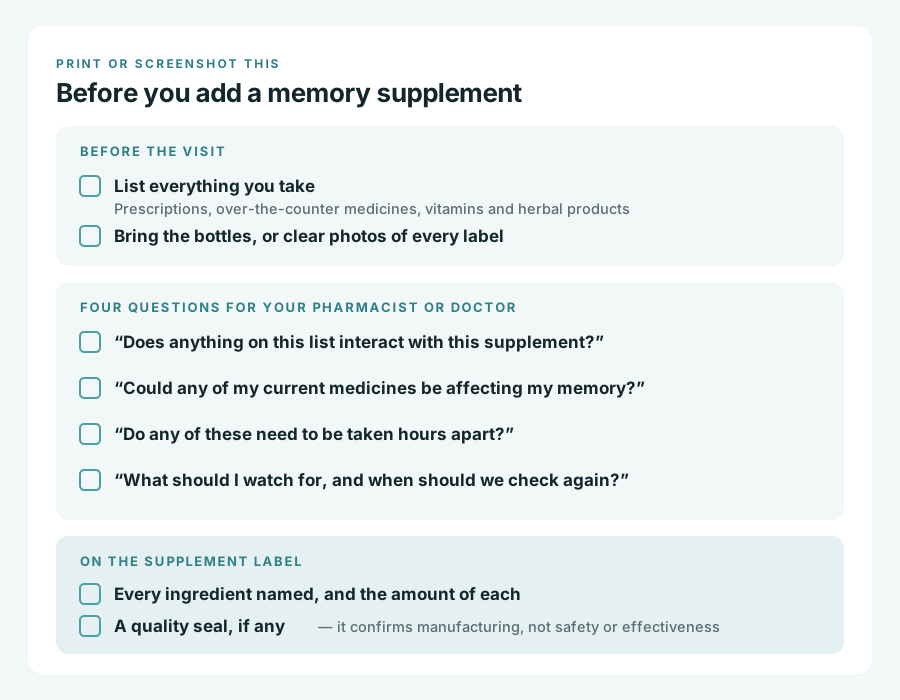
Two things make a pharmacist’s check easier, because a pharmacist can only check what is written down:
- Every ingredient named, with an amount. Many formulas name their ingredients but not how much of each is inside; your pharmacist can still check the names, and can tell you when an amount would change the answer.
- A quality seal, if there is one. The NIH Office of Dietary Supplements explains that seals from groups such as USP, NSF International and ConsumerLab.com show a product was properly made, contains what the label lists and has no harmful levels of contaminants — but they do not guarantee that a product is safe or effective.
What If You Manage A Parent’s Medicines?
The four steps above still apply if you help a mother or father with their medicines and are thinking about a memory supplement for them. A few things change when you are the one keeping track.
- Make one complete list, with them. The National Institute on Aging suggests bringing the names, doses and schedule of every medicine, vitamin, herbal remedy, over-the-counter drug and supplement the older adult takes — including those prescribed by other doctors. The FDA adds noting who prescribed each prescription and why.
- Take the supplement bottle itself. A photo of the label works too. As Step 4 explains, a pharmacist can only check what is written down.
- Get permission to speak with their doctor. The National Institute on Aging explains that to talk with a provider when the person is not there, you need their permission in writing; most offices have a consent form for this, sometimes called a HIPAA release.
- Ask about memory as well as interactions. The FDA notes that some medications cause side effects that look like other health problems, including memory difficulties, and advises asking whether a new problem could come from a medicine.
- A blood thinner changes the questions. The NIH’s complementary health center notes ginkgo may increase the risk of bleeding with anticoagulants such as warfarin. Our guide to memory supplements with Eliquis or warfarin goes through those questions one ingredient at a time.
- Blood pressure and heart-rate tablets count too. Memorial Sloan Kettering notes that huperzine A taken with beta blockers or calcium channel blockers may cause a severely slow heartbeat. Olive leaf and rhodiola are in the table above.
Questions to bring to their pharmacist
- Does anything on this label interact with anything on this list?
- Does it need to be spaced away from any of their medicines, and should it be taken with food?
- Could any medicine they already take be affecting their memory?
- What side effects should we watch for, and what should we do if one appears?
Keep your parent in the room and in the conversation. The National Institute on Aging advises letting the older adult answer the doctor’s questions unless you have been asked to, and always including them when you talk with the doctor.
Which Labels Could You Take To The Pharmacist?
If you want to bring a specific formula to that conversation, two on this site have labels a pharmacist can work through. Phytomem One names all ten of its ingredients, and we have already gone through them medicine by medicine on its comparison page. Brain C-13 comes from a named company and publishes a Supplement Facts panel with amounts. The full reviews explain each label.
Two formulas worth a closer look
Two formulas worth showing your pharmacist
Both labels are easy to bring along to the pharmacy — and each formula comes with a money-back guarantee.
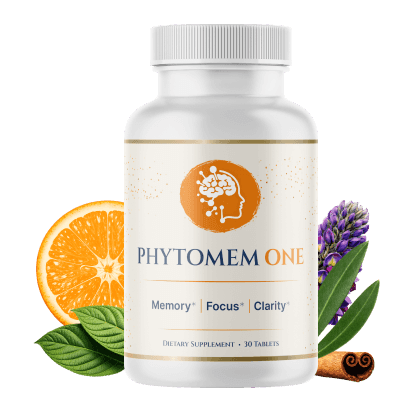
Phytomem One
Tablets
One tablet a day with food, with all ten ingredients named — and a medicine-by-medicine page on this site to take along.
- Anyone who wants one tablet a day
- Readers who like a medicine-by-medicine page to take along
Covered by a 60-day money-back guarantee
Before you start · Berberine and cinnamon matter with diabetes medicine; fucoidan and saffron with a blood thinner.
See Phytomem One on the official siteRead our Phytomem One review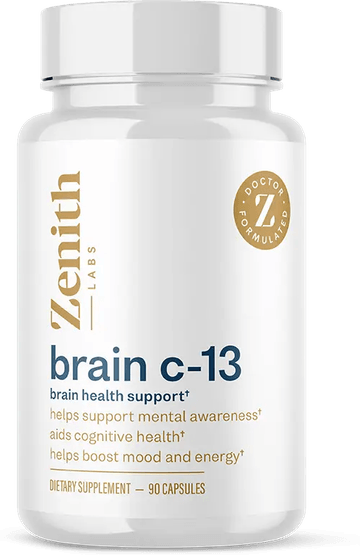
Brain C-13
Capsules
From Zenith Labs, a named company with a postal address and phone number, with a published Supplement Facts panel listing citicoline, bacopa and four more ingredients with amounts.
- Readers who want to see amounts on the label
- Anyone who prefers a company they can look up
Covered by a 180-day money-back guarantee
Before you start · Huperzine A, named on the sales page, matters with cholinesterase inhibitors and heart-rate medicines; turmeric with a blood thinner.
See Brain C-13 on the official siteRead our Brain C-13 reviewListed in no particular order. We publish no scores or rankings.
When Should You See A Doctor?
Ask for an appointment, rather than starting any supplement, if memory problems are getting worse, if they began around the time a medicine was started or changed, or if they come with confusion that is new to you. The National Institute on Aging notes that finding the cause of memory problems is what determines the best next step — and a medicine review is part of that.
If you have unwanted side effects from any medicine, keep taking it until you have spoken to the person who prescribed it.
Ready to compare? Go back to the two formulas above, or read the full reviews of Phytomem One and Brain C-13.
Frequently asked
Can supplements interact with medications?
Yes. The FDA says certain dietary supplements can change the absorption, metabolism or excretion of a medication, and advises bringing a list of all your supplements and medicines to every health care visit. The NIH Office of Dietary Supplements also advises telling all your health care providers, including pharmacists, about any supplements you take.
What medicines can affect memory in older adults?
The American Geriatrics Society’s 2023 Beers Criteria single out first-generation antihistamines such as diphenhydramine, benzodiazepines and “Z-drug” sleep medicines for their effects on thinking in older adults, and urges caution with bladder antimuscarinics. AARP also lists some antiseizure drugs, tricyclic antidepressants and opioid painkillers. If you take any of them, ask your doctor to review them with you.
Should I stop a medicine if I think it is affecting my memory?
No. Talk to the doctor who prescribed it first. The National Institute on Aging advises not to stop a medicine before talking with a health care provider, and AARP notes that lowering a dose or stopping should be done under your doctor’s supervision.
Does a quality seal mean a supplement is safe?
No. The NIH Office of Dietary Supplements explains that seals from groups such as USP, NSF International and ConsumerLab.com show a product was properly made, contains the listed ingredients and is free of harmful levels of contaminants — but they do not guarantee that a product is safe or effective.
How do I bring everything I take to a pharmacist?
Write down each medicine, vitamin and supplement with the amount and the time you take it, as the National Institute on Aging suggests, or bring the bottles themselves. Using one pharmacy for all your prescriptions keeps your records in one place.
What should I ask a pharmacist about a memory supplement for my parent?
Bring the label and a complete list of what your parent takes, then ask: does anything on the label interact with anything on the list, does it need spacing from any medicine or taking with food, could a current medicine be affecting memory, and what side effects should you watch for. The FDA notes that some medications can cause memory difficulties as a side effect.
Is huperzine A safe for older adults?
That depends on the person and on what else they take, so ask their doctor or pharmacist. Memorial Sloan Kettering lists side effects including nausea, dizziness, sweating and a slow heartbeat, and notes huperzine A may increase side effects with cholinesterase inhibitors such as donepezil and may cause a severely slow heartbeat with beta blockers or calcium channel blockers.
References
- Taking Medicines Safely as You Age — National Institute on Aging — 2022
- Memory Problems, Forgetfulness, and Aging — National Institute on Aging — 2023
- Dietary Supplement Use: United States, August 2021–August 2023 — NCHS Data Brief No. 561, CDC — 2026
- Prescription Medication Use, Coverage, and Nonadherence Among Adults Age 65 and Older: United States, 2021–2022 — National Health Statistics Reports No. 209, CDC — 2024
- Mixing Medications and Dietary Supplements Can Endanger Your Health — U.S. Food and Drug Administration — 2022
- 5 Medication Safety Tips for Older Adults — U.S. Food and Drug Administration — 2024
- Taking Someone to a Doctor’s Appointment: Tips for Caregivers — National Institute on Aging — 2023
- Ginkgo: Usefulness and Safety — NIH National Center for Complementary and Integrative Health — 2025
- Olive Leaf — Memorial Sloan Kettering Cancer Center, About Herbs — 2023
- American Geriatrics Society 2023 Updated AGS Beers Criteria for Potentially Inappropriate Medication Use in Older Adults — Journal of the American Geriatrics Society — 2023
- Drugs That May Cause Memory Loss — AARP — 2025
- Dietary Supplements: What You Need to Know — NIH Office of Dietary Supplements — 2023
- Magnesium: Fact Sheet for Health Professionals — NIH Office of Dietary Supplements — 2026
- Vitamin B12: Fact Sheet for Health Professionals — NIH Office of Dietary Supplements — 2025
- Huperzia serrata (Huperzine A) — Memorial Sloan Kettering Cancer Center, About Herbs — 2022
- Turmeric — Memorial Sloan Kettering Cancer Center, About Herbs — 2026
- Rhodiola — Memorial Sloan Kettering Cancer Center, About Herbs — 2026
- Bacopa monnieri — StatPearls, NCBI Bookshelf — 2023
- SYNTHROID (levothyroxine sodium) Prescribing Information — U.S. Food and Drug Administration — 2024
- Diabetes and Dietary Supplements: What You Need To Know — NIH National Center for Complementary and Integrative Health — 2023
- Berberine and Weight Loss: What You Need To Know — NIH National Center for Complementary and Integrative Health — 2023
Disclosure
All content is for informational purposes only and is not a substitute for professional medical advice, diagnosis, or treatment. Each product covered is a dietary supplement, not a prescription drug, and statements about it have not been evaluated by the U.S. Food and Drug Administration. Results vary with individual health status, consistency of use, and lifestyle. This page contains affiliate links — if you buy through them we may earn a small commission at no additional cost to you. Read our disclosure and our editorial policy.