
How Phytomem One Fits With Your Medicines
The most useful comparison for a formula with active ingredients is the one against what is already in your medicine cabinet. Here is the list to take to your appointment.
Quick answer
Several Phytomem One ingredients are worth raising with your doctor if you take medicines: berberine, Ceylon cinnamon, olive leaf and kudzu with diabetes medicine; fucoidan and saffron with a blood thinner; berberine with cyclosporine or tacrolimus. It is a short conversation, and the list below makes it easy.
Most comparisons set one product against another. For Phytomem One, the comparison that matters most is closer to home: how does it sit alongside the medicines you already take?
That is not a warning sign. It follows from what the formula is. Its ingredients were chosen because they do something in the body — and anything that does something is worth a word with the person who manages your prescriptions.
The List To Take To Your Appointment
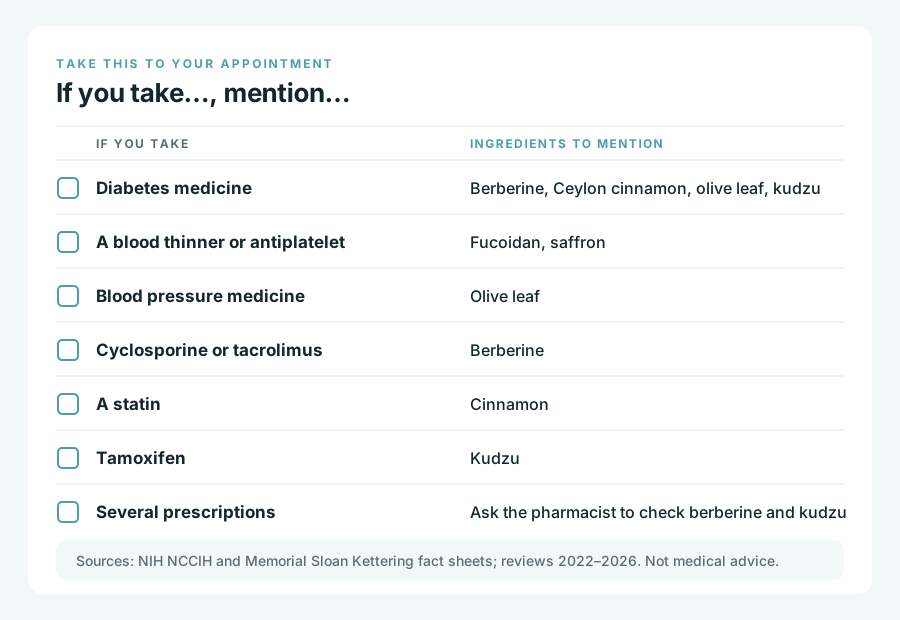
Medicine By Medicine
Each row says what the published sources actually state. Where a finding comes from lab or animal studies only, we say so — it is a reason to mention the ingredient, not a reason for alarm.
| If you take | Mention | What the sources say |
|---|---|---|
| Diabetes medicine | Berberine, Ceylon cinnamon, olive leaf, kudzu | NCCIH advises anyone on medicines to talk with their provider before berberine, and notes that cinnamon with conventional diabetes drugs can cause unwanted side effects. Olive leaf and kudzu lowered blood sugar in lab and animal studies; clinical relevance is not yet known. |
| A blood thinner or antiplatelet | Fucoidan, saffron | Memorial Sloan Kettering notes fucoidan may increase bleeding risk with warfarin or heparin. Reviews of saffron advise caution alongside anticoagulant and antiplatelet medicines. |
| Blood pressure medicine | Olive leaf | In lab experiments olive leaf added to the blood-pressure-lowering effect; clinical relevance is not yet known. |
| Cyclosporine or tacrolimus | Berberine | NCCIH notes berberine has been shown to interact with cyclosporine, and Memorial Sloan Kettering adds it may raise blood levels of both transplant medicines. |
| A statin | Cinnamon | Memorial Sloan Kettering records a report of liver inflammation when cinnamon was taken with statins. Its page covers all types of cinnamon. |
| Tamoxifen | Kudzu | Memorial Sloan Kettering advises people taking tamoxifen, or with hormone-sensitive cancers, to avoid kudzu. |
| Several prescriptions | Berberine, kudzu | Memorial Sloan Kettering notes berberine may reduce the effect of medicines processed by certain liver enzymes, and kudzu altered those enzymes in lab studies. A pharmacist can check your list. |
This table is a starting point for a conversation, not medical advice. Never start, stop or change a prescription without your doctor.
How To Have The Conversation
- Bring the bottle, or a photo of the label. It names all ten ingredients, which is exactly what your doctor or pharmacist needs.
- Bring your medicine list. Including anything you take only sometimes, and other supplements.
- Ask one direct question: "Is there any reason I shouldn't add this, and should we check anything after a few weeks?"
- Your pharmacist counts. If an appointment is weeks away, a pharmacist can usually look at the label against your prescriptions.
If Your Doctor Gives You The Go-Ahead
Then the practical side is simple. One tablet a day with food, and the smallest package — two bottles — lasts 60 days, the same length as the maker's 60-day guarantee. If you take diabetes medicine, your doctor may want to see your numbers again after a few weeks; that is good practice, and it also gives you a clear record of how you are doing.
And if you take none of the medicines on the list, the conversation is shorter still — though the bottle is still worth mentioning at your next routine visit.
Which Situation Are You In?
- If you take no regular medicines, mention the bottle at your next visit and start when it suits you.
- If you take one of the medicines above, have the short conversation first, with the label in hand.
- If you take several prescriptions, ask a pharmacist to check the label against your list.
- If you are unsure what you take, your pharmacy can usually give you a list of your prescriptions — bring it along.
See the Phytomem One packages on the official site
Frequently asked
Is Phytomem One safe to take with my medicines?
That depends on which medicines, which is why the answer belongs to your doctor or pharmacist rather than to a website. What this page gives you is the list of ingredients worth mentioning for each kind of medicine, drawn from NIH and Memorial Sloan Kettering sources, so the conversation takes minutes rather than guesswork.
Why do some ingredients need a conversation at all?
Because they are active. Berberine, cinnamon and olive leaf were chosen for what they do to blood sugar, and fucoidan and saffron have effects on blood clotting that researchers have noted. An ingredient that does something in the body is exactly the kind worth mentioning to the person who manages your prescriptions.
Which ingredients have no known medicine interactions?
For banaba, fucoxanthin, Morosil and xylitol, we found no medicine interactions listed in the sources we checked. That is not the same as a guarantee, so mention the whole bottle anyway — it is easiest to hand over the label.
Should I stop my medicine to take a supplement?
No. Never stop or change a prescription to make room for a supplement. If your doctor agrees you can add Phytomem One, they may want to check your blood sugar or other results after a few weeks, especially if you take diabetes medicine.
References
- Diabetes and Dietary Supplements: What You Need To Know — NIH National Center for Complementary and Integrative Health — 2023
- Berberine and Weight Loss: What You Need To Know — NIH National Center for Complementary and Integrative Health — 2023
- Cinnamon — NIH National Center for Complementary and Integrative Health — 2024
- Berberine — Memorial Sloan Kettering Cancer Center, About Herbs — 2023
- Fucoidan — Memorial Sloan Kettering Cancer Center, About Herbs — 2026
- Olive Leaf — Memorial Sloan Kettering Cancer Center, About Herbs — 2023
- Kudzu — Memorial Sloan Kettering Cancer Center, About Herbs — 2022
- Cinnamon — Memorial Sloan Kettering Cancer Center, About Herbs — 2021
- Saffron — Journal of Primary Health Care — 2022
- Adverse Events of Saffron (Crocus sativus L.): Systematic Review of Current Evidence — Health Science Reports — 2026
Disclosure
All content is for informational purposes only and is not a substitute for professional medical advice, diagnosis, or treatment. Each product covered is a dietary supplement, not a prescription drug, and statements about it have not been evaluated by the U.S. Food and Drug Administration. Results vary with individual health status, consistency of use, and lifestyle. This page contains affiliate links — if you buy through them we may earn a small commission at no additional cost to you. Read our disclosure and our editorial policy.