
Phytomem One Review: Berberine, Cinnamon and Your Medicines
Saffron for the mind, berberine and its partners for blood sugar, and a small supporting pair — all in one tablet with breakfast. Here is what you are actually buying.
Quick answer
Phytomem One is a once-daily tablet that combines saffron — the ingredient with human trials on cognition — with berberine, Ceylon cinnamon, banaba and kudzu, chosen for blood sugar, plus three supporting extracts and a sweetener. A bottle holds 30 tablets, no amounts are published, and the smallest package lasts 60 days, matching the 60-day guarantee.
Try it with the 60-day guarantee
The appointment went fine, mostly. Blood pressure steady, weight about the same. Then the doctor glanced at one number on the printout — the sugar one — and said it was worth keeping an eye on.
On the drive home you tried to remember exactly what else she had said, and found you could not quite. Not alarming. Just one more small moment in a year that has had a few of them: the name that arrives an hour late, the reason you came into the kitchen.
Two things that seem to have nothing to do with each other. A growing number of researchers are interested in whether they are connected, and some supplement makers have started building formulas around that idea.
So this page does the careful thing. It reads what the label names, sets each ingredient against the human research that actually exists, and shows you where the formula's reasoning is established and where it is still a hypothesis. Then you decide.
1. What Is Phytomem One?
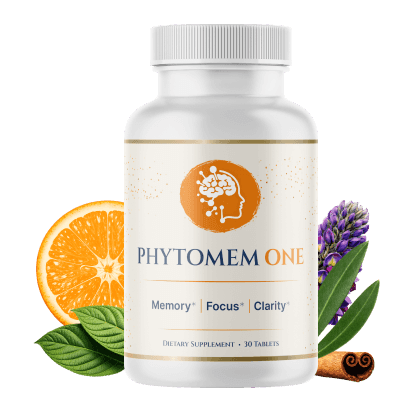
Phytomem One is a once-daily tablet for memory, focus and clarity — the three words printed on its label. It is sold direct through the maker's own site, with ClickBank as the retailer handling the transaction and refunds. The maker describes it as non-GMO and stimulant-free, and orders include three digital guides.
What makes it worth a closer look is its structure. Rather than a single long list, the maker arranges the ten ingredients into three working groups, each with a job. Reading the formula group by group is the clearest way to understand what you would be taking.
2. What Is In Phytomem One?
We start here on every product, because it is the document you would read if you could hold the bottle in a shop. Phytomem One gives you a clear count, and holds back the amounts.
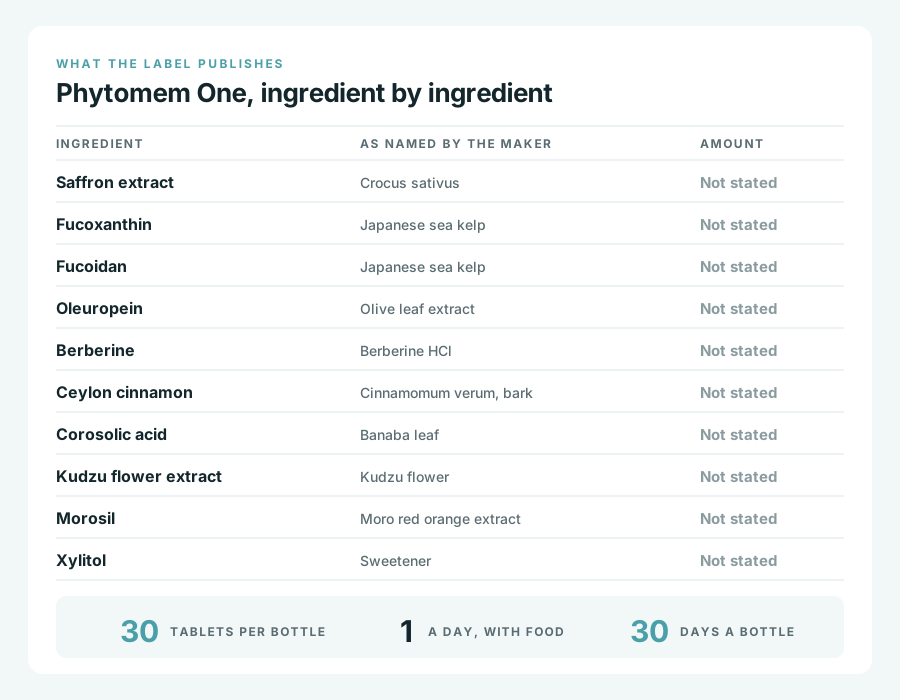
What you can check: the bottle reads 30 tablets, the instruction is one a day with food, and so one bottle is 30 days. Every ingredient is named, and several with their source — berberine as berberine HCl, cinnamon as Ceylon bark, corosolic acid from banaba leaf.
What you cannot check: the amount of each ingredient, because none is published. That means the comparison between what is in a tablet and what a trial used cannot be made from the outside. It is a plain statement of what is and is not verifiable before you spend, and a great many well-made supplements are sold exactly this way.
One more thing this list makes visible. The same ten ingredients, in the same order and with the same botanical sources, are also published for another formula sold direct to consumers, MemoVolt. Neither page states an amount for anything, so from the outside the two published lists are the same list. The pages differ on form — this one describes tablets, the other capsules — and both carry a 60-day guarantee. How the two are connected is not stated on either page, and we do not know. We mention it for one practical reason: if you already take one of them, a bottle of the other is the same published formula a second time.
3. What Does The Research Say About The Ingredients In Phytomem One?
Ten ingredients do not carry equal weight in the research. Taken group by group, the picture is clearer.
Group 1: saffron and its partners
Saffron is the ingredient with human research on cognition itself. A 2024 systematic review in Phytotherapy Research gathered 46 randomised trials lasting 4 to 48 weeks and found saffron more effective than placebo in improving cognition, and well tolerated — with the caution that its trials mixed healthy people and people with neurological or psychiatric conditions. Two 2020 reviews, one on cognitive function and one on mild cognitive impairment and dementia, point the same way. Its partners in this group have been studied for other things: fucoxanthin, from sea kelp, was tested in a 2023 twelve-week randomised trial measuring weight, waist and insulin; fucoidan and oleuropein, from kelp and olive leaf, have human literature mostly on metabolic and cardiovascular measures.
Group 2: berberine and the blood-sugar group
Berberine is the most researched ingredient in the formula. It has been through many randomised trials, pooled in a 2024 umbrella meta-analysis that measured fasting glucose, HbA1c and insulin resistance. Banaba, the source of corosolic acid, was tested in a 2022 twelve-week randomised, double-blind trial measuring insulin sensitivity and secretion. Ceylon cinnamon and kudzu flower have smaller human literatures.
Group 3: the supporting pair
Morosil is a standardised extract of Moro red oranges from Sicily, with a small human literature on body weight and metabolic measures. Xylitol is a sweetener.
As with every finished formula sold this way, there is no published trial on this exact combination — the evidence above is evidence about ingredients.
4. How Is The Phytomem One Formula Designed?
Put the three groups side by side, and the idea behind the formula comes into focus.
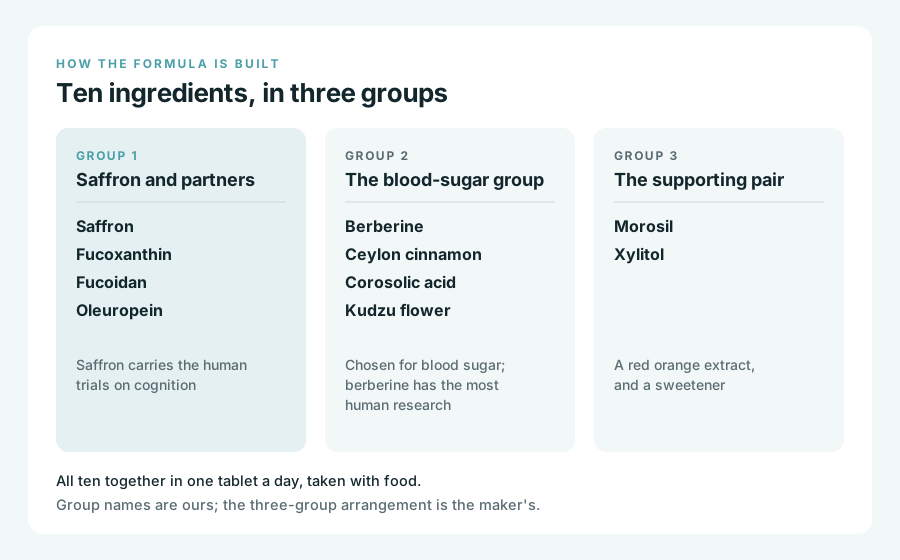
Phytomem One works on two fronts at once. One group leads with saffron, the ingredient studied for the mind directly. Another is built around berberine, the ingredient studied most for blood sugar. The third supports the other two. It is a formula for someone who sees memory and metabolism as part of the same picture.
That is a considered way to build a supplement. The brain runs on glucose, and how well the body handles glucose is ordinary, well-established physiology. Pairing the formula's most researched blood-sugar ingredient with its cognitive one in a single daily tablet follows directly from that.
Where the reasoning becomes a hypothesis is the final step. Whether supporting blood sugar with these ingredients produces a change in memory you would notice has not been tested for this formula — a statement about where the research has reached, not a judgement on the ingredients.
Which leaves a practical way to think about it. If a doctor has mentioned your blood sugar, or it runs in your family, and your memory is on your mind too, this formula is aimed at exactly that combination. It also means one conversation matters before you start — the one in the next section and in the questions below.
See Phytomem One and decide for yourself5. How Do You Take Phytomem One, And When Would You Notice A Change?
The maker's instruction is one tablet a day, with food. Breakfast is the easiest anchor: the same time, the same plate, every day.
On timing, it helps to set the bottle against the research. The blood-sugar trials cited above ran twelve weeks. One bottle lasts 30 days, and the smallest package — two bottles — lasts 60 days. So the first package tells you whether the tablet and the routine suit you; judging whether the formula does anything for you is better measured over about three months.
Because several ingredients are active in the body, speak to your doctor before starting if you take medicine for diabetes, a blood thinner, or any regular prescription. The comparison page for this product is built entirely around that conversation, medicine by medicine.
6. What Do Buyers Say About Phytomem One?
Independently verifiable feedback is limited for this product, as it is for most supplements sold direct. The sales page carries testimonials, and states in its own footer that names have been changed — so we do not reproduce them here. This site publishes no score, no star rating and no review count for any product.
What can be said fairly, and without a testimonial: for a daily tablet judged over months, the practical question is whether the routine lasts past the first few weeks. Tying it to a meal you never skip is the simplest way to make sure it does.
What it does well
- Saffron — the ingredient here with human trials on cognition
- Berberine — among the most researched ingredients for blood sugar
- One tablet a day with food, stimulant-free by the maker’s description
- The smallest package lasts 60 days, the same length as the guarantee
- From $1.63 a day at the six-bottle tier, with free US shipping
What to know before you buy
- No amount published for any ingredient
- Several ingredients act on blood sugar — worth raising with your doctor first
- Sold in packages of two, three or six bottles, not singly
- No published trial on this exact combination
- Sold through the maker's own site, with ClickBank as retailer
7. How Much Does Phytomem One Cost, And Is There A Guarantee?
Prices are the manufacturer's list prices at the time of writing and change without notice. We publish what a bottle costs and what a day costs. We do not publish savings claims and we do not reproduce countdown pricing.
| Package | Price per bottle | Per day | Shipping |
|---|---|---|---|
| 2 bottles | $79 per bottle | $2.63 | Small fee at checkout |
| 3 bottles | $59 per bottle | $1.97 | Free, US |
| 6 bottles | $49 per bottle | $1.63 | Free, US |
| Guarantee | 60 days, money back, handled by the manufacturer | ||
Per-day cost uses the label: 30 tablets at one a day, so one bottle lasts 30 days.
Order Now on the official siteThe 60-day guarantee is the term the manufacturer publishes, and they handle it, not us. It lines up neatly with the smallest package: two bottles last exactly 60 days, so the whole of a first order sits inside the refund window. Three bottles reach the twelve-week mark the blood-sugar trials used.
8. Who Is Phytomem One For?
A question about you rather than about the bottle, so we will answer it that way.
This is likely a good fit if a doctor has mentioned your blood sugar, or it runs in your family, and your memory is on your mind as well; if you want saffron and berberine in one daily tablet rather than two separate products; if you prefer a stimulant-free routine; and if 60 days with a guarantee is the right way for you to try something.
Look elsewhere if you want to verify ingredient amounts against published trials before spending — this label does not publish them; or if you take medicine for diabetes, blood pressure or blood clotting and have not yet spoken to your doctor about it. That conversation comes first.
And the case where the answer is neither: if the forgetting has been getting worse month over month, or someone close to you has mentioned it, the next step is an appointment rather than a bottle. No supplement on this site prevents, treats or reverses any condition.
If that sounds like you, see it here
Frequently asked
What is in Phytomem One, and does it publish the amounts?
The sales page names ten ingredients: saffron extract, fucoxanthin, fucoidan, oleuropein from olive leaf, berberine HCl, Ceylon cinnamon bark, corosolic acid from banaba leaf, kudzu flower extract, Morosil red orange extract and xylitol. No amount is published for any of them. The bottle states 30 tablets.
How do I take it, and how long does a bottle last?
One tablet a day, with food. The bottle holds 30, so each bottle lasts a month. The smallest package is two bottles, which comes to 60 days — the same length as the guarantee.
How long before most people would notice anything?
Give it weeks, not days. The saffron trials pooled in a 2024 review lasted between 4 and 48 weeks, and the blood-sugar trials on banaba and fucoxanthin ran twelve. Nothing in this formula is designed to work within the hour — it is stimulant-free by the maker’s description and meant for steady daily use.
Does Phytomem One have side effects?
There is no published trial on Phytomem One’s exact combination, so what is known comes from single ingredients. For saffron, a 2020 review of five trials found no difference in side effects compared with placebo or the medicines it was tested against, and a second 2020 review reported no serious adverse events. For berberine, a 2023 review of 18 placebo-controlled trials reported no serious adverse events, while digestive complaints tended to be more frequent with berberine than with placebo. If you are pregnant, take a regular prescription medicine or have surgery coming up, ask your doctor first, and see the next question.
Can I take it with my prescription medication?
Ask the person who wrote your prescription first, and take the bottle with you. If you take medicine for diabetes, mention berberine, Ceylon cinnamon and olive leaf; if you take a blood thinner, mention fucoidan and saffron; and if you take cyclosporine or tacrolimus after a transplant, mention berberine. The comparison page for this product goes through each kind of medicine in turn.
When should I speak to a doctor instead of trying a supplement?
If the forgetting is getting worse month over month, if other people have started noticing it, if it comes with confusion about time or place, or if it began suddenly, that is a clinical conversation and not a supplement question. Nothing on this page prevents, treats or reverses any condition.
References
- New horizons for the study of saffron (Crocus sativus L.) and its active ingredients in the management of neurological and psychiatric disorders: a systematic review of clinical evidence and mechanisms — Phytotherapy Research — 2024
- Effects of saffron (Crocus sativus L.) on cognitive function: a systematic review of randomised controlled trials — Neurological Sciences — 2020
- Saffron for mild cognitive impairment and dementia: a systematic review and meta-analysis of randomised clinical trials — BMC Complementary Medicine and Therapies — 2020
- The effect of berberine supplementation on glycemic control and inflammatory biomarkers in metabolic disorders: an umbrella meta-analysis of randomised controlled trials — Clinical Therapeutics — 2024
- Overall and Sex-Specific Effect of Berberine for the Treatment of Dyslipidemia in Adults: A Systematic Review and Meta-Analysis of Randomized Placebo-Controlled Trials — Drugs — 2023
- Effect of banaba (Lagerstroemia speciosa) on metabolic syndrome, insulin sensitivity and insulin secretion — Journal of Medicinal Food — 2022
- Effect of fucoxanthin on metabolic syndrome, insulin sensitivity and insulin secretion — Journal of Medicinal Food — 2023
Disclosure
All content is for informational purposes only and is not a substitute for professional medical advice, diagnosis, or treatment. Each product covered is a dietary supplement, not a prescription drug, and statements about it have not been evaluated by the U.S. Food and Drug Administration. Results vary with individual health status, consistency of use, and lifestyle. This page contains affiliate links — if you buy through them we may earn a small commission at no additional cost to you. Read our disclosure and our editorial policy.