
Supplements to Avoid on Eliquis or Warfarin: Memory Supplements and B12
A blood thinner is the medicine where a small interaction matters most. That makes the conversation before a new supplement short, specific and worth having. Here are the questions, and the ingredient names to bring.
Quick answer
Before adding a memory supplement to a blood thinner such as apixaban (Eliquis), warfarin or clopidogrel, show the full label to your pharmacist or doctor. Ask whether any ingredient affects bleeding, whether any could change how your medicine is broken down, and whether you need extra monitoring. Never stop or change your blood thinner on your own. If you want to try one, two options and what to ask about each are below.
The blood thinner came with a folded leaflet, and you read it more carefully than most. You mention it at the dentist. You check before you reach for a pain reliever.
Now you are thinking about something for memory — for the names that arrive late, and the reason you walked into the kitchen. And the first question in your mind is exactly the right one: will it clash with what I already take?
That question has a good answer, and it is not a simple yes or no. It is a short conversation with your pharmacist or doctor, with the label in your hand. This guide gives you the questions to bring. If you take several other medicines as well, our checklist for people on several medicines covers the wider picture.
Further down, we look at two formulas and what to ask about each: MemoryFuel and NeuroVera — each with a money-back guarantee.
How Can A Supplement Interact With A Blood Thinner?
A supplement can interact with a blood thinner in two ways, and “blood thinner” covers more than one kind of medicine. MedlinePlus describes warfarin as an anticoagulant that decreases the clotting ability of the blood, and apixaban (Eliquis) as a factor Xa inhibitor that blocks a natural substance that helps clots form. Clopidogrel (Plavix) is an antiplatelet medicine: it keeps platelets from collecting and forming clots.
These are the two ways a supplement can meet any of them.
It can add its own effect on bleeding. The FDA-approved warfarin label explains that some botanicals, such as garlic and ginkgo, may cause bleeding events when taken alone, and that those effects would be expected to add to warfarin’s.
It can change how the medicine is handled. The body clears many medicines with liver enzymes that have names like CYP2C9 and CYP3A4. The warfarin label says the more potent form of warfarin is broken down by CYP2C9, and that substances which block CYP2C9, 1A2 or 3A4 have the potential to increase warfarin’s effect. The apixaban label says apixaban is handled by CYP3A4 and by a transporter called P-gp, and advises avoiding St. John’s wort because it lowers apixaban levels. Clopidogrel works differently again: MedlinePlus notes it must be changed inside the body before it starts working.
Age is part of the picture too. The warfarin label notes that patients 60 or older appear to have a greater than expected response to warfarin’s effect — one more reason the person who knows your dose should see any new label.
None of this means a memory supplement is off the table. It means the details on the label matter more than usual, and that the check is worth doing before the first dose rather than after.
What Should You Ask Your Pharmacist Or Doctor?
Ask the six questions below. They turn one piece of advice into a conversation: the MedlinePlus pages for warfarin, apixaban and clopidogrel all say to tell your doctor and pharmacist about the vitamins, nutritional supplements and herbal products you take.
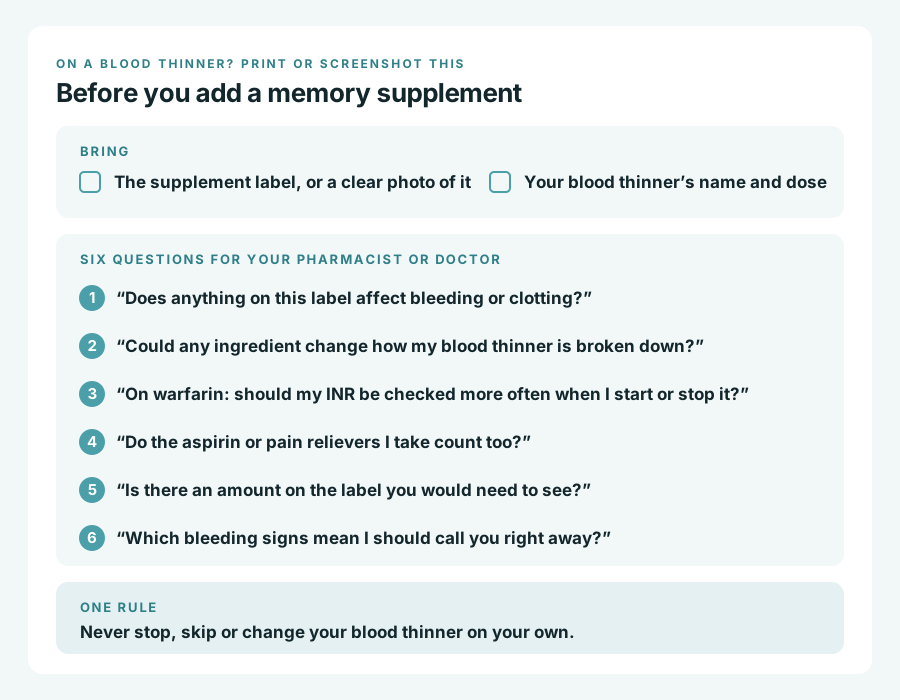
- “Does anything on this label affect bleeding or clotting?” This is the first check for any ingredient with its own effect on platelets or clotting, and the table in the next section lists common ones.
- “Could any ingredient change how my blood thinner is broken down?” Many enzyme notes come from laboratory studies, and their importance in people is often unknown. Your pharmacist knows which enzymes matter for your medicine and can weigh them.
- “If I take warfarin, should my INR be checked more often when I start — or stop — this?” The warfarin label says INR monitoring should be more frequent when starting or stopping botanical products.
- “Do the aspirin or pain relievers I take count too?” MedlinePlus lists aspirin and NSAID pain relievers such as ibuprofen and naproxen among the nonprescription products that may interact with warfarin, apixaban and clopidogrel alike.
- “Is there an amount on the label you would need to see?” For some ingredients the amount changes the answer. With vitamin E, for example, the NIH Office of Dietary Supplements says the bleeding concern is with large doses. When a label publishes no amounts, your pharmacist can tell you whether that matters.
- “Which bleeding signs mean I should call you right away?” Hearing the list from the person who knows your history makes it easier to remember.
Write the answers down, on the back of the label copy or in your phone, and bring them to your next appointment with whoever manages your blood thinner.
Which Vitamins And Herbs Should You Ask About On Eliquis Or Warfarin?
Some ingredients come up again and again in the reference sources for blood thinners. If any of these names appears on a label you are considering, say it out loud at the pharmacy counter.
| Ingredient | What the reference source says |
|---|---|
| Ginkgo | The NIH’s complementary health center says ginkgo may increase the risk of bleeding in people taking anticoagulant drugs such as warfarin. |
| Garlic | The same NIH center says garlic supplements may increase the risk of bleeding, which matters if you take anticoagulants or aspirin. The warfarin label names garlic and ginkgo among botanicals that may cause bleeding on their own. |
| Turmeric | Memorial Sloan Kettering notes turmeric may increase the risk of bleeding with warfarin or other blood thinners. |
| Fish oil | The NIH Office of Dietary Supplements notes fish oil can have antiplatelet effects at high doses and might raise INR with warfarin, although most research found 3 to 6 grams a day did not significantly change anticoagulation. |
| Vitamin E | The NIH Office of Dietary Supplements says large doses taken with anticoagulant or antiplatelet medicines can increase the risk of bleeding. The amount needed is unknown, but probably above 400 IU a day. |
| Vitamin K | For warfarin, the NIH Office of Dietary Supplements advises keeping vitamin K intake from food and supplements consistent, because sudden changes can raise or lower its effect. |
| St. John’s wort, coenzyme Q10, ginseng | The warfarin label lists these among botanicals that may decrease its effect. The apixaban (Eliquis) label advises avoiding St. John’s wort, because it lowers apixaban levels. |
Not a complete list, and not medical advice. The vitamin K advice is specific to warfarin and similar medicines. Your pharmacist can check the full label against your full list.
What Do Two Memory Labels Show Against These Questions?
Read against these questions, one label names four nutrients whose NIH fact sheets list no blood-thinner interaction, and the other names an herb that inhibited an enzyme that breaks down warfarin in lab studies. To show what the answers look like in practice, here are two formulas on this site, read ingredient by ingredient against the same reference sources. Neither is described here as safe or unsafe with a blood thinner — that is your prescriber’s call.
MemoryFuel: four nutrients and creatine
MemoryFuel is a daily powder that names five ingredients: vitamin D3, vitamin B12, magnesium, choline and creatine. The NIH Office of Dietary Supplements fact sheets for vitamin D, vitamin B12, magnesium and choline do not list blood thinners among their medication interactions. Creatine has no NIH fact sheet, so name it to your pharmacist too.
Vitamin K and vitamin E, two names from the table above, are not among the five ingredients it names. No amount is published for any ingredient, which is worth mentioning when you show the label.
NeuroVera: the clearest reason to bring the label
NeuroVera is a stimulant-free capsule built around bacopa and lion’s mane, with gotu kola, schisandra and shilajit alongside. Here the second question — how the medicine is broken down — is the one that matters, ingredient by ingredient.
- Lion’s mane. Memorial Sloan Kettering’s entry, updated in June 2024, lists no bleeding or blood-thinner interaction.
- Gotu kola. Memorial Sloan Kettering notes that in laboratory studies gotu kola inhibited several liver enzymes, including CYP2C9 and CYP3A4, and that the clinical relevance has not been determined. CYP2C9 is the enzyme the warfarin label names for warfarin’s more potent form. That is a lab finding, not a proven interaction — and it is a clear reason to show the label before you start.
- Shilajit. None of the reference sources used in this guide covers it, so ask about it by name.
No amount is published for any of the five. Both full reviews go through each label in more detail, and none of this replaces what your pharmacist sees when the label and your prescription are side by side.
Two formulas worth a closer look
Two formulas worth showing your pharmacist
If you would like to try a memory formula, these two are a sensible starting point for that conversation — and each comes with a money-back guarantee.
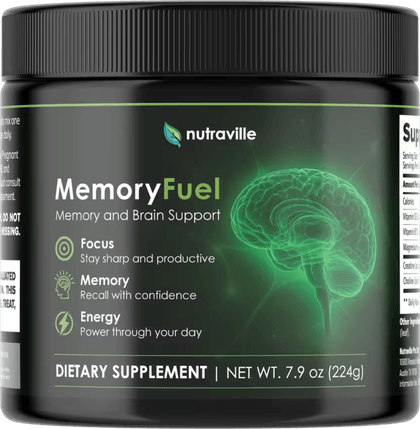
MemoryFuel
Powder
A daily powder naming vitamin D3, B12, magnesium and choline — none with a blood-thinner interaction listed in the NIH fact sheets — plus creatine, which has a memory result in adults aged 66 to 76.
- Readers who would rather drink than swallow capsules
- Anyone who wants everyday nutrients plus creatine in one scoop
Covered by a 90-day money-back guarantee
Before you start · With kidney disease, ask about creatine and magnesium first. Magnesium needs spacing from some antibiotics and osteoporosis tablets.
See MemoryFuel on the official siteRead our MemoryFuel review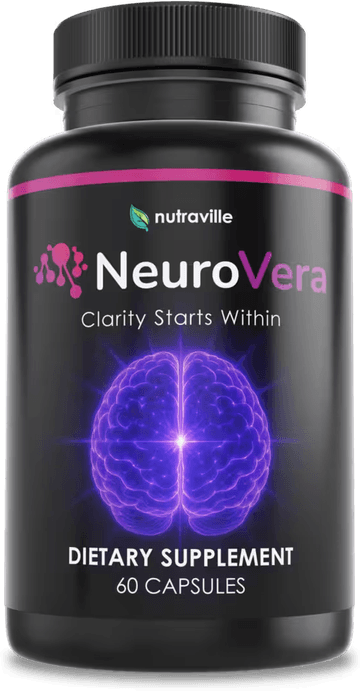
NeuroVera
Capsules
A stimulant-free capsule built around bacopa and lion’s mane, two ingredients with modern human trials on memory and attention. Memorial Sloan Kettering lists no bleeding interaction for lion’s mane.
- Readers who prefer a stimulant-free routine
- Anyone who wants to try one bottle first
Covered by a 365-day money-back guarantee
Before you start · Gotu kola inhibited CYP2C9 in lab studies, with clinical relevance undetermined — show the label to your pharmacist.
See NeuroVera on the official siteRead our NeuroVera reviewListed in no particular order. We publish no scores or rankings.
When Should You Call Your Doctor?
Call your doctor right away if you notice signs of bleeding. For warfarin, MedlinePlus lists signs such as bleeding that won’t stop, nosebleeds, bleeding gums, easy bruising, pink, red or dark brown urine, and red or tarry black bowel movements.
Book an appointment, rather than starting a supplement, if your memory problems are getting worse or began around the time a medicine was started or changed. The National Institute on Aging lists medication side effects among the factors that can cause memory problems, and says finding the cause is what points to the best next step.
And keep taking your blood thinner exactly as prescribed while you ask. Never stop or change it on your own.
Ready to compare? Go back to the two formulas above, or read the full reviews of MemoryFuel and NeuroVera.
Frequently asked
What supplements should you avoid on Eliquis?
Ask your pharmacist or doctor about any supplement before you start it. The FDA-approved apixaban (Eliquis) label advises avoiding St. John’s wort, which lowers apixaban levels, and notes that aspirin and long-term use of NSAID pain relievers increase the risk of bleeding. Reference sources also flag ginkgo, garlic and turmeric for bleeding with anticoagulants. No general list replaces a check of your own label.
What supplements can you take with blood thinners?
This site does not call any supplement safe with a blood thinner, because the answer depends on your medicine, your dose and the exact label. What reference sources can show is whether an interaction is listed. For example, the NIH Office of Dietary Supplements fact sheets for vitamin B12 and vitamin D do not list blood thinners among their medication interactions. Your pharmacist can check the rest of the label.
Can ginkgo biloba be taken with blood thinners?
Only the person who prescribes your blood thinner can answer that for you. The NIH’s complementary health center says ginkgo may increase the risk of bleeding in people taking anticoagulant drugs such as warfarin, and the warfarin label names ginkgo among botanicals that may cause bleeding on their own. Ask before starting any product that contains it.
Do I need an extra INR check if I start or stop a supplement on warfarin?
Ask the person who manages your INR. The FDA-approved warfarin label says INR should be monitored more often when starting or stopping botanical products, and that drugs and dietary changes affect INR levels. Tell them before you start a supplement, and again if you stop it.
Should I pause my blood thinner to try a memory supplement?
No. Never stop, skip or change a blood thinner to make room for a supplement. MedlinePlus advises not to stop clopidogrel without talking to your doctor, and the warfarin label advises patients not to start or stop other products, including herbal products, except on their physician’s advice.
References
- WARFARIN SODIUM tablets — Prescribing Information, DailyMed (U.S. National Library of Medicine) — 2022
- ELIQUIS (apixaban) — Prescribing Information, DailyMed (U.S. National Library of Medicine) — 2025
- Warfarin — MedlinePlus Drug Information — 2026
- Apixaban — MedlinePlus Drug Information — 2025
- Clopidogrel — MedlinePlus Drug Information — 2026
- Ginkgo: Usefulness and Safety — NIH National Center for Complementary and Integrative Health — 2025
- Garlic: Usefulness and Safety — NIH National Center for Complementary and Integrative Health — 2025
- Turmeric — Memorial Sloan Kettering Cancer Center, About Herbs — 2026
- Omega-3 Fatty Acids: Fact Sheet for Health Professionals — NIH Office of Dietary Supplements — 2025
- Vitamin E: Fact Sheet for Health Professionals — NIH Office of Dietary Supplements — 2021
- Vitamin K: Fact Sheet for Health Professionals — NIH Office of Dietary Supplements — 2021
- Vitamin D: Fact Sheet for Health Professionals — NIH Office of Dietary Supplements — 2025
- Vitamin B12: Fact Sheet for Health Professionals — NIH Office of Dietary Supplements — 2025
- Magnesium: Fact Sheet for Health Professionals — NIH Office of Dietary Supplements — 2026
- Choline: Fact Sheet for Health Professionals — NIH Office of Dietary Supplements — 2022
- Lion’s Mane Mushroom — Memorial Sloan Kettering Cancer Center, About Herbs — 2024
- Gotu Kola — Memorial Sloan Kettering Cancer Center, About Herbs — 2022
- Memory Problems, Forgetfulness, and Aging — National Institute on Aging — 2023
Disclosure
All content is for informational purposes only and is not a substitute for professional medical advice, diagnosis, or treatment. Each product covered is a dietary supplement, not a prescription drug, and statements about it have not been evaluated by the U.S. Food and Drug Administration. Results vary with individual health status, consistency of use, and lifestyle. This page contains affiliate links — if you buy through them we may earn a small commission at no additional cost to you. Read our disclosure and our editorial policy.