
MemoryFuel Reviews: Creatine and B12 in a Daily Scoop
Four nutrients the body relies on every day, one ingredient with memory research of its own, and a powder you stir into water. Here is what you are actually buying.
Quick answer
MemoryFuel is a daily powder from Nutraville that combines vitamin D3, vitamin B12, magnesium and choline with creatine — the ingredient with a memory result in older adults specifically. Every ingredient’s form is named, no amounts are published, and one scoop a day in water makes a tub last a month. The guarantee runs 90 days.
Try it with the 90-day guarantee
There is a little box on the kitchen counter with the days of the week on its lids. Every morning it gets a bit fuller — something for blood pressure, something for the joints, something the doctor added last spring.
And then there are the moments that no box seems to reach. The word that will not come in conversation. The appointment you were sure was next week. The name of a neighbour you have known for years, gone for a second at exactly the wrong time.
If you have looked for something to help, you already know how hard it is to judge a label from the outside — which names matter, which forms, and what the research behind them really found.
So this page does the careful thing. It reads what the label names, sets each ingredient against the human research that actually exists — including where that research is encouraging and where it is not — and then leaves the decision with you.
1. What Is MemoryFuel?
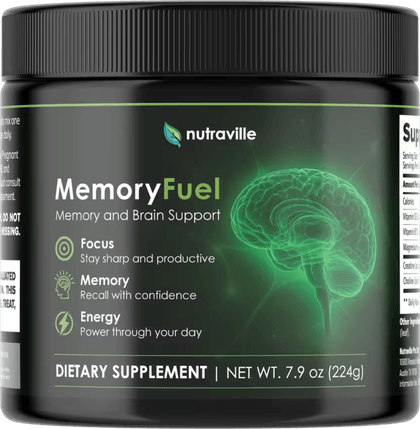
MemoryFuel is a powdered supplement carrying the Nutraville name on its tub, sold direct through the maker's own site with ClickBank as the retailer handling the transaction and the refunds. The maker presents it as a daily formula for memory and brain health.
Two things define its approach. It is a drink — one scoop stirred into a glass of water — and its named ingredients are nutrients with well-known roles in the body, joined by creatine, an ingredient most people know from sport and which has since been studied for memory.
2. What Is In MemoryFuel?
We start here on every product, because it is the document you would read if you could hold the tub in a shop. MemoryFuel is specific about one thing, and holds back another.
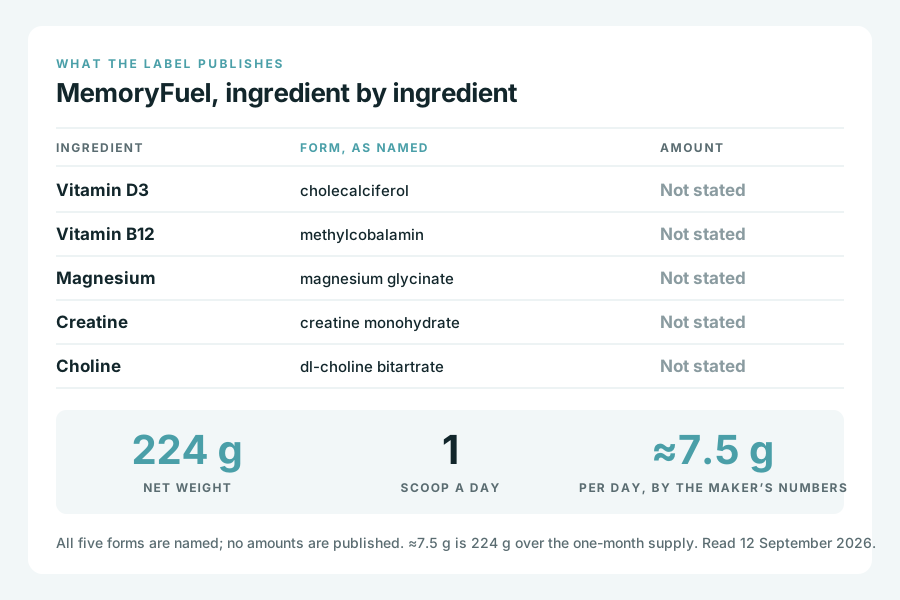
What you can check: the form of every ingredient. That matters more than it sounds. Vitamin B12 as methylcobalamin, magnesium as magnesium glycinate, creatine as creatine monohydrate, the form behind most creatine research. Naming the form tells you exactly which version of each nutrient you are getting.
What you cannot check: the amount of each ingredient, because none is published. The tub states 224 grams, sold as a one-month supply, which works out to roughly 7.5 grams of powder a day by the maker's own numbers — the total for the scoop, not a figure for any single ingredient. That is a plain statement of what is and is not verifiable before you spend, and a great many well-made supplements are sold exactly this way.
3. What Does The Research Say About The Ingredients In MemoryFuel?
The five ingredients are not the same kind of thing, and the research treats them differently. It is most useful to take them in order of what has been measured for memory.
Creatine — the memory result in older adults
A 2023 systematic review and meta-analysis in Nutrition Reviews pooled randomised controlled trials of creatine and memory in healthy people. The clearest effect was in older adults, aged 66 to 76. When the authors re-ran the analysis with a corrected method, the overall effect across all ages was no longer significant, and the result in older adults held. The trials were few and small, and doses and lengths varied widely — from a few days to 24 weeks.
Vitamin B12 — essential, and most useful when levels are low
The nervous system needs B12 to work properly, and a deficiency can show up as memory trouble. Low levels are also common with age: the NIH Office of Dietary Supplements notes that between 3% and 43% of older adults living at home are deficient, partly because absorbing B12 from food gets harder. A 2021 meta-analysis of 16 trials found that, in people without advanced neurological disease, adding B12 did not measurably change cognitive function — which is why its value depends on whether you are low to begin with.
Vitamin D3 — a nutrient the skin makes less of with age
Vitamin D comes mainly from sunlight, and the skin's ability to produce it declines with age. Its research on memory points the same way as B12's: two studies within the large VITAL trial, published in 2021, gave adults aged 60 and over 2,000 IU a day for two to three years and found no difference in cognitive decline compared with placebo. Keeping vitamin D where it should be remains its own good reason.
Magnesium and choline — everyday roles
Magnesium is involved in many processes in the body, including nerve function, and men over 70 are among the groups most likely to fall short of it through diet. Choline is used to make acetylcholine, a messenger the brain relies on for memory. For both, the case in this formula rests on those established roles rather than on a trial measuring memory.
As with every finished formula sold this way, there is no published trial on this exact combination — the evidence above is evidence about ingredients.
4. How Is The MemoryFuel Formula Designed?
Read the five as a group rather than a list, and the idea behind the formula becomes clear.
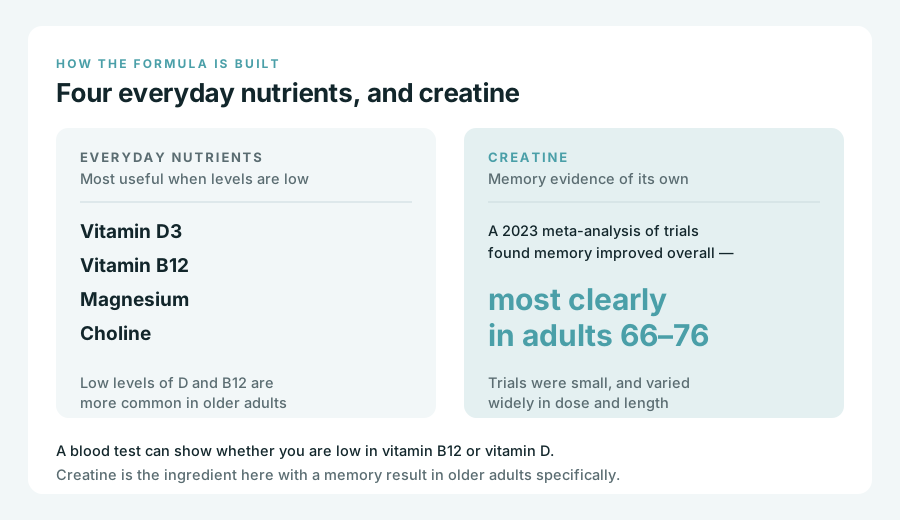
MemoryFuel is built in two parts. The first is a foundation of four everyday nutrients — D3, B12, magnesium and choline — three of which are more likely to run low later in life, whether through less sunlight, harder absorption or a lighter diet. The second is creatine, the one ingredient here with a memory result measured in older adults specifically.
That is a coherent way to build a formula. It covers nutrients the brain is known to depend on, and adds an ingredient whose memory research found its clearest result in the age group most likely to be reading this.
Where the reasoning becomes a hypothesis is the foundation. Whether topping up D3 and B12 helps memory in someone whose levels are already fine has not been shown — the trials above say that benefit depends on starting low. Creatine's memory result, by contrast, came from healthy people who were not selected for being low in anything.
Which leaves a practical way to think about it. If you are over 60, eat little meat or fish, or take a medicine that can lower B12, the foundation is aimed squarely at you. If you would rather add creatine to your day than another capsule, the formula is built around exactly that.
See MemoryFuel and decide for yourself5. How Do You Take MemoryFuel, And When Would You Notice A Change?
The maker's instruction is one scoop a day, mixed into 6 to 8 ounces of water. A drink is easy to tie to something you already do — the first glass of water in the morning, or alongside breakfast.
On timing, the research gives a range rather than a single answer. The creatine trials in the 2023 review lasted anywhere from a few days to 24 weeks. One tub lasts about 30 days. So a first tub tells you whether the drink and the routine suit you; judging whether it does anything for your memory is better measured over a few months.
The 90-day guarantee covers three tubs' worth of that time. If your doctor checks your vitamin B12 or D before you start, you will also have something concrete to compare later.
6. What Do Buyers Say About MemoryFuel?
Independently verifiable feedback is limited for this product, as it is for most supplements sold direct. This site publishes no score, no star rating and no review count for any product, and we do not reproduce testimonials we cannot stand behind.
What can be said fairly, and without a testimonial: for a daily drink judged over months, the practical question is whether the routine lasts past the first few weeks. Some people find a drink easier to keep up than a capsule, and some find the opposite — worth knowing about yourself before you choose how many tubs to start with.
What it does well
- Creatine — the ingredient with a memory result in adults 66 to 76 specifically
- Every ingredient’s form is named, from methylcobalamin to creatine monohydrate
- Nutrients that tend to run lower with age: vitamin D3, B12 and magnesium
- A powder stirred into water, with no capsules to swallow
- A single tub can be bought on its own, with a 90-day guarantee
What to know before you buy
- No amount published for any ingredient
- The vitamins’ benefit for memory depends on starting with low levels
- Creatine’s memory trials were small and varied in dose and length
- No published trial on this exact combination
- Sold through the maker's own site, with ClickBank as retailer
7. How Much Does MemoryFuel Cost, And Is There A Guarantee?
Prices are the manufacturer's list prices at the time of writing and change without notice. We publish what a tub costs and what a day costs. We do not publish savings claims and we do not reproduce countdown pricing.
| Package | Price per tub | Per day | Shipping |
|---|---|---|---|
| 1 tub | $69 per tub | $2.30 | Added at checkout |
| 3 tubs | $59 per tub | $1.97 | Free, US |
| 6 tubs | $49 per tub | $1.63 | Free, US |
| Guarantee | 90 days, money back, handled by the manufacturer | ||
Per-day cost uses the maker's one-month supply: one scoop a day, so one tub lasts 30 days.
Order Now on the official siteThe 90-day guarantee is the term the manufacturer publishes, and they handle it, not us. Read the terms at checkout before choosing a package. The comparison page looks at a different question: which of these nutrients you might already be getting from food.
8. Who Is MemoryFuel For?
A question about you rather than about the tub, so we will answer it that way.
This is likely a good fit if you are over 60 and want creatine in your daily routine; if you eat little meat or fish; if you like knowing the exact form of each ingredient; if you would rather drink a glass of water than swallow another capsule; and if 90 days to change your mind is what makes trying it comfortable.
Look elsewhere if you want to verify ingredient amounts against published trials before spending — this label does not publish them; if you have kidney disease and have not yet asked your doctor about creatine and magnesium; or if a blood test has already shown a deficiency and your doctor has prescribed a specific dose — follow that first.
And the case where the answer is neither: if the forgetting has been getting worse month over month, or someone close to you has mentioned it, the next step is an appointment rather than a tub. No supplement on this site prevents, treats or reverses any condition.
If that sounds like you, see it here
Frequently asked
What is in MemoryFuel, and does it publish the amounts?
The sales page names five ingredients, each with its form: vitamin D3 as cholecalciferol, vitamin B12 as methylcobalamin, magnesium as magnesium glycinate, creatine as creatine monohydrate, and choline as dl-choline bitartrate. No amount is published for any of them. The tub states a net weight of 224 grams.
How do I take it, and how long does a tub last?
The maker’s instruction is one scoop a day, mixed into 6 to 8 ounces of water. The maker sells one tub as a one-month supply, so it lasts about thirty days. It is a powder, so there are no capsules to swallow.
Is creatine suitable for older adults?
A 2023 meta-analysis of trials found its clearest memory result in adults aged 66 to 76. If you have kidney disease, or take medicine that affects your kidneys, ask your doctor before starting creatine — and mention the magnesium too.
Does MemoryFuel have side effects?
There is no published trial on MemoryFuel’s exact combination, so what is known comes from single ingredients. For creatine, a 2025 analysis of 685 clinical trials, at an average of about 12.5 grams a day, found side effects reported about as often with creatine as with placebo — 4.6% against 4.2% of participants — and those it looked at included digestive complaints and muscle cramps or pain. The vitamin B12 and vitamin D trials cited below do not report side effects in their summaries. If you are pregnant, take a regular prescription medicine or have surgery coming up, ask your doctor first, and see the next question.
Can I take it with my prescription medication?
Ask the person who wrote your prescription first, and take the tub with you. Two things are worth raising: magnesium can affect how some antibiotics and osteoporosis medicines are absorbed, so timing may matter; and if you take metformin or an acid reducer, those can lower vitamin B12 over time, which is useful for your doctor to know.
When should I speak to a doctor instead of trying a supplement?
If the forgetting is getting worse month over month, if other people have started noticing it, if it comes with confusion about time or place, or if it began suddenly, that is a clinical conversation and not a supplement question. A simple blood test can also show whether you are low in vitamin B12 or vitamin D. Nothing on this page prevents, treats or reverses any condition.
References
- Effects of creatine supplementation on memory in healthy individuals: a systematic review and meta-analysis of randomized controlled trials — Nutrition Reviews — 2023
- Commentary: The effects of creatine supplementation on cognitive function in adults: a systematic review and meta-analysis — Frontiers in Nutrition — 2026
- Safety of creatine supplementation: analysis of the prevalence of reported side effects in clinical trials and adverse event reports — Journal of the International Society of Sports Nutrition — 2025
- Effects of Vitamin B12 Supplementation on Cognitive Function, Depressive Symptoms, and Fatigue: A Systematic Review, Meta-Analysis, and Meta-Regression — Nutrients — 2021
- Effect of vitamin D on cognitive decline: results from two ancillary studies of the VITAL randomized trial — Scientific Reports — 2021
- Vitamin B12: Fact Sheet for Health Professionals — NIH Office of Dietary Supplements — 2025
- Vitamin D: Fact Sheet for Health Professionals — NIH Office of Dietary Supplements — 2025
- Choline: Fact Sheet for Health Professionals — NIH Office of Dietary Supplements — 2022
- Magnesium: Fact Sheet for Consumers — NIH Office of Dietary Supplements — 2021
Disclosure
All content is for informational purposes only and is not a substitute for professional medical advice, diagnosis, or treatment. Each product covered is a dietary supplement, not a prescription drug, and statements about it have not been evaluated by the U.S. Food and Drug Administration. Results vary with individual health status, consistency of use, and lifestyle. This page contains affiliate links — if you buy through them we may earn a small commission at no additional cost to you. Read our disclosure and our editorial policy.