
How MemoryFuel Compares
Every ingredient in MemoryFuel also comes from food or sunlight. The useful comparison is where each one comes from, what changes with age, and when a daily scoop makes sense.
Quick answer
The five nutrients in MemoryFuel all come from food or sunlight, so the real question is how much of each you already get. With age, vitamin D is made less readily by the skin and B12 becomes harder to absorb from food; creatine in the diet comes from meat and fish. A daily scoop puts all five in one routine, with a 90-day guarantee.
Most comparisons set one product against another. MemoryFuel invites a more basic question, because every nutrient in it is something your body already gets from somewhere: what are you getting from food, and where might a scoop fill in?
The answer is different for each nutrient, and for many people it shifts with the years.
Where Each Nutrient Comes From
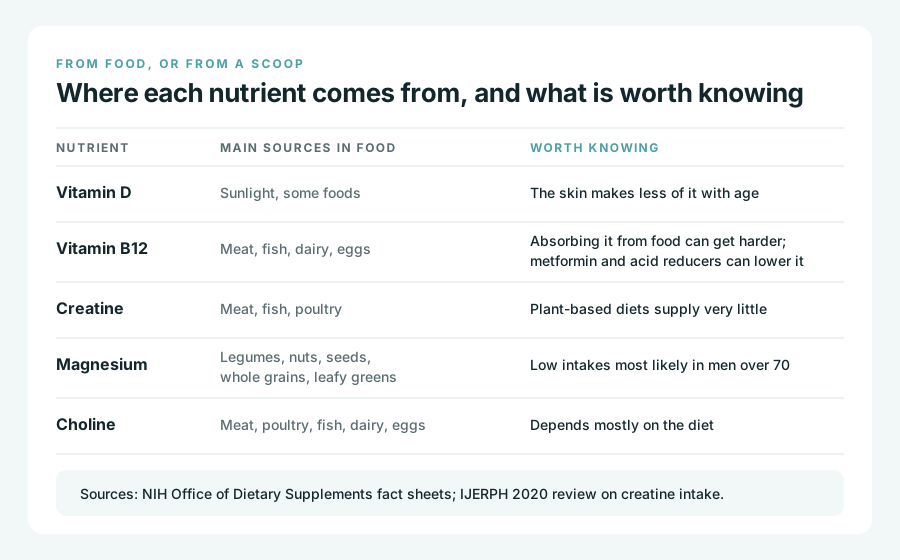
Two patterns stand out. Three of the five come mostly from animal foods — B12, choline and creatine — so how much you get depends heavily on how much meat, fish, eggs and dairy you eat. And two are affected by age itself, regardless of diet: the skin makes less vitamin D, and many people absorb less of the B12 in their food.
The Comparison
Read across a row rather than down a column. Food, a combined scoop and single-nutrient bottles are not rivals — each one covers the same nutrients in a different way.
| Criteria | MemoryFuel scoop | From food | Single-nutrient supplements |
|---|---|---|---|
| What you get | D3, B12, magnesium, choline and creatine in one drink | All five, in amounts that depend on what you eat | One nutrient per bottle |
| Vitamin B12 | Included, as methylcobalamin | Meat, fish, dairy, eggs; absorbing it from food can get harder with age | Sold on its own |
| Vitamin D | Included, as cholecalciferol | Mainly sunlight, plus some foods; the skin makes less with age | Sold on its own |
| Creatine | Included, as creatine monohydrate | Meat, fish and poultry; very little in plant-based diets | Sold on its own |
| Amount of each nutrient | Not published | Varies with the diet | Stated on each label |
| Daily routine | One scoop in 6–8 oz of water | The meals you already eat | One product per nutrient |
| Cost per day | $1.63 to $2.30, by package | Part of the grocery bill | Varies by product |
| Guarantee | 90 days, money back | Not applicable | Varies by maker |
| Where to buy | Official site → | Widely available | Widely available |
Prices are the maker's list price at the time of writing and change without notice. Every link goes through our own redirect and lands on the maker's official site.
Whatever the source, ask your prescriber before starting a supplement if you take any prescription, and mention creatine and magnesium specifically if you have kidney disease.
When Food Covers It
Food is always the first place to look, and for some people it does the whole job. If you eat meat, fish, eggs or dairy regularly, get outdoors often, and a blood test shows healthy B12 and vitamin D, your diet is already supplying much of what is in the tub. That is worth knowing, and a good conversation to have with your doctor.
When A Daily Scoop Makes Sense
- You are over 50. US dietary guidance advises adults over 50 to get most of their vitamin B12 from fortified foods or supplements, because absorbing it from food gets harder with age.
- You eat little meat or fish. Creatine in the diet comes from those foods, and a 2020 review found lower creatine stores in vegetarians.
- You spend most of your day indoors. Vitamin D depends mainly on sunlight, and the skin makes less of it with age.
- You would rather have one routine than several bottles. A single scoop in water covers all five nutrients at once.
When Single-Nutrient Supplements Make Sense
If a blood test has shown a specific deficiency and your doctor has prescribed a measured dose of that nutrient, follow that plan — a stated amount of one nutrient is what the prescription is for. A combined formula like MemoryFuel is aimed at a different situation: someone who wants the everyday nutrients, several of which tend to run low later in life, together with creatine, in one daily habit.
Which One Fits Which Situation
- If your diet is varied and your blood tests are healthy, food is already doing much of the work.
- If your doctor has prescribed a dose of one nutrient, that single supplement comes first.
- If you are over 60, eat little meat or fish, or spend little time outdoors, and want creatine alongside the everyday nutrients, a daily scoop is built for exactly that.
- If you are unsure, the 90-day guarantee gives you three months to decide.
See the MemoryFuel packages on the official site
Frequently asked
Can I get these nutrients from food instead?
All five come from ordinary food: vitamin B12, choline and creatine from meat, fish, dairy or eggs; magnesium from legumes, nuts, seeds, whole grains and leafy greens; and vitamin D mainly from sunlight. How much you actually get depends on your diet, how much time you spend outdoors and, for B12, how well you absorb it. Food always comes first; a supplement is a way to fill a gap.
Why does B12 from a supplement matter more after 50?
Absorbing the vitamin B12 that is naturally bound up in food gets harder with age for many people. For that reason, US dietary guidance advises adults over 50 to get most of their B12 from fortified foods or a supplement, as summarised by the NIH Office of Dietary Supplements.
I eat little meat or fish. Does that affect creatine?
Yes. Creatine in the diet comes from meat, fish and poultry, and a 2020 review found that vegetarians tend to have lower creatine stores in their muscles than people who eat meat. The body also makes some creatine of its own, but the dietary part comes almost only from animal foods.
Should I get a blood test before starting?
It is a good idea, and simple to ask for. A blood test can show whether you are low in vitamin B12 or vitamin D, which tells you and your doctor where you are starting from. If a deficiency turns up and your doctor prescribes a specific dose, follow that first. If you have kidney disease, ask about creatine and magnesium before starting.
References
- Vitamin B12: Fact Sheet for Health Professionals — NIH Office of Dietary Supplements — 2025
- Vitamin D: Fact Sheet for Health Professionals — NIH Office of Dietary Supplements — 2025
- Benefits of Creatine Supplementation for Vegetarians Compared to Omnivorous Athletes: A Systematic Review — International Journal of Environmental Research and Public Health — 2020
- Choline: Fact Sheet for Health Professionals — NIH Office of Dietary Supplements — 2022
- Magnesium: Fact Sheet for Consumers — NIH Office of Dietary Supplements — 2021
Disclosure
All content is for informational purposes only and is not a substitute for professional medical advice, diagnosis, or treatment. Each product covered is a dietary supplement, not a prescription drug, and statements about it have not been evaluated by the U.S. Food and Drug Administration. Results vary with individual health status, consistency of use, and lifestyle. This page contains affiliate links — if you buy through them we may earn a small commission at no additional cost to you. Read our disclosure and our editorial policy.