
How Brain C-13 Compares
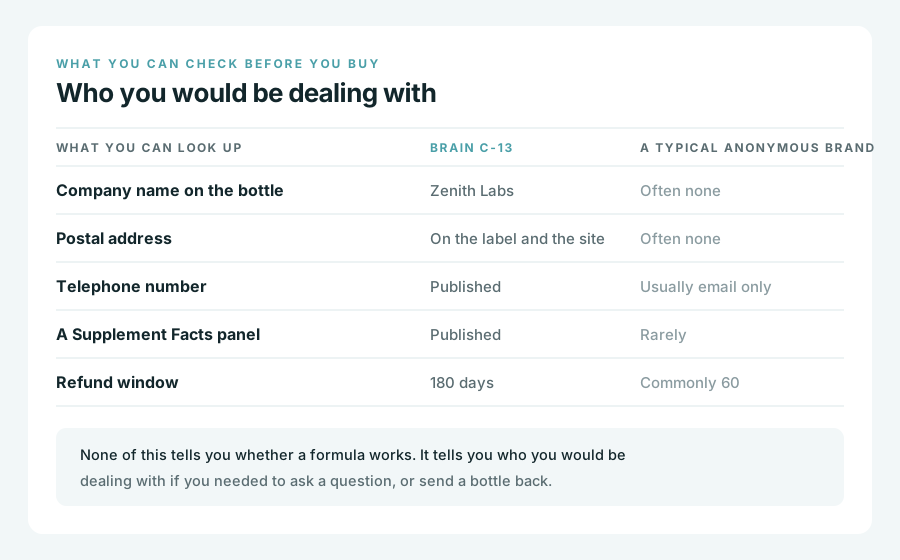
The useful comparison here is not ingredient against ingredient. It is how much you can find out about who you are buying from before you spend anything.
Quick answer
Brain C-13 comes from a company with a name, an address, a telephone number and a published Supplement Facts panel — which is unusual for a supplement sold this way. That does not make the formula work. It changes what happens after you buy: who you can ask, and where you can send a bottle back.
Most comparisons in this category set one ingredient list against another. This one is different, because of a fact from the review page that has nothing to do with the formula: Brain C-13 comes from a company you can look up in full — name, address, telephone and a published Supplement Facts panel.
So the useful question is not which blend is stronger. It is how much you can find out before you spend anything, and what that is actually worth.
What It Is Worth, Stated Carefully
Start with what it is not, so the rest can be trusted. None of this is evidence that the formula works. A company with a phone number can sell you something that does nothing for you. An anonymous brand can sell you something well made. Being able to look up a seller is not a clinical finding and this page will not dress it up as one.
What it changes is everything on the other side of the purchase. If the capsules disagree with you, there is a number to call. If the panel on the bottle is not what you expected, there is a published address to send it to. If you want to know what changed between formula versions, there is a company that can be asked. Those are small things until the day you need one.
The Comparison
Read across a row rather than down a column. There is no score here and no order of merit — each cell describes what that route gives you.
| Criteria | Brain C-13 | An anonymous online brand | A pharmacy shelf brand | Single ingredients |
|---|---|---|---|---|
 | ||||
| Company name on the bottle | Zenith Labs | Often none | Yes | Yes |
| Address and telephone | Both published | Often neither | Both published | Both published |
| A Supplement Facts panel | Published | Rarely | On the box | On the box |
| Amounts you can check | On the published panel | Usually none | Yes, as standard | Yes, as standard |
| Where you buy it | The maker’s funnel, via ClickBank | The maker’s funnel | A shop or a pharmacy | Almost anywhere |
| Refund window | 180 days | Commonly 60 | Shop policy | Shop policy |
| Somewhere to send a bottle back | A published returns address | Varies | The shop | The shop |
| Typical cost per day | $1.10 to $1.97 | Often $1.60 to $2.60 | Varies | Varies |
| Where to buy | Official site → | Sold everywhere | Sold everywhere | Sold everywhere |
Prices are the maker's list price at the time of writing and change without notice. Every link goes through our own redirect and lands on the maker's official site.
Whatever you buy, ask your prescriber before combining it with a prescription, and take the bottle so they can read the panel themselves.
What Brain C-13 Brings That An Anonymous Brand Does Not
- A panel with numbers on it. Naming ingredients without amounts is normal in this aisle and permitted. Publishing the quantities and the standardisations is not, and it is the difference between a list you can research and a list you can only read.
- Someone to contact. A company name, a postal address and a telephone number, all on the label rather than buried in a terms page.
- Six months rather than two. A 180-day window is long enough to give the ingredients the time their trials actually ran for — which almost no 60-day guarantee is.
- $1.10 a day at the six-bottle tier, with shipping included in the US.
What The Other Routes Bring That This Does Not
The other side deserves the same care, because this page is not here to talk you into anything.
A pharmacy shelf lets you read before you pay. The panel is on the box in your hand, and you can put it back. With anything sold through a funnel — this one included — you read the panel after it arrives, which is a real difference however good the refund policy is.
Single ingredients let you match a trial exactly. If you want 300 mg of standardised bacopa and nothing else, you can buy precisely that, run it for twelve weeks, and know what you took. No multi-ingredient formula can offer that, and no amount of company transparency substitutes for it.
Which One Fits Which Situation
- If being able to look up the seller matters to you, this is the one product here that answers that question, and the refund window backs it up.
- If you want to read the panel before paying, a pharmacy shelf is the only route that allows it, and that is a reasonable thing to insist on.
- If you want to match a published trial exactly, buy the single ingredient at the amount the trial used.
- If what you want is the combination — citicoline, bacopa and phosphatidylserine in one routine rather than three — then this is a combination that also tells you, in full, who made it.
See Brain C-13 on the official site
Frequently asked
Does a named company mean the supplement works better?
No, and it would be dishonest to suggest it. A company with an address and a phone number can sell you something that does nothing, and an anonymous one can sell you something well made. What being able to look up the seller changes is the part after you click buy: whether there is a person to ask, a panel to read, and an address to post a bottle to. Those are real, and they are separate from whether the formula does anything.
Why does almost nobody in this category publish a Supplement Facts panel?
Because a proprietary blend does not have to. Naming the ingredients without the amounts is permitted, and it protects a formula from being copied — which is the reason makers usually give. The cost is that nobody outside the company can line the product up against published research. Brain C-13 publishing a panel is the exception here rather than the rule, and it is worth saying plainly.
Is a pharmacy brand a better bet than either?
For checking what you are taking, a shelf product is the simplest route: the panel is on the box before you pay, and you can put it back. What it does not usually give you is a six-month refund window, or a formula built around compounds like citicoline and bacopa at studied amounts. Different things, and which matters more depends on what you are trying to do.
Can I take any of these with prescription medication?
Ask your prescriber before combining, and take the bottle with you so they can read the panel themselves. For this formula, turmeric is worth raising if you take a blood thinner, and huperzine A — if the version you receive contains it — matters if you take a cholinesterase inhibitor or medicine for glaucoma or heart rhythm.
References
- Citicoline and Memory Function in Healthy Older Adults: A Randomized, Double-Blind, Placebo-Controlled Clinical Trial — The Journal of Nutrition — 2021
- The effect of plant active substances on cognitive function in healthy older adults: a systematic review and network meta-analysis of randomized controlled trials — Frontiers in Pharmacology — 2025
- Effect of phosphatidylserine on cognitive function in the elderly: a systematic review and meta-analysis — 2022
- The effect of curcumin supplementation on cognitive function: an updated systematic review and meta-analysis — Frontiers in Nutrition — 2025
Disclosure
All content is for informational purposes only and is not a substitute for professional medical advice, diagnosis, or treatment. Each product covered is a dietary supplement, not a prescription drug, and statements about it have not been evaluated by the U.S. Food and Drug Administration. Results vary with individual health status, consistency of use, and lifestyle. This page contains affiliate links — if you buy through them we may earn a small commission at no additional cost to you. Read our disclosure and our editorial policy.