
Bacopa on Its Own or in a Blend: What It Is Usually Paired With
You have read about bacopa and you are ready to try it. The next question is practical: a bottle of bacopa on its own, or a formula that pairs it with other compounds? Here is what each route has behind it.
Quick answer
Most bacopa research tested it on its own: about 300 mg a day of a standardized extract for 12 weeks, with mixed results. Only a few trials tested bacopa inside a mix, and each result belongs to that exact mix. A single ingredient gives you a known amount; a formula gives you one routine. Two blends with bacopa follow below.
You did the reading. Bacopa kept coming up: an old herb, studied for memory, with real trials behind it. Then you went to buy some, and the shelf split in two. On one side, plain bacopa capsules. On the other, formulas with bacopa near the top of a longer list, next to names like phosphatidylserine and huperzine A.
You are still sharp at work, mostly. It is the name that will not come in a meeting, or the afternoon when the same paragraph needs a third read. You do not want to pay for ingredients you do not need. You also do not want to buy one ingredient, give it two months, and wonder if you picked the wrong half of the idea.
That is a fair question, and the research can answer part of it. The rest is a choice about how you like to take things, and this guide sets it out plainly.
Further down, we look at two blends that include bacopa: NovuBrain+ and NeuroZoom — each with a money-back guarantee.
What Did The Bacopa Trials Actually Test?
Nearly all of the evidence is about bacopa on its own. StatPearls, a clinical review on the National Library of Medicine’s bookshelf, describes the amounts used in trials as 300 to 450 mg a day of an extract, standardized for its active compounds, and notes that the studies showing cognitive benefits typically lasted 12 weeks.
It works on more than one pathway. The same review describes several proposed mechanisms, including effects on acetylcholine, a chemical messenger involved in memory: changes in its release, in the receptors that pick it up, and in the enzyme that breaks it down. That detail matters later, because it explains why formulas pair bacopa with the compounds they do.
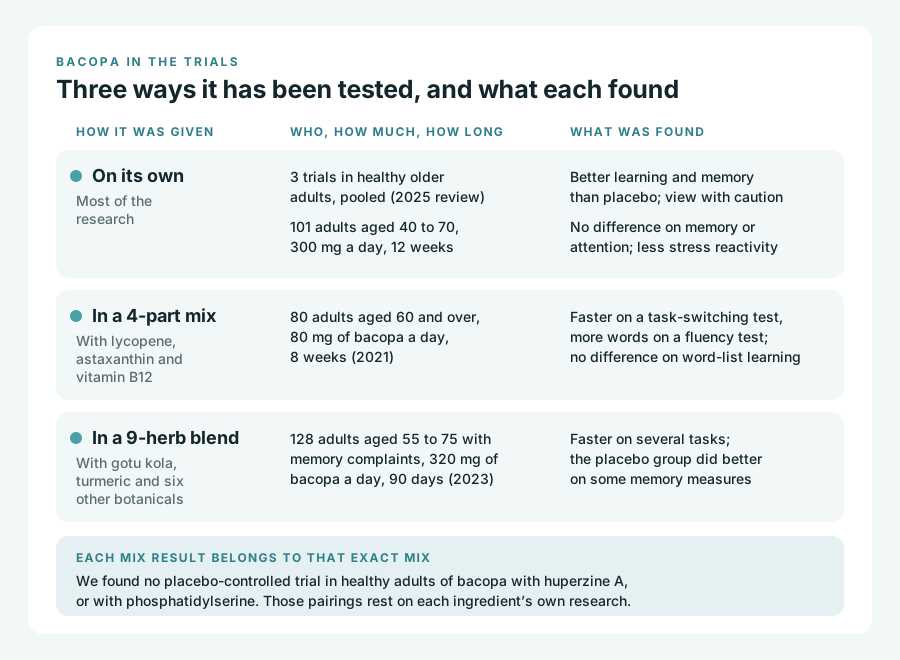
The results are mixed, and recent ones are honest about it. A 2025 network meta-analysis in Frontiers in Pharmacology pooled three trials of bacopa extract alone in healthy older adults and found better learning and memory than placebo; its authors add that the strength of the evidence should be viewed with caution. A 2025 trial in Clinical Drug Investigation gave 300 mg a day for 12 weeks to 101 adults aged 40 to 70 who reported memory and attention problems. It found no difference from placebo in verbal learning, attention or working memory, but the bacopa group reported greater reductions in stress reactivity and less fatigue after a demanding task.
The dose, the time of day and the side effects of bacopa alone are covered in our bacopa guide, so this page does not repeat them. The question here is what changes once bacopa sits in a formula.
What Should You Decide Before Choosing A Bottle?
Decide three things: whether you want to know the amount, whether you want to know what did what, and how many bottles you will keep up. None of them costs anything.
1. Do you want to know the amount?
The FDA explains that a Supplement Facts panel gives the amount of each dietary ingredient per serving, except for ingredients that are part of a proprietary blend. A single-ingredient bottle almost always states its bacopa amount, so you can set it beside the 300 mg the trials used. Many formulas do not state it. If matching the trial amount matters most to you, that settles it.
2. Do you want to know what did what?
If you start one ingredient and notice a change, you know where it came from. If you start several at once, you know the routine helped, but not which part. Some people care a great deal about that; others simply want the routine.
3. How many bottles will you actually keep up?
Bacopa was studied over 8 to 12 weeks of daily use. A routine you keep for three months tells you more than a better-planned one you drop in week three. Be honest about whether you would rather open one bottle each morning or several.
Which Bacopa Pairings Have Their Own Evidence?
A handful of trials have tested bacopa inside a mix rather than on its own. They are worth knowing in detail, because they show what a combination result does and does not tell you.
Bacopa with lycopene, astaxanthin and vitamin B12
The BLAtwelve study, published in Nutrients in 2021, gave 80 adults aged 60 and over, with no sign of cognitive problems, either a daily mix or a placebo for 8 weeks. The mix held 80 mg of bacopa extract, 100 mg of lycopene, 160 mg of astaxanthin and 6 micrograms of vitamin B12. The mix group got faster on a task-switching test, the study’s main measure, and named more words on a letter fluency test. There was no difference on learning and recalling a word list.
Two details are worth holding on to. The bacopa amount was well below the 300 mg of the single-ingredient trials. And the authors wrote that they could not tell whether the result came from the four compounds working together or from any one of them. The 2025 network meta-analysis counted this mix as its own entry and ranked it first for executive function and language among the plant substances it compared, from this single trial, with the same call for caution.
Bacopa inside a nine-herb blend
A 2023 trial in Frontiers in Nutrition gave 128 adults aged 55 to 75, who felt their memory had slipped, a blend or a placebo for 90 days. The blend held 320 mg of bacopa with gotu kola, turmeric, reishi, rosemary, cardamom, holy basil, green tea and seaweed. The blend group was faster on several attention and working-memory tasks. On some memory measures, the placebo group did better. No serious side effects were reported; loose stools and more frequent bathroom trips came up in the blend group.
What these two trials tell you
A combination can be tested, and when it is, the result is real for that combination: those ingredients, at those amounts, in those people. It does not transfer to a different mix, even one that shares bacopa. That is not a mark against formulas. It is simply where the evidence sits.
The pairings you see most often
On the shelf, bacopa is most often paired with two other compounds, each with its own reasoning.
- Huperzine A. Memorial Sloan Kettering describes it as slowing the enzyme that breaks down acetylcholine. Since bacopa is thought to act partly on the same messenger, pairing them follows a clear logic: two routes to one signal.
- Phosphatidylserine. One of the building blocks of brain-cell membranes, and a compound with a research line of its own. Our guide to phosphatidylserine or fish oil covers what that research measured.
We found no placebo-controlled trial in healthy adults that tested bacopa together with huperzine A, or with phosphatidylserine. So these pairings rest on how each ingredient works and on each one’s own research, which is the case for almost every formula on the market.
Should You Take Bacopa Alone Or In A Formula?
Put the research and the three questions together, and the choice comes down to what you value.
Bacopa on its own gives you a known amount you can line up with the trials, and a clean answer about what did what. It covers one compound, and if you later want to add phosphatidylserine or anything else, that is another bottle and another amount to track.
A formula with bacopa gives you several compounds, chosen to work on related pathways, in one routine and under one refund window. Formulas often print no amount for each ingredient, so you cannot line them up with a specific trial, and most have no published trial on their exact mix; neither of the two below does.
Neither is the clever choice. If you have started single bottles before and stopped halfway, one routine may be the more honest answer. If you want to check every number, a single ingredient is.
Which Formulas With Bacopa Could Fit One Routine?
If the one-routine side of that trade-off is where you land, two formulas on this site include bacopa, each arranged in its own way.
NovuBrain+ is two capsules with breakfast. It pairs bacopa, standardized for bacosides, with huperzine A, and phosphatidylserine with DHA omega-3, plus L-glutamine, DMAE and vitamin B12. The maker describes it as caffeine-free, and it is sold as a one-time purchase. Its comparison page sets it beside buying phosphatidylserine, DHA and huperzine A as separate bottles, which is this same question from another side.
NeuroZoom is a 35-ingredient formula. Roughly half the list is everyday vitamins and minerals; the rest is a nootropic group built around acetylcholine, with huperzine A, choline and DMAE, plus bacopa, phosphatidylserine and tyrosine, and six botanical extracts. The maker describes one bottle as a one-month supply. Its comparison page sets it beside a daily multivitamin.
Neither label publishes an amount for each ingredient, and the full reviews explain what each one does show.
Two formulas worth a closer look
Two blends that include bacopa
If one routine suits you better than several bottles, both of these put bacopa beside compounds chosen for related pathways — each with a money-back guarantee.
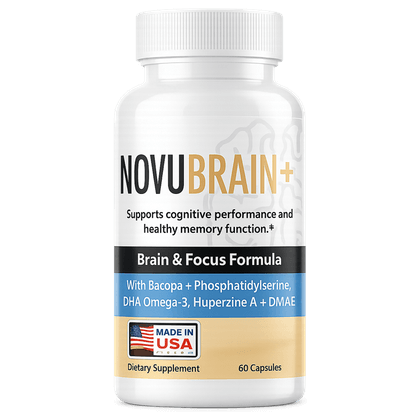
NovuBrain+
Capsules
Bacopa standardized for bacosides, paired with huperzine A, and phosphatidylserine paired with DHA omega-3: two capsules with breakfast, caffeine-free by the maker’s description.
- Readers who want several studied compounds in one routine
- Anyone avoiding caffeine and auto-ship
Covered by a 60-day money-back guarantee
Before you start · Huperzine A is worth naming if you take a beta-blocker, a calcium channel blocker or a prescription memory medicine; bacopa if you take thyroid medicine.
See NovuBrain+ on the official siteRead our NovuBrain+ review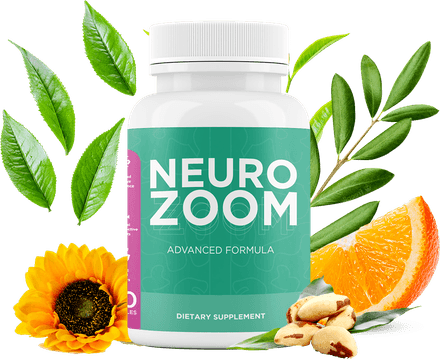
NeuroZoom
Capsules
Bacopa and phosphatidylserine inside a nootropic group built around acetylcholine, with huperzine A and choline, on top of a broad vitamin and mineral base.
- Readers not already taking a multivitamin
- Anyone wanting micronutrients and nootropics in one
Covered by a 60-day money-back guarantee
Before you start · Huperzine A is worth naming if you take a prescription memory medicine, medicine for glaucoma or anything for heart rhythm.
See NeuroZoom on the official siteRead our NeuroZoom reviewListed in no particular order. We publish no scores or rankings.
Who Should Check Before Starting?
A formula brings more than one ingredient to the conversation, so take the label, or a photo of it, to your pharmacist or doctor if any of these apply:
- You take thyroid hormone, or have a thyroid condition. StatPearls advises using bacopa cautiously, or avoiding it, in that case.
- You take a prescription memory medicine, such as donepezil, galantamine or rivastigmine. Memorial Sloan Kettering advises against combining huperzine A with them, and StatPearls notes that bacopa may add to the effects of cholinergic medicines.
- You take a beta-blocker or a calcium channel blocker. Memorial Sloan Kettering notes that huperzine A may lower heart rate with these medicines.
- You take a medicine that blocks dopamine, such as some antipsychotics. Memorial Sloan Kettering lists this interaction for huperzine A.
- You take an anticholinergic medicine. StatPearls notes that bacopa may reduce its effect.
The NovuBrain+ review also flags DHA for anyone on a blood thinner, and the NeuroZoom review explains why to bring your multivitamin label along. Not a complete list. Never stop, reduce or change a prescription to make room for a supplement.
When Should You See A Doctor?
If memory lapses start to get in the way of daily life or work, or feel like a real change from how you were, that is a conversation for an appointment rather than a supplement question. Losing a name now and then, or reading a paragraph twice on a long afternoon, is common.
MedlinePlus lists some of the things a doctor can look at, including prescription medicines and low vitamin B12, and notes that tests such as thyroid levels may be part of the checkup.
Ready to compare? Go back to the two blends above, or read the full reviews of NovuBrain+ and NeuroZoom.
Frequently asked
Is a brain supplement better than taking bacopa alone?
Not in any way research has settled. Most bacopa trials tested it alone, at about 300 mg a day of a standardized extract for 12 weeks. A few trials tested bacopa inside a mix, and their results belong to that exact mix. A single ingredient gives you a known amount; a formula gives you one routine with several compounds. Which suits you depends on what you want to be able to check.
What should I take with bacopa for memory?
Research has not named one best partner. The pairings with their own trials are specific mixes: bacopa with lycopene, astaxanthin and vitamin B12 in adults over 60, and bacopa inside a nine-herb blend in adults aged 55 to 75. Formulas often pair bacopa with huperzine A or phosphatidylserine for a reason you can follow, and we found no placebo-controlled trial of those pairs in healthy adults. Ask your pharmacist before combining anything with your medicines.
Is it better to stack nootropics or take one?
Each has a real advantage. One ingredient at a time tells you what, if anything, made a difference, and lets you match the amount a trial used. A formula keeps several compounds in one routine, which is easier to keep up for the weeks these ingredients were studied over. Stacking several single bottles on top of a formula adds up fast, so write one list and have a pharmacist look at it.
Can I take bacopa and phosphatidylserine together?
They appear together in several formulas, and we found no placebo-controlled trial of the pair in healthy adults, so research has not answered it either way. Bring both labels, or the formula label, and your medicine list to your pharmacist. StatPearls notes that bacopa calls for caution with thyroid medicine and with medicines that act on acetylcholine.
Can I take bacopa and huperzine A together?
Ask your prescriber first, especially if you take any regular medicine. StatPearls describes bacopa as acting partly on acetylcholine, and Memorial Sloan Kettering describes huperzine A as slowing the enzyme that breaks acetylcholine down. Memorial Sloan Kettering advises against combining huperzine A with prescription memory medicines such as donepezil, with beta-blockers or calcium channel blockers, and with medicines that block dopamine.
How long before I know if a bacopa formula is working?
Weeks, not days. The bacopa trials ran 8 to 12 weeks, and the two combination trials ran 8 weeks and 90 days. The honest window to judge a formula like this is 4 to 12 weeks. Decide before you start what you will pay attention to, and check in with yourself partway through.
What are the side effects of bacopa?
In the 2025 trial cited below, adults aged 40 to 70 took 300 mg of bacopa extract a day for 12 weeks. More of them reported side effects than people on placebo, mainly digestive complaints and headaches, and the authors reported no serious adverse reactions. If you are pregnant, take a regular prescription such as thyroid hormone or a memory medicine, or have surgery coming up, ask your doctor or pharmacist before starting. The section on who should check before starting lists the interactions to raise.
References
- Bacopa monnieri — StatPearls, NCBI Bookshelf — 2023
- The Effects of a Bacopa monnieri Extract (Bacumen®) on Cognition, Stress, and Fatigue in Healthy Adults: A Randomized, Double-Blind, Placebo-Controlled Trial — Clinical Drug Investigation — 2025
- The effect of plant active substances on cognitive function in healthy older adults: a systematic review and network meta-analysis of randomized controlled trials — Frontiers in Pharmacology — 2025
- Improvement of Executive Function after Short-Term Administration of an Antioxidants Mix Containing Bacopa, Lycopene, Astaxanthin and Vitamin B12: The BLAtwelve Study — Nutrients — 2021
- Chronic supplementation of a multi-ingredient herbal supplement increases speed of cognitive task performance alongside changes in the urinary metabolism of dopamine and the gut microbiome in cognitively intact older adults experiencing subjective memory decline: a randomized, placebo controlled, parallel groups investigation — Frontiers in Nutrition — 2023
- Questions and Answers on Dietary Supplements — U.S. Food and Drug Administration — 2026
- Huperzia serrata — Memorial Sloan Kettering Cancer Center, About Herbs — 2022
- Memory Loss — MedlinePlus Medical Encyclopedia — 2025
Disclosure
All content is for informational purposes only and is not a substitute for professional medical advice, diagnosis, or treatment. Each product covered is a dietary supplement, not a prescription drug, and statements about it have not been evaluated by the U.S. Food and Drug Administration. Results vary with individual health status, consistency of use, and lifestyle. This page contains affiliate links — if you buy through them we may earn a small commission at no additional cost to you. Read our disclosure and our editorial policy.