
NeuroPrime Drops Review: One Drop a Day, 365-Day Refund
A dropper bottle built on three of the most-studied compounds in this category, a 365-day guarantee, and no amounts published. Here is what you are actually buying.
Quick answer
NeuroPrime is a liquid dropper supplement built on nine botanicals, three of which — lion’s mane, bacopa and ginkgo — have real human trials on cognition. The serving is one drop a day. No amount is published for any ingredient, and the guarantee runs a full 365 days.
Try it with the full 365-day guarantee
It is usually a name that goes first. Someone you have known for years is standing in front of you, and for a second and a half there is simply nothing there. You talk around it. They never notice. You do.
Then it is the reason you came into the kitchen. Then it is a paragraph you have now read three times without owning a word of it. And somewhere along the way you stopped saying it out loud, because spoken it sounds heavier than it actually feels.
If you have gone looking for something to do about it, you already know what the search returns. Pages promising reversal. Pages built to worry you into a decision by the third paragraph. You have learned to close the tab, and you were right to.
So this page does the slow and useful thing instead. It reads the label and tells you what is printed and what is not. It sets each named ingredient against the human research that actually exists. Then you decide — which is the part nobody has been letting you do.
1. What Is NeuroPrime Used For?
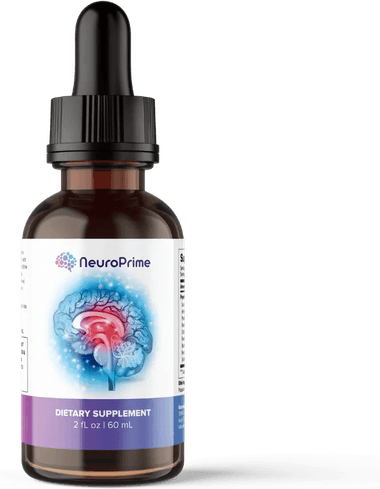
NeuroPrime is a liquid dropper supplement sold direct through the maker's own site, with ClickBank as the retailer handling the transaction and the refunds. The format is the first thing worth noticing, and not a cosmetic detail: if capsules are difficult for you, or you already take several a day and would rather not add another, a drop stirred into your morning coffee is a materially different proposition. Section two of the comparison page takes that apart properly.
The maker describes it as a blend of hard-to-source plant ingredients, stimulant-free and plant-based, designed to support memory function. That is their framing, reported here as their claim. What makes the bottle worth a closer look is not the framing — it is the ingredient list, which section four gets to.
2. What Is In NeuroPrime?
We start here on every product, because it is the document you would read if you could pick the bottle up in a shop. The sales page names nine ingredients, and publishes an amount for none of them.
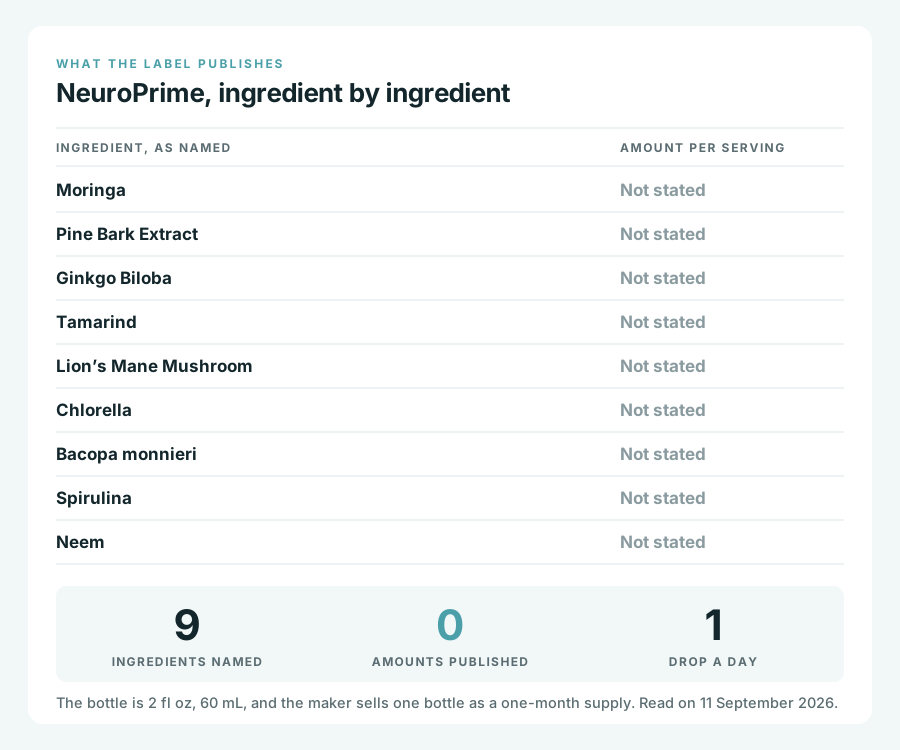
Two things the label does give you, and both are more useful than they look. The bottle is 2 fl oz, 60 mL, and the serving is one drop a day — a very simple routine to keep. The maker sells a single bottle as a one-month supply, and that is what makes a cost per day calculable in section seven.
What you cannot do is check the amounts against the published research, and with bacopa and ginkgo in particular the amount is much of the question. That is a plain statement of what is and is not verifiable before you spend, and plenty of well-made supplements are sold exactly this way.
3. What Does The Research Say About The Ingredients In NeuroPrime?
Nine ingredients, and the human research behind them is uneven — which is true of every formula in this aisle. Grouping them by how much evidence exists is more useful than taking them in the order the page lists them.
Bacopa monnieri — the best-defined of the nine
Bacopa has been through multiple randomised controlled trials and meta-analyses. A 2025 network meta-analysis of randomised trials in healthy older adults ranked a bacopa compound among the top plant substances studied for executive function and language function. The amount those trials converged on is 300 mg a day, over eight to twelve weeks.
The picture is not unanimous, and it would be dishonest to present it as one. A 2025 trial in 101 adults aged 40 to 70 with self-reported memory and attention problems found no greater cognitive improvement than placebo at that same 300 mg over twelve weeks, though it did report effects on stress and fatigue. That is a real body of evidence with real disagreement inside it, which is more than most ingredients in this aisle can claim.
Ginkgo biloba — positive, with a condition attached
Ginkgo has genuine positive trials, and the reviews attach a condition to them: the effect was shown convincingly at 240 mg a day of standardised extract, taken for 22 weeks or longer, and even then reviewers describe the effects as modest. Both halves of that condition matter — the amount and the duration.
Lion’s mane — active research, not yet settled
Lion’s mane is the ingredient here with the most current research activity. A 2026 randomised, double-blind, placebo-controlled trial — posted as a preprint and not yet peer reviewed — in adults aged 40 to 75 with self-reported cognitive difficulty reported greater improvement in visual attention, working memory, sleep quality and mood than placebo. A separate acute study in healthy younger adults found no effect on global cognition from a single dose. Reviewers summarise the field as promising and built on small, short trials.
The remaining six
Moringa, French maritime pine bark, tamarind, chlorella, spirulina and neem have human literature of varying depth, largely on antioxidant and general wellness measures rather than on cognition specifically. And as with almost every finished formula sold direct, there is no published trial on this exact combination — everything above is evidence about ingredients.
4. How Is The NeuroPrime Formula Designed?
Put the nine side by side and the design logic is clear, and it is the most useful thing on this page.
This is a conventional, well-trodden nootropic panel in an unconventional format. Lion’s mane, bacopa and ginkgo are the three compounds a cautious formulator reaches for in this category, and they carry more human cognitive research behind them than anything else on the shelf. Around them sit six plant extracts with antioxidant literature. Nothing here is exotic, and nothing here is a compound invented for a sales page.
The second half of the design is the delivery. A blend of this kind is normally sold as capsules, often two or three a day. Here it is one drop, stirred into whatever you are already drinking. That is a deliberate choice about how the product fits into a life, rather than about what is in it.
Where the reasoning stops being established and becomes a hypothesis is the join between those two halves: whether the amounts delivered in a single daily drop match the amounts the trials used. The trials that produced the positive results ran on published doses — 300 mg of bacopa, 240 mg of standardised ginkgo — and this label publishes none, so the two cannot be lined up.
Which leaves a straightforward way to think about it. If capsules are a real obstacle for you, or if what has defeated you before was not the formula but the routine, then this bottle is built for exactly that problem — and the ingredients inside it are the ones with the most research behind them in the whole category.
See NeuroPrime and decide for yourself5. How Do You Take NeuroPrime, And When Would You Notice A Change?
The maker's instruction is one drop a day, preferably in the morning, taken directly or stirred into tea, coffee, juice or any other drink, with the bottle shaken first. Follow whatever the bottle itself states when it arrives.
On timing, the ingredients answer for themselves, and the answer is patience. Bacopa's trials ran eight to twelve weeks. Ginkgo needed 22 weeks or longer before an effect showed convincingly. Nothing here acts on the day you take it, and change in this category is the kind you notice looking back rather than in the moment.
This is where the guarantee becomes the practical point rather than a marketing line. At 365 days, the refund window is longer than every trial cited on this page. You would find out whether it does anything for you with months to spare — which is a materially different proposition from the 60-day windows that are standard in this aisle.
6. What Do Buyers Say About NeuroPrime?
Independently verifiable feedback is limited for this product, as it is for most supplements sold direct. This site publishes no score, no star rating and no review count for any product, and we do not reproduce testimonials we cannot stand behind.
What can be said fairly, and without a testimonial: for a dropper supplement the recurring practical questions are taste and whether the routine survives a busy week. Both are worth knowing about yourself before committing to a timescale measured in months, and neither requires anyone's story to establish.
What it does well
- Lion’s mane, bacopa and ginkgo — three ingredients with real human cognitive trials, in one bottle
- One drop a day, a very simple routine to keep
- A liquid dropper, for anyone who finds capsules difficult or already takes several
- A 365-day guarantee, longer than every trial cited on this page
- Stimulant-free, so it adds nothing to an afternoon that is already difficult
What to know before you buy
- No amount published for any of the nine ingredients
- The bottle is 2 fl oz, 60 mL, sold by the maker as a one-month supply
- No published trial on this exact combination
- A liquid botanical extract has a taste of its own, which is why the maker suggests mixing it
- Sold through the maker's own site, with ClickBank as retailer
7. How Much Does NeuroPrime Cost, And Is There A Guarantee?
Prices are the manufacturer's list prices at the time of writing and change without notice. We publish what a bottle costs and what a day costs. We do not publish savings claims and we do not reproduce countdown pricing.
| Package | Price per bottle | Per day | Shipping |
|---|---|---|---|
| 1 bottle | $69 per bottle | $2.30 | Shipping fee applies |
| 3 bottles | $59 per bottle | $1.97 | Free, US |
| 6 bottles | $49 per bottle | $1.63 | Free, US |
| Guarantee | 365 days, money back, handled by the manufacturer | ||
Per-day cost uses the maker's own framing of one bottle as a one-month supply.
Order Now on the official siteThe 365-day guarantee is the term the manufacturer publishes, and they handle it, not us. It deserves more than a skim, because it is what turns the months this research demands into something you can actually test rather than merely commit to. A full year is longer than the evidence window for every ingredient in the bottle.
8. Who Is NeuroPrime For?
A question about you rather than about the bottle, so we will answer it that way.
This is likely a good fit if capsules are a problem for you and a drop in your coffee solves it; if you want lion’s mane, bacopa and ginkgo together rather than buying three separate bottles; if what defeated you last time was keeping the routine rather than the formula itself; and if a full year to change your mind is what makes trying it tolerable.
Look elsewhere if you want to verify amounts against published trials before spending — this label does not allow it, and for bacopa and ginkgo the amount is much of the question; or if you take a blood thinner, an antiplatelet, thyroid medication or a sedative and have not yet raised ginkgo and bacopa with your prescriber.
And the case where the answer is neither: if the forgetting has been getting worse month over month, or someone close to you has mentioned it, the next step is an appointment rather than a bottle. No supplement on this site prevents, treats or reverses any condition.
If that sounds like you, see it here
Frequently asked
Does NeuroPrime publish how much of each ingredient it contains?
No. Nine ingredients are named on the sales page — moringa, pine bark, ginkgo, tamarind, lion’s mane, chlorella, bacopa, spirulina and neem — and no amount is published for any of them. The bottle is 2 fl oz, 60 mL, and the stated serving is one drop a day.
How do you take it, and does it taste of anything?
The maker’s instruction is one drop a day, preferably in the morning, taken directly or stirred into tea, coffee, juice or any other drink, with the bottle shaken first. A botanical extract in a liquid base generally has a taste of its own, which is why the maker suggests mixing it. If you take it in a drink, the taste question mostly settles itself.
How long before most people would notice anything?
Eight to twelve weeks at the earliest. That is the window the bacopa trials used, and ginkgo needed 22 weeks or longer before an effect showed convincingly. Nothing in this category acts on the day you take it. The 365-day guarantee outlasts every trial cited on this page, which is unusual and worth weighing properly.
Does NeuroPrime have side effects?
Nobody has published a trial on this exact formula, so the evidence comes from its ingredients one at a time. Bacopa: in a 12-week trial cited below, people on 300 mg a day reported more side effects than those on placebo — mostly digestive complaints and headaches, none serious. Lion’s mane: an eight-week study at 2 g a day, still a preprint, reported no adverse events. Ginkgo: the review cited below does not detail side effects. Pregnant, on a daily prescription medicine, or facing surgery? Ask your doctor first; the next question covers ginkgo and blood thinners.
Can I take it with my prescription medication?
Ask the person who wrote your prescription first. Ginkgo is the one to raise specifically if you take a blood thinner or an antiplatelet, and bacopa is worth mentioning if you take thyroid medication or a sedative. It is one short question at your next appointment, and worth asking before the first drop rather than after.
When should I speak to a doctor instead of trying a supplement?
If the forgetting is getting worse month over month, if other people have started noticing it, if it comes with confusion about time or place, or if it began suddenly, that is a clinical conversation and not a supplement question. Nothing on this page prevents, treats or reverses any condition.
References
- The Effects of a Bacopa monnieri Extract (Bacumen®) on Cognition, Stress, and Fatigue in Healthy Adults: A Randomized, Double-Blind, Placebo-Controlled Trial — Clinical Drug Investigation — 2025
- The effect of plant active substances on cognitive function in healthy older adults: a systematic review and network meta-analysis of randomized controlled trials — Frontiers in Pharmacology — 2025
- Ginkgo biloba: a leaf of hope in the fight against Alzheimer’s dementia — clinical trial systematic review, Antioxidants — 2024
- A randomized, double-blind, placebo-controlled study evaluating the impact of Hericium erinaceus (Lion’s Mane) on cognitive performance and subjective wellbeing — medRxiv (preprint, not peer reviewed) — 2026
- Acute effects of a standardised extract of Hericium erinaceus on cognition and mood in healthy younger adults — Frontiers in Nutrition — 2025
Disclosure
All content is for informational purposes only and is not a substitute for professional medical advice, diagnosis, or treatment. Each product covered is a dietary supplement, not a prescription drug, and statements about it have not been evaluated by the U.S. Food and Drug Administration. Results vary with individual health status, consistency of use, and lifestyle. This page contains affiliate links — if you buy through them we may earn a small commission at no additional cost to you. Read our disclosure and our editorial policy.