
NeuroPrime Drops vs Pills: How Do Memory Drops Compare?
The comparison here is not which formula is stronger. It is what a once-daily drop changes about keeping a routine for the months this category's evidence needs.
Quick answer
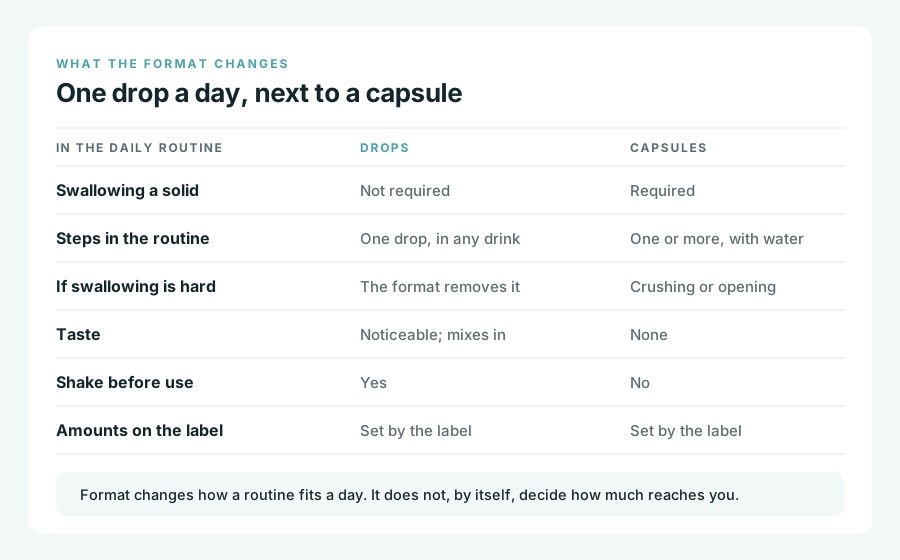
NeuroPrime arrives as one drop a day rather than a capsule. That changes whether you have to swallow anything, how many steps the routine has, and how likely you are to still be doing it in week ten. How much of a compound reaches you is a separate question, set by the formulation rather than by the format.
Most comparisons in this category set one formula against another. This one is different, because the interesting thing about NeuroPrime is not a compound nobody else has. It is that a conventional botanical panel arrives in an unconventional way.
So the useful question is not which product is stronger. It is what a once-daily drop actually changes about living with a supplement for the months this category's research demands — and what it honestly does not change at all.
What The Format Changes, And What It Does Not
Start with absorption, because it is the first thing most people wonder about. How much of a compound reaches you is set by the formulation — the extract, the carrier and the amount — rather than by the container it arrives in. There is no general rule that runs in either direction here: a well-made liquid and a well-made capsule can each deliver well, and the question is always about a specific product rather than about a format.
What the format does change is the part nobody puts on a label: whether the routine survives. The trials behind these ingredients ran eight to twelve weeks for bacopa and twenty-two weeks or longer for ginkgo. A regimen you keep for five months beats a better-specified one you abandon in week three, and that is not a marketing line — it is the arithmetic of a category where nothing works quickly.
The Part People Do Not Mention At Appointments
Trouble swallowing capsules is far more common than the quiet around it suggests. A 2023 systematic review in Pharmacy pooled the quantitative literature and found that across seven studies, between 10 and 34.2 per cent of patients reported difficulty swallowing solid oral dose forms. The most frequently reported workaround was crushing the tablet, followed by splitting it and opening capsules.
Two honest caveats on that figure. Those studies were run in hospitals, nursing homes, rehabilitation and long-term care, so the numbers describe patients in clinical settings rather than the general public. And difficulty is not the same as impossibility — most people manage.
But the reason it belongs on this page is simple: if you are someone who has quietly been crushing tablets into yoghurt, or who has abandoned a supplement because adding a fourth capsule to the morning was one too many, then the format is not a detail for you. It is the whole decision.
The Comparison
Read across a row rather than down a column. There is no score here and no order of merit — each cell describes what that format involves.
| Criteria | NeuroPrime drops | Capsule blends | Single-ingredient capsules | Powders |
|---|---|---|---|---|
 | ||||
| What the daily step is | One drop, in any drink | One to three capsules with water | One capsule per ingredient | A scoop, measured and mixed |
| Swallowing a solid | Not required | Required | Required | Not required |
| Containers to run three compounds | One | One | Three | Three |
| Amounts printed on the label | Not stated here | Varies by product | Yes, as standard | Yes, as standard |
| Matching a published trial dose | Cannot be checked from the label | Depends on the label | Directly, if you want to | Directly, if you want to |
| Taste | Noticeable; mixes into a drink | None | None | Noticeable |
| Preparation | Shake the bottle | None | None | Measure and stir |
| Refund window here | 365 days | Varies by seller | Varies by seller | Varies by seller |
| Where to buy | Official site → | Sold everywhere | Sold everywhere | Sold everywhere |
Prices are the maker's list price at the time of writing and change without notice. Every link goes through our own redirect and lands on the maker's official site.
Whatever the format, the medication question is the same. Ask your prescriber before combining any of these with a prescription. Ginkgo is the one to raise with a blood thinner or an antiplatelet, and bacopa with thyroid medication or a sedative.
Why Keeping It Going Is The Variable Nobody Prices
Adherence to long-term regimens sits at roughly half in older adults, and simplifying the regimen is one of the few interventions that reliably moves that number. Nothing about that is specific to supplements — it is how people behave with anything taken daily for months.
Set that against what this category asks of you. Eight weeks before bacopa's trials reported anything. Twenty-two weeks before ginkgo's did. The gap between a product working and a product appearing not to work is very often the gap between week three and week twelve.
- One step instead of several. A drop in a coffee you were already making attaches to a habit that already exists.
- Nothing to swallow. If that was the obstacle, it is simply gone.
- One container rather than three. Three bottles is three chances to run out of one and quietly stop.
- A 365-day window. Longer than every trial cited here, which means the timescale the evidence needs is a timescale you can afford to test.
What The Other Formats Bring That A Drop Does Not
The other side deserves the same care, because this page is not here to talk you into anything.
A single-ingredient capsule gives you a number you can check. If a trial reports an effect at 300 mg a day over twelve weeks, you can buy 300 mg a day and run it for twelve weeks. That is the only route where the thing on your counter and the thing in the study are the same size — and no dropper bottle that withholds its amounts can offer you that.
Separate bottles also isolate the answer. Take one compound and something changes, and you know what changed it. Take nine together and a good outcome is genuinely useful but not attributable, which matters if you intend to keep going for years.
And capsules have no taste. A botanical extract in a liquid base does, which is why the maker suggests a drink rather than the tongue.
Which One Fits Which Situation
- If swallowing capsules is difficult, the dropper settles the question before any other argument gets a hearing.
- If you have abandoned a supplement halfway before, the simplest regimen is the honest choice. One drop and a year to decide is built for how people actually behave rather than how they intend to.
- If you want to match the trials exactly, buy the single ingredients at published amounts. It is the only route where you can verify what you are taking.
- If you already take several capsules a day without minding, the format argument does not apply to you, and the decision comes back to the ingredient list on the review page.
See NeuroPrime on the official site
Frequently asked
Do drops absorb better than capsules?
There is no general rule in either direction. How much of a compound reaches you is set by the formulation — the extract, the carrier and the amount — rather than by whether it arrives as a liquid or inside a shell, so it is a question about a specific product rather than about a format. What the format does change is how easy the routine is to keep, and in a category whose trials run for months, that is not a small thing.
How common is trouble swallowing capsules?
More common than most people assume. A 2023 systematic review in Pharmacy found that across seven studies, between 10 and 34.2 per cent of patients reported difficulty swallowing solid oral dose forms, and the most common workaround was crushing the tablet. Those figures come from hospitals, nursing homes and long-term care rather than the general public, so read them as an indication rather than a population rate — but if you have been quietly struggling, you are nowhere near alone.
Is one drop really enough, compared with a capsule?
That depends on what is in the drop, and this label does not publish amounts, so it cannot be answered from the outside. What can be said is that volume is not the measure — a concentrated extract in a small volume and a large capsule of diluted powder can carry very different amounts. The honest position is that neither format tells you the amount; only a label that prints it does.
Which format is better for sticking with it?
Whichever one you will still be doing in week ten. Adherence to long-term regimens sits around half in older adults, and simplifying a regimen is one of the few things that reliably improves it. If capsules are the reason your last attempt ended in a drawer, a single drop in your morning coffee removes that reason. If capsules have never bothered you, this argument does not apply to you at all.
References
- Adult Patients with Difficulty Swallowing Oral Dosage Forms: A Systematic Review of the Quantitative Literature — Pharmacy (Basel) — 2023
- Effects of medication adherence interventions for older adults with chronic illnesses: a systematic review and meta-analysis — Osong Public Health and Research Perspectives — 2022
- The effect of plant active substances on cognitive function in healthy older adults: a systematic review and network meta-analysis of randomized controlled trials — Frontiers in Pharmacology — 2025
- Ginkgo biloba: a leaf of hope in the fight against Alzheimer’s dementia — clinical trial systematic review, Antioxidants — 2024
Disclosure
All content is for informational purposes only and is not a substitute for professional medical advice, diagnosis, or treatment. Each product covered is a dietary supplement, not a prescription drug, and statements about it have not been evaluated by the U.S. Food and Drug Administration. Results vary with individual health status, consistency of use, and lifestyle. This page contains affiliate links — if you buy through them we may earn a small commission at no additional cost to you. Read our disclosure and our editorial policy.