
Lion’s Mane vs Bacopa After 60: What Each Was Tested For, Who Each Suits, and Taking Them Together
Both names come up whenever memory supplements do. They are different kinds of ingredient, tested for different things. Here is what each was studied for, and what is known about taking them together.
Quick answer
They were tested for different things. Bacopa’s trials in older adults mostly measured learning and recalling word lists over 12 weeks, with mixed results. A 2026 lion’s mane trial, not yet peer reviewed, measured attention, sleep and mood over 8 weeks. We found no trial of the two together, so bring both labels to your doctor. If you want to try one, two formulas that combine bacopa and lion’s mane are compared below.
You have probably seen both on the same shelf, and sometimes in the same bottle: bacopa, an herb, and lion’s mane, a mushroom. One friend mentions the first, an article praises the second, and some formulas simply put them together.
After 60, the useful question is less “which is better?” and more “which matches what I want, and what I already take?” The research can partly answer that — as long as you know what each ingredient was actually measured on.
Further down, we look at two formulas that combine bacopa and lion’s mane: NeuroPrime and CogniSurge — each with a money-back guarantee.
How Are Bacopa And Lion’s Mane Different?
Bacopa (Bacopa monnieri) is a creeping plant used in Ayurvedic medicine. StatPearls, a clinical review on the National Library of Medicine’s bookshelf, notes that its effects are believed to come mainly from compounds called triterpenoid saponins, and that it may inhibit the enzyme that breaks down acetylcholine, a chemical messenger.
Lion’s mane (Hericium erinaceus) is an edible mushroom used in East Asian cooking. Memorial Sloan Kettering Cancer Center notes that two groups of its compounds, hericenones and erinacines, crossed the blood-brain barrier and promoted nerve growth factor in preclinical studies — lab and animal research, not trials in people.
Different starting points led researchers to different tests. That is why the two are hard to rank against each other, and why this guide does not try.
What Was Bacopa Tested For?
In older adults, bacopa has mostly been tested on memory for words. Two earlier 12-week trials — one in 54 healthy adults aged 65 or older, the other in 98 healthy adults over 55 — reported better learning or recall of a word list than placebo.
Newer trials have been less clear. A 2021 trial in 28 adults over 55 found no better word recall than placebo after 12 weeks. A 2025 trial in 101 adults aged 40 to 70 with memory complaints found no difference in verbal learning, attention or working memory — though people taking bacopa reported lower stress reactivity, and less fatigue and stress after a demanding computer task.
A 2025 network meta-analysis of trials in healthy older adults found an advantage for bacopa on learning and memory, and its authors advised viewing the evidence with caution because the trials were short and of moderate size. How much to take, when, and which side effects to expect are covered in our bacopa guide; in short, the trials used about 300 mg of extract a day for 12 weeks, and its most common side effects are digestive.
What Was Lion’s Mane Tested For?
Lion’s mane has fewer human trials, most of them small, and the latest measured attention, working memory, sleep and mood. The most recent one we found was posted in April 2026 as a preprint on medRxiv, which means it had not yet been through peer review. It gave adults aged 40 to 75 with self-reported cognitive difficulty either 2 g a day of lion’s mane fruiting body and mycelium or a placebo, for 8 weeks; 109 people were included in the main analysis.
The lion’s mane group improved more than the placebo group on a visual attention and working memory task, and in their own daily ratings of sleep quality, morning restedness and mood. The authors reported no adverse events in the lion’s mane group.
The other trials are smaller still. A 12-week trial in Japan, in 31 healthy adults with an average age of about 61, found an improvement on a general cognitive screening test, but not on the word-pair or visual memory tests it also used. In younger adults, a 2023 pilot trial of 41 people aged 18 to 45 found faster performance on one attention test an hour after a single dose, and a trend toward lower stress after 28 days; a 2025 study of 18 people aged 18 to 35 found no overall effect on thinking or mood from a single dose.
A 2024 review in Neuroscience & Biobehavioral Reviews described the results of mushroom intervention studies as mixed, found some improvement in mood and cognitive function with lion’s mane in middle-aged and older adults, and called for larger studies.
Who May Each One Suit?
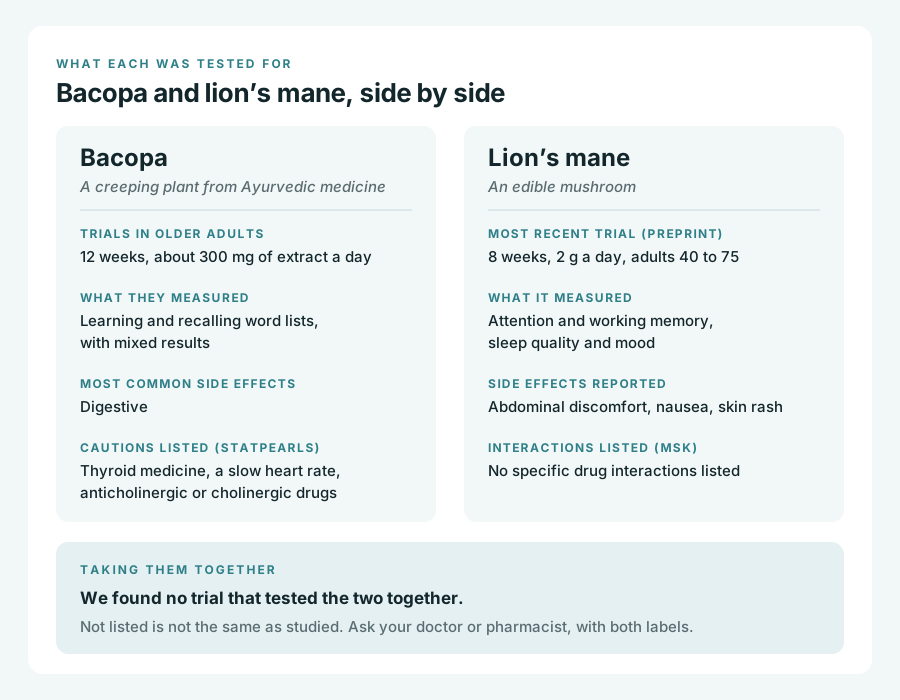
Each may suit a different concern, matched to what it was measured on, though neither treats or prevents any condition and we found no trial that compared them directly:
- If remembering new things you hear or read is your main concern, bacopa is the ingredient whose trials in older adults used word-list memory tests — with mixed results over 12 weeks.
- If attention, sleep quality or mood are part of the picture, the most recent lion’s mane trial measured those, over 8 weeks, in adults aged 40 to 75 — with the caveat that it has not yet been peer reviewed.
- If you take thyroid medicine, have a slow heart rate, or take anticholinergic or cholinergic medicines, bacopa is the one with specific cautions in StatPearls to raise first.
- If you have allergies, mention them: Memorial Sloan Kettering lists skin rash among the side effects reported with lion’s mane, and a 2025 systematic review in Frontiers in Nutrition notes that allergic reactions are possible.
Can You Take Them Together?
Some formulas combine bacopa and lion’s mane, including the two below. What reference sources say about the pair is limited, so it is worth being precise.
What the sources list. StatPearls lists cautions for bacopa with thyroid hormone, anticholinergic and cholinergic drugs, a slow heart rate, and medicines broken down by several liver enzymes. Memorial Sloan Kettering’s lion’s mane page lists no specific drug interactions, while reminding readers that herbal supplements can interact with some medications and affect how they work.
What they do not list. Neither source mentions an interaction between bacopa and lion’s mane, and we found no published trial that tested the two together. An interaction that is not listed is not the same as a combination that has been studied — this one has not been answered by research either way.
So the answer belongs with your doctor or pharmacist, with both labels in hand. The FDA notes that some supplements can change how a medicine is absorbed, broken down or cleared, and advises bringing a list of all your supplements and medicines to every health care visit.
Who Should Check Before Taking Bacopa?
Take the label, and your full list of medicines and supplements, to whoever manages your prescriptions. Raise it specifically if you:
- Take thyroid hormone medicine or have a thyroid condition. StatPearls notes that taking bacopa with thyroid hormone may result in too much thyroid hormone.
- Have a slow heart rate, a stomach ulcer, asthma or COPD, which StatPearls says bacopa may worsen.
- Take several prescription medicines. StatPearls notes bacopa inhibits several liver enzymes that break down medicines, which may change how some of them work. Our memory supplement checklist for people on several medicines covers that conversation step by step.
Never stop, reduce or change a prescription to make room for a supplement.
What Should You Look For Before You Buy?
If you have decided a formula is worth trying, these are the things to confirm before you order.
- The ingredient you are choosing, named on the label. Bacopa, lion’s mane, or both — so you know which research applies to you.
- An amount for each, or a company that will tell you. The trials used set amounts; if the label does not print them, ask the maker before you order.
- A routine you can keep for about 12 weeks. That is how long the bacopa trials in older adults ran, so judge a formula over months, not days.
- A guarantee that covers that time. Read the refund terms so a fair trial does not cost you if it does not suit you.
- A clear answer on your medicines. Bring the label to your pharmacist, especially if you take thyroid medicine.
Which Formulas Combine Both?
If you want both ingredients in one routine, two formulas on this site include them. NeuroPrime is a liquid taken as one drop a day, with bacopa, lion’s mane, ginkgo and six other botanicals; its comparison page looks at the drop format next to capsules and powders. CogniSurge is a stimulant-free capsule with bacopa and lion’s mane alongside gotu kola, schisandra and shilajit. Neither publishes the amount of each ingredient, which the full reviews explain.
Two formulas worth a closer look
Two formulas with bacopa and lion’s mane together
If you would rather not choose between them, both formulas combine the two — each with a 365-day money-back guarantee.
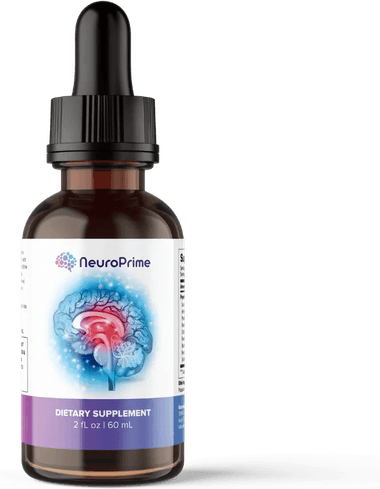
NeuroPrime
Drops
Lion’s mane and bacopa in one bottle, with ginkgo and six other botanicals, taken as one drop a day — directly or stirred into a drink, for anyone who finds capsules difficult.
- Readers who find capsules difficult
- One drop a day, in a drink you already have
Covered by a 365-day money-back guarantee
Before you start · Ginkgo matters with a blood thinner, and bacopa with thyroid medicine or a sedative.
See NeuroPrime on the official siteRead our NeuroPrime review
CogniSurge
Capsules
A stimulant-free capsule built on five traditional botanicals, with lion’s mane and bacopa alongside gotu kola, schisandra and shilajit. Two capsules a day.
- Readers who want to avoid caffeine
- Anyone who prefers capsules
Covered by a 365-day money-back guarantee
Before you start · Mention bacopa if you take thyroid medicine or a sedative.
See CogniSurge on the official siteRead our CogniSurge reviewListed in no particular order. We publish no scores or rankings.
When Should You See A Doctor About Memory Changes?
The National Institute on Aging suggests talking with a doctor if you notice changes in your memory, and lists signs that make it more pressing: asking the same questions over and over, getting lost in places you know well, having trouble following recipes or directions, or becoming more confused about time, people and places. It is normal to forget things once in a while.
The institute notes that medication side effects, sleep problems and low vitamin B12 are among the causes of memory problems a doctor can look for.
Ready to compare? Go back to the two formulas above, or read the full reviews of NeuroPrime and CogniSurge.
Frequently asked
Is lion’s mane or bacopa better for memory?
Neither has been shown to be better, because we found no trial comparing them. Bacopa’s trials in older adults tested memory for word lists over 12 weeks, with mixed results. Lion’s mane has fewer and smaller trials; the most recent, not yet peer reviewed, found more improvement than placebo on a visual attention and working memory task, and in ratings of sleep quality and mood, over 8 weeks.
Can I take lion’s mane and bacopa together?
Ask your doctor or pharmacist first, with both labels. The reference sources we checked do not list an interaction between the two, and we found no trial that tested them together — so the combination has not been answered by research either way. StatPearls lists cautions for bacopa with thyroid medicine and several other medicines.
Is lion’s mane safe for elderly people?
No source we checked assesses lion’s mane supplements in older adults specifically. Memorial Sloan Kettering lists abdominal discomfort, nausea and skin rash as side effects reported in a clinical study, and advises talking with your healthcare providers before taking lion’s mane supplements. In a 2026 trial in adults aged 40 to 75, not yet peer reviewed, no adverse events were reported with lion’s mane.
How long do lion’s mane and bacopa take to work?
The trials show the timescale that was studied, not a promise. Bacopa’s trials in older adults ran for 12 weeks. The most recent lion’s mane trial ran for 8 weeks, and a single dose in younger adults showed no overall effect on thinking or mood. Neither is something to judge after a few days.
Does lion’s mane interact with medications?
Memorial Sloan Kettering’s lion’s mane page lists no specific drug interactions, but notes that herbal supplements can interact with some medications and affect how they work, and advises talking with your healthcare providers before taking lion’s mane as a supplement. Bring the label and your full medicine list.
References
- Bacopa monnieri — StatPearls, NCBI Bookshelf — 2023
- Lion’s Mane Mushroom — Memorial Sloan Kettering Cancer Center, About Herbs — 2024
- A randomized, double blind, placebo controlled study evaluating the impact of Hericium erinaceus (Lions Mane) on cognitive performance and subjective wellbeing — medRxiv (preprint, not peer reviewed) — 2026
- Benefits, side effects, and uses of Hericium erinaceus as a supplement: a systematic review — Frontiers in Nutrition — 2025
- The Acute and Chronic Effects of Lion’s Mane Mushroom Supplementation on Cognitive Function, Stress and Mood in Young Adults: A Double-Blind, Parallel Groups, Pilot Study — Nutrients — 2023
- Acute effects of a standardised extract of Hericium erinaceus (Lion’s Mane mushroom) on cognition and mood in healthy younger adults: a double-blind randomised placebo-controlled study — Frontiers in Nutrition — 2025
- A review of the effects of mushrooms on mood and neurocognitive health across the lifespan — Neuroscience & Biobehavioral Reviews — 2024
- The Effects of a Bacopa monnieri Extract (Bacumen®) on Cognition, Stress, and Fatigue in Healthy Adults: A Randomized, Double-Blind, Placebo-Controlled Trial — Clinical Drug Investigation — 2025
- The Neurocognitive Effects of Bacopa monnieri and Cognitive Training on Markers of Brain Microstructure in Healthy Older Adults — Frontiers in Aging Neuroscience — 2021
- The effect of plant active substances on cognitive function in healthy older adults: a systematic review and network meta-analysis of randomized controlled trials — Frontiers in Pharmacology — 2025
- Mixing Medications and Dietary Supplements Can Endanger Your Health — U.S. Food and Drug Administration — 2022
- Memory Problems, Forgetfulness, and Aging — National Institute on Aging — 2023
Disclosure
All content is for informational purposes only and is not a substitute for professional medical advice, diagnosis, or treatment. Each product covered is a dietary supplement, not a prescription drug, and statements about it have not been evaluated by the U.S. Food and Drug Administration. Results vary with individual health status, consistency of use, and lifestyle. This page contains affiliate links — if you buy through them we may earn a small commission at no additional cost to you. Read our disclosure and our editorial policy.