
How to Compare Memory Supplements When Not Every Label Lists the Dose
You have bought a bottle before that did nothing, and now you read the back first. Here is how to compare two memory formulas line by line, what the trials used, and what a label can tell you even without the amounts.
Quick answer
Compare two memory supplements on four lines of the Supplement Facts panel: the serving size, the amount of each ingredient per serving, the form of each ingredient, and how that amount compares with what a trial used. When amounts are not printed, the form and the order still tell you something. Two formulas that show what is inside follow below.
You have done this before. A bottle with a good story on the front, a few months of capsules, and at the end of it, nothing you could point to. You are not angry about it anymore. You are just more careful.
So now you turn the bottle over first. And this is where it gets frustrating: one label lists a number beside every ingredient, another prints one total for a group of them, and a third names its ingredients with no numbers at all. You want to compare two formulas fairly, and the labels are not written in the same language.
This guide gives you one way to read them all, the same way every time. It will not tell you which bottle works. It will tell you exactly what you can check, and what you cannot, before you spend anything.
Further down, we look at two formulas that show you what is inside, each in its own way: Brain C-13 and MemoryFuel — each with a money-back guarantee.
Why Are Two Labels So Hard To Compare?
The differences you see on the back of the bottle come from the federal rules for supplement labels, 21 CFR 101.36. Knowing three of those rules makes every panel easier to read.
The normal rule is an amount for every ingredient. The regulation asks for the quantity by weight per serving of each dietary ingredient, printed beside its name or right after it. That covers vitamins and minerals, and it covers other ingredients such as plant extracts.
The exception is the proprietary blend. A group of ingredients can be printed under one name with a single figure: the total weight of the blend. The ingredients inside must still be named, and they must be listed in descending order of predominance by weight, heaviest first. Our guide to reading a proprietary blend walks through that order in detail.
The third rule is the form. The same regulation lets a label name the source of an ingredient in parentheses, after the word “as” or “from” — its own example is “Calcium (as calcium carbonate)”. For a plant, the label names the part of the plant used.
Put those together and a memory supplement label can sit in one of three places. It can print each amount, which lets you set each ingredient beside a study. It can print a blend total and an order, which gives you the scale and a ranking. Or it can name ingredients, often with their forms, without an amount you can read before buying.
Is a blend, or a label without amounts, a red flag? The rules allow both, and they are common across the whole market. A company can have more than one reason for printing a label a certain way, and none of those reasons can be read from outside the company. What you can read is what the label lets you check — and that is what the rest of this guide uses.
What Should You Do Before Comparing Any Bottle?
Three steps come before any label, and they cost nothing. They are also the steps that would have changed how the last bottle went for many people in your position.
1. Write down everything you already take
Prescriptions, a daily multivitamin, a calcium or vitamin D tablet, anything from the pharmacy shelf. Many memory formulas include vitamins and minerals, so part of a new bottle may already be on your counter. If you are weighing a formula that packs many ingredients into one bottle, our guide to all-in-one brain formulas shows how to spot the overlap.
2. Ask whether a B12 test makes sense for you
MedlinePlus, the National Library of Medicine’s health site, lists long-term use of metformin and antacids among the causes of low vitamin B12, along with a strict vegetarian diet, and lists problems concentrating among its effects. A blood test measures it. If a test shows you are low, that is a conversation with your doctor about the dose you need, before any formula.
3. Decide what question you are asking the label
There are two honest ways to buy. One is to match a dose you read about in research — for that, you need an amount for each ingredient. The other is to try a formula over a set period and see how you feel — for that, the form of the ingredients, the routine and the refund window matter more than the split. Knowing which buyer you are this time tells you which labels to keep reading.
How Do You Set A Label Beside The Trials?
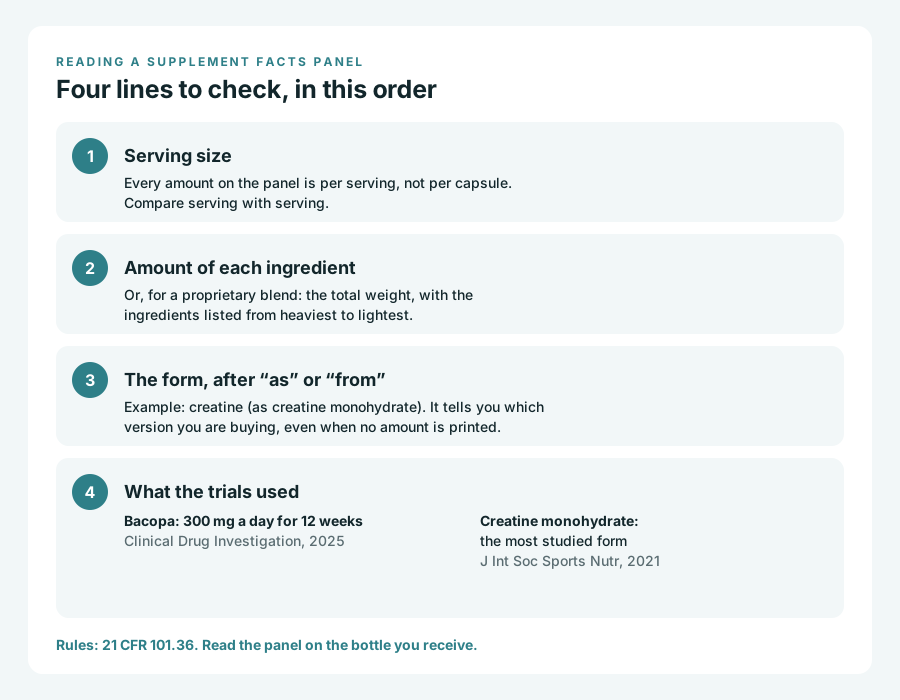
Set the label’s amount beside what human studies actually gave people, since a printed amount is only useful if you have something to compare it with. Here are two ingredients common in memory formulas, with what those studies used and found. None of these studies tested a finished formula.
Bacopa: 300 mg a day for 12 weeks
In a 2025 trial in Clinical Drug Investigation, 101 adults aged 40 to 70 with self-reported memory and attention difficulties took 300 mg of bacopa extract a day for 12 weeks, or a placebo. There was no difference between the groups on verbal learning, attention or working memory, the main questions. The bacopa group reported greater drops in stress reactivity, and less fatigue after a demanding mental task, with more stomach complaints and headaches. Our guide to bacopa after 60 covers its wider research.
Creatine: the form matters as much as the amount
A 2021 review in the Journal of the International Society of Sports Nutrition describes creatine monohydrate as the most extensively studied and commonly used form of creatine in supplements since the early 1990s, and found no published evidence that other forms raise the body’s creatine stores more. So when a label says “creatine (as creatine monohydrate)”, you know it is the form most of the research used.
How to set two panels side by side
With those numbers in hand, the comparison takes about a minute per bottle:
- Start with the serving size. Every amount on the panel is per serving. If one formula’s serving is three capsules and another’s is one, compare the servings, not the capsules.
- Match the units. Milligrams (mg) and micrograms (mcg) differ by a factor of a thousand. Read the unit before the number.
- Match the form. An amount of an ingredient in one form is not automatically comparable with the same amount in another. The words after “as” tell you which form you have.
- Then set the amount beside the trial. 300 mg of bacopa a day is the figure from the trial above. Write the label’s figure next to them, and you have your answer in plain numbers.
One more check belongs here, because it is easy to miss: read the panel on the bottle you actually receive, and compare it with the one you read online. Formulas are updated over time, and the bottle in your hand is the one you are taking.
What If No Amount Is Printed?
You still have three things on the page. Plenty of well-made formulas are sold without a per-ingredient amount you can read before buying.
The form of each ingredient. A label that says vitamin B12 as methylcobalamin, magnesium as magnesium glycinate, or creatine as creatine monohydrate tells you exactly which version of each nutrient you are getting. That lets you look the ingredient up, and lets a pharmacist answer questions about it.
The size of the daily serving. A powder states a net weight on the tub, and the maker states how long a tub lasts. Divide one by the other and you know roughly how much powder you take each day in total — not the share of any single ingredient, but the scale of the serving.
The order, if there is a blend. Heaviest first. An ingredient near the top of a blend makes up more of it than one near the bottom.
What you cannot do with that information is match a study dose. If that is the question you are asking, a label with an amount for each ingredient is the one that answers it. If your question is whether a formula fits your routine over a few months, the form, the format and the refund window carry more of the decision. Our guide to how long memory supplements take to work shows how to set that window.
What Should You Look For Before You Buy?
- A serving size you can live with. One scoop or three capsules a day are different routines. The trials above ran for 12 weeks, so the routine has to last that long.
- An amount per ingredient, if matching a study matters to you. It is the only way to set a label beside the 300 mg or 500 mg the trials used.
- The form after “as”. It tells you which version of each ingredient you are buying, whether or not an amount is printed.
- Every ingredient you need to raise with your doctor. Some plant compounds act on the body in ways that matter alongside prescriptions; see the section on who should check first.
- A refund window longer than your test. If you plan to judge at week 12, a guarantee that runs past it lets you decide on your own evidence.
Which Formulas Show You What Is Inside?
The two formulas below sit in different places on the scale this guide describes, and each one gives you something specific to read. They are not here to be compared with each other.
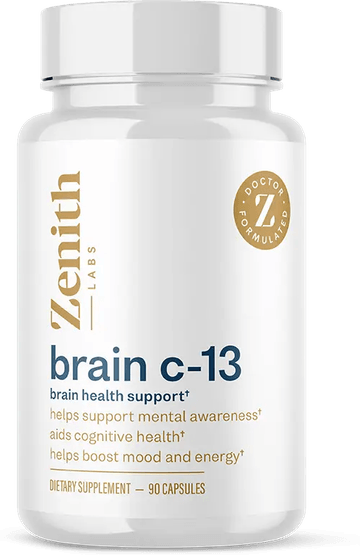
Brain C-13, from Zenith Labs, is sold with a published Supplement Facts panel with an amount for every ingredient: citicoline 250 mg, bacopa 300 mg, rhodiola 200 mg, phosphatidylserine 100 mg, turmeric 150 mg and rosemary 100 mg. Its bacopa figure is the same 300 mg the 2025 trial used; the 2021 citicoline memory trial used 500 mg. As its review explains, that panel states 60 capsules at two a day, while the bottle shown holds 90 capsules taken three a day, and the sales page also names saffron and huperzine A — so the panel appears to describe an earlier version. The practical step is the one in this guide: read the panel on the bottle that arrives. The company publishes its name, postal address and phone number, which its comparison page looks at in detail. The guarantee runs 180 days.
MemoryFuel, from Nutraville, is a powder that names the form of every ingredient: vitamin D3 as cholecalciferol, vitamin B12 as methylcobalamin, magnesium as magnesium glycinate, creatine as creatine monohydrate, and choline as dl-choline bitartrate. No amount is published for any ingredient. The tub states 224 grams and is sold as a one-month supply at one scoop a day in water, which works out to roughly 7.5 grams of powder a day by the maker’s numbers. Its comparison page sets each nutrient beside food and single supplements. The guarantee runs 90 days.
As with finished formulas generally, there is no published trial on either exact combination; the research above is research on ingredients.
Two formulas worth a closer look
Two formulas that let you read what is inside
If reading the label before you buy matters to you, each of these gives you something concrete to check — each with a money-back guarantee.
Brain C-13
Capsules
A published Supplement Facts panel with an amount for every ingredient — citicoline, bacopa at 300 mg, rhodiola, phosphatidylserine, turmeric and rosemary — from a company that prints its name, address and phone number.
- Readers who want numbers to set beside the trials
- Anyone who wants six months to decide
Covered by a 180-day money-back guarantee
Before you start · Huperzine A, if the version you receive contains it, and turmeric with a blood thinner are worth raising with your doctor.
See Brain C-13 on the official siteRead our Brain C-13 review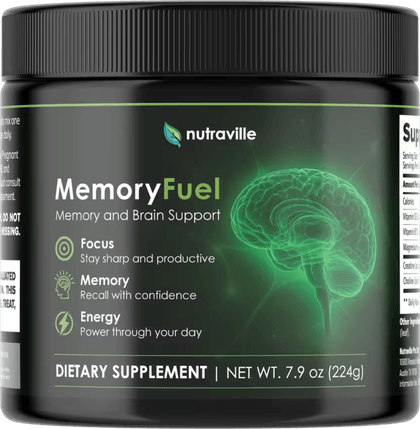
MemoryFuel
Powder
A daily powder that names the form of every ingredient — creatine monohydrate, methylcobalamin, magnesium glycinate, vitamin D3 and choline — stirred into a glass of water.
- Readers who want to know exactly which form they take
- Anyone who would rather drink than swallow capsules
Covered by a 90-day money-back guarantee
Before you start · Creatine and magnesium are worth raising if you have kidney disease or take certain antibiotics or osteoporosis medicine.
See MemoryFuel on the official siteRead our MemoryFuel reviewListed in no particular order. We publish no scores or rankings.
Who Should Check Before Starting?
Take the label, or a photo of the panel, to your pharmacist or doctor if any of these apply to you. A label with every amount makes that conversation shorter; a label without them makes the photo even more useful.
- You take a prescription memory medicine, a beta-blocker or a calcium channel blocker. Memorial Sloan Kettering describes huperzine A as an acetylcholinesterase inhibitor and advises avoiding it with acetylcholinesterase inhibitors such as donepezil, galantamine or rivastigmine, with calcium channel blockers or beta-blockers, and with medicines that block dopamine D2 receptors. The Brain C-13 review names huperzine A for the version you receive, if it contains it.
- You take a blood thinner. The Brain C-13 review names turmeric as worth mentioning. The NIH’s complementary health center advises talking with your health care provider before using any herbal product, because some herbs and medicines interact.
- You avoid soy. The Brain C-13 review notes that its published panel lists soy.
- You take doxycycline or alendronate. MedlinePlus advises taking products that contain magnesium 1 to 2 hours apart from doxycycline, and taking any supplement, vitamin or antacid at least 30 minutes after alendronate. The MemoryFuel review names magnesium for some antibiotics and osteoporosis medicines.
- You have, or are at risk of, reduced kidney function. A 2025 review in Frontiers in Nutrition found no kidney harm from creatine in healthy people, and advises close monitoring for people with or at risk of reduced kidney function. It also notes creatine can raise creatinine on a blood test without kidney damage — worth telling whoever orders your tests.
If you take several medicines, our checklist for several medicines shows what to bring. Never stop, reduce or change a prescription to make room for a supplement.
When Should You See A Doctor?
See a doctor when changes go beyond a slower name or a lost word now and then, which is common after 55. Book an appointment if changes in memory or thinking are getting worse month over month, if they came on suddenly, if they affect daily life, or if someone close to you has noticed them. That is a conversation for a clinician, not a label.
And if something changes after you start a new formula — a new symptom, or a reaction that begins when the bottle does — mention it to your doctor, with the panel in hand.
Ready to compare? Go back to the two formulas above, or read the full reviews of Brain C-13 and MemoryFuel.
Frequently asked
Are proprietary blend supplements a scam?
No. A proprietary blend is written into the federal labeling rules for supplements: the label gives the total weight of the blend and lists its ingredients from heaviest to lightest. It is common and legal. What it changes is what you can check: you cannot set each ingredient beside the amount a study used.
Can you trust a supplement that does not list every amount?
A missing amount tells you what you can and cannot verify, not whether a company is honest. Read what the label does give you: the form of each ingredient, the serving size, the total weight, and the order. Then decide whether matching a study dose matters to you, and look at the refund window if it does not.
How do I compare memory supplements by dose?
Put both panels side by side and check four lines in order: the serving size, the amount of each ingredient per serving, the form of each ingredient, and how that amount compares with what a trial used. For example, a 2025 bacopa trial used 300 mg a day for 12 weeks.
Is the amount on the panel per capsule or per serving?
Per serving. US labeling rules list the amount of each ingredient per serving, and the serving size is printed at the top of the panel. If a serving is two or three capsules, the amount shown is for all of them together, so one capsule holds a share of it.
What does the word "as" mean on a Supplement Facts panel?
It names the source or form of the ingredient. US labeling rules allow it in parentheses after the ingredient, such as "Calcium (as calcium carbonate)". For memory formulas it tells you, for example, whether creatine is creatine monohydrate, the form most studied since the early 1990s, according to a 2021 review.
How long should I take a memory supplement before judging it?
Plan on weeks, not days. The bacopa trial above ran for 12 weeks, and 4 to 12 weeks is a fair window to judge how a formula fits your routine. Note the guarantee length before you start and pick the week you will decide.
References
- 21 CFR 101.36 — Nutrition labeling of dietary supplements, Code of Federal Regulations (current text) — 2026
- The Effects of a Bacopa monnieri Extract (Bacumen®) on Cognition, Stress, and Fatigue in Healthy Adults: A Randomized, Double-Blind, Placebo-Controlled Trial — Clinical Drug Investigation — 2025
- Common questions and misconceptions about creatine supplementation: what does the scientific evidence really show? — Journal of the International Society of Sports Nutrition — 2021
- A short review of the most common safety concerns regarding creatine ingestion — Frontiers in Nutrition — 2025
- Huperzia serrata — Memorial Sloan Kettering Cancer Center, About Herbs — 2022
- Turmeric — NIH National Center for Complementary and Integrative Health — 2025
- Vitamin B12 deficiency anemia — MedlinePlus, National Library of Medicine — 2026
- Doxycycline — MedlinePlus Drug Information, National Library of Medicine — 2026
- Alendronate — MedlinePlus Drug Information, National Library of Medicine — 2026
Disclosure
All content is for informational purposes only and is not a substitute for professional medical advice, diagnosis, or treatment. Each product covered is a dietary supplement, not a prescription drug, and statements about it have not been evaluated by the U.S. Food and Drug Administration. Results vary with individual health status, consistency of use, and lifestyle. This page contains affiliate links — if you buy through them we may earn a small commission at no additional cost to you. Read our disclosure and our editorial policy.