
How Long Do Memory Supplements Take to Work After 60? How Long the Trials Ran, and When to Judge Yours
Three weeks in, it is easy to decide nothing is happening. Here is how long the research actually waited, ingredient by ingredient, and a simple way to judge your own routine.
Quick answer
Expect weeks to months, not days. In published trials, citicoline and most bacopa studies ran 12 weeks, lion’s mane up to 8 weeks, saffron 4 to 48 weeks, and a large multivitamin trial first tested memory after one year. Judge your own routine at weeks 4, 8 and 12 — and see a doctor if memory gets worse. If you want to try one, two formulas to give a fair trial are compared below.
Three weeks in, the bottle is a good way down and nothing feels different. Names still arrive late. The kitchen doorway still wipes the reason you walked through it.
It is natural to wonder whether you are wasting your time. Before you decide, it helps to know how long the researchers themselves waited before they measured anything. For most ingredients in memory formulas, it was a good deal longer than three weeks.
Further down, we look at two formulas to give a fair trial: Pineal Guardian X and Phytomem One — each with a money-back guarantee.
Why Is A Trial’s Length The Best Clue You Have?
A clinical trial sets its length in advance and tests people at fixed points. That makes the length a useful guide to patience — and a poor guide to promises.
Take COSMOS-Web, part of the large COSMOS trial. More than 3,500 adults over 60 took a daily multivitamin or a placebo and did memory tests at home at the end of each year, according to the National Eye Institute. The multivitamin group did better at the one-year test. No memory test came earlier, so the study cannot say what happened sooner.
A 2025 bacopa trial checked in more often. Its 101 participants answered questionnaires at weeks 4 and 8, and did their memory tests at the start and at week 12. The diary below borrows that rhythm.
A trial’s length tells you when researchers looked. It is not a promise of anything by then.
How Long Was Each Ingredient Studied?
Six ingredients with human trials, and how long those trials ran.
| Ingredient | How long the trials ran | Who took part | What they found |
|---|---|---|---|
| Multivitamin | 1 year to the main result; followed for 3 years | More than 3,500 adults over 60 (COSMOS-Web) | Better immediate recall than placebo at 1 year, and across the 3 years on average. Memory was first tested at the end of year one. |
| Bacopa | 12 weeks in most trials | Healthy adults; one 2025 trial in 101 adults aged 40 to 70 | A pooled analysis of studies lasting 12 weeks or more found better free recall, not other measures. The 2025 trial found no cognitive difference from placebo, and less stress reactivity. |
| Citicoline | 12 weeks | 100 healthy adults aged 50 to 85 with age-associated memory complaints | Episodic memory improved more than with placebo at 500 mg a day. Several authors worked for the maker of the citicoline tested. |
| Saffron | 4 to 48 weeks | 46 trials mixing healthy people and people with neurological or psychiatric conditions | More effective than placebo for cognition across the pooled trials, and well tolerated. |
| Creatine | 5 days to 24 weeks | 10 trials in healthy people, 8 pooled | Memory improved in adults aged 66 to 76; a corrected reanalysis found no significant effect across all ages. The trials were few and small, and their length did not change the result. |
| Lion’s mane | A single dose to 8 weeks | Adults 18 to 35 (one dose); 18 to 45 (28 days); 40 to 75 with self-reported cognitive difficulty (8 weeks) | No overall effect after one dose. The 8-week trial reported more improvement in attention, working memory, sleep and mood than placebo — a preprint not yet peer reviewed. |
Sources: American Journal of Clinical Nutrition 2023; StatPearls 2023; Clinical Drug Investigation 2025; Journal of Nutrition 2021; Phytotherapy Research 2024; Nutrition Reviews 2023; Frontiers in Nutrition 2025; Nutrients 2023; medRxiv 2026. None of these trials tested a formula sold on this site.
What Can’t The Table Tell You?
- A result is an average. Each finding describes a group compared with a placebo group. It cannot say how any one person will respond.
- The people differ. The creatine result was clearest in adults 66 to 76; the saffron trials mixed healthy people with people who had neurological or psychiatric conditions; the lion’s mane trials were mostly in younger adults.
- The amounts differ. The citicoline trial used 500 mg a day, the 2025 bacopa trial 300 mg, the 8-week lion’s mane trial 2 grams. A formula’s amount may differ, and some labels do not publish one.
- The multivitamin result belongs to the multivitamin tested. It is not evidence for any other product, including the formulas further down this page.
The National Institute on Aging also notes that some forgetfulness is a normal part of aging, such as occasionally misplacing things or forgetting to pay a bill. A single bad morning is a poor test.
How Can You Track Weeks 4, 8 And 12?
You need a note from before you start, a tick for each dose, and three dates in the calendar, not a test kit.
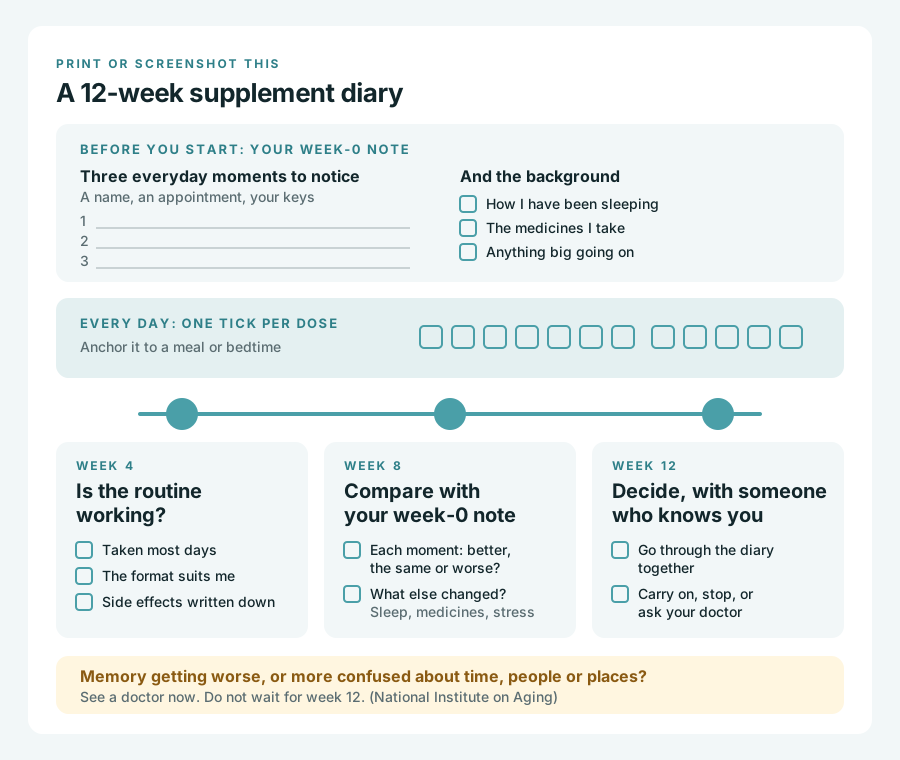
Before you start: your week-0 note
Write down three everyday moments you would like to notice — a name that slips, an appointment you nearly miss, keys you cannot find. Add how you have been sleeping, what medicines you take, and anything big going on. The National Institute on Aging lists medication side effects, sleep problems and stressful life events among the things that can affect memory, so they belong in the picture.
Every day: one tick
Consistency is the first thing the diary checks. The National Institute on Aging suggests using meals or bedtime as reminders, or charts, calendars and weekly pill boxes.
Week 4: is the routine working?
A check on the habit, not the result. Have you taken it most days? Does the format suit you? The National Institute on Aging advises writing side effects down so you can report them accurately.
Week 8: compare with your week-0 note
For each of your three moments, write “better”, “the same” or “worse”. Note anything else that changed — sleep, a new medicine, a stressful month.
Week 12: decide, with someone who knows you
Twelve weeks is the length the citicoline trial and most bacopa trials used. Go through the diary with someone close to you, then decide whether to carry on, stop, or ask your doctor.
What Should You Look For Before You Buy?
If you have decided a formula is worth trying, these are the things to confirm before you order.
- Ingredients whose trials ran for a known length. The table above tells you how many weeks to plan for before judging.
- A guarantee that outlasts those weeks. Check the refund window against the time you intend to test, and read how returns work.
- A daily routine you will really keep. Trials measured people who took their dose every day; a formula you forget cannot be judged fairly.
- A starting date and a diary. Write down the day you begin and use the week 4, 8 and 12 check-ins above.
How Does A Guarantee Fit The Timeline?
If you are choosing a formula, set its refund window against the diary.
Pineal Guardian X is a liquid dropper built on lion’s mane, bacopa and ginkgo. Its maker publishes a 365-day guarantee. That window runs past the week-12 checkpoint and past the length of the bacopa and lion’s mane trials in the table.
Phytomem One is a once-daily tablet that leads with saffron, whose trials ran 4 to 48 weeks. Its maker publishes a 60-day guarantee, and its smallest package — two bottles — lasts 60 days. That first order covers the week-4 and week-8 checkpoints: time to see whether the tablet and the routine suit you. Its review notes that three bottles reach twelve weeks.
Neither guarantee says anything about results. Read each review for what the label does and does not publish.
Two formulas worth a closer look
Two formulas to give a fair trial
Start the diary on day one, and set each money-back guarantee against the weeks you plan to test.
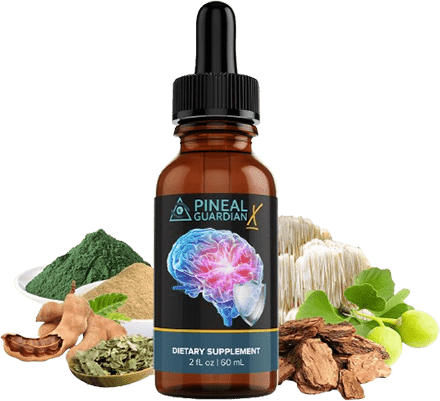
Pineal Guardian X
Drops
A liquid dropper built on lion’s mane, bacopa and ginkgo — ingredients studied over weeks to months — with a 365-day guarantee that runs past the week-12 checkpoint.
- Readers who want a full year to decide
- Anyone who finds capsules difficult
Covered by a 365-day money-back guarantee
Before you start · Ginkgo matters with a blood thinner, and bacopa with thyroid medicine or a sedative.
See Pineal Guardian X on the official siteRead our Pineal Guardian X review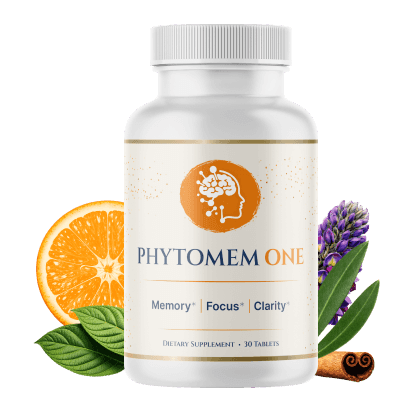
Phytomem One
Tablets
One tablet a day with food, led by saffron, whose trials ran 4 to 48 weeks. The smallest package lasts 60 days, matching the 60-day guarantee.
- Anyone who wants one tablet a day
- Readers whose doctor has mentioned blood sugar
Covered by a 60-day money-back guarantee
Before you start · Berberine and cinnamon matter with diabetes medicine; fucoidan and saffron with a blood thinner.
See Phytomem One on the official siteRead our Phytomem One reviewListed in no particular order. We publish no scores or rankings.
Who Should Check Before Starting?
Anyone taking the medicines below should raise them with a doctor or pharmacist first, because twelve weeks is a long time alongside your usual medicines:
- Blood thinners: ginkgo and fucoidan may increase bleeding risk with anticoagulants such as warfarin, according to the NIH’s complementary health center and Memorial Sloan Kettering.
- Thyroid hormone: a StatPearls review notes bacopa taken with thyroid hormone may lead to too much thyroid hormone.
- Diabetes medicine: the same NIH center says berberine may interact with some medicines, and cinnamon can cause unwanted side effects with diabetes drugs.
Phytomem One’s medicine-by-medicine page goes further. Never stop or change a prescription to make room for a supplement.
When Should You See A Doctor Before Week 12?
Do not wait for week 12. The National Institute on Aging advises talking with a doctor about noticeable changes in memory, and lists signs such as asking the same questions over and over, getting lost in places you know well, or becoming more confused about time, people and places. Bring your diary.
Ready to compare? Go back to the two formulas above, or read the full reviews of Pineal Guardian X and Phytomem One.
Frequently asked
How long does it take for memory supplements to work?
It depends on the ingredient. Citicoline and most bacopa trials ran 12 weeks, saffron trials 4 to 48 weeks, and a large multivitamin trial first tested memory after one year. A realistic plan is to take it consistently and judge it at weeks 4, 8 and 12, not in days.
How long does bacopa take to work?
Most bacopa trials ran 12 weeks, at 300 to 450 mg of extract a day, according to a StatPearls review. Results are mixed: a pooled analysis found better free recall, while a 2025 trial found no cognitive difference from placebo after 12 weeks.
How long does lion’s mane take to work?
The trials are short and small, from a single dose to 8 weeks. The 8-week trial, in adults 40 to 75, reported improvements in attention and sleep, but it is a preprint not yet peer reviewed.
Is it better to take brain supplements at night or in the morning?
Follow the label first. Cleveland Clinic notes that multivitamins are best taken with food, and vitamin B12 in the morning because it can be energizing. The National Institute on Aging suggests meals or bedtime as reminders. If you take other medicines, ask your pharmacist whether any need spacing.
References
- Multivitamin Supplementation Improves Memory in Older Adults: A Randomized Clinical Trial — The American Journal of Clinical Nutrition — 2023
- Multivitamin improves memory in older adults, study finds — National Eye Institute, NIH — 2023
- Bacopa monnieri — StatPearls, NCBI Bookshelf — 2023
- The Effects of a Bacopa monnieri Extract (Bacumen®) on Cognition, Stress, and Fatigue in Healthy Adults: A Randomized, Double-Blind, Placebo-Controlled Trial — Clinical Drug Investigation — 2025
- Citicoline and Memory Function in Healthy Older Adults: A Randomized, Double-Blind, Placebo-Controlled Clinical Trial — The Journal of Nutrition — 2021
- New horizons for the study of saffron (Crocus sativus L.) and its active ingredients in the management of neurological and psychiatric disorders: a systematic review of clinical evidence and mechanisms — Phytotherapy Research — 2024
- Effects of creatine supplementation on memory in healthy individuals: a systematic review and meta-analysis of randomized controlled trials — Nutrition Reviews — 2023
- Commentary: The effects of creatine supplementation on cognitive function in adults: a systematic review and meta-analysis — Frontiers in Nutrition — 2026
- Acute effects of a standardised extract of Hericium erinaceus (Lion’s Mane mushroom) on cognition and mood in healthy younger adults: a double-blind randomised placebo-controlled study — Frontiers in Nutrition — 2025
- The Acute and Chronic Effects of Lion’s Mane Mushroom Supplementation on Cognitive Function, Stress and Mood in Young Adults: A Double-Blind, Parallel Groups, Pilot Study — Nutrients — 2023
- A randomized, double-blind, placebo-controlled study evaluating the impact of Hericium erinaceus (Lion’s Mane) on cognitive performance and subjective wellbeing — medRxiv (preprint) — 2026
- Memory Problems, Forgetfulness, and Aging — National Institute on Aging — 2023
- Taking Medicines Safely as You Age — National Institute on Aging — 2022
- The Best Time to Take Vitamins — Cleveland Clinic — 2021
- Ginkgo — NIH National Center for Complementary and Integrative Health — 2025
- Diabetes and Dietary Supplements: What You Need To Know — NIH National Center for Complementary and Integrative Health — 2023
- Fucoidan — Memorial Sloan Kettering Cancer Center, About Herbs — 2026
Disclosure
All content is for informational purposes only and is not a substitute for professional medical advice, diagnosis, or treatment. Each product covered is a dietary supplement, not a prescription drug, and statements about it have not been evaluated by the U.S. Food and Drug Administration. Results vary with individual health status, consistency of use, and lifestyle. This page contains affiliate links — if you buy through them we may earn a small commission at no additional cost to you. Read our disclosure and our editorial policy.