
What a Proprietary Blend Actually Hides, and How to Read One Before You Buy
Two labels can carry the same 820 mg and tell you completely different amounts about what you are buying. Here is what the rules allow a company to leave out, the one clue the law still gives you, and how to decide with what remains.
Quick answer
A proprietary blend lists several ingredients under one name and publishes one total weight for the whole group, rather than an amount for each. It is legal, it is common, and it is not evidence of anything being wrong. What it costs you is specific: you cannot compare what is in the bottle with the dose a study used. The one clue the rules still give you is the order — ingredients must be listed from most to least by weight.
You turn the bottle over to do the sensible thing. You have read that a compound helps at a certain amount, and you want to know whether this bottle has that amount in it.
And the panel says: Proprietary Blend, 820 mg. Underneath, eight ingredients, no numbers. The question you came to answer cannot be answered.
That experience is so ordinary in this market that most people stop reading labels altogether. This article is the opposite of that: what the blend takes away, what it leaves behind, and how to use the part that remains.
What Is A Proprietary Blend In Supplements?
A proprietary blend is an exception in US labelling rules, which normally require a dietary supplement to list its ingredients and the amount of each one per serving. A group of ingredients can be presented as a blend under a name the company chooses, with a single figure for the total weight of the group.
Two conditions still apply, and both matter to you. Every ingredient in the blend has to be named. And they have to be listed in order of weight, from most to least.
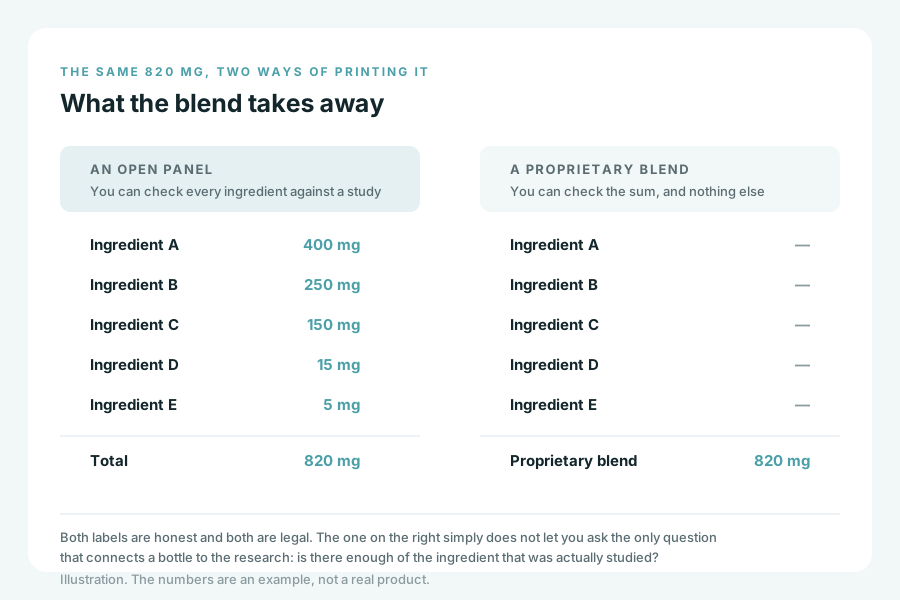
Look at the two columns. The total is identical. What changes is whether you can tell that ingredient D is 15 mg — and whether that matters depends entirely on what ingredient D is.
Why Do Companies Use Proprietary Blends?
There are two reasons, and it would be dishonest to give you only the unflattering one.
The first is competition. A fully published formula can be copied by anyone with a manufacturer and a website, and the company that paid to develop it has no way to stop them. That is a genuine commercial problem, and plenty of careful companies use blends for exactly this reason.
The second is cost. A blend can be built mostly from one inexpensive ingredient, with small amounts of the expensive ones whose names sell the bottle. Nobody has to admit to this, because the panel does not require it.
Here is the part worth holding on to: you cannot tell the two apart from the outside. Not from the label, not from the sales page, and not from any review, including this one. Anyone who tells you which kind of company you are looking at is guessing.
What Is The Most Useful Clue On A Blended Label?
The ordering rule is the most useful thing on a blended panel, and almost nobody uses it.
Ingredients inside a blend appear from most to least by weight. That is not a style choice; it is required. So the position of a name carries information even when its number does not appear.
Take a bottle sold on one hero ingredient. If that ingredient is printed first, it is the largest part of the blend by weight. If it is printed seventh of eight, it is one of the smallest — and a marketing photograph of that plant on the front of the bottle is doing a lot of work for a very small amount of it.
You still do not know the number. But "near the top" and "near the bottom" are real information, and they are free.
What Should You Check On A Blended Label?
Four things, in about a minute, before you spend anything.
1. Is there a Supplement Facts panel at all? Some pages name ingredients in marketing copy and publish no panel anywhere. That is a step further than a blend: not even the total is given.
2. Is there a total for the blend? A number for the group is more than nothing. It tells you the scale of what you are taking.
3. Where does the hero ingredient sit in the order? First or second is one thing. Last of ten is another.
4. What is the refund window? This is the one people skip, and for a blended formula it matters most. If you cannot verify the dose before you buy, the only real test is your own body over time — and the guarantee is what makes that test affordable.
What Does A Proprietary Blend Look Like On A Real Label?
The two formulas below show the two states this article describes, at different points on the scale; they are not here to be compared with each other.
One publishes a blend total and no split — you can see the scale of what you are taking, and not its composition. The other publishes neither. Both are ordinary; both are sold this way every day; and reading each one differently is exactly the skill this article is about. The full labels are in our AquaBurn review and our ElectroSlim review.
Two formulas worth a closer look
Two labels, two different amounts of information
Not a comparison between them — an illustration of the two states this article describes.
AquaBurn
Powder
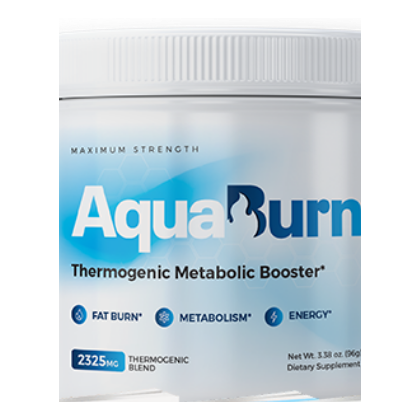
Publishes a total and not the split: 2325 mg of thermogenic blend, across nineteen named ingredients in two groups. You can see the scale of the dose; you cannot see how it divides.
- Readers who want at least a number to weigh
- Anyone who wants 180 days to test it on themselves
Covered by a 180-day money-back guarantee
Before you start · Nineteen ingredients inside one total means each one is a fraction of it.
See AquaBurn on the official siteRead our AquaBurn review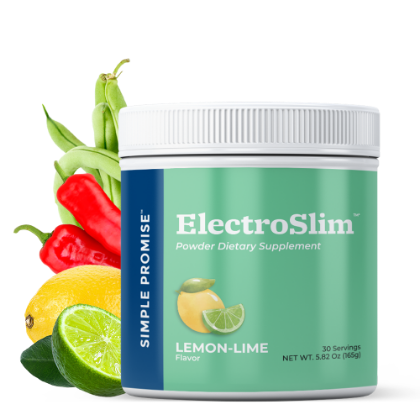
ElectroSlim
Powder
Publishes no amounts at all, but names three branded ingredients — which identifies the supplier and its research, even though not the dose in this scoop.
- Readers who value being able to look the ingredient up
- Anyone who wants a full year to change their mind
Covered by a 365-day money-back guarantee
Before you start · A branded ingredient tells you who made it, not how much of it is here.
See ElectroSlim on the official siteRead our ElectroSlim reviewListed in no particular order. We publish no scores or rankings.
When Should You See A Doctor?
A label you cannot fully read is a good reason to bring it to someone who can. The NIH Office of Dietary Supplements advises telling all of your health care providers about every supplement you take, and bringing the list to appointments, because supplements can change how a medicine is absorbed, processed or cleared.
With a blend that matters more, not less, for a plain reason: neither you nor your pharmacist can see how much of anything is in it. Bring the bottle, or a photograph of the panel. It takes the guesswork out of a conversation that is otherwise built on it.
And see a doctor rather than a label if something changes that you did not expect — new symptoms, or a reaction that starts when the bottle does.
What Does A Proprietary Blend Mean For Your Decision?
A proprietary blend is not a warning sign. It is a limit on what you can know, and limits are worth naming rather than resenting.
If you are shopping to match a dose from research, a blend makes that impossible, and you should buy something that publishes its numbers. If you are trying a formula to find out how you respond, the panel matters less than the refund window and the honesty of the page around it.
Both are sensible ways to buy. What is not sensible is paying for a bottle because a plant on the front looked impressive, without checking where that plant sits in the list.
Frequently asked
What is a proprietary blend?
A group of ingredients printed on a Supplement Facts panel under one name, with a single total weight for the whole group instead of an amount for each ingredient. US labelling rules allow it: the ingredients must be listed, and they must appear in order from most to least by weight, but the split between them does not have to be published.
Is a proprietary blend legal?
Yes. It is written into the federal labelling rules for dietary supplements, and it is how a large part of this market is sold. A blend on a label tells you nothing about whether a company is honest or careless. It tells you what you will and will not be able to check.
Why do companies use them?
The usual reason given is competition: a published formula can be copied. That is a real commercial concern. A second reason is less flattering and also real, and the order rule is what exposes it — a blend can be mostly one cheap ingredient with small amounts of the expensive ones named on the front of the bottle.
How can I tell what is actually in the blend?
From the outside, you cannot, and no website can tell you either. What you can do is read the order, because it is not random: ingredients appear from most to least by weight. If the compound the bottle is named after sits near the end of the list, that position is information.
Should I avoid supplements with proprietary blends?
That is your decision to make rather than ours, and it depends on what you are buying for. If you are trying to match a dose you read about in research, a blend makes that impossible. If you are trying a formula to see how you feel, the refund window matters more than the panel. Both are reasonable ways to shop.
Does a proprietary blend have side effects?
A blend is a way of printing a label, so any side effects come from the ingredients inside it. Without the amount of each one, you cannot compare the blend with the doses that studies tested. NCCIH notes that supplements may interact with medicines or pose risks if you have certain medical problems or are going to have surgery, and that many have not been tested in pregnant women. Take the bottle, or a photo of the panel, to your doctor or pharmacist, as the section on seeing a doctor explains. If side effects appear, NCCIH advises stopping the supplement and contacting your health care provider.
References
- Nutrition Labeling of Dietary Supplements, 21 CFR 101.36 — proprietary blends may declare the total weight of the blend, with ingredients listed in descending order of predominance — US Food and Drug Administration — 2024
- Food; Designation of Ingredients, 21 CFR 101.4 — ingredients listed in descending order of predominance by weight — US Food and Drug Administration — 2024
- Dietary Supplements: What You Need to Know — how to read the Supplement Facts panel, and telling your providers what you take — NIH Office of Dietary Supplements — 2023
- Using Dietary Supplements Wisely — National Center for Complementary and Integrative Health — 2022
Disclosure
All content is for informational purposes only and is not a substitute for professional medical advice, diagnosis, or treatment. Each product covered is a dietary supplement, not a prescription drug, and statements about it have not been evaluated by the U.S. Food and Drug Administration. Results vary with individual health status, consistency of use, and lifestyle. This page contains affiliate links — if you buy through them we may earn a small commission at no additional cost to you. Read our disclosure and our editorial policy.