
All-in-One Brain Formulas: How to Tell if Each Ingredient Counts
You want one bottle, not a shelf of them. Here is how to read a formula that puts everything in one capsule, what the studies of its ingredients used, and what to know about huperzine A before you take it daily.
Quick answer
One bottle can be enough for your routine, but the ingredient count cannot tell you if each part is there in a studied amount. A daily serving has a fixed weight that every ingredient shares. Look for an amount per ingredient, or a blend total, and ask about huperzine A if you take heart or memory medicine. Two all-in-one formulas follow below.
Your days are full. There is the job, the calendar, maybe a parent to check on, and a kitchen counter that already holds more bottles than you meant it to. So when you notice that names come a little slower and the afternoon goes a little softer than it used to, the last thing you want is five more bottles to keep track of.
The all-in-one formula answers that wish directly: one capsule, one habit, everything inside. It is a reasonable thing to want. The fair question is the one you are probably already asking yourself, standing at the screen with the order button in front of you: if it holds that many ingredients, is there enough of each one to matter?
This guide shows you how to answer that from the label itself, what the studies of the usual ingredients actually used, and what to know about huperzine A, the most pharmacologically active compound on one of the two labels below.
Further down, we look at two formulas that put everything in one bottle: NeuroZoom and Neuro Serge — each with a money-back guarantee.
Do More Ingredients Mean Less Of Each?
They can, because a daily serving is a fixed amount of powder: whatever fits in the capsules the label tells you to take. Every ingredient on the list shares that space. Adding a name to the front of the bottle does not add room inside it, so a longer list and a larger amount of each ingredient pull in opposite directions.
That does not make a long list a bad sign. Some ingredients are used in small amounts by nature, and a formula can be designed around that. It means the count tells you nothing about the weight. A 35-ingredient formula and a six-ingredient formula can each hold studied amounts, or not, and the only place to find out is the Supplement Facts panel.
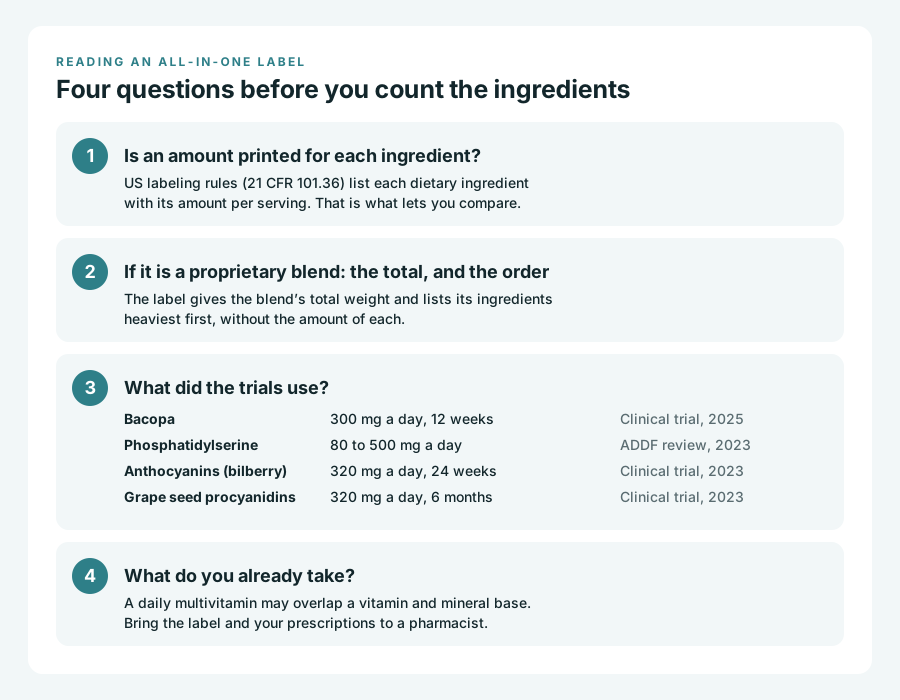
US labeling rules shape what that panel shows. Under the federal regulation for supplement labels, 21 CFR 101.36, each dietary ingredient is listed with its amount per serving. There is one exception: a proprietary blend. For a blend, the label gives the total weight of the blend and lists its ingredients in descending order of predominance by weight, heaviest first, without the amount of each.
So a label can tell you three different things. It can print each amount, which lets you set each ingredient beside a study. It can print a blend total and an order, which gives you a ceiling and a ranking. Or it can name ingredients without a Supplement Facts amount you can see before buying, in which case the question stays open until the bottle is in your hand.
What Should You Do Before Buying Any Bottle?
Write down what you already take, and decide which routine you will keep: two checks that cost nothing and change the answer for a lot of people your age.
1. Write down what you already take
Many all-in-one brain formulas include vitamins and minerals. If you already take a daily multivitamin, part of a new bottle may be something you are already swallowing. That overlap matters because a multivitamin is not a throwaway: in the COSMOS-Web trial, published in 2023 in The American Journal of Clinical Nutrition, 3,562 older adults took either a daily commercial multivitamin or a placebo for three years, and the multivitamin group had better immediate recall at one year, a difference that held across all three years.
The NIH’s National Center for Complementary and Integrative Health also notes that dietary supplements may interact with your medications. A written list, with the vitamins, the prescriptions and anything else, is what a pharmacist needs to answer your question in a few minutes.
2. Be honest about which routine you will keep
The ingredient studies below ran from 12 weeks to six months. A formula only has a chance to show you anything if you are still taking it at week 12. If you have abandoned a supplement halfway before because there were too many bottles, that is a real reason to prefer one. If you like to know exactly what did what, that is a real reason to prefer separate bottles. Our guide to bacopa alone or in a formula walks through that trade-off for one ingredient.
How Much Of Each Ingredient Did The Trials Use?
Most of these ingredients were studied at hundreds of milligrams a day. Here is what the human studies of ingredients common in all-in-one formulas gave people, and what they found. These are the numbers a printed amount would let you compare against. None of them tested a finished all-in-one formula.
Bacopa: 300 mg a day
In a 2025 trial in Clinical Drug Investigation, 101 adults aged 40 to 70 took 300 mg of bacopa extract a day for 12 weeks, or a placebo. There was no difference between the groups on verbal learning, attention or working memory, the main questions. The bacopa group reported greater drops in stress reactivity, and in fatigue after a demanding task, with some reports of stomach complaints and headaches.
Phosphatidylserine: 80 to 500 mg a day
The Alzheimer’s Drug Discovery Foundation’s 2023 report describes trials of 80 to 500 mg a day, most lasting under six months. It finds that phosphatidylserine may have some benefit for memory, with slight improvements in adults that were not large enough to be clinically relevant.
Bilberry anthocyanins: 320 mg a day
A 2023 trial in the American Journal of Geriatric Psychiatry gave 206 adults aged 60 to 80, who had mild cognitive impairment or heart and metabolic conditions, 320 mg a day of purified anthocyanins from bilberry and blackcurrant for 24 weeks. On the main memory measure at 24 weeks there was no significant difference. Between weeks 8 and 24 the two groups moved differently: the anthocyanin group improved while the placebo group declined.
Grape seed: 320 mg a day
A 2023 trial in Heliyon gave 71 adults aged 60 and over with mild cognitive impairment 320 mg a day of grape seed procyanidins, or a placebo, for six months. Scores rose in both groups, and the difference between them was not significant.
Put those next to each other and the point of this guide is plain. Three of these four ingredients were studied in the hundreds of milligrams each. A formula that holds several of them, plus vitamins, minerals and other extracts, is sharing one daily serving among all of them, which is exactly why a printed amount is useful.
Can You Take Huperzine A Every Day?
That is a question for your pharmacist first, because huperzine A, from a club moss, Huperzia serrata, works differently from the ingredients above. Memorial Sloan Kettering Cancer Center describes it as an acetylcholinesterase inhibitor: it slows the enzyme that breaks down acetylcholine, a chemical messenger involved in memory. That is the same way some prescription memory medicines work. Its summary says studies are limited, with mixed results.
Because it acts on the body in that way, it is the ingredient in an all-in-one formula that most deserves a question before you take it daily. Memorial Sloan Kettering lists these reported side effects: nausea, loss of appetite, dizziness, vomiting, constipation, insomnia, excitability, thirst, sweating, a slow heartbeat, stomach pain, sleepiness, restlessness, a stuffy nose, diarrhea and swelling. It advises avoiding huperzine A with four kinds of medicine, listed in the section on who should check first.
Its summary does not set out a long-term daily amount. So the useful answer to “can I take it every day?” is personal rather than general: it depends on your heart rate, your medicines and how you feel on it, which is a short conversation with a pharmacist or doctor who knows your list.
What Should You Look For Before You Buy?
- An amount per ingredient, if matching the trials matters to you. It lets you and your pharmacist set the label beside the 300 mg or 320 mg the studies used.
- If it is a blend, the total and the order. The heaviest ingredient comes first. Where a name sits in the list tells you something even without the split.
- The overlap with what you already take. A vitamin and mineral base can double up on a multivitamin; a pharmacist can tell you whether to replace rather than add.
- Huperzine A on the list. If you take heart or memory medicine, it is the name to raise first.
- A refund window long enough to judge it. The studies ran 12 weeks to six months. Note the guarantee and pick the week you will decide.
Which All-In-One Formulas Could Fit This Routine?
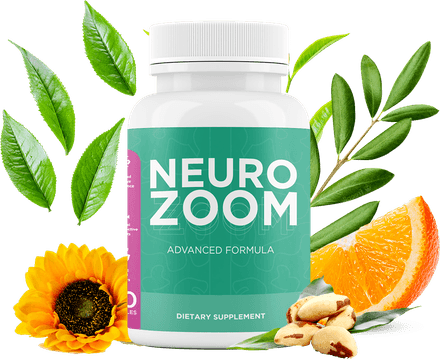
NeuroZoom names 35 ingredients in one capsule routine. By the grouping in its review, about nineteen are everyday vitamins and minerals; eleven are compounds built around acetylcholine, including huperzine A, choline, DMAE, bacopa, phosphatidylserine and tyrosine; and six are botanical extracts, including green tea, olive leaf and bilberry. It contains no stimulants. No amount and no serving size are published, and the maker describes one bottle as a one-month supply. Its comparison page sets it beside a daily multivitamin. The guarantee runs 60 days.
Neuro Serge is a proprietary blend of more than twenty plants and nutrients, and its page names six: olive leaf, cassia cinnamon, deglycyrrhizinated licorice, green tea, grape seed and bilberry. Four of the six have human trials that measured cognition. It is stimulant-free, and the maker describes it as once daily; the bottle holds 60 capsules sold as a 30-day supply. No amount is published for any ingredient, and huperzine A is not among the six named. Its comparison page sets it beside buying bilberry, grape seed and green tea on their own. The guarantee runs 180 days.
Neither label, as its review explains, prints the amount of each ingredient, and as with finished formulas generally, there is no published trial on either exact combination.
Two formulas worth a closer look
Two formulas that put everything in one bottle
If one routine is what you are after, these two gather a long ingredient list into a single daily habit — each with a money-back guarantee.
NeuroZoom
Capsules
A 35-in-1 capsule: a broad vitamin and mineral base together with huperzine A, choline, bacopa and phosphatidylserine, plus six botanical extracts, with no stimulants.
- Readers who do not already take a multivitamin
- Anyone who wants one capsule routine
Covered by a 60-day money-back guarantee
Before you start · Huperzine A is worth naming if you take a prescription memory medicine, medicine for glaucoma or anything for heart rhythm.
See NeuroZoom on the official siteRead our NeuroZoom review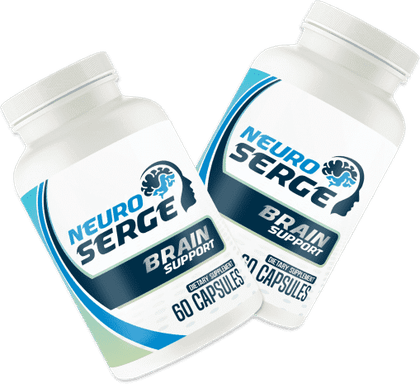
Neuro Serge
Capsules
A stimulant-free blend of more than twenty plants and nutrients, naming olive leaf, cassia cinnamon, licorice, green tea, grape seed and bilberry, four of which have trials that measured cognition.
- Readers who want a blend rather than one compound
- Anyone who wants six months to decide
Covered by a 180-day money-back guarantee
Before you start · Green tea and grape seed are worth raising with a blood thinner; cassia cinnamon with blood sugar medicine; licorice with blood pressure treatment.
See Neuro Serge on the official siteRead our Neuro Serge reviewListed in no particular order. We publish no scores or rankings.
Who Should Check Before Starting?
Take the label, or a photo of it, to your pharmacist or doctor if any of these apply to you.
- You take a prescription memory medicine, such as donepezil, galantamine or rivastigmine. Memorial Sloan Kettering advises avoiding huperzine A with acetylcholinesterase inhibitors, the group these medicines belong to.
- You take a beta-blocker or a calcium channel blocker. Memorial Sloan Kettering lists both among the medicines to avoid with huperzine A, and a slow heartbeat among its side effects. The NeuroZoom review also names medicine for glaucoma and anything for heart rhythm.
- You take a medicine that blocks dopamine, such as some antipsychotics. Memorial Sloan Kettering lists this group for huperzine A as well.
- You take a blood thinner. The Alzheimer’s Drug Discovery Foundation lists a possible increase in bleeding risk with phosphatidylserine, and the Neuro Serge review names green tea extract and grape seed to raise alongside a blood thinner.
- You take medicine for blood sugar or blood pressure. The Neuro Serge review names cassia cinnamon for blood sugar medicine and licorice for blood pressure treatment.
If you take several medicines, our checklist for several medicines shows what to bring. Never stop, reduce or change a prescription to make room for a supplement.
When Should You See A Doctor?
Book an appointment if changes in memory or thinking start to affect your work or daily life, if they came on suddenly, or if someone close to you has noticed them. A slower name or a softer afternoon on its own is common in your forties and fifties.
And if you notice dizziness or a slower heartbeat after starting a formula that contains huperzine A, mention it to your doctor; both are on Memorial Sloan Kettering’s list of reported side effects.
Ready to compare? Go back to the two formulas above, or read the full reviews of NeuroZoom and Neuro Serge.
Frequently asked
Is an all-in-one brain supplement worth it?
It depends on what you value. One bottle means one routine, and the ingredient trials in this area ran for 12 weeks to a year, so a habit you keep matters. What you give up, when amounts are not printed, is the ability to set each ingredient beside the amount a study used. Decide which of the two matters more to you before you buy.
Do 35-in-1 supplements have enough of each ingredient?
The count alone cannot tell you. A daily serving has a fixed weight, and the ingredients share it. The way to find out is the Supplement Facts panel: an amount printed per ingredient, or for a blend, the total weight with ingredients listed from heaviest to lightest, as US labeling rules require. If neither is printed, the question stays open.
What should I know before taking huperzine A every day?
Memorial Sloan Kettering describes huperzine A as slowing the enzyme that breaks down acetylcholine, with limited studies and mixed results. It lists side effects such as nausea, dizziness, sweating, insomnia and a slow heartbeat, and advises avoiding it with prescription memory medicines, beta-blockers, calcium channel blockers and medicines that block dopamine. Ask your doctor or pharmacist before starting it.
Can I take an all-in-one brain formula with my multivitamin?
Check first. Some all-in-one formulas include a full vitamin and mineral base, so they overlap a daily multivitamin. If the amounts are not printed, the two cannot be added up on paper. Take both labels to a pharmacist and ask whether to replace one rather than add both.
Is it better to take brain ingredients separately or in one formula?
Neither is established as better. Separate bottles let you match the amounts used in trials and tell which one did something. One formula gives you a single routine and, often, a single refund window. No published trial has tested either formula on this page as a whole, so the choice is about how you like to take supplements.
How long should I try an all-in-one brain supplement?
Plan on weeks, not days. The ingredient trials described here ran from 12 weeks to six months, and 4 to 12 weeks is a fair first window to judge how a formula fits your routine. Note the guarantee length before you start and decide in advance at which week you will judge it.
References
- 21 CFR 101.36 — Nutrition labeling of dietary supplements, Code of Federal Regulations (current text) — 2026
- Huperzia serrata — Memorial Sloan Kettering Cancer Center, About Herbs — 2022
- The Effects of a Bacopa monnieri Extract (Bacumen®) on Cognition, Stress, and Fatigue in Healthy Adults: A Randomized, Double-Blind, Placebo-Controlled Trial — Clinical Drug Investigation — 2025
- Phosphatidylserine — Cognitive Vitality Reports, Alzheimer’s Drug Discovery Foundation — 2023
- A Randomised Placebo-Controlled Study of Purified Anthocyanins on Cognition in Individuals at Increased Risk for Dementia — American Journal of Geriatric Psychiatry — 2023
- The effect of grape seed procyanidins extract on cognitive function in elderly people with mild cognitive impairment: A randomized, double-blind, placebo-controlled clinical trial — Heliyon — 2023
- Multivitamin Supplementation Improves Memory in Older Adults: A Randomized Clinical Trial — The American Journal of Clinical Nutrition — 2023
- Dietary and Herbal Supplements — NIH National Center for Complementary and Integrative Health — 2020
Disclosure
All content is for informational purposes only and is not a substitute for professional medical advice, diagnosis, or treatment. Each product covered is a dietary supplement, not a prescription drug, and statements about it have not been evaluated by the U.S. Food and Drug Administration. Results vary with individual health status, consistency of use, and lifestyle. This page contains affiliate links — if you buy through them we may earn a small commission at no additional cost to you. Read our disclosure and our editorial policy.