
Neuro Serge Supplement Review: What Is in It?
Six named botanicals, a blend with no amounts published, and a 180-day guarantee. Here is what you are actually buying, and what the research behind it measured.
Quick answer
Neuro Serge is a once-daily capsule built on six named botanicals — olive leaf, cassia cinnamon, licorice, green tea, grape seed and bilberry — inside a proprietary blend, so no amount is published for any of them. Four of the six have human trials that measured cognition. The guarantee runs 180 days.
Try it with the full 180-day guarantee
It is rarely the big things. It is the word that will not come, halfway through a sentence you were perfectly confident about when you started it. You talk around it. Nobody at the table notices. You notice.
Then it is writing down three names before a meeting you would once have walked into cold. Then it is reading the same paragraph a third time and still not owning it. And at some point you stopped bringing it up, because said out loud it sounds heavier than it feels.
If you have gone looking for something to do about it, you already know what the search returns. Pages that promise reversal. Pages built to frighten you into a decision by the third paragraph. You have learned to close the tab, and you were right to.
So this page does the slow, useful thing instead. It reads the label and tells you what is printed and what is not. It puts each named ingredient against the human research that actually exists, including where that research points somewhere other than memory. Then you decide — which is the part nobody has been letting you do.
1. What Is Neuro Serge?
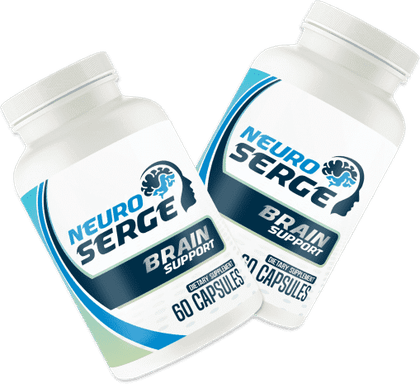
Neuro Serge is a capsule supplement sold direct through the maker's own site, with ClickBank as the retailer handling the transaction and the refunds. The maker describes it as a once-daily formula, and states that it is manufactured in the United States in a facility that is GMP-certified and FDA-registered — the manufacturing standards this category is held to.
The formula is presented as a proprietary blend of more than twenty plants and nutrients, and the page is explicit that it is stimulant-free, non-GMO, gluten-free and non-habit-forming. The story it tells is a general one rather than a mechanism: that supporting the body broadly supports the brain along with it. Section four is where that idea gets examined properly, because it turns out to describe the ingredient list more accurately than the marketing does.
2. What Is In Neuro Serge?
We start here on every product, because it is the document you would read if you could hold the bottle in a shop. The page describes a blend of more than twenty ingredients. It names six. And because the blend is proprietary, no amount is published for any of them — that is what the word proprietary means in this context, and it is a legal formulation rather than an oversight.
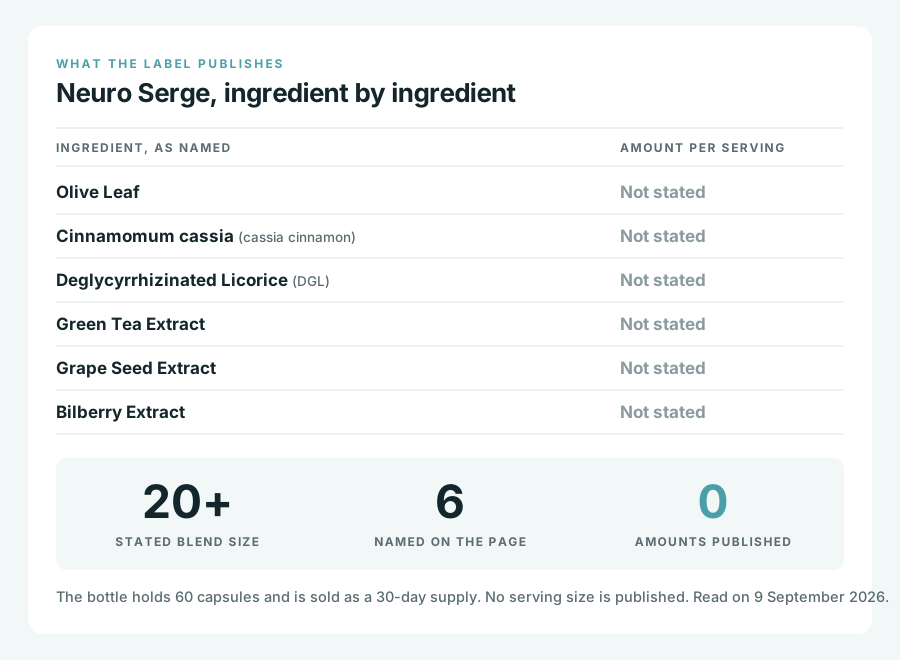
There is a second question the page leaves open, and this one has an answer you can work out. No serving size is published — not on the sales page, not in the maker's own press release, both of which say only "once daily". But the label photograph reads 60 capsules, and the maker sells a single bottle as a 30-day supply. Two of the manufacturer's own statements, divided, give two capsules a day. We publish the arithmetic and attribute it, rather than presenting it as an instruction: follow whatever the bottle itself says when it arrives.
None of this is evidence of a poor formula, and a great many well-made supplements are sold as proprietary blends. It is a plain statement of what you can and cannot verify before you spend.
3. What Does The Research Say About The Ingredients In Neuro Serge?
Six named botanicals, and the honest summary is that they are not equally well studied for this purpose. Grouping them by how much human evidence exists is more useful than taking them in the order the page lists them.
Bilberry and grape seed — the two with the most on-point trials
Bilberry's active compounds are anthocyanins, and they have been tested directly on cognition. A 2023 randomised placebo-controlled trial in the American Journal of Geriatric Psychiatry gave 206 adults aged 60 to 80 320 mg a day of purified anthocyanins from bilberry and blackcurrant for 24 weeks. Participants had either mild cognitive impairment or two or more cardiometabolic conditions — which is to say, close to the reader this product is sold to.
The field as a whole is not settled, and it would be dishonest to imply otherwise. A 2025 systematic review and meta-analysis in Current Nutrition Reports pooled the randomised trials on anthocyanins and cognition and found no significant effect on working memory, verbal learning, immediate memory or delayed memory, in healthy and cognitively impaired adults alike. The authors attribute much of the difficulty to how widely the trials differ in dose and in how they measure cognition.
Grape seed is the other one with a directly relevant trial. A 2023 randomised, double-blind, placebo-controlled study gave adults aged 60 and over with mild cognitive impairment 320 mg a day of grape seed procyanidins for six months; scores rose in both groups, with no significant difference between them. A separate 2024 trial in Foods tested a standardised grape extract in healthy older adults over 84 days and reported improvements across memory, attention and language domains. Our guide to pine bark, grape seed and olive leaf after 60 sets these trials side by side.
Green tea — tested at length, with a specific and modest result
The most rigorous recent test is a 12-month randomised controlled trial published in PLOS ONE in 2024, in 99 older adults with subjective cognitive decline or mild cognitive impairment, taking 2 g of matcha daily. It is worth being exact about what it found: an improvement in social acuity — the reading of facial emotion — and no improvement in global cognition. A full year, a real population, and a narrow result. That is more informative than a vaguer positive finding would have been.
Olive leaf — one human cognitive trial, in a clinical population
Olive leaf's polyphenol is oleuropein, and its human literature is overwhelmingly cardiovascular: a 2022 meta-analysis of randomised trials examined its effect on blood pressure and cholesterol in the general adult population. There is one cognitive trial, the GOLDEN study, published in Neurology International in 2024, in 55 patients with mild Alzheimer's disease. It is a small trial in a diagnosed population, which is a different question from the one most readers of this page are asking, and it is reported here for completeness rather than as a claim. No supplement prevents, treats or reverses dementia.
Cassia cinnamon and licorice — real trials, different endpoints
Both have genuine human research, and neither has it on memory. Cassia cinnamon's randomised trials measure blood glucose and blood lipids; the meta-analytic literature there is substantial and it is metabolic. Deglycyrrhizinated licorice has been studied for digestive comfort and inflammatory markers. Saying so is not a criticism of either ingredient — it is a description of what was measured.
And, as with almost every finished formula sold direct, there is no published trial on this exact combination. Everything above is evidence about ingredients. The maker is unusually direct about this in its own press release, stating plainly that it does not claim the product replicates the outcomes of the studies published on these ingredients. That is a more careful sentence than this category usually manages.
4. How Is The Neuro Serge Formula Designed?
Put the six side by side and a clear design logic appears — and it is the most useful thing on this page.
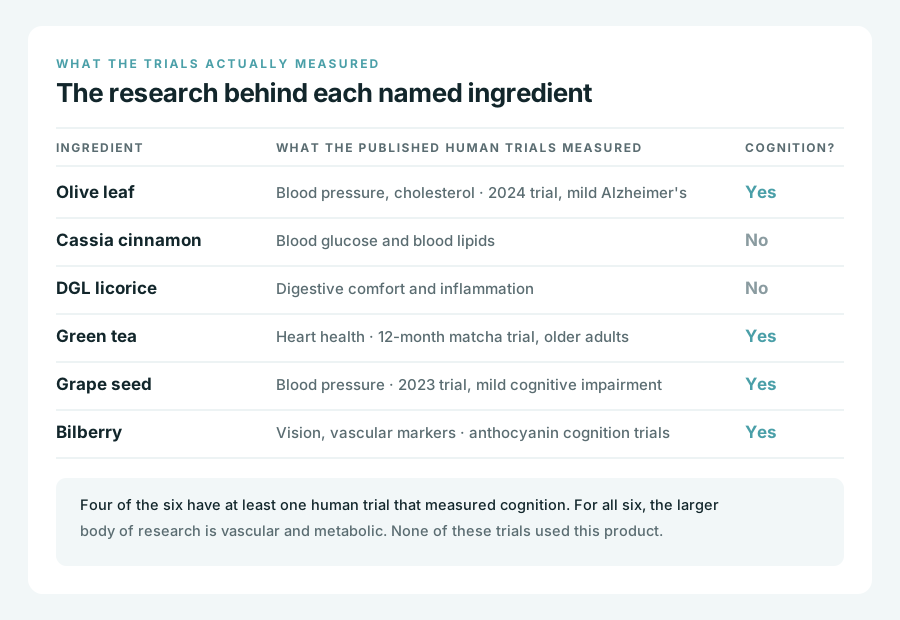
This is a vascular and metabolic panel. Olive leaf is studied for blood pressure and cholesterol. Cassia cinnamon for blood glucose. Grape seed for blood pressure and circulation. Bilberry for vascular and retinal markers. Green tea for cardiovascular endpoints. The through-line across all six is not neurotransmitters or nerve growth — it is blood vessels, blood sugar and oxidative load.
That is a coherent design rather than an accident, and it rests on a real idea: cognitive ageing and vascular health are genuinely connected, and the compounds that act on circulation and glucose are a reasonable place for a formulator to start. Four of these six have gone on to be tested on cognition directly, which is more than most botanical blends in this aisle can say.
Where the reasoning stops being established and becomes a hypothesis is the last step: whether moving vascular and metabolic markers translates into remembering a name. The trials that measured cognition here were run on single compounds at published amounts — 320 mg of anthocyanins, 320 mg of grape seed procyanidins, 2 g of matcha — and this bottle publishes no amounts at all, so it cannot be lined up against any of them.
Which leaves a straightforward way to think about it. If your own situation already involves blood pressure, blood sugar or circulation — and for a great many readers in their fifties and sixties it does — then this ingredient list is aimed squarely at territory you are already standing in, and the brain is being approached through the door of general health rather than around it.
See Neuro Serge and decide for yourself5. How Do You Take Neuro Serge, And When Would You Notice A Change?
The maker's instruction is "once daily, with water", and no capsule count is given. Follow the bottle. As section two set out, the label's 60 capsules against a 30-day supply works out to two a day, but that is our arithmetic on the maker's numbers and not a direction from them.
On timing, the ingredients answer for themselves, and the answer is patience. The grape seed trial ran six months. The matcha trial ran twelve. The anthocyanin trial ran 24 weeks. The shortest positive trial cited on this page was 84 days. The maker itself recommends three to six months, which is one of the rare occasions in this category where the marketing and the evidence agree about the timescale. Our guide to how long memory supplements take to work explains how to judge your own results over that time.
That is exactly why the guarantee is the practical fact rather than a marketing line. At 180 days, the refund window is longer than every trial cited here except the matcha one. You would have your answer with time to spare, which is a materially different proposition from the 60-day windows that are standard in this aisle.
6. What Do Buyers Say About Neuro Serge?
Publicly posted feedback is limited, and most of what exists sits on the manufacturer's own page. This site publishes no score, no star rating and no review count for any product, so what follows is description rather than a tally.
What can be said fairly, and without a testimonial: for a capsule taken over months, the recurring practical questions are whether the routine survives a busy week and whether the capsules are easy to swallow. Both are worth knowing about yourself before committing to a six-month timescale.
What it does well
- Four of the six named ingredients have human trials that measured cognition directly
- A 180-day guarantee, three times the 60 days that is standard in this aisle
- The maker states plainly that it does not claim to replicate the cited studies
What to know before you buy
- A proprietary blend, so no amount is published for any ingredient
- Six ingredients are named of the more than twenty the page describes
- No serving size published; 60 capsules against a 30-day supply implies two a day
- No published trial on this exact combination
- Green tea is one of the six named, and green tea contains caffeine (NCCIH); no amount is published
- Sold through the maker's own site, with ClickBank as retailer
7. How Much Does Neuro Serge Cost, And Is There A Guarantee?
Prices are the manufacturer's list prices at the time of writing and change without notice. We publish what a bottle costs and what a day costs. We do not publish savings claims and we do not reproduce countdown pricing.
| Package | Price per bottle | Per day | Shipping |
|---|---|---|---|
| 2 bottles | $79 per bottle | $2.63 | Shipping fee applies |
| 3 bottles | $69 per bottle | $2.30 | Free, US |
| 6 bottles | $49 per bottle | $1.63 | Free, US |
| Guarantee | 180 days, money back, handled by the manufacturer | ||
Per-day cost uses the maker's own framing of one bottle as a 30-day supply.
Order Now on the official siteThe three- and six-bottle orders also include digital bonus guides, which the maker values on the page. We would not weigh a digital bonus heavily in a decision of this size, and the numbers above are the part that matters.
The 180-day guarantee is the term the manufacturer publishes, and they handle it, not us. It deserves more than a skim, because it is what makes the six-month timescale the research demands into something you can actually test rather than merely commit to.
8. Who Is Neuro Serge For?
A question about you rather than about the bottle, so we will answer it that way.
This is likely a good fit if your own health picture already involves blood pressure, blood sugar or circulation, because that is the territory this panel was built for; if you would rather take one blend than assemble four separate bottles; and if you can judge something over months rather than days, with a 180-day window making that affordable to do.
Look elsewhere if you want to check amounts against published trials before spending — a proprietary blend does not allow it, and for anthocyanins and grape seed the amount is much of the question; or if you take a blood thinner, medication for blood sugar or treatment for blood pressure and have not yet raised green tea, cinnamon and licorice with your prescriber.
And the case where the answer is neither: if the forgetting has been getting worse month over month, or someone close to you has mentioned it, the next step is an appointment rather than a bottle. No supplement on this site prevents, treats or reverses any condition.
If that sounds like you, see it here
Frequently asked
Does Neuro Serge publish how much of each ingredient it contains?
No. The formula is described as a proprietary blend, which by definition means the amounts are not broken out. Six ingredients are named on the sales page — olive leaf, cassia cinnamon, deglycyrrhizinated licorice, green tea, grape seed and bilberry — and no amount is published for any of them.
How many capsules a day is a serving?
The maker does not state it, so follow whatever the bottle says when it arrives. What can be said is arithmetic rather than instruction: the label reads 60 capsules, and the maker sells one bottle as a 30-day supply, which works out to two a day. Both halves of that come from the manufacturer; the division is ours.
How long before most people would notice anything?
Months, not days. The human trials behind these ingredients ran from 84 days to 12 months — the grape seed trial ran six months, the matcha trial ran a year. Nothing in this category acts on the day you take it, and the maker itself recommends three to six months. The 180-day guarantee is what makes that timescale affordable to test.
Does Neuro Serge have side effects?
No published trial has tested this exact combination, so what is known comes from single ingredients. The NIH fact sheet on green tea cited below lists nausea, constipation, stomach discomfort and raised blood pressure as side effects of green tea extract supplements, and notes that liver injury, though uncommon, has been reported. In the 24-week anthocyanin trial cited below (320 mg a day), the researchers reported the capsules as well tolerated. The grape and olive leaf summaries do not mention side effects. If you are pregnant, take a prescription medicine every day, or have surgery coming up, ask your doctor first; see the next question.
Can I take it with my prescription medication?
Ask the person who wrote your prescription first. Green tea extract is worth naming specifically if you take a blood thinner, because of its vitamin K content, and grape seed is worth mentioning for the same reason. Cassia cinnamon is the one to raise if you take medication for blood sugar, and licorice if you are treated for blood pressure. It is one short question at your next appointment.
When should I speak to a doctor instead of trying a supplement?
If the forgetting is getting worse month over month, if other people have started noticing it, if it comes with confusion about time or place, or if it began suddenly, that is a clinical conversation and not a supplement question. Nothing on this page prevents, treats or reverses any condition.
References
- A Randomised Placebo-Controlled Study of Purified Anthocyanins on Cognition in Individuals at Increased Risk for Dementia — American Journal of Geriatric Psychiatry — 2023
- The Effect of Anthocyanins on Cognition: A Systematic Review and Meta-analysis of Randomized Clinical Trial Studies in Cognitively Impaired and Healthy Adults — Current Nutrition Reports — 2025
- The effect of grape seed procyanidins extract on cognitive function in elderly people with mild cognitive impairment: a randomized, double-blind, placebo-controlled clinical trial — 2023
- Standardized Grape (Vitis vinifera L.) Extract Improves Short- and Long-Term Cognitive Performances in Healthy Older Adults: A Randomized, Double-Blind, and Placebo-Controlled Trial — Foods — 2024
- Effect of matcha green tea on cognitive functions and sleep quality in older adults with cognitive decline: A randomized controlled study over 12 months — PLOS ONE — 2024
- Green Tea: Usefulness and Safety — NIH National Center for Complementary and Integrative Health — 2025
- The Role of Greek Olive Leaf Extract in Patients with Mild Alzheimer's Disease (the GOLDEN Study): A Randomized Controlled Clinical Trial — Neurology International — 2024
- The effects of olive leaf extract on cardiovascular risk factors in the general adult population: a systematic review and meta-analysis of randomized controlled trials — 2022
Disclosure
All content is for informational purposes only and is not a substitute for professional medical advice, diagnosis, or treatment. Each product covered is a dietary supplement, not a prescription drug, and statements about it have not been evaluated by the U.S. Food and Drug Administration. Results vary with individual health status, consistency of use, and lifestyle. This page contains affiliate links — if you buy through them we may earn a small commission at no additional cost to you. Read our disclosure and our editorial policy.