
Thinking About a Memory Supplement for Mom or Dad? Start Here
You want to help, and you want to get it right. Here is what to check first, where vitamin B12 fits, and how to choose a formula with your parent rather than for them.
Quick answer
Start with a checkup. Memory changes in an older parent can come from things a doctor can test for, such as low vitamin B12, thyroid disease or a medicine side effect. Bring the full list of what they take. If you and your parent then choose a supplement, decide together and take the label to their pharmacist. Two formulas to consider are below.
It was a good visit. Lunch, the garden, the grandchildren on the phone. But your father told the same story twice before dessert, and when you asked about the appointment he had next week, he was not sure there was one.
On the drive home you start searching. Something for his routine, something he would actually take, something that will not clash with the pills already lined up on his kitchen counter. And underneath it, the harder question: how do you bring this up without making him feel watched?
This guide is for the son or daughter in that car. It starts where a good doctor would start, explains where vitamin B12 fits, and then shows how to choose a formula with your parent, so the routine is theirs and nothing is hidden.
Further down, we look at two formulas that fit an easy daily routine: MemoryFuel, a scoop stirred into water, and NeuroPrime, one drop a day — each with a money-back guarantee.
What Can Change A Parent’s Memory?
Some forgetting comes with the years. MedlinePlus, the National Library of Medicine’s health site, notes that it is normal to have some trouble learning new things or to need more time to remember them, and that normal aging does not lead to dramatic memory loss.
Between those two lies a long list of causes that have nothing to do with age itself. MedlinePlus includes side effects of prescription medicines, alcohol, low levels of vitamins such as B1 or B12, and depression. It also notes that a doctor may order blood tests for suspected problems such as low B12 or thyroid disease.
Vitamin B12 deserves a closer look, because it is the one most often searched for. A 2025 review in American Family Physician lists older age among the risk factors for a B12 deficiency, along with limited intake and long-term use of metformin or acid-reducing medicines called proton pump inhibitors. It names fatigue, brain fog and depression among the possible symptoms.
None of this tells you what is behind your parent’s forgetting. It tells you why the first step is someone who can look: several of these causes are things a doctor can check, and several are things a doctor can act on.
Should A Checkup Come Before Any Supplement?
A checkup should come first: the search for a supplement often begins as a way to do something right now, and the most useful something is usually an appointment. There are ways to make it feel like an ordinary one.
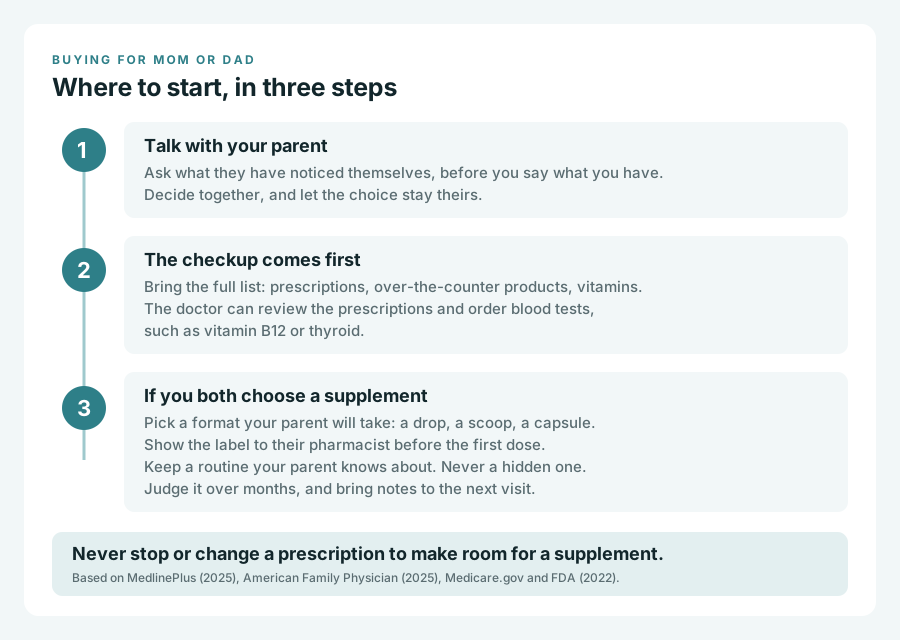
1. Talk with your parent first
Ask what they have noticed themselves, before you say what you have noticed. Keep it about how they feel and what they would like to do, without sounding like a test, and let the decisions stay theirs wherever they can.
2. Use the visit that already exists
If your parent is on Medicare, the yearly wellness visit is a natural place to start. Medicare says it pays for this visit once every 12 months, that you pay nothing if the provider accepts assignment, and that it includes a review of current prescriptions and a cognitive assessment. If a problem is suspected, Medicare covers a separate, more thorough visit. Be honest about why you would like your parent to go, offer to book it, and offer to drive.
3. Bring one complete list
The FDA advises bringing a list of all the dietary supplements and medicines a person takes, including the doses and how many times a day, and notes that certain supplements can change how a medicine is absorbed, broken down or cleared. For a parent, that means the prescriptions from every doctor, the over-the-counter products and the vitamins already in the cupboard. Our guide to what to bring to the doctor or pharmacist has a printable card for it.
4. Ask about the blood tests
The American Family Physician review advises measuring B12 in people who have at least one risk factor and one sign, and periodic checks in people on metformin long term. When a result is borderline, it suggests a second test, methylmalonic acid. If a deficiency is found, it notes that B12 taken by mouth works for most people. That treatment, and its dose, comes from your parent’s doctor.
What Do Tests And Trials Show For B12 And Other Nutrients?
It depends on the ingredient, and on whether a vitamin level was low to begin with. Here is what human trials measured for the main ingredients in the two formulas below, and in whom.
Vitamin B12
The research divides cleanly. Correcting a low level is the job, and a blood test shows whether there is one. Adding B12 when the level is fine is a different question: a 2021 meta-analysis in Nutrients pooled 16 randomized trials with 6,276 participants who had no overt B12 deficiency and no advanced neurological disorder, and found no effect on any area of cognitive function.
Vitamin D
Two studies within the VITAL trial, published in Scientific Reports in 2021, gave adults aged 60 and older, average age about 71, 2,000 IU of vitamin D3 a day for two to nearly three years. Overall, there was no difference in cognitive decline compared with placebo. As with B12, the reason to take vitamin D is keeping the level where it should be.
Creatine
Creatine is better known from sport. A 2023 systematic review and meta-analysis in Nutrition Reviews pooled ten randomized trials of creatine and memory in healthy people and found a significant improvement in memory in adults aged 66 to 76. Results varied a great deal between trials, which were small.
Bacopa
Bacopa is a plant extract. A 2026 network meta-analysis in Phytomedicine pooled 29 randomized trials in 2,107 healthy adults and found that bacopa improved working memory and delayed memory compared with placebo. There were no differences in attention or processing speed.
No finished formula, including the two below, has a published trial of its own exact combination. The evidence above is evidence about ingredients.
How Do You Choose A Formula Together?
If the checkup is done and your parent would like to try something, three practical questions decide whether a supplement becomes a routine or a bottle at the back of the cupboard.
- A format they will take. If capsules are the problem, drops and powders skip the swallow. Our guide to liquid and powder supplements covers how each is taken, and why tablets should never be crushed without asking the pharmacist.
- A label the pharmacist can read. Every ingredient should be named, so it can be checked against the medicines on your parent’s list. Where amounts are not published, the ingredient names are still what the pharmacist works from.
- A routine your parent knows about. Tie it to something they already do, such as breakfast or the morning coffee, and let them be the one who takes it. A supplement taken without a person’s knowledge is never part of a good plan, and the doctor and pharmacist need to know about it too.
Two formulas on this site come in formats that are easy to fold into a morning. MemoryFuel is a powder from Nutraville: one scoop a day in 6 to 8 ounces of water, with vitamin D3, vitamin B12 as methylcobalamin, magnesium, choline and creatine monohydrate. Its sales page speaks of six ingredients and names five, so take the tub itself to the pharmacist. NeuroPrime is a liquid taken as one drop a day, preferably in the morning, straight or stirred into tea, coffee, juice or another drink, with the bottle shaken first. It names nine botanicals, including bacopa, ginkgo and lion’s mane. Neither publishes the amount of each ingredient, which the full reviews explain.
Two formulas worth a closer look
Two formulas that fit a parent’s morning
A scoop in water or a drop in a drink, each with a money-back guarantee — easy to choose together and easy to show the pharmacist.
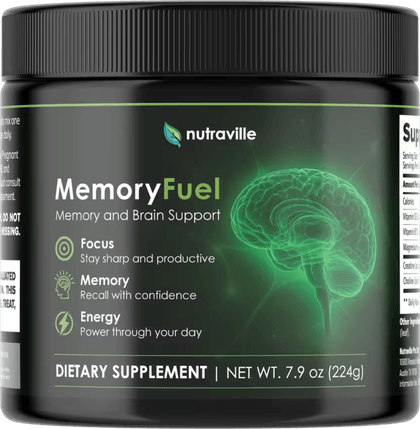
MemoryFuel
Powder
One scoop a day in 6 to 8 ounces of water, with vitamin D3, vitamin B12 as methylcobalamin, magnesium and choline, plus creatine monohydrate — the ingredient with a memory result in adults 66 to 76.
- Parents who would rather drink than swallow capsules
- Diets light on meat and fish
Covered by a 90-day money-back guarantee
Before you start · With kidney disease, ask about creatine and magnesium first. Magnesium needs spacing from some antibiotics and osteoporosis tablets.
See MemoryFuel on the official siteRead our MemoryFuel review
NeuroPrime
Drops
One drop a day, taken straight or stirred into a drink, from a 2 fl oz dropper bottle. Nine botanicals named, including bacopa, ginkgo and lion’s mane.
- Parents who find capsules difficult
- One drop a day, in the morning coffee or tea
Covered by a 365-day money-back guarantee
Before you start · Ginkgo matters with a blood thinner, and bacopa with thyroid medicine or a sedative.
See NeuroPrime on the official siteRead our NeuroPrime reviewListed in no particular order. We publish no scores or rankings.
Who Should Check Before Starting?
If your parent takes medicines from more than one doctor, one pharmacist seeing the whole list is worth a lot. Take the tub or the bottle along if any of these apply:
- A blood thinner, such as warfarin. The NIH’s National Center for Complementary and Integrative Health notes that ginkgo may increase the risk of bleeding in people taking anticoagulant drugs. Our guide for people on a blood thinner lists the questions to ask.
- Metformin or an acid reducer. Both are linked to lower B12, according to the American Family Physician review, which is worth the doctor knowing before any vitamin is added. More in our article on metformin and B12.
- A kidney condition. A 2025 review in Frontiers in Nutrition found no harm to kidney function from creatine in healthy people, and advises caution for people with existing kidney conditions, because evidence is lacking for them.
- Thyroid medicine or a sedative. Bacopa is the ingredient to mention. Our article on memory supplements and thyroid medicine covers that conversation.
- Several medicines at once. Our checklist for people on several medicines walks through the list, step by step.
Never stop, reduce or change a parent’s prescription to make room for a supplement.
When Should Your Parent See A Doctor?
New forgetting in a parent is a reason for an appointment first, before any supplement. Book one if the forgetting is getting worse month over month, if other people have started to notice it, if it comes with confusion about time or place, or if it seems to have started suddenly.
A sudden change in how clearly your parent is thinking should not wait for the next routine visit. And if a doctor has already found a condition behind the memory changes, follow the plan that doctor gives: this guide is about the time before an answer, not after it.
Ready to look together? Go back to the two formulas above, or read the full reviews of MemoryFuel and NeuroPrime.
Frequently asked
Should my mom take a memory supplement?
Start with a checkup rather than a bottle. Memory changes in an older adult can come from things a doctor can test for, such as low vitamin B12, thyroid disease or a medicine side effect. If those are looked at and your mom wants to try a supplement, choose it with her, take the label to her pharmacist, and make sure her doctor knows.
Is B12 good for elderly memory?
B12 matters most when the level is low. Older age, metformin and acid-reducing medicines all raise the risk of a deficiency, and a blood test shows whether that is the case. In a 2021 meta-analysis of 16 trials in people without a clear deficiency, B12 supplements did not improve cognitive function. So the test comes first.
What vitamins should my elderly father take for memory?
The ones his blood work says he needs. Ask his doctor whether a B12 test makes sense, especially if he takes metformin or an acid reducer, and follow any dose the doctor gives. Vitamins B12 and D did not change memory in trials of people whose levels were not low, so a general top-up is not the same as treating a deficiency.
Can I put a supplement in my parent’s coffee without telling them?
No. Whatever your parent takes should be something they know about and agreed to, and their doctor and pharmacist should know about it too. A drop in the morning coffee is fine when the label allows it and your parent chose it. A hidden one leaves out the people who check it against their medicines.
What if my parent will not see a doctor about memory?
Many older adults on Medicare can have a yearly wellness visit at no cost when the provider accepts assignment, and Medicare says it includes a review of prescriptions and a cognitive assessment. Be open about why you would like them to go, offer to book it and go along, and bring their full list of medicines and supplements.
How long does a memory supplement take to show anything?
Think in months, not days. The ingredient trials in this article lasted from several weeks to a few years, so a fair try of a daily routine is measured in months. Keep a short note of what you and your parent notice, and bring it to the next appointment.
References
- Memory loss — MedlinePlus Medical Encyclopedia, National Library of Medicine — 2025
- Vitamin B12 Deficiency: Common Questions and Answers — American Family Physician — 2025
- Mixing Medications and Dietary Supplements Can Endanger Your Health — U.S. Food and Drug Administration — 2022
- Effects of Vitamin B12 Supplementation on Cognitive Function, Depressive Symptoms, and Fatigue: A Systematic Review, Meta-Analysis, and Meta-Regression — Nutrients — 2021
- Effect of vitamin D on cognitive decline: results from two ancillary studies of the VITAL randomized trial — Scientific Reports — 2021
- Effects of creatine supplementation on memory in healthy individuals: a systematic review and meta-analysis of randomized controlled trials — Nutrition Reviews — 2023
- Comparative effects of Bacopa monnieri and Ginkgo biloba on cognitive functions: A systematic review and network meta-analysis — Phytomedicine — 2026
- Ginkgo: Usefulness and Safety — NIH National Center for Complementary and Integrative Health — 2025
- A short review of the most common safety concerns regarding creatine ingestion — Frontiers in Nutrition — 2025
Disclosure
All content is for informational purposes only and is not a substitute for professional medical advice, diagnosis, or treatment. Each product covered is a dietary supplement, not a prescription drug, and statements about it have not been evaluated by the U.S. Food and Drug Administration. Results vary with individual health status, consistency of use, and lifestyle. This page contains affiliate links — if you buy through them we may earn a small commission at no additional cost to you. Read our disclosure and our editorial policy.