
What to Bring When You Ask Your Doctor About a Memory Supplement
You have decided to ask before you start, which is the careful thing to do. Here is how to make that conversation short and useful: what to bring, what to ask, and what an online checker can and cannot tell you.
Quick answer
Yes, tell your doctor or pharmacist before starting a memory supplement. Bring a written list of every medicine, vitamin and supplement you take, with doses, plus the full ingredient list of the product you are considering. Ask whether anything interacts, needs spacing, or should be rechecked later. Online checkers help you prepare, not decide. Two ingredient lists to bring are below.
The appointment is on the calendar for next Thursday, and the list of questions is already started on the back of an envelope. Blood pressure refill. That twinge in the knee. And, at the bottom, the one you are not sure how to ask: you have been reading about a memory supplement, and you want to know whether it is all right with everything else you take.
Maybe you have asked before and been sent in a circle — the doctor said to check with the pharmacist, and the pharmacist said to check with the doctor. That is frustrating, and often it happens because nobody had the full picture in front of them at the same time. This guide is about putting that picture in one place, so either of them can give you a real answer.
Further down, we read two ingredient lists the way a pharmacist would — Phytomem One and NeuroPrime — and each comes with a money-back guarantee.
Why Should You Tell Your Doctor About A Supplement?
The FDA explains that certain dietary supplements can change the absorption, metabolism or excretion of a medication — in plain terms, how much of a medicine gets in, how fast the body breaks it down, and how fast it leaves. That is why your doctor and pharmacist need to know about a supplement in the same way they need to know about a new prescription.
It is also the part of the list that most often goes unsaid. In a 2023 study in Gerontology & Geriatric Medicine, 173 adults aged 65 and older in Connecticut were asked about complementary health practices, including herbs and supplements. Among those using herbs or supplements, 71.9% had told their primary care practitioner. Among everyone who had not told, the top reasons were simple: they never thought to (50%), and the practitioner never asked (42%).
A 2024 study in BMC Primary Care looked at 65 patients aged 65 and older, each taking at least five regular medicines, in Swiss family practices. Seventy percent took at least one supplement, three on average — and their doctor was unaware of at least one of them for 60% of patients.
Neither study means something went wrong for those patients. They show that the supplement conversation rarely starts on its own. If you bring it up, it happens.
What Should You Bring To The Appointment?
Four things turn a vague question into one that can be answered in a few minutes. All of them fit in an envelope.
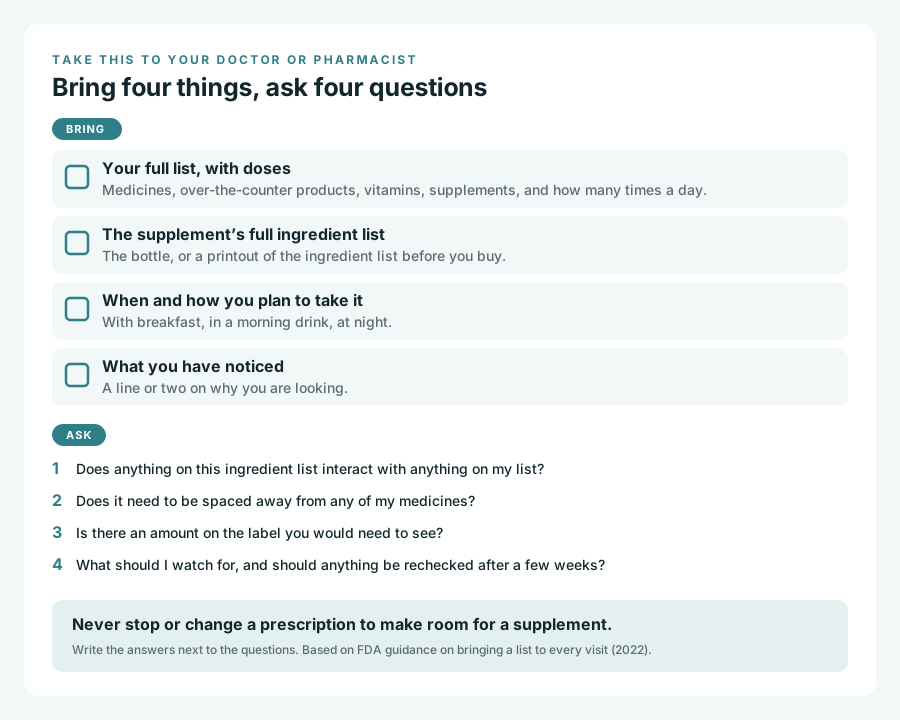
1. Your full list, with doses
The FDA’s advice is specific: bring a list of all the dietary supplements and medications you are currently taking, including the dosages and how many times a day you take them. Include over-the-counter products such as pain relievers, antacids and sleep aids, and anything you take only now and then. If you take several medicines, our checklist for people on several medicines walks through building that list and the interaction questions behind it.
2. The supplement’s full ingredient list
Not the name on the front — the list of what is inside. Before you buy, you will not have a bottle, so print the ingredient list from the maker’s page or from a review that reproduces it. The details that matter most to a pharmacist are:
- Every ingredient, by name. If the list says which part of a plant or which extract is used — “olive leaf”, “Ceylon cinnamon bark” — keep that detail on the page you bring.
- The serving. One tablet, two capsules, one drop: how much you would take, and how often.
- Any amounts the label gives. Many memory formulas name their ingredients without the amount of each. That still leaves plenty to check, because most interaction notes start from the name.
3. When and how you plan to take it
“With breakfast”, “in my morning coffee”, “at night”. Some medicines are timed around food or around other products, so the pharmacist may suggest a different time rather than a different supplement.
4. What you have noticed
A line or two about why you are looking — names that arrive late, losing your train of thought, feeling foggy after meals. This is not for the supplement decision alone. It gives your doctor the chance to ask whether something else on your list, or something new in your health, could be part of the picture.
Four questions to ask
- “Does anything on this ingredient list interact with anything on my list?”
- “Does it need to be spaced away from any of my medicines?”
- “Is there an amount on the label you would need to see?”
- “What should I watch for — and should anything be rechecked after a few weeks?”
Write the answers next to the questions. That page is what you bring next time.
Should You Ask Your Doctor Or Your Pharmacist?
Both are the right person to ask; they simply see different parts of the picture.
Your doctor knows why each medicine is there, what your recent results looked like, and what you have noticed about your memory over time. That makes the doctor the person to decide whether a supplement fits your health as a whole, and whether a follow-up check makes sense.
Your pharmacist can set an ingredient list against your medicine list line by line, usually without an appointment. Filling everything at one pharmacy keeps that list complete. And if you have a Medicare drug plan, it is worth asking about its Medication Therapy Management program. Medicare.gov explains that plans with drug coverage must offer these services to people who meet certain requirements, at no cost to them, and that they usually include a review of your medications with a pharmacist or other health professional, a written summary, and a medication list. Bring your supplements to that review too.
A simple way to avoid the circle: take the same envelope to both. When the pharmacist and the doctor are looking at the same list, they are answering the same question.
Should You Try An Online Interaction Checker First?
Many people try an online interaction checker first, and it is a reasonable way to prepare. It helps to know what is happening behind the search box.
A checker is a database lookup. You type in names, and it returns the interactions its editors have recorded for those names. It can only check names it recognizes, so if a product name returns nothing, that does not mean its contents were checked. Enter each ingredient on its own.
Herb and supplement coverage varies. A 2022 review in Drug Metabolism and Disposition compared ten herb-drug interaction databases and mapped how often each covered fifty popular herbs, showing that different databases focus on different plants. Its authors concluded that publicly available herb-drug interaction databases are mostly outdated or incomplete.
Much of what is recorded comes from the lab. The NIH’s National Center for Complementary and Integrative Health (NCCIH) notes that most herb-drug interactions identified in current sources are hypothetical, inferred from animal studies or cell experiments, and that well-designed clinical studies are limited. A flagged result is a reason to ask, not proof of harm — and a clean result is not proof of safety.
Two free reference tools are built with that caution in mind. NCCIH’s HerbList app summarizes more than 50 popular herbs, including side effects and herb-drug interactions, and lets you mark favorites to talk about with your doctor or pharmacist. Memorial Sloan Kettering’s About Herbs database, written for the public as well as health professionals, lists possible side effects and interactions for each entry. Print what you find and bring it along. The checker prepares the question; the person who knows your list answers it.
What Would A Pharmacist Point To On Two Labels?
To show what this looks like in practice, here are two memory formulas on this site, with the details a pharmacist would want and the ingredient names worth pointing to. Both sales pages name every ingredient, and neither publishes the amount of each, which the full reviews explain.
Phytomem One: ten ingredients, one tablet with food
Phytomem One is one tablet a day with food, stimulant-free by the maker’s description. Its sales page names ten ingredients: saffron extract, fucoxanthin, fucoidan, oleuropein from olive leaf, berberine HCl, Ceylon cinnamon bark, corosolic acid from banaba leaf, kudzu flower extract, Morosil red orange extract and xylitol.
Names to point to: berberine, Ceylon cinnamon and olive leaf if you take diabetes medicine; fucoidan and saffron if you take a blood thinner; berberine if you take cyclosporine or tacrolimus. Its medicine-by-medicine page is built to be printed and taken to exactly this conversation.
NeuroPrime: nine botanicals, one drop a day
NeuroPrime is a liquid in a 2 fl oz dropper bottle, taken as one drop a day, preferably in the morning, straight or stirred into tea, coffee or juice — stimulant-free by the maker’s description. Its sales page names nine botanicals: moringa, pine bark, ginkgo, tamarind, lion’s mane, chlorella, bacopa, spirulina and neem.
Names to point to: ginkgo if you take a blood thinner or an antiplatelet medicine; bacopa if you take thyroid medication or a sedative. If you take your morning medicines with coffee, say so — it tells the pharmacist exactly when the drop would go in. Its format page covers what a drop changes for anyone who already swallows several pills a day.
Two formulas worth a closer look
Two ingredient lists worth taking to the counter
Both name every ingredient, so the whole list fits on the page you bring — and each formula comes with a money-back guarantee.

Phytomem One
Tablets
One tablet a day with food, with all ten ingredients named — led by saffron, which has human trials on cognition — and a medicine-by-medicine page on this site to print and take along.
- Anyone who wants one tablet a day
- Readers who like a printed page to take to the appointment
Covered by a 60-day money-back guarantee
Before you start · Berberine and cinnamon matter with diabetes medicine; fucoidan and saffron with a blood thinner.
See Phytomem One on the official siteRead our Phytomem One review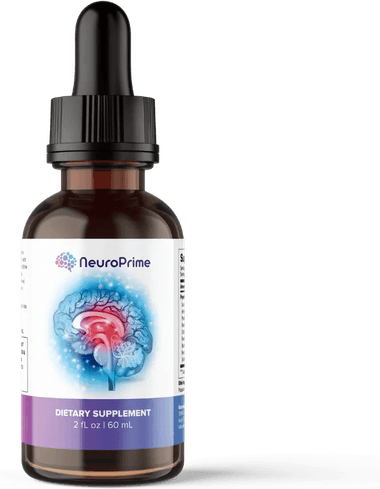
NeuroPrime
Drops
Nine named botanicals, including lion’s mane, bacopa and ginkgo, taken as one drop a day, straight or stirred into a morning drink.
- Readers who already take several pills a day
- Anyone who wants a long refund window
Covered by a 365-day money-back guarantee
Before you start · Ginkgo matters with a blood thinner, and bacopa with thyroid medicine or a sedative.
See NeuroPrime on the official siteRead our NeuroPrime reviewListed in no particular order. We publish no scores or rankings.
Who Should Check Before Starting?
Everyone benefits from the conversation, but for some medicines it should come before the first dose, not after. Each of these has its own guide on this site, so the details are not repeated here.
- A medicine where small changes matter. NCCIH singles out medicines with a narrow range between too little and too much — it names warfarin, digoxin and cancer chemotherapy — as deserving special attention.
- A blood thinner or antiplatelet. See our questions to ask on Eliquis, warfarin or clopidogrel.
- Diabetes medicine. See our guide to berberine, cinnamon and metformin.
- Thyroid medication. See our guide to memory supplements and thyroid medication.
- A statin, blood pressure or heart medicine. See our guide to memory supplements with statins and heart medicines.
Never stop, reduce or change a prescription to make room for a supplement.
What Should You Do After The Conversation?
If you get the go-ahead, add the supplement to your written list straight away, with the date you started. That list now travels to every appointment and every pharmacy, as the FDA advises.
Then give it time. Memory formulas are judged over weeks, not days — the trials behind ingredients such as bacopa ran eight to twelve weeks — so a follow-up question at your next routine visit fits the timeline well. If your doctor asked to recheck anything, put it on the calendar now.
And if the answer was “not with this medicine”, that is useful too. You now know which ingredient names to look for on the next label you read.
When Should You See A Doctor?
Some situations call for an appointment rather than a supplement question. Book one if the forgetting is getting worse month over month, if other people have started to notice it, if it began suddenly, or if it comes with confusion about time or place. Mention, too, if it started around the time a medicine was added or changed.
After starting any supplement, contact your doctor or pharmacist if you notice anything new or unusual, and keep taking your prescriptions exactly as written while you ask. Nothing on this page prevents, treats or reverses any condition.
Ready to compare? Go back to the two formulas above, or read the full reviews of Phytomem One and NeuroPrime.
Frequently asked
Should I tell my doctor about memory supplements?
Yes, every one of them. The FDA notes that some supplements can change how a medicine is absorbed, broken down or cleared. In a 2023 survey of adults 65 and older, the most common reasons people had not mentioned a supplement were that they never thought to tell their doctor, or the doctor never asked. Bring it up yourself.
What should I bring to the doctor about supplements?
A written list of everything you take — prescriptions, over-the-counter medicines, vitamins and supplements — with the dose and how many times a day, as the FDA advises. Add the full ingredient list of the supplement you are considering, either the bottle or a printout of the maker’s page, and a note of when you plan to take it.
Can a pharmacist check supplement interactions?
Yes, a pharmacist can compare an ingredient list with your medicine list, and it is often quicker to arrange than an appointment. If you have a Medicare drug plan and qualify for its Medication Therapy Management program, Medicare.gov explains you can get a review of your medications with a pharmacist or other health professional at no cost.
Is there a free supplement interaction checker?
There are free tools, including the NIH’s HerbList app and Memorial Sloan Kettering’s About Herbs database. Use them to prepare your questions, not to settle them. A 2022 review of ten herb-drug interaction databases found that publicly available ones are mostly outdated or incomplete, so “no interaction found” is not the same as no interaction.
What if the supplement label does not list the amount of each ingredient?
Bring the list anyway. Your pharmacist can still check every ingredient by name, and can tell you whether, for a particular ingredient and medicine, the amount would change the answer.
Should I stop one of my medicines to make room for a supplement?
No. Never stop, skip or change a prescription to make room for a supplement. Keep taking everything exactly as prescribed while you ask your questions, and let the person who prescribed it make any decision about it.
References
- Mixing Medications and Dietary Supplements Can Endanger Your Health — U.S. Food and Drug Administration — 2022
- Disclosure of Complementary and Alternative Medicine Use Among Older Adults: A Cross-Sectional Study — Gerontology & Geriatric Medicine — 2023
- Exploring GP and patient attitudes towards the use and deprescribing of dietary supplements: a survey study in Switzerland — BMC Primary Care — 2024
- Overview of Current Herb-Drug Interaction Databases — Drug Metabolism and Disposition — 2022
- Herb-Drug Interactions, Clinical Digest — NIH National Center for Complementary and Integrative Health — 2024
Disclosure
All content is for informational purposes only and is not a substitute for professional medical advice, diagnosis, or treatment. Each product covered is a dietary supplement, not a prescription drug, and statements about it have not been evaluated by the U.S. Food and Drug Administration. Results vary with individual health status, consistency of use, and lifestyle. This page contains affiliate links — if you buy through them we may earn a small commission at no additional cost to you. Read our disclosure and our editorial policy.