
On Metformin and Forgetting Words? The B12 Test to Ask For, and What to Consider Next
The tablet that helps steady your blood sugar has one well-known effect on a vitamin your nerves depend on. Before anything else, that is worth measuring. Here is the test, and what each result points to.
Quick answer
Forgetting words is not a listed side effect of metformin. But long-term use can lower vitamin B12, and low B12 is one factor that can affect memory. Ask your doctor about a B12 test. If it is low, follow their plan to correct it; if it is normal, look at other causes. Never stop metformin on your own. If you want a formula, there is one for each result below.
You are halfway through a sentence and the word simply is not there. Not a hard word — the name of the street, the thing you use to open the tin. It comes back a minute later, after the conversation has moved on.
You have taken metformin for years, and it does its job. So when you read online that metformin “causes memory loss,” it stings, and it raises a question you do not want to ask out loud: is the medicine doing this?
The honest answer is more useful than a yes or a no. There is one real, well-documented link between long-term metformin and a nutrient your nerves rely on — and it is something your doctor can measure with an ordinary blood test.
Further down, we look at one formula for each B12 result: MemoryFuel and CogniSurge — each with a money-back guarantee.
Can Metformin Cause Memory Problems?
The FDA-approved label, the document that lists what the medicine is known to do, does not list memory loss or confusion among its side effects. The most common ones for metformin tablets are diarrhea, nausea or vomiting, gas, weakness, indigestion, abdominal discomfort and headache. The American Diabetes Association’s 2026 Standards of Care also describe metformin’s principal side effects as digestive.
Two things on the label are still worth knowing. The first is low blood sugar. The label notes that metformin may increase the risk of low blood sugar when it is combined with insulin or with medicines such as sulfonylureas, and Cleveland Clinic lists confusion or trouble concentrating among the early symptoms of low blood sugar, along with shakiness, sweating and hunger.
The second is vitamin B12, which has its own section on the label, and its own section below.
It is also fair to say what the research on metformin and thinking has found, because the headlines tend to run one way. In a 2020 observational study in Diabetes Care, older adults in Sydney with type 2 diabetes who took metformin showed slower decline in overall thinking scores over six years than those with diabetes who did not. The authors wrote that large randomized studies are needed to know whether metformin itself is the reason.
How Does Metformin Lower Vitamin B12?
The NIH Office of Dietary Supplements notes that metformin might reduce the absorption of vitamin B12 and significantly lower blood levels of it. Vitamin B12 helps keep nerve and blood cells healthy.
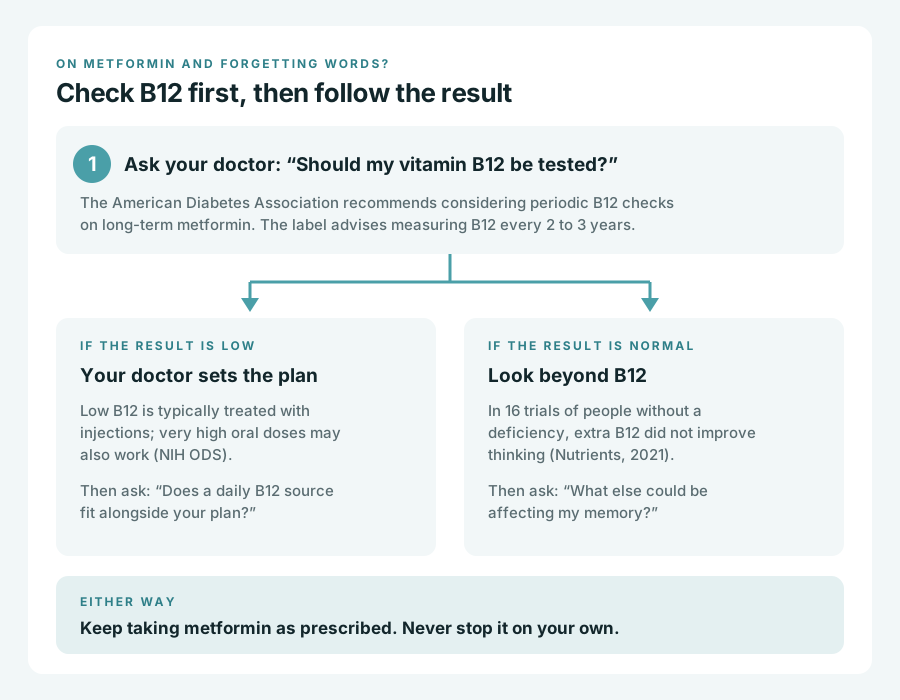
The metformin label puts a number on it. In clinical trials lasting 29 weeks, about 7% of patients whose B12 had been normal saw it fall below the normal range. The label advises measuring B12 at 2 to 3 year intervals in people taking metformin.
The American Diabetes Association calls lower B12 a known consequence of long-term metformin treatment. Its 2026 Standards recommend considering periodic B12 checks for people on long-term metformin, especially those with anemia or nerve symptoms in the hands or feet. The Standards also point to a higher dose (1,500 mg a day or more), longer treatment (4 to 5 years) and other risk factors, and suggest checking every year once someone has taken metformin for more than 4 years.
Age adds to it. Depending on the definition used, the NIH Office of Dietary Supplements says between 3% and 43% of older adults living at home have low B12, partly because absorbing it from food gets harder. Acid reducers such as omeprazole can also interfere with B12 absorption.
And the symptoms can be quiet. Because the body stores a large reserve, the NIH notes that signs of low B12 can take several years to appear. Its consumer fact sheet lists tiredness, numbness or tingling in the hands and feet, problems with balance, confusion and poor memory among them. The National Institute on Aging lists low levels of nutrients such as vitamin B12 among the factors that can cause memory problems.
What B12 Test Should You Ask For?
The usual first step is a blood test for vitamin B12. The NIH Office of Dietary Supplements explains how it is read:
- Serum B12. Most laboratories consider a level below 200 or 250 pg/mL low, although the cutoff varies by laboratory.
- Methylmalonic acid (MMA). This is the most sensitive marker. When B12 falls between 150 and 399 pg/mL, experts suggest checking MMA to help confirm a deficiency. MMA also rises with reduced kidney function and tends to be higher in older adults, which your doctor will factor in.
Three questions make the appointment easy: “Has my B12 been checked since I started metformin?”, “If it is borderline, should we check MMA too?” and, if you take one, “Does my acid reducer matter here?”
Should You Ask About Vitamin D And Magnesium Too?
They are worth raising while you ask about B12, because both often come up next to it when diabetes and brain fog are discussed. The reference sources are clear about what each one was studied for.
Vitamin D. The NIH Office of Dietary Supplements says older adults are at higher risk of low vitamin D, partly because the skin makes less of it with age. Observational studies link lower vitamin D to higher blood sugar, but the office says clinical trials provide little evidence that supplements help control blood sugar or manage type 2 diabetes, especially in people whose levels are already adequate. The American Diabetes Association’s 2026 Standards do not recommend vitamin D supplements for people with diabetes who are not deficient.
On thinking, the best-known trial points the same way. In two studies within the VITAL trial, published in 2021, adults aged 60 and over took 2,000 IU of vitamin D3 a day for two to three years, and their thinking scores changed no differently from those on placebo.
Magnesium. The same NIH office lists people with type 2 diabetes and older adults among the groups more likely to fall short, because diabetes can increase the magnesium lost in urine and absorption drops with age. Acid reducers known as proton pump inhibitors, such as omeprazole, can also lower magnesium when taken for more than a year — the same medicines that can affect B12. For blood sugar itself, the American Diabetes Association does not recommend magnesium supplements.
None of these sources measured brain fog. As with B12, the useful question is whether you are low. So while you are asking about B12, it is fair to add: “Should we check my vitamin D too?” The usual test is 25-hydroxyvitamin D, and most people are considered sufficient at 20 ng/mL or more. If you take one of those acid reducers long term, the FDA advises doctors to consider checking magnesium from time to time.
What If Your B12 Comes Back Low, Or Normal?
If your B12 comes back low
Your doctor sets the plan, and the dose. The NIH Office of Dietary Supplements notes that low B12 is typically treated with injections, and that very high oral doses (1,000 to 2,000 mcg) did about as well as injections at bringing blood levels back up in three small trials, with low-quality evidence. The American Diabetes Association’s advice for B12 on metformin is to monitor and replete as appropriate — keep taking your metformin while that happens.
Once there is a plan, it is reasonable to ask whether a daily B12 source fits alongside it. The NIH advises adults over 50 to get most of their B12 from fortified foods or supplements, because in most cases the body can absorb B12 from those sources.
If your B12 comes back normal
Then B12 is unlikely to be the explanation, and more of it is unlikely to help. A 2021 meta-analysis in Nutrients pooled 16 randomized trials with 6,276 participants who had no overt B12 deficiency and found no effect on any area of cognitive function from B12 alone or with other B vitamins.
The next question is what else could be involved. The National Institute on Aging’s list of factors includes thyroid, kidney or liver problems, medication side effects, sleep problems, depression and anxiety. Your doctor can work through them with you.
If nothing else turns up and you still want to try a memory formula, two features make sense for someone who already manages blood sugar with medicine. The first is no stimulant. The second is no ingredient chosen for blood sugar: the NIH’s complementary health center says herbal supplements such as cinnamon can cause unwanted side effects when used with conventional diabetes drugs, so leaving that territory to your prescription keeps the conversation simpler.
Two formulas that match each path
For the low-B12 path, MemoryFuel names vitamin B12 in the form of methylcobalamin, one of the body’s active forms, alongside vitamin D3, magnesium, choline and creatine. It publishes no amounts, so it belongs in front of your doctor rather than in place of the dose they recommend. For the normal-B12 path, CogniSurge is a stimulant-free capsule whose five named botanicals — schisandra, gotu kola, shilajit, lion’s mane and bacopa — do not include any of the supplements on the NIH complementary health center’s list for diabetes. The full reviews explain each label.
Two formulas worth a closer look
One formula for each test result
Once you know your B12 result, here is a formula that fits each path — each with a money-back guarantee.

MemoryFuel
Powder
For a low result, once your doctor has a plan: a daily powder with vitamin B12 as methylcobalamin, plus vitamin D3, magnesium, choline and creatine.
- A low B12 result, once your doctor has a plan
- Readers who would rather drink than swallow capsules
Covered by a 90-day money-back guarantee
Before you start · If your doctor prescribes a specific B12 dose, follow that first. With kidney disease, ask about creatine and magnesium.
See MemoryFuel on the official siteRead our MemoryFuel review
CogniSurge
Capsules
For a normal result: a stimulant-free capsule built on five named botanicals, including bacopa and lion’s mane, which have modern human trials on memory and attention.
- A normal B12 result, when the fog continues
- Readers who want to avoid caffeine
Covered by a 365-day money-back guarantee
Before you start · Mention bacopa if you take thyroid medicine or a sedative.
See CogniSurge on the official siteRead our CogniSurge reviewListed in no particular order. We publish no scores or rankings.
Who Should Check Before Starting?
- Everyone on metformin. Take the label to the person who prescribes it, and never stop, reduce or change metformin to make room for a supplement.
- If you have kidney disease. Ask about creatine and magnesium before starting a formula that contains them.
- If you take thyroid hormone. A StatPearls review notes that bacopa taken with thyroid hormone may lead to too much thyroid hormone.
How Can You Help A Parent On Metformin?
The steps are the same as your own, and you can make the appointment easier for them.
- Go with them, if they want you there. The National Institute on Aging suggests bringing a family member or friend, who can remind the patient of the questions and take notes on what the doctor says.
- Bring everything they take. The same guide suggests a list with the dose and time of every prescription, over-the-counter medicine, vitamin and supplement — or simply a bag with all of it. Include any formula you are thinking of buying for them.
- Ask the B12 question for them. “Has Mom’s B12 been checked since she started metformin?” The American Diabetes Association suggests checking every year once someone has taken metformin for more than 4 years.
If your parent has read about berberine, the NIH’s complementary health center notes that it may interact with some medicines and advises anyone who takes medicines to talk with their provider first. Memorial Sloan Kettering adds that, in human studies, berberine lowered the activity of liver enzymes that process many common drugs. Neither source gives separate advice for older adults, so the medicine list is the thing to bring.
And the same rule applies to them as to you: nobody should stop or change metformin to make room for a supplement.
When Should You See A Doctor?
Ask for an appointment if you notice numbness or tingling in your hands or feet, problems with balance, or memory problems that are getting worse. Speak to your doctor promptly if confusion comes with shakiness, sweating or a racing heart, which Cleveland Clinic lists among the signs of low blood sugar.
If you think metformin is behind a symptom, keep taking it and tell the person who prescribed it. That conversation, and a B12 result, are the right place to start.
Ready to compare? Go back to the two formulas above, or read the full reviews of MemoryFuel and CogniSurge.
Frequently asked
Does metformin cause memory loss?
Memory loss is not among the side effects listed on the FDA-approved metformin label, where the most common are digestive, along with weakness and headache. But long-term metformin use can lower vitamin B12, and the National Institute on Aging lists low B12 among the factors that can cause memory problems. That is why a B12 test is a sensible first question for your doctor.
Is confusion a side effect of metformin?
Confusion is not among the most common side effects on the metformin label. The label does note that metformin may increase the risk of low blood sugar when it is combined with insulin or medicines such as sulfonylureas, and Cleveland Clinic lists confusion or trouble concentrating among the symptoms of low blood sugar. If confusion comes with shakiness or sweating, speak to your doctor promptly.
Is memory loss on metformin reversible?
It depends on the cause, which is why testing comes first. The National Institute on Aging says finding the cause of memory problems determines the best course of action, and the NIH Office of Dietary Supplements notes that the nerve-related symptoms of low B12 can occur without anemia, so early diagnosis matters. Your doctor can tell you what your own results mean.
What are the symptoms of B12 deficiency from metformin?
Symptoms listed by the NIH Office of Dietary Supplements include tiredness or weakness, pale skin, numbness or tingling in the hands and feet, problems with balance, depression, confusion, poor memory and a sore mouth or tongue. It also notes that symptoms can take several years to appear, because the body stores a large reserve of B12.
Should I take a B12 supplement if I am on metformin?
Ask your doctor, ideally with a test result in hand. The American Diabetes Association recommends considering periodic B12 checks for people on long-term metformin. The NIH Office of Dietary Supplements advises adults over 50 to get most of their B12 from fortified foods or supplements. Keep taking metformin as prescribed either way.
Does vitamin D or magnesium help brain fog with diabetes?
The reference sources did not measure brain fog. The NIH Office of Dietary Supplements says trials give little evidence that vitamin D helps control blood sugar, especially when levels are already adequate, and the American Diabetes Association does not recommend magnesium supplements for blood sugar. Low levels are more common with age and diabetes, so a blood test is the sensible first step.
My dad takes metformin. Should he take a B12 or memory supplement?
Start with his doctor and a B12 test. The American Diabetes Association suggests periodic B12 checks on long-term metformin. The National Institute on Aging suggests bringing a list of every medicine, vitamin and supplement to the visit, or a bag with all of them — include any formula you are considering. He should keep taking metformin as prescribed.
References
- METFORMIN HYDROCHLORIDE tablets — Prescribing Information, DailyMed (U.S. National Library of Medicine) — 2020
- 3. Prevention or Delay of Diabetes and Associated Comorbidities: Standards of Care in Diabetes—2026 — Diabetes Care — 2026
- 9. Pharmacologic Approaches to Glycemic Treatment: Standards of Care in Diabetes—2026 — Diabetes Care — 2026
- Vitamin B12: Fact Sheet for Health Professionals — NIH Office of Dietary Supplements — 2025
- Vitamin B12: Fact Sheet for Consumers — NIH Office of Dietary Supplements — 2023
- Memory Problems, Forgetfulness, and Aging — National Institute on Aging — 2023
- Hypoglycemia (Low Blood Sugar) — Cleveland Clinic — 2026
- Metformin Use Is Associated With Slowed Cognitive Decline and Reduced Incident Dementia in Older Adults With Type 2 Diabetes: The Sydney Memory and Ageing Study — Diabetes Care — 2020
- Effects of Vitamin B12 Supplementation on Cognitive Function, Depressive Symptoms, and Fatigue: A Systematic Review, Meta-Analysis, and Meta-Regression — Nutrients — 2021
- Diabetes and Dietary Supplements: What You Need To Know — NIH National Center for Complementary and Integrative Health — 2023
- Bacopa monnieri — StatPearls, NCBI Bookshelf — 2023
- Vitamin D: Fact Sheet for Health Professionals — NIH Office of Dietary Supplements — 2025
- Magnesium: Fact Sheet for Health Professionals — NIH Office of Dietary Supplements — 2026
- 5. Facilitating Positive Health Behaviors and Well-being to Improve Health Outcomes: Standards of Care in Diabetes—2026 — Diabetes Care — 2026
- Effect of vitamin D on cognitive decline: results from two ancillary studies of the VITAL randomized trial — Scientific Reports — 2021
- Talking With Your Doctor: A Guide for Older Adults — National Institute on Aging — 2021
- Berberine — Memorial Sloan Kettering Cancer Center, About Herbs — 2023
Disclosure
All content is for informational purposes only and is not a substitute for professional medical advice, diagnosis, or treatment. Each product covered is a dietary supplement, not a prescription drug, and statements about it have not been evaluated by the U.S. Food and Drug Administration. Results vary with individual health status, consistency of use, and lifestyle. This page contains affiliate links — if you buy through them we may earn a small commission at no additional cost to you. Read our disclosure and our editorial policy.