
Can’t Swallow Pills? Liquid and Powder Memory Supplements, and How to Take Them
If the capsule is the reason a supplement ended up in the drawer, the format can change. Here is how drops and powders work, what to check first, and when trouble swallowing is a question for your doctor.
Quick answer
If pills are hard to swallow, a memory supplement can come as drops or as a powder stirred into a drink. Follow the label for the serving and the liquid. Never crush a tablet or open a capsule without asking your pharmacist first, and tell your doctor if trouble swallowing is new or getting worse. If you want to try one, two formulas with nothing to swallow whole are compared below.
The glass of water is ready. The capsule sits on your tongue, and your throat simply will not cooperate. You take another sip, and another. Some mornings it goes down. Some mornings you give up and put the bottle back in the cupboard.
If you already take several tablets a day, one more can feel like the one too many. You are not being fussy. MedlinePlus notes that anyone can have a swallowing disorder, but that it is more common in older adults.
This guide covers the two formats that skip the swallow — drops and powders — how to take them, what their labels should tell you, and the one habit to avoid with any pill you already take.
Further down, we look at two formulas with nothing to swallow whole: NeuroPrime and MemoryFuel — each with a money-back guarantee.
Should You Crush Or Open The Pills You Already Take?
Crushing a tablet or opening a capsule can look like the obvious fix, but it is not always a safe one. The Institute for Safe Medication Practices explains that some medicines are made to release slowly over time. If those tablets are crushed or chewed, or the capsules opened, the medicine may go into the body too fast, which can cause harm.
Other tablets have a special coating that protects the stomach or delays absorption. Crushing destroys that coating, so the medicine may be absorbed too fast or stop working as intended. And the same group warns that some of these products have no letters such as ER, XR or SR at the end of their names to warn you.
So the rule is simple: ask your pharmacist before you crush, chew or open anything — a prescription, an over-the-counter medicine or a supplement. The Institute for Safe Medication Practices notes that a pharmacist may be able to suggest a liquid form, another medicine that can be crushed safely, or a smaller tablet.
Second, notice whether the trouble is new. MedlinePlus explains that swallowing problems often happen because of other conditions, and that swallowing treatment with a speech-language pathologist can help. It advises contacting your provider if swallowing problems are getting worse. A different supplement format does not replace that visit.
Trouble with capsules is more common than people say out loud. We looked at the numbers, and at what people most often do about it, on our NeuroPrime comparison page.
Which Supplement Formats Skip The Swallow?
Supplements are not limited to capsules: the NIH Office of Dietary Supplements notes that they come as tablets, capsules, gummies and powders, as well as drinks and bars. Gummies are one more format you will see on the shelf; this guide stays with drops and powders.
Drops
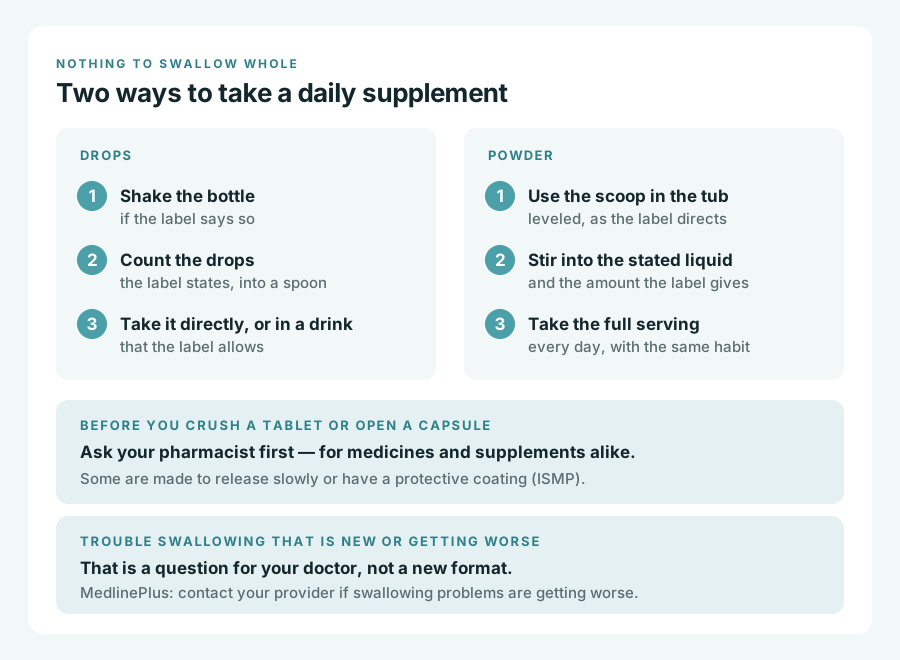
A liquid supplement in a dropper bottle states its serving as a number of drops or a measured dropperful. The label also says whether to shake the bottle, what time of day to take it, and whether it can go straight onto the tongue or into a drink.
Two small habits make drops easier to keep. Count the drops into a spoon or a small glass first, where you can see them. And tie the drop to something you already do every day: the National Institute on Aging notes that some people use meals or bedtime as reminders to take their medicine.
Powders
A powder comes with its own scoop. The label says how many scoops make one serving, what to mix it into and how much of that liquid to use. Use the scoop that came in the tub, level it as the label directs, and stir until it is mixed through.
If a speech-language pathologist or your doctor has given you instructions about drinks, those come first. MedlinePlus advises people with swallowing problems not to drink thin liquids without checking with their provider or therapist.
What Should You Check On A Liquid Or Powder Label?
Four things are worth a look before you buy, because the format changes how you take a supplement, but the label tells you what you are taking:
- The ingredients and amounts. The NIH Office of Dietary Supplements explains that a Supplement Facts label lists the active ingredients, the amount per serving and other ingredients such as flavorings. Where amounts are not printed, a pharmacist can still check the ingredient names.
- The directions. How many drops or scoops, how often, and in what liquid. The same office notes that the manufacturer suggests the serving size, but your health care provider might decide a different amount is right for you.
- How long the container lasts. A bottle or tub sold as a one-month supply tells you when you will need the next one — useful for a routine judged over months.
- A quality seal, if there is one. Seals from groups such as USP, NSF International and ConsumerLab.com show a product was properly made and contains what the label lists. The NIH office notes that they do not guarantee that a product is safe or effective.
What Does The Research Say About The Ingredients?
A drop or a scoop does not change what an ingredient was tested for. Here is what human trials found for three ingredients in the formulas below, and what each study measured, in whom.
Creatine
A 2023 systematic review and meta-analysis in Nutrition Reviews pooled eight randomized trials of creatine and memory in healthy people. The clearest effect was in adults aged 66 to 76. When the authors re-ran the analysis with a corrected method, the overall effect across all ages was no longer significant, and the result in older adults held. Doses ranged from about 2.2 to 20 grams a day, trials lasted from 5 days to 24 weeks, and results varied between them.
Bacopa
A 2026 network meta-analysis in Phytomedicine pooled 29 randomized trials in 2,107 healthy adults. Bacopa at 600 mg a day or more improved working memory compared with placebo, and lower doses improved delayed memory. There were no differences in attention or processing speed, and the authors describe the evidence as promising but limited.
A single trial can land differently. In a 2025 trial in Clinical Drug Investigation, 101 adults aged 40 to 70 with self-reported memory and attention problems took 300 mg of bacopa or a placebo daily for 12 weeks. Cognitive scores did not improve more than with placebo, though stress and fatigue measures did. The study was funded by the company that supplied the extract.
Vitamins B12 and D
These two work differently. A 2021 meta-analysis in Nutrients pooled 16 trials with 6,276 participants and found no effect of vitamin B12 on cognitive function in people without advanced neurological disorders or clear B12 deficiency. Two studies within the VITAL trial, published in 2021, gave adults aged 60 and older 2,000 IU of vitamin D a day and found no difference in cognitive decline over two to three years. Their case rests on keeping levels where they should be, and your doctor can tell you whether a blood test makes sense.
Who Should Check Before Starting?
Take the bottle or tub to your pharmacist or doctor if any of these apply, because a liquid or a powder carries the same interaction questions as a capsule:
- You take a blood thinner, such as warfarin. The NIH’s complementary health center notes ginkgo may increase the risk of bleeding with anticoagulant drugs.
- You take thyroid hormone or have a thyroid condition. A StatPearls review notes bacopa taken with thyroid hormone may lead to too much thyroid hormone, and describes bacopa as mildly sedating.
- You take osteoporosis tablets or certain antibiotics. The NIH Office of Dietary Supplements advises spacing magnesium at least 2 hours from bisphosphonates, and taking some antibiotics at least 2 hours before or 4 to 6 hours after it.
- You have, or are at risk of, reduced kidney function. A 2025 review in Frontiers in Nutrition recommends close monitoring during creatine use for these people, given limited data. It also notes creatine can raise blood creatinine, a common kidney test, without harming the kidneys — so tell your doctor before blood work.
- You take metformin or an acid reducer. The NIH Office of Dietary Supplements notes both can reduce vitamin B12 absorption — useful for your doctor to know.
Never stop, reduce or change a prescription to make room for a supplement.
How Can You Choose For A Parent?
If you are choosing for a mother or father who has started leaving the capsules in the saucer, a few habits make the choice easier on both of you.
- Ask first, and choose together. The National Institute on Aging says the best way to know what an older person needs is to ask them directly, and suggests raising a worry without sounding critical. Then, as far as possible, go with what they want — a drop, a scoop or neither.
- Make it a shared routine, not a secret. A drop in the morning coffee is fine when the label allows it and your parent knows it is there. Their doctor and pharmacist need to know about every supplement they take, and so do they.
- Follow the label on the drink. Some labels allow coffee, tea or juice; others name water and an amount. If the label names only one liquid, ask the pharmacist before using another.
- Do not crush their tablets to get them down. The National Institute on Aging advises telling the pharmacist about trouble swallowing pills, because a liquid form may exist, and not chewing, breaking or crushing tablets without first asking whether it changes how the medicine works.
- Bring one complete list. For appointments, the institute suggests bringing the names, doses and schedule of every medicine, vitamin, herbal remedy and supplement, including those prescribed by other doctors. To speak with your parent’s doctor when they are not there, you will need their written permission; most offices have a form for it.
And if a change in your parent’s memory is the reason you are looking, the same institute notes that occasional forgetfulness is a normal part of aging, but that more significant memory problems, or changes in thinking, personality or decision-making, could point to a condition that needs medical attention. It suggests offering to make the appointment, give a ride or go along. A new format does not replace that visit.
Which Formulas Come As A Drop Or A Scoop?
If you want a memory formula you do not have to swallow, for yourself or for a parent, two on this site come in exactly these formats. NeuroPrime is a liquid taken as one drop a day, preferably in the morning, straight or stirred into tea, coffee, juice or another drink, with the bottle shaken first. It names nine botanicals, including bacopa, ginkgo and lion’s mane. MemoryFuel is a powder: one scoop a day in 6 to 8 ounces of water, with vitamin D3, vitamin B12, magnesium, choline and creatine. Neither publishes the amount of each ingredient, which the full reviews explain.
Two formulas worth a closer look
Two memory formulas with nothing to swallow
A drop or a scoop, each with a money-back guarantee — pick the format that fits your morning.
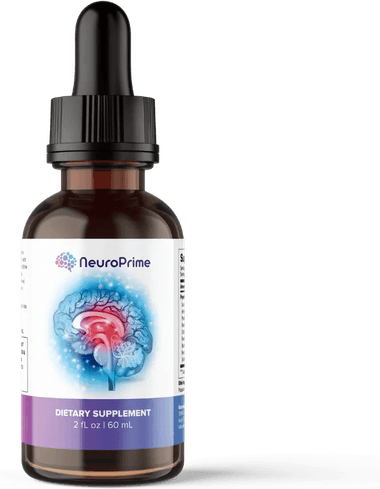
NeuroPrime
Drops
One drop a day, taken straight or stirred into a drink, from a 2 fl oz dropper bottle. Nine botanicals named, including bacopa, ginkgo and lion’s mane.
- Readers who find capsules difficult
- One drop a day, straight or in a drink
Covered by a 365-day money-back guarantee
Before you start · Ginkgo matters with a blood thinner, and bacopa with thyroid medicine or a sedative.
See NeuroPrime on the official siteRead our NeuroPrime review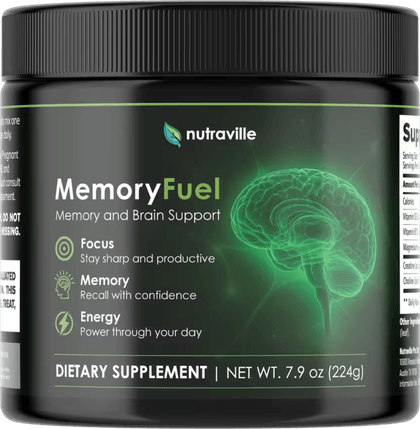
MemoryFuel
Powder
One scoop a day stirred into 6 to 8 ounces of water, from Nutraville, with the form of every ingredient named — including creatine monohydrate.
- Readers who prefer a drink
- Diets light on meat and fish
Covered by a 90-day money-back guarantee
Before you start · With kidney disease, ask about creatine and magnesium first. Magnesium needs spacing from some antibiotics and osteoporosis tablets.
See MemoryFuel on the official siteRead our MemoryFuel reviewListed in no particular order. We publish no scores or rankings.
When Should You See A Doctor About Swallowing?
Trouble swallowing that is new to you deserves an appointment rather than a new format. MedlinePlus advises contacting your provider if swallowing problems do not improve after a few days, or if they come and go.
It advises contacting your provider right away if swallowing problems are getting worse, if you are losing weight, if you have a fever or shortness of breath, if you cough or vomit up blood, or if you feel as if you are choking during or after eating or drinking.
If memory problems are the reason you are looking, the National Institute on Aging notes that finding the cause is what determines the best next step.
Ready to compare? Go back to the two formulas above, or read the full reviews of NeuroPrime and MemoryFuel.
Frequently asked
How to take supplements when you can’t swallow pills?
Look for the supplement as drops, a powder or a drink, and follow the label for the serving and the liquid to use. Do not crush a tablet or open a capsule without asking a pharmacist first: the Institute for Safe Medication Practices explains that some are made to release slowly or have a protective coating, and crushing them can cause harm or make them ineffective.
What can I do if I can’t swallow pills?
Tell your pharmacist and your doctor. For medicines, the Institute for Safe Medication Practices notes there may be a liquid form, another medicine that can be crushed safely, or a smaller tablet. If the trouble swallowing is new or getting worse, MedlinePlus advises contacting your provider, and notes that swallowing treatment with a speech-language pathologist can help.
Can I crush a tablet or open a capsule and mix it into food?
Only if your pharmacist tells you that product can be. Some tablets and capsules are made to release medicine slowly, and crushing, chewing or opening them may send it into the body too fast. Others have a coating that crushing destroys. Some of these products have no letters such as ER or XR on the name to warn you.
Can I mix a supplement powder or drops into coffee or juice?
Follow the label of that product. Some labels name a specific liquid and amount; others allow several drinks. If you have been told to avoid thin liquids because of a swallowing problem, MedlinePlus advises checking with your provider or therapist before drinking them.
Are liquid and powder supplements safe with my medicines?
The format does not settle that — the ingredients do. The FDA notes that certain supplements can change how a medicine is absorbed, broken down or cleared, and advises bringing a list of all your supplements and medicines to every visit. Take the bottle or tub to your pharmacist.
How do I get an elderly parent to take a supplement?
Ask them first and choose together: the National Institute on Aging says the best way to know what an older person needs is to ask them directly, and to go with their wishes as far as possible. A drop or a powder can help if capsules are the problem. Tie it to something they already do, such as a meal, and make sure their doctor and pharmacist know about it.
Are liquid vitamins good for an older parent’s memory?
A liquid changes how a vitamin is taken, not what it does. A 2021 meta-analysis found no effect of vitamin B12 on cognitive function in people without clear B12 deficiency, and two VITAL studies found no difference with vitamin D in adults aged 60 and older. Their role is keeping levels where they should be; your parent’s doctor can say whether a blood test makes sense.
References
- Is It Safe to Crush Medicine Tablets So They Are Easier to Swallow? — Institute for Safe Medication Practices — 2024
- Swallowing Disorders — MedlinePlus, National Library of Medicine — 2025
- Swallowing problems — MedlinePlus Medical Encyclopedia — 2024
- Swallowing difficulty — MedlinePlus Medical Encyclopedia — 2025
- Taking Medicines Safely as You Age — National Institute on Aging — 2022
- Does an Older Adult in Your Life Need Help? — National Institute on Aging — 2023
- Taking Someone to a Doctor’s Appointment: Tips for Caregivers — National Institute on Aging — 2023
- Dietary Supplements: What You Need to Know — NIH Office of Dietary Supplements — 2023
- Effects of creatine supplementation on memory in healthy individuals: a systematic review and meta-analysis of randomized controlled trials — Nutrition Reviews — 2023
- Commentary: The effects of creatine supplementation on cognitive function in adults: a systematic review and meta-analysis — Frontiers in Nutrition — 2026
- Comparative effects of Bacopa monnieri and Ginkgo biloba on cognitive functions: A systematic review and network meta-analysis — Phytomedicine — 2026
- The Effects of a Bacopa monnieri Extract (Bacumen®) on Cognition, Stress, and Fatigue in Healthy Adults: A Randomized, Double-Blind, Placebo-Controlled Trial — Clinical Drug Investigation — 2025
- Effects of Vitamin B12 Supplementation on Cognitive Function, Depressive Symptoms, and Fatigue: A Systematic Review, Meta-Analysis, and Meta-Regression — Nutrients — 2021
- Effect of vitamin D on cognitive decline: results from two ancillary studies of the VITAL randomized trial — Scientific Reports — 2021
- Ginkgo: Usefulness and Safety — NIH National Center for Complementary and Integrative Health — 2025
- Bacopa monnieri — StatPearls, NCBI Bookshelf — 2023
- Magnesium: Fact Sheet for Health Professionals — NIH Office of Dietary Supplements — 2026
- Vitamin B12: Fact Sheet for Health Professionals — NIH Office of Dietary Supplements — 2025
- A short review of the most common safety concerns regarding creatine ingestion — Frontiers in Nutrition — 2025
- Mixing Medications and Dietary Supplements Can Endanger Your Health — U.S. Food and Drug Administration — 2022
- Memory Problems, Forgetfulness, and Aging — National Institute on Aging — 2023
Disclosure
All content is for informational purposes only and is not a substitute for professional medical advice, diagnosis, or treatment. Each product covered is a dietary supplement, not a prescription drug, and statements about it have not been evaluated by the U.S. Food and Drug Administration. Results vary with individual health status, consistency of use, and lifestyle. This page contains affiliate links — if you buy through them we may earn a small commission at no additional cost to you. Read our disclosure and our editorial policy.