
Is a Memory Supplement for Women Different From Any Other?
A bottle sold to women and a plain one can share the same memory ingredients. What can differ is what surrounds them. Here is how to read the difference, and what has actually been studied in women your age.
Quick answer
Usually not in the memory ingredients themselves. Bacopa, ginkgo and creatine have the same research whoever buys them, and only a few small trials looked at women in midlife. What a label sold to women can change is what surrounds them: plant estrogens, iron or caffeine plants. Check those first. Two formulas whose named ingredients include none of them follow below.
It was the neighbour’s name. Twelve years of waving across the driveway, and yesterday it simply was not there. You smiled, said “hi, you”, and spent the evening going through the alphabet in your head. At three in the morning, awake again after a wave of heat, you picked up your phone.
The search results are full of bottles sold to women: softer colours, the word “her” somewhere on the front. You are not sure you need a formula for women. You are not sure you don’t. Mostly you want to know whether the difference is real, or whether it is the colour of the bottle.
This guide answers that by reading what goes inside, group by group, and by showing which ingredients were actually studied in women in their 40s and 50s.
Further down, we look at two formulas whose named ingredients include no plant estrogens and no caffeine plants: NeuroVera and MemoryFuel — each with a money-back guarantee.
Is It Normal For Names To Slip In Your 40s And 50s?
You are in large company. The Menopause Society reports that 40% to 60% of midlife women notice cognitive symptoms such as forgetfulness during the menopause transition. It describes them as difficulty remembering words, names, anecdotes and numbers, trouble focusing, and distractibility, and says the changes are typically mild and within the limits of normal.
Cleveland Clinic explains the mechanism in plain terms: dipping estrogen can affect brain function and cause momentary lapses in recall, and it tends to affect verbal memory in particular, such as remembering words and names. That is why the neighbour’s name goes first, rather than the route home. The same article notes that this kind of fog tends to stay stable or improve.
Hormones are rarely the only thread. Broken sleep from night sweats, stress and a day spent doing four things at once all make recall harder, and they are the parts you can change this week.
What Helps Memory Before Any Supplement?
Before any bottle, three steps from Cleveland Clinic’s advice on menopause and memory cost nothing and work alongside anything you decide later.
- Protect your sleep. If heat wakes you at night, that is worth raising with your doctor in its own right. Our guide to hormone therapy or supplements for brain fog sets out what each option is for.
- Do one thing at a time. Cleveland Clinic notes that multitasking drains mental resources during perimenopause.
- Keep your mind in use. Puzzles, a new language or a creative project are among the activities it suggests.
If you are already past menopause, our guide to brain fog after menopause lists, ingredient by ingredient, whether women past menopause were included in the research.
How Should You Read A Memory Label Sold To Women?
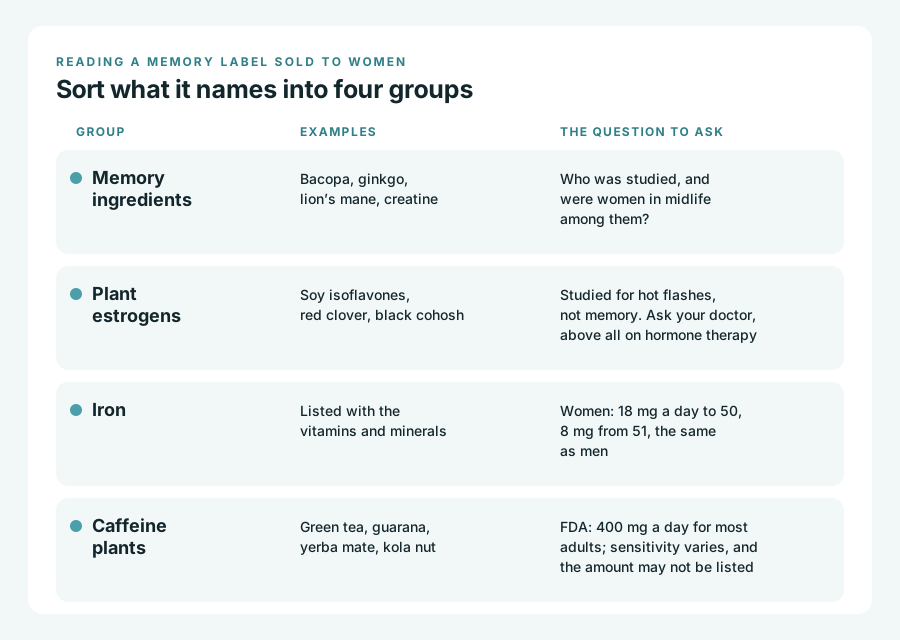
The useful way to read any memory label, whoever it is sold to, is to sort what it names into groups. Only the first group is about memory. The others are where a formula sold to women may differ, and each one comes with its own question.
1. The memory ingredients
Bacopa, ginkgo, lion’s mane, creatine, choline and B vitamins appear in formulas sold to everyone. Their research does not change with the colour of the bottle. The question for this group is the one the next section answers: who was studied, and were women in midlife among them?
2. Plant estrogens
Some labels add plants studied for menopause symptoms. The NIH’s National Center for Complementary and Integrative Health says soy isoflavones may reduce hot flashes slightly, with inconsistent results, and that it is uncertain whether soy affects thinking, because studies conflict. Red clover contains isoflavones similar in structure to estrogen, and its hot-flash studies have been inconsistent. A 2023 review of black cohosh products found possible benefit for overall menopause symptoms, including hot flashes. The same center notes concerns that black cohosh may affect the liver in some people, and advises seeing a provider if dark urine or fatigue appear.
None of the three was studied mainly for memory. If you take hormone therapy, or have been told to avoid estrogen, any of them is a conversation for your doctor before the first dose.
3. Iron
MedlinePlus lists 18 mg of iron a day for women aged 19 to 50 and 8 mg from age 51, the same as for men. A formula built around a younger woman’s needs may carry more iron than you need after your periods stop. If you already take a multivitamin, compare the two labels.
4. Caffeine plants
The FDA cites 400 mg of caffeine a day as an amount not generally linked to negative effects for most adults, and notes that sensitivity varies. It also explains that many supplements state their caffeine voluntarily. A label can name green tea, guarana, yerba mate or kola nut without giving a caffeine figure. Our guide to brain supplements without caffeine lists where it hides.
What Has Been Studied In Women In Midlife?
Of the ingredients you are most likely to see, creatine is the one with a trial in midlife women; here is what the research we could open and verify says about each, and whether women in their 40s and 50s were the people being studied.
Creatine: the one with a trial in midlife women
A 2021 review in Nutrients on creatine in women’s health notes that women have 70% to 80% lower creatine stores than men, and that women have been reported to have lower creatine levels in the brain, particularly the frontal lobe. The authors call creatine use among women understudied.
A 2025 trial in the Journal of the American Nutrition Association then tested it in 36 healthy women in perimenopause or past menopause, average age 50. Over eight weeks, the group taking 1,500 mg a day of creatine hydrochloride had faster reaction times than placebo and higher creatine levels in the front of the brain, and all versions were well tolerated. It is one small trial, of one form of creatine. Our guide to creatine for brain fog after 40 covers the wider research.
Bacopa: women and men together
Bacopa has been tested in mixed groups of adults around midlife, and in the summaries we could read, results were not reported separately for women. A 2025 trial in Clinical Drug Investigation gave 300 mg a day for 12 weeks to 101 adults aged 40 to 70 with memory and attention complaints. It found no difference from placebo on verbal learning, attention or working memory, and less stress reactivity and fatigue after demanding tasks, with more digestive complaints and headaches. The Merck Manual describes an earlier trial in 98 adults aged 55 and over, also 300 mg a day for 12 weeks, with better verbal learning and delayed recall than placebo.
Gotu kola and ginkgo: early or unsettled
Memorial Sloan Kettering notes that a preliminary study of gotu kola suggested benefit for thinking, while a meta-analysis did not find strong enough evidence to support it. For ginkgo, the NIH’s complementary health center says it is uncertain whether it influences cognitive performance in healthy people. We found no recent trial of either in women in perimenopause specifically.
Does A Woman Need A Different Formula?
Not for the memory ingredients, as far as the research goes. They were mostly tested in women and men together, at the same amounts. Our guide to memory supplements for women and men over 50 looks at the one large trial that compared the two.
What does differ is what you bring to the label. Whether you take hormone therapy, a thyroid tablet or an antidepressant. Whether caffeine already sets off your heart or your nights. Whether you are past 51 and need less iron. A formula sold to women can be a good fit or a poor one for those reasons, and a plain one the same.
Why Do These Two Formulas Come Up Here?
These two come up because of what their labels name, and what they do not. Neither is made or sold for women, and neither has been tested in menopause.
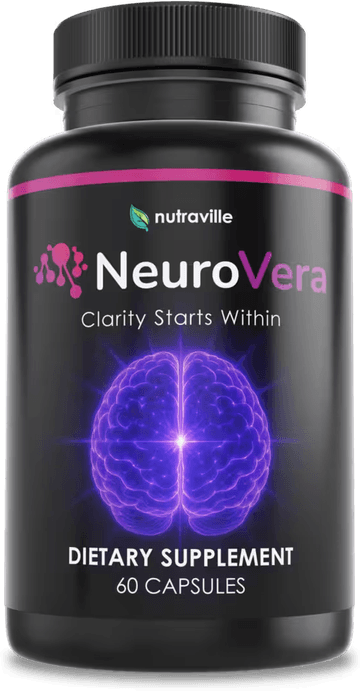
NeuroVera is a capsule built around bacopa and lion’s mane, with gotu kola, schisandra and shilajit alongside. The maker states it contains no stimulants. It is two capsules a day, a bottle can be bought on its own, and the guarantee runs 365 days. Its review covers the lion’s mane research.
MemoryFuel is a powder that names five ingredients: vitamin D3, vitamin B12, magnesium glycinate, choline and creatine monohydrate, the form behind most creatine research, which is not the hydrochloride form used in the midlife trial above. It is one scoop a day in water, and the guarantee runs 90 days.
Neither label names a plant estrogen, iron or a caffeine plant, and neither publishes the amount of each ingredient, which the full reviews explain.
Two formulas worth a closer look
Two formulas with no plant estrogens or caffeine plants named
If you would rather keep hormones and caffeine out of the picture, these two name neither among their ingredients — each with a money-back guarantee.
NeuroVera
Capsules
Two stimulant-free capsules a day built around bacopa and lion’s mane, two ingredients with modern human trials on memory and attention, with gotu kola alongside.
- Readers who want a plant-based formula without stimulants
- Anyone who wants a year to decide
Covered by a 365-day money-back guarantee
Before you start · Mention bacopa if you take thyroid medicine or a sedative, and gotu kola if your medicines are broken down by liver enzymes.
See NeuroVera on the official siteRead our NeuroVera review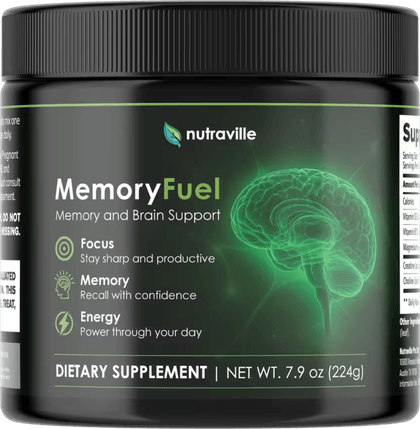
MemoryFuel
Powder
One scoop a day in water: vitamin D3, B12, magnesium and choline, with creatine monohydrate, the form behind most creatine research.
- Readers who would rather drink than swallow capsules
- Anyone who wants creatine in a daily routine
Covered by a 90-day money-back guarantee
Before you start · With kidney disease, ask about creatine first. Magnesium needs spacing from some antibiotics and osteoporosis tablets.
See MemoryFuel on the official siteRead our MemoryFuel reviewListed in no particular order. We publish no scores or rankings.
Who Should Check Before Starting?
Take the label, or a photo of it, to your pharmacist or doctor if any of these apply to you.
- You take thyroid hormone. The Merck Manual advises people taking thyroid hormone medicine not to take bacopa.
- You take a blood thinner, a calcium channel blocker or an antiseizure medicine. The Merck Manual notes bacopa may change blood levels of medicines broken down by liver enzymes, naming warfarin, some calcium channel blockers and antiseizure medicines. Memorial Sloan Kettering notes gotu kola slowed several of the same enzymes in lab studies, with the clinical relevance not yet known.
- You have kidney disease, or are at risk of it. A 2025 safety review in Frontiers in Nutrition recommends close monitoring during creatine use for these people. Creatine can also raise blood creatinine, a common kidney test, so tell your doctor before blood work.
- You take antibiotics or osteoporosis tablets. MedlinePlus advises taking magnesium oxide at least two hours apart from other medicines. Ask your pharmacist how to time a formula with magnesium around yours.
- You take hormone therapy, or have been told to avoid estrogen. Any label with soy, red clover or black cohosh is worth showing your doctor first.
If you take several medicines, our checklist for several medicines shows what to bring. Never stop, reduce or change a prescription to make room for a supplement.
When Should You See A Doctor?
See your doctor if forgetting is getting worse month over month rather than holding steady, if other people have started to notice, if it began suddenly, or if it comes with confusion about time or place; a lost name now and then is common in midlife.
It is also worth an appointment if night sweats are costing you sleep, or if you feel tired all the time. A thyroid check and a conversation about your menopause options both start there.
Ready to compare? Go back to the two formulas above, or read the full reviews of NeuroVera and MemoryFuel.
Frequently asked
Do women’s brain supplements work?
It depends on what is inside, not on who the label is aimed at. The memory ingredients in them, such as bacopa, ginkgo or creatine, have the same research whoever buys the bottle, and most of it enrolled women and men together. Read the label in groups: memory ingredients, plant estrogens, iron and caffeine plants, and judge each group on its own.
Are brain fog supplements for women different?
Sometimes in what surrounds the memory ingredients. A label sold to women may add plant estrogens such as soy, red clover or black cohosh, which were studied for hot flashes rather than memory, or iron, which women need less of from age 51. Those additions are worth checking against your own health and medicines.
What is the best natural memory supplement for women?
No ingredient has been shown to work better for women than for men. A few have been studied in midlife women specifically, the clearest being a small 2025 creatine trial that found faster reaction time. Before choosing, check whether the formula adds plant estrogens or caffeine plants, and pick a routine you can keep for 8 to 12 weeks.
Can I take bacopa during menopause?
The reference sources we checked do not single out menopause. The cautions they list apply to anyone: the Merck Manual lists stomach upset, nausea and dry mouth, and advises people taking thyroid hormone not to take bacopa. If you take any prescription, mention bacopa to your doctor or pharmacist first.
Does ginkgo help memory in perimenopause?
The evidence does not settle it. The NIH’s complementary health center says it is uncertain whether ginkgo influences cognitive performance in healthy people, and that ginkgo may raise the risk of bleeding with blood thinners such as warfarin. Neither formula on this page contains ginkgo.
Is gotu kola good for memory and focus?
The research is early. Memorial Sloan Kettering notes that a preliminary study suggested benefit, while a meta-analysis did not find strong enough evidence to support gotu kola for cognitive function. In lab studies it slowed several liver enzymes that break down medicines, so mention it to your pharmacist if you take prescriptions.
Why do I forget names in my 40s?
For many women it is part of the menopause transition. The Menopause Society reports that 40% to 60% of midlife women notice symptoms such as forgetfulness, including words and names, and calls the changes typically mild. Cleveland Clinic adds that falling estrogen tends to affect recall of words and names, and that this tends to stay stable or improve.
References
- Perimenopause — The Menopause Society — 2025
- Menopause Memory Loss: Should You Be Worried? — Cleveland Clinic — 2025
- Soy: Usefulness and Safety — NIH National Center for Complementary and Integrative Health — 2025
- Red Clover: Usefulness and Safety — NIH National Center for Complementary and Integrative Health — 2025
- Black Cohosh: Usefulness and Safety — NIH National Center for Complementary and Integrative Health — 2024
- Ginkgo: Usefulness and Safety — NIH National Center for Complementary and Integrative Health — 2025
- Iron in diet — MedlinePlus Medical Encyclopedia — 2025
- Spilling the Beans: How Much Caffeine is Too Much? — U.S. Food and Drug Administration — 2024
- Creatine Supplementation in Women’s Health: A Lifespan Perspective — Nutrients — 2021
- The Effects of 8-Week Creatine Hydrochloride and Creatine Ethyl Ester Supplementation on Cognition, Clinical Outcomes, and Brain Creatine Levels in Perimenopausal and Menopausal Women (CONCRET-MENOPA): A Randomized Controlled Trial — Journal of the American Nutrition Association — 2025
- The Effects of a Bacopa monnieri Extract (Bacumen®) on Cognition, Stress, and Fatigue in Healthy Adults: A Randomized, Double-Blind, Placebo-Controlled Trial — Clinical Drug Investigation — 2025
- Bacopa — Merck Manual Professional Edition — 2025
- Gotu Kola — Memorial Sloan Kettering Cancer Center, About Herbs — 2022
- A short review of the most common safety concerns regarding creatine ingestion — Frontiers in Nutrition — 2025
- Magnesium Oxide — MedlinePlus Drug Information — 2024
Disclosure
All content is for informational purposes only and is not a substitute for professional medical advice, diagnosis, or treatment. Each product covered is a dietary supplement, not a prescription drug, and statements about it have not been evaluated by the U.S. Food and Drug Administration. Results vary with individual health status, consistency of use, and lifestyle. This page contains affiliate links — if you buy through them we may earn a small commission at no additional cost to you. Read our disclosure and our editorial policy.