
Hormone Therapy or a Supplement for Brain Fog: What Each One Is For
They are often weighed as if they were two answers to one question. They are not. Here is what each one is prescribed or studied for, what the trials measured, and how to bring both to your next appointment.
Quick answer
They do different jobs. Hormone therapy is prescribed mainly for hot flashes and night sweats, and a 2024 follow-up found no lasting effect on thinking either way. Memory supplements were studied for memory and attention in adults, not for menopause. If night sweats break your sleep, raise them with your doctor. Two stimulant-free formulas are compared below.
It is three in the morning and you are awake again, after a wave of heat that came from nowhere. Earlier that day you stood in front of the fridge with no idea what you had come for, and a name you have known for years would not come.
Your doctor said it is normal at this stage. Part of you is relieved. Another part wants to know what to do about it, and the two options you keep reading about are hormone therapy and a supplement. They tend to be presented as rivals: one the medical route, the other the natural one.
That framing makes the choice harder than it needs to be. The two were developed and tested for different things. Once you know what each one is actually for, the question you take to your appointment gets much clearer.
Further down, we look at two stimulant-free formulas: CogniSurge and NovuBrain+ — each with a money-back guarantee.
Why Does Brain Fog Show Up In Midlife?
Hormone changes, broken nights and other causes common at this age can all play a part, and you are far from alone. The Menopause Society reports that 40% to 60% of midlife women notice cognitive symptoms such as forgetfulness during the menopause transition.
Nights are one thread. The Menopause Society describes night sweats as hot flashes that happen during sleep, and notes that they can contribute to sleep and mood problems. A night broken three times is a hard start to any morning, whatever your age.
Other causes overlap with this stage of life. MedlinePlus notes that an underactive thyroid is more common in women and in people over 50, and lists feeling slowed down among its early symptoms. Its page on memory loss lists depression, the effects of some prescription medicines, and low levels of vitamin B12 among the causes of memory problems.
So hormones are a likely part of the story, and not necessarily the whole of it. That matters for the choice ahead, because hormone therapy and a memory supplement each speak to a different part of that picture.
What Is Hormone Therapy Prescribed For?
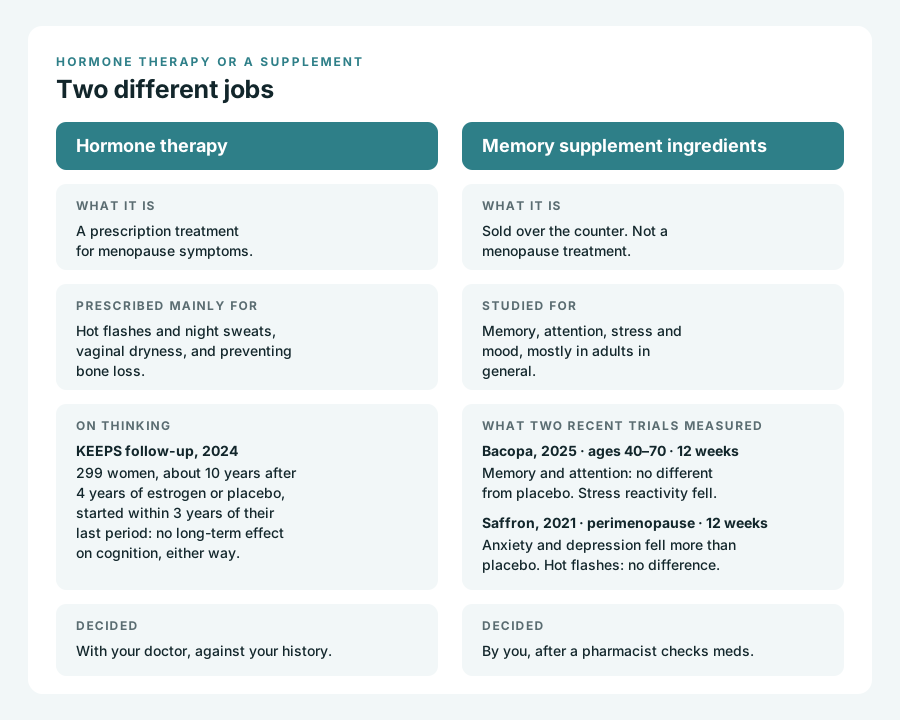
Hormone therapy is prescribed mainly for hot flashes, night sweats, vaginal dryness and bone loss; this page does not recommend for or against it. It is a prescription treatment, and the decision belongs to you and your doctor. Here is what the reference sources say, so you can walk in informed.
The Menopause Society’s 2022 position statement, published under its former name, The North American Menopause Society, calls hormone therapy the most effective treatment for hot flashes and night sweats and for the genitourinary syndrome of menopause, such as vaginal dryness, and notes that it prevents bone loss. For women under 60, or within 10 years of their last period, who have no reason not to take it, it describes the balance of benefit and risk as favorable for bothersome hot flashes. It also says treatment should be individualized and reviewed over time.
If you still have periods, The Menopause Society notes that hormone therapy can cause nuisance breakthrough bleeding. Your doctor will want to know about that, and about your own and your family’s history, before deciding anything.
And on thinking itself?
Some of the most direct evidence for women in early menopause comes from the KEEPS study. Women who were within three years of their last period took estrogen as a pill or a skin patch, or a placebo, for four years. About ten years later, 299 of them were tested again. A 2024 report in PLoS Medicine found no long-term effect of hormone therapy on cognition: no harm, and no benefit. The strongest predictor of later scores was how women scored at the start.
In plain terms: hormone therapy treats the symptoms that can wreck your nights. Whether better nights leave you clearer in the morning is something only you can notice, and it is worth describing to your doctor in exactly those words.
How Are Hot Flashes Treated Without Hormones?
The Menopause Society lists two FDA-approved nonhormone medicines for hot flashes: a low dose of paroxetine, an antidepressant, and fezolinetant, a medicine developed specifically for hot flashes. It adds other prescriptions that doctors use off-label, including certain antidepressants, gabapentin and oxybutynin.
Not every option is a pill. The same page names cognitive behavioral therapy, clinical hypnosis and weight loss. These are worth asking about by name.
Notice what all of these are aimed at: hot flashes and night sweats. If you want something for focus and memory during the day, that is a separate question, and it is the one the next section deals with.
What Did Supplement Trials In Midlife Measure?
Recent midlife trials measured memory, attention, stress and mood. A memory supplement is not a menopause treatment, and the honest way to judge one is to ask what its ingredients were tested for, and in whom. Two ingredients sold in memory formulas have recent trials in people in midlife; bacopa is in both formulas below.
Bacopa. A 2025 trial in Clinical Drug Investigation gave 101 adults aged 40 to 70, who reported memory and attention problems, 300 mg of bacopa a day or a placebo for 12 weeks. Scores for verbal learning, attention and working memory did not improve more than with placebo. Self-reported stress reactivity fell more in the bacopa group, as did fatigue after a demanding task. Stomach complaints and headaches were more common with bacopa.
Saffron. A 2021 trial in the Journal of Menopausal Medicine gave 86 women aged 40 to 60 in perimenopause 14 mg of a saffron extract twice a day or a placebo for 12 weeks. Anxiety and depression scores fell more with saffron. Hot flashes improved about equally in both groups. Thinking and memory were not measured. The study was funded by the maker of the extract.
Read together, those results describe what a memory formula can reasonably be for: a daily routine aimed at focus, stress and mood, judged over 4 to 12 weeks, rather than a replacement for hot flash treatment. If you want the ingredient-by-ingredient view, our guide to brain fog after menopause shows which supplements were tested in women past menopause and which were tested only in adults in general.
One more practical point. If your heart already races during a hot flash, you may prefer to keep caffeine out of the picture. Our guide to caffeine-free memory supplements shows where caffeine hides on a label under plant names.
Can you use both?
They aim at different things, so the question is not either-or. The order matters, though: hormone therapy, or any prescription for hot flashes, is the one your doctor manages, so a supplement gets added to that plan, not the other way round. Bring the label to that conversation. The next section lists what to point out.
Who Should Check Before Starting?
Take the label to your doctor or pharmacist if any of these apply to the formulas below, because being free of caffeine does not make a formula free of interactions:
- You take a beta-blocker, a calcium channel blocker or a prescription memory medicine. Memorial Sloan Kettering lists interactions between huperzine A and prescription memory medicines that work the same way, such as donepezil, with beta-blockers and calcium channel blockers, and with medicines that block dopamine. NovuBrain+ lists huperzine A.
- You take thyroid hormone. The Merck Manual notes that bacopa may increase thyroid hormone levels, and advises people on thyroid hormone medicine not to take it. Both formulas list bacopa.
- You take warfarin, certain blood pressure medicines or seizure medicines. The Merck Manual notes bacopa may change blood levels of medicines processed by the liver’s cytochrome P450 enzymes, naming warfarin, some calcium channel blockers and antiseizure medicines as examples.
- You take warfarin or another blood thinner. NovuBrain+ lists DHA omega-3, which our NovuBrain+ review suggests mentioning to the doctor who manages a blood thinner.
Not a complete list. Never stop, reduce or change a prescription, including hormone therapy, to make room for a supplement.
Which Stimulant-Free Formulas Could Fit This Routine?
If you want a daily formula for focus and memory with no caffeine in it, two on this site are described by their makers as stimulant-free. CogniSurge is built on five traditional botanicals — schisandra, gotu kola, shilajit, lion’s mane and bacopa — taken as two capsules a day with water. NovuBrain+ is two capsules with breakfast, naming seven compounds: bacopa, huperzine A, phosphatidylserine from sunflower, DHA omega-3, L-glutamine, DMAE and vitamin B12. Neither publishes the amount of each ingredient, which the full reviews explain.
Know what these two are and are not. Neither is a hormone therapy, and neither was designed around menopause or tested in women going through it. What they offer is a daily routine aimed at focus and memory, with no stimulant in it, alongside whatever you and your doctor decide about hot flashes.
Two formulas worth a closer look
Two stimulant-free formulas for focus and memory
Both are stated by their makers to be stimulant-free, so caffeine is not part of the routine — and each comes with a money-back guarantee.

CogniSurge
Capsules
Stated by its maker to contain no stimulants, and built on five traditional botanicals including bacopa and lion’s mane, taken as two capsules a day at whatever time suits your routine.
- Readers who want to avoid caffeine
- Anyone who wants a long refund window
Covered by a 365-day money-back guarantee
Before you start · Mention bacopa if you take thyroid hormone or warfarin.
See CogniSurge on the official siteRead our CogniSurge review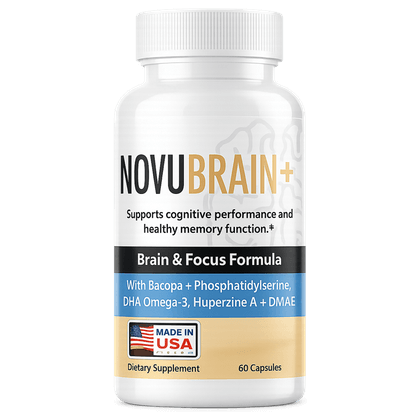
NovuBrain+
Capsules
Described by its maker as caffeine-free and stimulant-free, pairing bacopa and huperzine A with phosphatidylserine from sunflower and DHA omega-3, taken as two capsules with breakfast.
- Readers who avoid soy, since its phosphatidylserine comes from sunflower
- Anyone who prefers a one-time purchase with no auto-ship
Covered by a 60-day money-back guarantee
Before you start · Mention huperzine A if you take heart or prescription memory medicine, and DHA if you take a blood thinner.
See NovuBrain+ on the official siteRead our NovuBrain+ reviewListed in no particular order. We publish no scores or rankings.
When Should You See A Doctor About Menopause Brain Fog?
If hot flashes or night sweats are disturbing your sleep or your days, that alone is a good reason to book a visit: The Menopause Society lists several treatments, with and without hormones. Ask, too, whether a thyroid test, a vitamin B12 level or a review of your medicines makes sense for you.
See a doctor promptly if forgetting is getting worse month over month, if other people have started to notice it, if it comes with confusion about time or place, or if it began suddenly. Those are questions for a clinical visit, not for a supplement.
Ready to compare? Go back to the two formulas above, or read the full reviews of CogniSurge and NovuBrain+.
Frequently asked
Does HRT help menopause brain fog?
Hormone therapy is prescribed mainly for hot flashes, night sweats, vaginal dryness and bone loss. On thinking itself, a 2024 follow-up of women who started hormone therapy within three years of their last period found no lasting effect on cognition, good or bad, about ten years later. If night sweats are breaking your sleep, that is the part to raise with your doctor.
Can supplements help brain fog in perimenopause?
The trials are small and measured different things. In a 2021 trial of 86 women aged 40 to 60 in perimenopause, saffron lowered anxiety and depression scores more than placebo over 12 weeks, but not hot flashes, and thinking was not measured. A 2025 bacopa trial in adults aged 40 to 70 found no difference from placebo on memory or attention, though stress reactivity fell. Give any formula 4 to 12 weeks.
Is it better to try a supplement before asking about HRT?
They are not two versions of the same thing, so one does not have to come before the other. Hormone therapy is a prescription treatment for menopause symptoms, decided with your doctor against your health history. A memory supplement is an over-the-counter product studied for memory and attention in adults. You can raise hot flashes with your doctor and decide on a supplement as a separate question, with the label in hand.
Can I take a memory supplement while on HRT?
Ask the person who prescribes it, and bring the label so they can see every ingredient by name. Some ingredients interact with other medicines: huperzine A, for example, with some heart and memory medicines, according to Memorial Sloan Kettering. Never stop or change your hormone therapy to make room for a supplement.
Is there a non-hormonal treatment for hot flashes?
Yes. The Menopause Society lists two FDA-approved nonhormone medicines for hot flashes, a low dose of the antidepressant paroxetine and fezolinetant, plus other prescriptions used off-label, cognitive behavioral therapy and clinical hypnosis. Your doctor can tell you which fit your health history.
How do I know if my brain fog is menopause or something else?
You cannot tell from the symptom alone, which is why a visit helps. The Menopause Society reports that 40% to 60% of midlife women notice symptoms such as forgetfulness. MedlinePlus notes that an underactive thyroid is more common in women and after 50, and that some medicines and low vitamin B12 can affect memory. A doctor can check those.
References
- Perimenopause — The Menopause Society — 2025
- Hot Flashes — The Menopause Society — 2025
- The 2022 hormone therapy position statement of The North American Menopause Society — Menopause — 2022
- Long-term cognitive effects of menopausal hormone therapy: Findings from the KEEPS Continuation Study — PLoS Medicine — 2024
- Hypothyroidism — MedlinePlus Medical Encyclopedia — 2024
- Memory loss — MedlinePlus Medical Encyclopedia — 2025
- The Effects of a Bacopa monnieri Extract (Bacumen®) on Cognition, Stress, and Fatigue in Healthy Adults: A Randomized, Double-Blind, Placebo-Controlled Trial — Clinical Drug Investigation — 2025
- The Effects of a Saffron Extract (affron®) on Menopausal Symptoms in Women during Perimenopause: A Randomised, Double-Blind, Placebo-Controlled Study — Journal of Menopausal Medicine — 2021
- Bacopa — Merck Manual Professional Edition — 2025
- Huperzia serrata — Memorial Sloan Kettering Cancer Center, About Herbs — 2022
Disclosure
All content is for informational purposes only and is not a substitute for professional medical advice, diagnosis, or treatment. Each product covered is a dietary supplement, not a prescription drug, and statements about it have not been evaluated by the U.S. Food and Drug Administration. Results vary with individual health status, consistency of use, and lifestyle. This page contains affiliate links — if you buy through them we may earn a small commission at no additional cost to you. Read our disclosure and our editorial policy.