
Nutrients Only, No Herbs: Memory Vitamins for Seniors on Medication
When the pill organizer is already full, a plant extract can feel like one unknown too many. Here is what a nutrients-only formula changes, what it does not, and what to ask before the first scoop.
Quick answer
Many people on several medicines prefer nutrients to herbs, because some herbal supplements change how medicines work. Nutrients can interact too: vitamin E with warfarin, and iron or other supplements with some antibiotics and bone medicines. Show the full label to your pharmacist first. Two nutrient-based formulas, one without herbs and one with them, are set out below.
The weekly pill organizer is full before anything new goes in: something for blood pressure, something for cholesterol, the tablet the cardiologist added last year. And then there is the forgetting, the name that will not come, the second trip back to the kitchen.
Plenty of people in that position, or their grown children, reach the same conclusion: if they are going to add anything for memory, they would rather it be a vitamin than a plant extract they cannot place. That instinct has a real basis. It also has a blind spot, and both are worth knowing before you buy.
Further down, we look at two nutrient-based formulas: MemoryFuel, built on nutrients and creatine, and NeuroZoom, which adds botanicals to a vitamin and mineral base — each with a money-back guarantee.
Why Do People On Several Medicines Avoid Herbs?
Because some herbs can change how medicines work, and long medicine lists are common after 65. The CDC’s National Center for Health Statistics reports that the share of adults aged 65 and older who took five or more prescription drugs in the past 30 days rose from 33.3% in 2001–2004 to 43.0% in 2017–March 2020. Every new product is one more thing to fit around that list.
Some supplements change how medicines behave. The FDA notes that certain dietary supplements can change the absorption, metabolism or excretion of a medication. Its best-known example is a herb: St. John’s wort can make some heart disease medicines, depression treatments, transplant drugs and birth control less effective.
Memory herbs are part of that question. A 2021 review in Pharmaceutics examined 170 compounds found in plant-based cognitive enhancers against 10 medicines commonly prescribed to older adults, and concluded that understanding these interactions is warranted to avoid unwanted side effects or a medicine not working as it should.
So preferring a formula without herbs is a reasonable starting point. It simply should not be the end of the check.
Can Vitamins And Minerals Interact With Medicines Too?
Vitamins and minerals have interactions of their own. The difference is that they tend to be well documented and practical to manage, often by timing rather than by avoiding the nutrient.
Timing around bone medicines
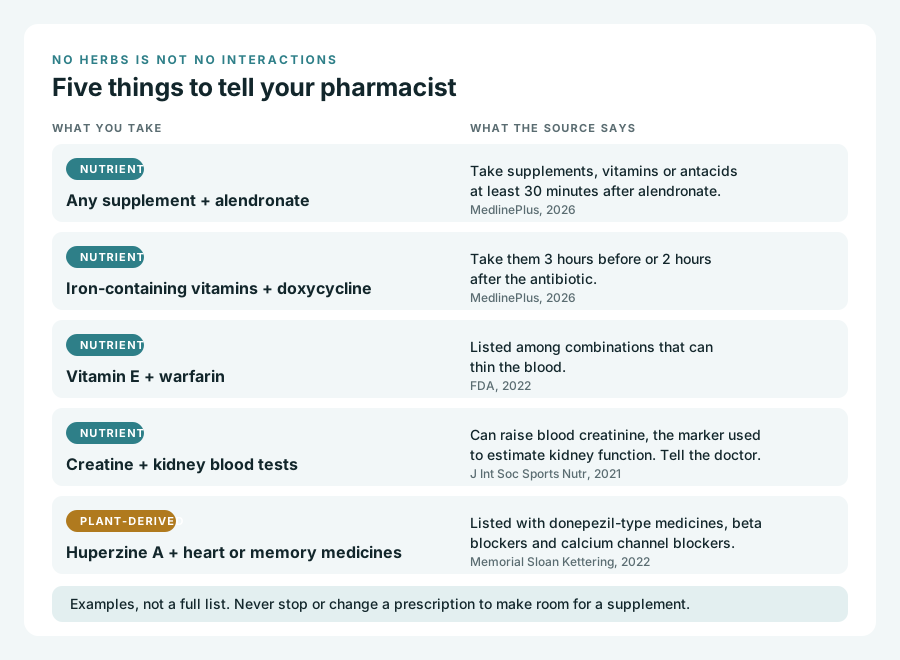
MedlinePlus advises that if you take alendronate, a common osteoporosis tablet, any other medications including supplements, vitamins or antacids should be taken at least 30 minutes after it. A morning vitamin drink taken alongside that tablet is exactly the situation to raise.
Timing around some antibiotics
For doxycycline, MedlinePlus advises taking iron preparations and vitamin products that contain iron 3 hours before or 2 hours after the antibiotic. That matters for broad formulas that include minerals.
Vitamin E and blood thinners
The FDA lists warfarin, ginkgo, aspirin and vitamin E among combinations that can thin the blood. Vitamin E is a nutrient, not a herb, and it appears in many multivitamin-style formulas.
Creatine and kidney blood tests
A 2021 review in the Journal of the International Society of Sports Nutrition notes that creatine can raise blood creatinine, the marker commonly used to estimate kidney function, and that this rise is unlikely to reflect a drop in kidney function in healthy people. The authors advise caution when reading creatinine-based results in people who take creatine. Their conclusions apply to healthy individuals, so kidney disease is a reason to ask first.
What Should You Check Before Buying Anything?
Three steps come before any formula, and none of them costs anything.
- Ask whether a medicine is part of the forgetting. MedlinePlus lists prescription medicines, and the overuse of some, such as opioids or sleeping medicines, among the causes of memory loss, alongside low levels of nutrients such as vitamin B1 or B12. Never stop a medicine to find out; ask the person who prescribed it.
- Ask for a blood test before buying a vitamin to fix a shortfall. Our guide to vitamins for brain fog over 60 lists the tests to ask for, and the one on metformin and vitamin B12 covers that specific link.
- Take every bottle to the pharmacist. Prescriptions, over-the-counter tablets and supplements, together with the label of anything new. Our checklist for people on several medicines sets out the questions to ask.
Do B12, Vitamin D, Magnesium And Creatine Help Memory?
It depends on the nutrient: choosing nutrients over herbs answers the interaction worry, not the memory one. Here is what the trials measured, and in whom.
Vitamin B12. A 2021 meta-analysis in Nutrients pooled 16 randomized trials with 6,276 participants who did not have advanced neurological disorders. It found no evidence that B12, alone or with other B vitamins, improved any area of cognitive function. Its value depends on whether you are low to begin with.
Vitamin D. Two studies within the VITAL trial, published in Scientific Reports in 2021, gave older adults, average age about 71, 2,000 IU of vitamin D3 a day or a placebo. Over two to three years, there was no overall difference in cognitive decline.
Creatine. A 2023 meta-analysis of ten randomized trials in Nutrition Reviews found that creatine improved measures of memory compared with placebo in healthy people, most clearly in older adults aged 66 to 76. The trials were few and small, and their doses and lengths varied. Our article on creatine and brain fog goes further into them.
A broad multivitamin. The largest positive result here belongs to a plain daily multivitamin-mineral, not a herbal formula. In a 2023 trial in the American Journal of Clinical Nutrition, 3,562 older adults took a daily multivitamin-mineral or a placebo for three years, and the multivitamin group did better on memory.
Magnesium. This guide did not find a memory trial of magnesium on the scale of the ones above. For someone on several medicines, the useful question about magnesium is the timing one covered earlier.
The honest summary: a nutrients-only formula has a coherent rationale and two encouraging lines of research behind it, creatine and the broad multivitamin, while B12 and vitamin D help most when a test shows you are low. The window to judge any of them is weeks to months, not days.
Which Nutrient-Based Formulas Could Fit This Routine?
Two formulas on this site build on everyday nutrients, and they answer the herb question differently, so it is worth being exact.
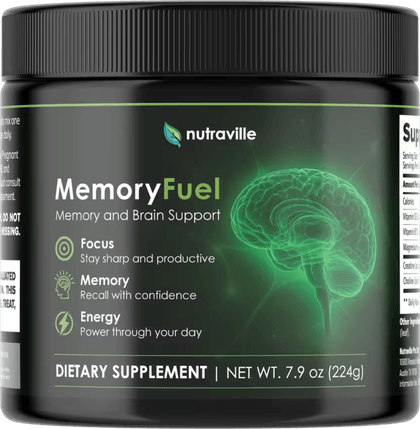
MemoryFuel is a powder stirred into water. The five ingredients its sales page names are vitamin D3, vitamin B12 as methylcobalamin, magnesium glycinate, choline and creatine monohydrate: nutrients plus creatine, with no plant extract among them. The same page refers to six ingredients while naming five, so if you avoid herbs because of your medicines, bring the label from the tub itself to your pharmacist. Its comparison page looks at which of those nutrients you may already get from food.
NeuroZoom is a capsule with a broad base of nineteen named vitamins and minerals, including iron, zinc, selenium and vitamin E. It also contains herbal and plant-derived ingredients: huperzine A, bacopa, and extracts of green tea, olive leaf, licorice, bilberry, cinnamon bark and grapefruit seed. It suits someone who wants a vitamin and mineral base and is comfortable with botanicals once their pharmacist has seen the list.
Neither publishes the amount of each ingredient, so neither label can be lined up against a prescribed dose or a lab result. The full reviews explain what each label shows.
Two formulas worth a closer look
Two nutrient-based formulas, one without herbs and one with
Both build a daily routine on everyday nutrients, and only one adds botanicals — each with a money-back guarantee.
MemoryFuel
Powder
One scoop a day in water. The five ingredients its sales page names are vitamin D3, vitamin B12, magnesium glycinate, choline and creatine, which has a memory result in adults 66 to 76, with no plant extract among them.
- Readers who would rather keep herbs out of their routine
- Anyone who prefers a drink to another capsule
Covered by a 90-day money-back guarantee
Before you start · Space it from alendronate, and mention the creatine before kidney blood tests or if you have kidney disease.
See MemoryFuel on the official siteRead our MemoryFuel review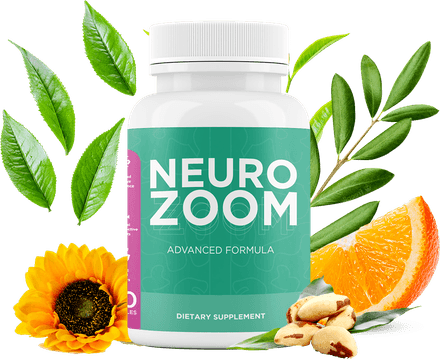
NeuroZoom
Capsules
A capsule with nineteen named vitamins and minerals, the kind of broad base a large multivitamin trial measured, plus huperzine A, bacopa and other botanicals.
- Readers who want a vitamin and mineral base and are open to botanicals
- Anyone not already taking a multivitamin
Covered by a 60-day money-back guarantee
Before you start · Huperzine A matters with donepezil-type and heart-rate medicines, and vitamin E with warfarin.
See NeuroZoom on the official siteRead our NeuroZoom reviewListed in no particular order. We publish no scores or rankings.
Who Should Check Before Starting?
Take the label, or a photo of it, to your pharmacist or doctor if any of these apply.
- You take alendronate or a similar bone tablet. MedlinePlus advises taking supplements and vitamins at least 30 minutes after it.
- You are prescribed doxycycline. Vitamin products that contain iron go 3 hours before or 2 hours after it, according to MedlinePlus.
- You take warfarin or another blood thinner. The FDA lists vitamin E with warfarin among combinations that can thin the blood.
- You have kidney disease, or your kidney function is checked regularly. Creatine can raise blood creatinine, so the person reading your results needs to know.
- You take a memory medicine such as donepezil, a beta blocker or a calcium channel blocker. Memorial Sloan Kettering notes that huperzine A may add to the side effects of cholinesterase inhibitors, and may slow the heart rate further with calcium channel blockers or beta blockers.
Never stop, reduce or change a prescription to make room for a supplement.
What Should You Do If You Are Buying For A Parent?
If you are the son or daughter doing the buying, three things keep it straightforward. Bring the full list of what your parent takes, including anything bought without a prescription. Put the new label in front of their pharmacist before the first dose. And make it a choice your parent knows about and agrees to: a routine they understand is one they keep, and one their doctor can see. Our checklist has a section for people who manage a parent’s medicines.
When Should You See A Doctor?
Make an appointment before starting anything if memory has been getting worse month over month, if family or friends have noticed, or if it began suddenly. Ask, too, whether any current medicine could be playing a part. Nothing on this page prevents, treats or reverses any condition.
Ready to compare? Go back to the two formulas above, or read the full reviews of MemoryFuel and NeuroZoom.
Frequently asked
Are there memory supplements without herbs?
Yes. Some formulas are built only on vitamins, minerals and compounds such as creatine or choline, with no plant extracts. Read the full ingredient list rather than the front of the bottle, because a "vitamin" formula can still include botanicals further down the panel, and take the label to your pharmacist before you start.
Can vitamins interact with my medications?
Some can. The FDA lists vitamin E alongside warfarin, aspirin and ginkgo among combinations that can thin the blood. MedlinePlus advises taking supplements and vitamins at least 30 minutes after alendronate, and vitamin products that contain iron 3 hours before or 2 hours after doxycycline. Your pharmacist can check your own list.
Is creatine OK for seniors on medication?
Ask your doctor first, especially if you have kidney disease or take medicines that affect the kidneys. A 2021 review notes that creatine can raise blood creatinine, the marker used to estimate kidney function, without meaning the kidneys are working less well. Tell whoever orders your blood work that you take it.
Do vitamin D and B12 help memory in older adults?
When levels are low, correcting them is a medical job with a blood test behind it. When levels are normal, trials have not found a benefit: a 2021 meta-analysis of 16 trials found no effect of B12 on cognitive function, and vitamin D3 at 2,000 IU a day made no difference to cognitive decline over two to three years in a large trial of older adults.
Does magnesium help memory in seniors?
This guide did not find a memory trial of magnesium on the scale of the vitamin and creatine trials it describes. For someone on several medicines, the practical question about magnesium is timing: some medicines, such as alendronate, need to be taken apart from supplements.
What should I check before buying a memory supplement for my parent?
Bring every bottle your parent takes, prescription and not, to their pharmacist with the new label, and ask about each ingredient. Make it a decision your parent agrees to and knows about, never something added to their routine quietly. If their memory has been getting worse, an appointment comes before any bottle.
References
- Prescription Drug Use — Health, United States, CDC National Center for Health Statistics — 2024
- Mixing Medications and Dietary Supplements Can Endanger Your Health — U.S. Food and Drug Administration — 2022
- Potential Herb–Drug Interactions in the Management of Age-Related Cognitive Dysfunction — Pharmaceutics — 2021
- Alendronate — MedlinePlus Drug Information, National Library of Medicine — 2026
- Doxycycline — MedlinePlus Drug Information, National Library of Medicine — 2026
- Memory loss — MedlinePlus Medical Encyclopedia — 2025
- Common questions and misconceptions about creatine supplementation: what does the scientific evidence really show? — Journal of the International Society of Sports Nutrition — 2021
- Huperzia serrata (Huperzine A) — Memorial Sloan Kettering Cancer Center, About Herbs — 2022
- Effects of Vitamin B12 Supplementation on Cognitive Function, Depressive Symptoms, and Fatigue: A Systematic Review, Meta-Analysis, and Meta-Regression — Nutrients — 2021
- Effect of vitamin D on cognitive decline: results from two ancillary studies of the VITAL randomized trial — Scientific Reports — 2021
- Effects of creatine supplementation on memory in healthy individuals: a systematic review and meta-analysis of randomized controlled trials — Nutrition Reviews — 2023
- Multivitamin Supplementation Improves Memory in Older Adults: A Randomized Clinical Trial — The American Journal of Clinical Nutrition — 2023
Disclosure
All content is for informational purposes only and is not a substitute for professional medical advice, diagnosis, or treatment. Each product covered is a dietary supplement, not a prescription drug, and statements about it have not been evaluated by the U.S. Food and Drug Administration. Results vary with individual health status, consistency of use, and lifestyle. This page contains affiliate links — if you buy through them we may earn a small commission at no additional cost to you. Read our disclosure and our editorial policy.