
Vitamins for Brain Fog Over 60: B12, Vitamin D, Magnesium, and the Blood Tests to Ask For First
Before you buy a vitamin for a foggy head, it is worth knowing which shortfalls a simple blood test can find — and which other causes to rule out first.
Quick answer
Low vitamin B12 is one cause of memory problems that a blood test can find, and vitamin D and magnesium run low more often after 60. Before taking anything, ask your doctor about testing and about other causes: sleep, stress, thyroid problems and medicines. Trials have not found that extra B12 or vitamin D sharpens thinking when levels are normal. If you want to try one, two nutrient-based formulas are compared below.
It is rarely one dramatic moment. It is walking into the kitchen and standing there. It is a name that arrives an hour after the conversation ended, or a page you read twice before it sinks in. After 60, it is easy to shrug and call it age.
Sometimes it is. But a few of the things that cloud thinking can be measured, and some are simple to correct once they are found. That is why the order matters: find out first, then decide what, if anything, to take.
Further down, we look at two nutrient-based formulas: MemoryFuel and NeuroZoom — each with a money-back guarantee.
What Deficiency Causes A Foggy Brain?
Low vitamin B12 can be one cause, though “brain fog” is not a diagnosis and has many possible causes. The National Institute on Aging lists low levels of important nutrients, such as vitamin B12, among the factors that may cause memory problems — alongside thyroid problems, medication side effects, sleep problems, and depression and anxiety. When a medical condition is behind it, the institute notes, memory problems usually go away once that condition is successfully treated.
Vitamin B12 — the clearest link to the nervous system
The NIH Office of Dietary Supplements explains that the central nervous system needs vitamin B12 to work properly. Depending on the definition used, between 3% and 43% of older adults living at home are deficient. Trouble absorbing B12 from food is one cause, and long-term use of metformin or acid-reducing proton pump inhibitors is another. A shortfall can also cause numbness and tingling in the hands and feet, sometimes without anemia.
Vitamin D — a nutrient the skin makes less of with age
Older adults are at increased risk of low vitamin D, partly because the skin’s ability to make it declines with age, and partly because they tend to spend more time indoors.
Magnesium — lower intake, lower absorption
Older adults eat less magnesium than younger adults, absorb less of it and lose more through the kidneys, the same office notes. In national surveys, men aged 71 and older are among the groups most likely to fall short through diet.
Which Blood Tests Should You Ask For First?
These are the checks to raise at your next appointment, and what the NIH Office of Dietary Supplements says each one can and cannot tell you.
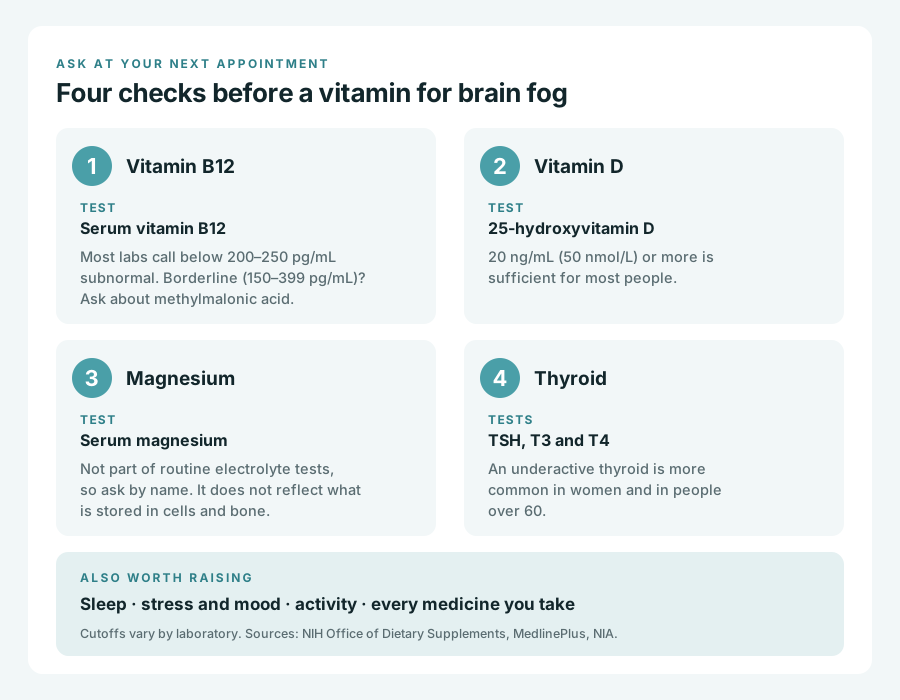
- Vitamin B12. A serum or plasma B12 level is the usual test. Most laboratories consider values below 200 or 250 pg/mL subnormal, though the cutoff varies by method and lab. Experts suggest also checking methylmalonic acid when B12 falls between 150 and 399 pg/mL, because it is the most sensitive marker — with the caveat that it also rises with kidney problems and tends to be higher in older adults.
- Vitamin D. The main measure is serum 25-hydroxyvitamin D. The Food and Nutrition Board considers 20 ng/mL (50 nmol/L) or more sufficient for most people, with the risk of deficiency rising below 12 ng/mL (30 nmol/L).
- Magnesium. A serum magnesium test is the most common, but the Office of Dietary Supplements notes that it has little correlation with the magnesium stored in your cells and bones, and that magnesium is not evaluated during routine electrolyte testing. So ask for it by name, and expect your doctor to weigh it alongside your diet and medicines.
- Thyroid. MedlinePlus lists TSH, T3 and T4 blood tests among the tools used to diagnose an underactive thyroid.
What If Your Blood Tests Come Back Normal?
A normal result is useful news, not the end of the search. These everyday causes are just as worth a look.
- Sleep. The National Institute on Aging says older adults need about the same sleep as other adults, seven to nine hours a night, and that a lack of quality sleep can lead to problems with memory.
- Stress and mood. The institute notes that major life events, such as retiring or losing a spouse, can leave people confused or forgetful, usually for a while. If memory problems last beyond a few weeks, it advises talking with your doctor.
- Movement. The CDC says regular physical activity can help keep your thinking, learning and judgment skills sharp as you age, and can help you sleep better. For adults 65 and older, it recommends at least 150 minutes a week of moderate activity, plus muscle-strengthening on at least 2 days and activities for balance.
- Thyroid. MedlinePlus notes that people older than 60, and women, are at higher risk of an underactive thyroid, that symptoms can include fatigue and depression, and that because it develops slowly, many people don’t notice symptoms for months or even years.
- Medicines. Medication side effects are on the institute’s list too. If you take several, our memory supplement checklist for people on several medicines covers which types to ask about. Never stop a medicine before talking with the person who prescribed it.
What Causes Brain Fog And Tiredness Together?
Several shortfalls that a blood test can find cause both at once, and it is a common pairing. It is not only an over-60 question, either: the same checks apply in your 40s and 50s, and they matter just as much if you are still working.
- Vitamin B12. The NIH Office of Dietary Supplements lists fatigue among the symptoms of deficiency, alongside nerve changes such as numbness and tingling. Because the body stores B12, the symptoms can take several years to appear.
- Iron. The same office notes that people with iron deficiency anemia may have weakness, fatigue and difficulty concentrating. The National Heart, Lung, and Blood Institute lists heavy menstrual periods, and regular use of aspirin or anti-inflammatory painkillers such as ibuprofen, among the causes. Mild or moderate iron deficiency anemia may cause no symptoms at all. The check is a blood test: a complete blood count, hemoglobin, blood iron and ferritin. Iron is not one to take on a hunch: the Office of Dietary Supplements notes that some people, such as those with hereditary hemochromatosis, absorb too much of it.
- Magnesium. Fatigue and weakness are among the early signs of magnesium deficiency, the office notes, along with loss of appetite and nausea. As covered above, the usual blood test has limits, so your doctor will weigh it with your diet and medicines.
- Vitamin D. The link is less direct. The office’s fact sheet ties low vitamin D to muscle weakness and pain rather than to tiredness itself, and the trials below found no difference in thinking.
- Thyroid. MedlinePlus lists fatigue or feeling slowed down, and weakness, among the early symptoms of an underactive thyroid. It is checked with TSH and free T4 blood tests.
Will a vitamin fix the tiredness? Usually only if you were low. The Office of Dietary Supplements notes that B12 is often promoted as an energy enhancer, but that it appears to do nothing for performance or endurance in people who are not deficient. A 2021 meta-analysis found only one trial of B12 for fatigue, too few to analyze. So the order stays the same: the test first, then the supplement, if any.
What Does The Research Say About Vitamins And Memory?
Vitamin B12. A 2021 meta-analysis in Nutrients pooled 16 randomized trials with 6,276 participants who did not have advanced neurological disorders or an obvious deficiency. It found no evidence that B12, alone or with other B vitamins, improved any area of cognitive function. The Office of Dietary Supplements summarizes the trials the same way for older adults.
Vitamin D. Two studies within the large VITAL trial, published in Scientific Reports in 2021, gave adults aged 60 and older 2,000 IU of vitamin D3 a day or a placebo. Over two to three years, there was no difference in cognitive decline between the groups.
A daily multivitamin. One broad formula has a large positive memory trial. In a 2023 study in the American Journal of Clinical Nutrition, 3,562 adults aged 60 and older took a daily multivitamin or a placebo for three years. The multivitamin group scored better on a word-recall memory test after one year and across the three years, with no significant differences on the other tasks measured. One of the study’s investigators stressed that a multivitamin is not a substitute for a healthy diet.
So the honest summary is this: correcting a deficiency is a medical job with a clear test behind it, while topping up levels that are already normal has not been shown to sharpen memory.
How much vitamin B12, vitamin D or magnesium?
This page will not give you a dose, because the right one depends on your blood test. What the NIH Office of Dietary Supplements publishes are the everyday reference amounts for adults 51 and older:
- Vitamin B12: 2.4 micrograms a day. No upper limit has been set, because of its low potential for harm. If a test shows a deficiency, the fact sheet notes it is typically treated with injections, and that high oral doses might also work — the form and the amount are your doctor’s decision.
- Vitamin D: 600 IU a day up to age 70, and 800 IU after 70. The upper limit for adults is 4,000 IU, and the Food and Nutrition Board noted that even intakes below that limit might have adverse effects over time — one more reason to test before taking more.
- Magnesium: 420 mg a day for men and 320 mg for women, counting food. The upper limit for magnesium from supplements is 350 mg, and high doses often cause diarrhea, nausea and cramping.
What Should You Look For Before You Buy?
If you have decided a formula is worth trying, these are the things to confirm before you order.
- Your blood test results first. They tell you whether a nutrient formula is aimed at a real gap.
- The form of each vitamin, named on the label. For example, vitamin B12 as methylcobalamin or cyanocobalamin, and vitamin D as D3 or D2.
- Your total from every product. Vitamins in a formula add to those in a multivitamin or a single-nutrient bottle, so add up the labels.
- A dose your doctor agrees with. If a test shows a deficiency, the amount to take is your doctor’s decision.
Where Do Nutrient Formulas Fit?
If your tests come back normal and you would still like a daily nutrient routine — or your doctor is comfortable with one alongside their plan — two formulas on this site are built on nutrients.
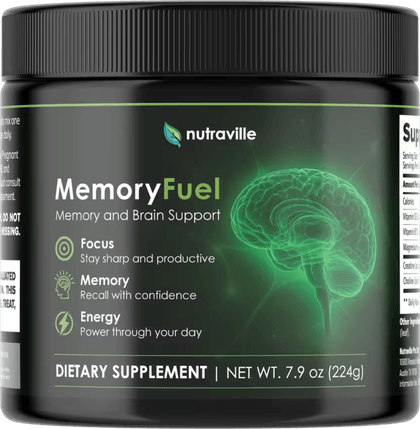
MemoryFuel is a powder that names vitamin B12 as methylcobalamin, vitamin D3, magnesium glycinate and choline, plus creatine monohydrate — the ingredient in it with a memory result of its own, clearest in adults aged 66 to 76 in a 2023 meta-analysis. Its comparison page looks at which of those nutrients you may already get from food.
NeuroZoom is a capsule whose named ingredients include nineteen vitamins and minerals — magnesium, several B vitamins including B6, and vitamins C and E among them — alongside compounds such as bacopa, phosphatidylserine and huperzine A. Vitamin B12 and vitamin D are not among the names on its sales page, so a low result for either is its own conversation with your doctor.
Neither publishes the amount of each ingredient, so neither label can be lined up against a lab result or a prescribed dose. The full reviews explain what each label shows.
Two formulas worth a closer look
Two nutrient-based formulas
Once your tests are back and your doctor agrees, these two bring everyday nutrients into one daily step — each with a money-back guarantee.
MemoryFuel
Powder
One scoop a day in water, naming vitamin B12 as methylcobalamin, vitamin D3, magnesium glycinate and choline — plus creatine, which has a memory result in adults 66 to 76.
- Readers who prefer a drink
- Anyone who wants B12, vitamin D3 and magnesium in one scoop
Covered by a 90-day money-back guarantee
Before you start · If a test finds a deficiency, follow your doctor’s dose first. Magnesium needs spacing from some antibiotics and osteoporosis tablets.
See MemoryFuel on the official siteRead our MemoryFuel review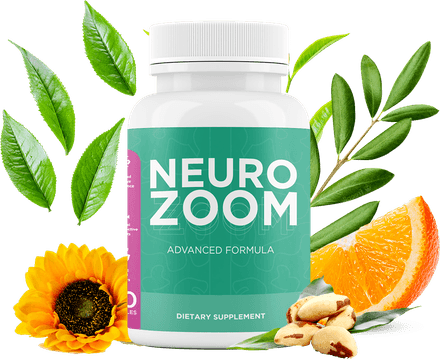
NeuroZoom
Capsules
A capsule with a broad base of nineteen named vitamins and minerals, including magnesium and B vitamins, plus bacopa, phosphatidylserine and huperzine A.
- Readers who want a vitamin and mineral base plus memory nutrients
- Once-a-day routines
Covered by a 60-day money-back guarantee
Before you start · Huperzine A matters with cholinesterase inhibitors and heart-rate medicines. If you already take a multivitamin, compare the two labels.
See NeuroZoom on the official siteRead our NeuroZoom reviewListed in no particular order. We publish no scores or rankings.
Who Should Check Before Starting?
Take the label, or a photo of it, to your pharmacist or doctor if any of these apply to you.
- You take metformin or an acid reducer. The NIH Office of Dietary Supplements notes both can lower vitamin B12 over time — worth a test, and worth your doctor knowing.
- You take osteoporosis tablets or certain antibiotics. The same office advises taking magnesium at least 2 hours apart from bisphosphonates, and taking tetracycline or quinolone antibiotics at least 2 hours before or 4 to 6 hours after it. It also notes that diuretics and proton pump inhibitors can affect magnesium levels.
- You take a cholinesterase inhibitor or a heart-rate medicine. Memorial Sloan Kettering notes huperzine A may add to the side effects of cholinesterase inhibitors such as donepezil, and may lower heart rate with calcium channel blockers or beta blockers.
Never stop, reduce or change a prescription to make room for a supplement.
When Should You See A Doctor?
Make an appointment, rather than starting a vitamin, if your memory or thinking has been getting worse, if people close to you have noticed, or if it comes with numbness or tingling in your hands or feet. The National Institute on Aging notes that finding the cause of memory problems is what determines the best course of action — and a few blood tests are a simple place to start.
Ready to compare? Go back to the two formulas above, or read the full reviews of MemoryFuel and NeuroZoom.
Frequently asked
What vitamins help with brain fog?
It depends on whether you are low in one. The National Institute on Aging lists low levels of nutrients such as vitamin B12 among the causes of memory problems, and a blood test can show it. In people whose levels are already normal, trials have not found that extra vitamin B12 or vitamin D improves thinking. Ask your doctor about testing first.
How much vitamin B12 should I take for brain fog?
That is a question for your doctor, and it depends on a blood test. The NIH Office of Dietary Supplements lists the recommended daily intake for adults as 2.4 micrograms. If a test shows a deficiency, the amount and the form of treatment — injections or high oral doses — are your doctor’s decision.
What vitamin deficiency makes you forgetful?
Vitamin B12 is the one the National Institute on Aging names among the factors that can cause memory problems. The NIH Office of Dietary Supplements adds that low B12 can also cause numbness and tingling in the hands and feet, sometimes without anemia. Other causes, such as thyroid problems, poor sleep and medicine side effects, can feel similar, so a doctor’s check is the reliable way to know.
What causes brain fog in seniors?
Many things. The National Institute on Aging lists thyroid, kidney or liver problems, medication side effects, depression and anxiety, alcohol misuse, sleep problems and low nutrients such as vitamin B12. Stressful life events, such as retirement or losing a spouse, can also leave people forgetful for a while. Finding the cause is what points to the right next step.
Can I take vitamin B12 or magnesium with my medicines?
Ask your pharmacist or doctor first, and bring the label. The NIH Office of Dietary Supplements notes that metformin and acid reducers can lower vitamin B12 over time, and that magnesium should be taken at least 2 hours apart from osteoporosis tablets called bisphosphonates. Never stop or change a prescription to make room for a supplement.
What is the best vitamin for brain fog and fatigue?
The one you are actually low in. The NIH Office of Dietary Supplements lists fatigue among the signs of low vitamin B12, iron and magnesium, and notes that iron deficiency anemia can also make it hard to concentrate. A thyroid problem can feel similar. Blood tests show which, if any, applies. When levels are normal, extra B12 has not been shown to improve thinking.
Does vitamin D help brain fog and fatigue?
The research we found does not show that. The NIH Office of Dietary Supplements links low vitamin D to muscle weakness and pain, and in two studies within the VITAL trial, 2,000 IU a day made no difference to cognitive change in adults 60 and older over two to three years. If you think you are low, a 25-hydroxyvitamin D blood test will tell you.
References
- Memory Problems, Forgetfulness, and Aging — National Institute on Aging — 2023
- Sleep and Older Adults — National Institute on Aging — 2025
- Vitamin B12: Fact Sheet for Health Professionals — NIH Office of Dietary Supplements — 2025
- Vitamin D: Fact Sheet for Health Professionals — NIH Office of Dietary Supplements — 2025
- Magnesium: Fact Sheet for Health Professionals — NIH Office of Dietary Supplements — 2026
- Hypothyroidism — MedlinePlus, National Library of Medicine — 2026
- Benefits of Physical Activity — Centers for Disease Control and Prevention — 2025
- Older Adult Activity: An Overview — Centers for Disease Control and Prevention — 2025
- Effects of Vitamin B12 Supplementation on Cognitive Function, Depressive Symptoms, and Fatigue: A Systematic Review, Meta-Analysis, and Meta-Regression — Nutrients — 2021
- Effect of vitamin D on cognitive decline: results from two ancillary studies of the VITAL randomized trial — Scientific Reports — 2021
- Multivitamin Supplementation Improves Memory in Older Adults: A Randomized Clinical Trial — The American Journal of Clinical Nutrition — 2023
- Daily multivitamin may improve memory in older adults — Harvard T.H. Chan School of Public Health — 2023
- Effects of creatine supplementation on memory in healthy individuals: a systematic review and meta-analysis of randomized controlled trials — Nutrition Reviews — 2023
- Huperzia serrata (Huperzine A) — Memorial Sloan Kettering Cancer Center, About Herbs — 2022
- Iron: Fact Sheet for Health Professionals — NIH Office of Dietary Supplements — 2025
- Iron-Deficiency Anemia — National Heart, Lung, and Blood Institute — 2022
- Hypothyroidism — MedlinePlus Medical Encyclopedia — 2024
Disclosure
All content is for informational purposes only and is not a substitute for professional medical advice, diagnosis, or treatment. Each product covered is a dietary supplement, not a prescription drug, and statements about it have not been evaluated by the U.S. Food and Drug Administration. Results vary with individual health status, consistency of use, and lifestyle. This page contains affiliate links — if you buy through them we may earn a small commission at no additional cost to you. Read our disclosure and our editorial policy.