
How to Check Who Makes a Memory Supplement Before You Buy
You have been burned before, so this time you want to know who is behind the bottle. Here is what the label has to tell you, what a GMP claim really covers, and where complaints end up.
Quick answer
Read the label: it must name the manufacturer, packer or distributor, its place of business, and a U.S. address or phone number for reporting a serious side effect. A GMP claim describes rules every supplement maker must follow, not proof a formula works. Then search the name with “complaint”. Two formulas that name their maker follow below.
There is a drawer in your kitchen with a few bottles in it, half used. One came from an ad on television, one a friend swore by, and one kept arriving after you thought you had only ordered once. None of them did much, and one of them taught you to read your card statement more closely.
So now, before you even look at an ingredient list, you want to know something simpler: who actually makes this, where they are, and what happens if something goes wrong. That is not cynicism. It is the right first question, and it has answers you can check yourself.
This guide walks through them. It will not tell you whether a formula works for you; only weeks of taking it can do that. It will show you what the label is required to say, what a manufacturing claim covers, and where complaints are recorded, so you can decide whom to trust with your money.
Further down, we look at two formulas that carry the maker’s name on the bottle: Brain C-13 and NeuroVera — each with a money-back guarantee.
What Does A Supplement Label Have To Tell You?
A supplement bottle is a regulated document, and two federal requirements, in particular, make it tell you who is behind it before you spend anything.
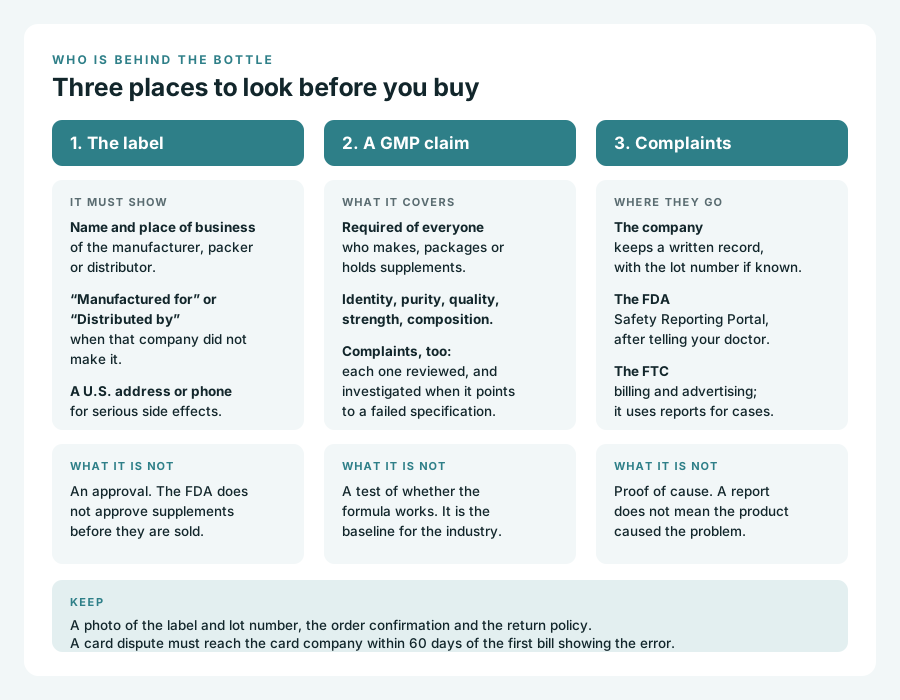
A name and a place of business. Federal labeling rules require a packaged food, supplements included, to state conspicuously the name and place of business of the manufacturer, packer or distributor. If the company named did not make the product itself, the name has to be qualified with wording such as “Manufactured for” or “Distributed by”. That is worth knowing: the company on the label can be the brand owner rather than the factory, and the label tells you which company answers for the product.
A way to report a serious problem. The Federal Food, Drug, and Cosmetic Act requires a supplement label to carry a U.S. address or U.S. phone number through which the company responsible for it can receive a report of a serious adverse event. If you ever need to report a reaction, that line is where to look.
And what the label does not mean. The FDA states that it does not have the authority to approve dietary supplements before they are marketed. Companies are responsible for making sure their products are not adulterated or misbranded. A bottle on sale has not been through an approval step, which is exactly why the information on it matters. Our guide to reading reviews against the label covers the other required wording, including the FDA statement next to any claim.
How Do You Check A Supplement Company Before You Order?
Run five checks: none takes long, and none requires taking anyone’s word for anything.
- Find the name on the bottle. Look at the product photo and the Supplement Facts panel on the sales page. Note the company named and whether it says “Manufactured for” or “Distributed by”.
- Look for the address and phone number. Both, or at least one, belong on the label. Write them down before you order, not after.
- Search the name. The Federal Trade Commission’s advice for online shopping is to search the product or company name plus the words “complaint” or “scam” to see what other people experienced. Do it for both the product and the company.
- Note who takes the payment. Some supplements sold online use a separate retailer to process the order, and that is the name that appears on your card statement. Knowing it in advance means a charge will not surprise you.
- Pay by credit card and keep records. The FTC says paying by credit card best protects you if something goes wrong, and suggests keeping the company name, the website and the return policy. Our guides to checkouts with no auto-ship and to long money-back guarantees cover what to read next to the order button.
What Does GMP Mean On A Supplement?
“Made under GMP” or “cGMP”, which appears on many supplement pages, stands for current good manufacturing practices, a real set of federal rules. The useful thing is to know what they cover.
Who has to follow them. The FDA explains that its regulations require those who manufacture, package or hold dietary supplements to follow current good manufacturing practices. It is a legal requirement for everyone in the business, not something a company opts into. Facilities that make supplements also have to register with the FDA before they begin operating.
What they are for. In the FDA’s words, the practices help ensure the identity, purity, quality, strength and composition of supplements. In plain terms: that what is in the bottle is what the label says, in the amount it says, without contamination.
What they include that most buyers never hear about. The same rules cover complaints. A “product complaint” is defined broadly: any communication, written, electronic or spoken, expressing concern about a supplement’s quality that could be related to manufacturing, from an odd smell or taste to an illness, a damaged container or a product that seems mislabeled. A qualified person must review every product complaint, investigate any that suggests the product failed one of its specifications, and quality control staff must approve those decisions and the follow-up.
What they do not cover. Manufacturing rules are about how a product is made, not about whether the formula does what you hope. Because the requirement applies to the whole industry, a GMP statement on its own does not separate one company from another; it describes the baseline. And it is not an FDA approval, because the FDA does not approve supplements before they are sold.
Where Are Supplement Complaints Recorded?
“Complaints” can mean several different records, kept by different people for different reasons. Knowing which one you are reading changes what it can tell you.
With the company
Under the manufacturing rules, the written record of a quality complaint must include the product’s name, the batch or lot number when it is available, the date, the nature of the complaint and how the product was used if known, any reply, and the findings of any investigation. That is why the lot number on your bottle is worth a photo: it is how a complaint gets traced to the right batch.
With the FDA
The FDA asks people to report a problem with a supplement to their health care provider first, and then to the agency through the federal Safety Reporting Portal. It uses these reports to look for early signals that a product may present a risk. The agency also publishes the reports it receives about foods and supplements, and it is clear about their limits: the presence of a report does not mean the FDA has determined that the product caused the event, the information has not been verified as cause and effect, and it cannot be used to estimate how often something happens.
With the FTC
Billing, delivery and advertising problems go to the Federal Trade Commission. The FTC says it cannot take action on behalf of individuals, but it processes every report and uses them to investigate and bring cases against fraud and bad business practices. For a wrong charge, the faster route is your card company: the FTC notes your letter has to reach it within 60 days of the first bill showing the error.
On complaint and review websites
Searching a name with “complaint” will also bring up business-complaint and review sites. Read them the way you would read a neighbor’s story: useful for the kind of problem, not proof of a pattern. Sort what you find into billing, shipping, refunds and side effects. A complaint about a slow refund tells you something different from a complaint about a reaction, and a report of a reaction, as the FDA itself notes, is not proof of cause.
What Do Trials Say About Side Effects?
Trials give the best answer, because they record side effects in both groups and compare them, something no complaint list can do.
Bacopa is a useful example because it appears in many memory formulas. In a 2025 trial in Clinical Drug Investigation, 101 adults aged 40 to 70 with self-reported memory and attention problems took 300 mg of bacopa extract a day for 12 weeks, or a placebo. On the main cognitive measures there was no difference between the groups; the bacopa group reported greater drops in stress reactivity and in fatigue after a demanding task. It was generally well tolerated, with no serious adverse reactions, although people taking bacopa reported more side effects than those on placebo, mainly digestive complaints and headaches.
That is the shape of a fair answer: a known, mostly mild pattern, measured against a placebo. Our guide to bacopa after 60 covers its wider research and how to take it.
What Should You Look For Before You Buy?
- A company name you can read on the bottle, with a place of business, and an address or phone number for reporting a problem.
- A label you can check against itself. The count and the daily serving tell you how long a bottle lasts; any published amounts let you compare with the research.
- A retailer you recognize on the checkout, so the charge on your statement matches what you expect.
- A refund window longer than your test. Memory ingredients are usually judged over 4 to 12 weeks, so a guarantee that covers that lets you decide on your own experience.
- Every ingredient you would need to raise with your doctor, listed on the label so you can show it to them.
Which Formulas Name Their Maker On The Bottle?
The two formulas below each tell you which company stands behind them, and each gives you concrete facts to read before you pay. They are not here to be compared with each other.
Brain C-13 is a capsule supplement that carries the Zenith Labs name on its label. It also publishes a Supplement Facts panel with amounts: citicoline 250 mg, bacopa 300 mg, rhodiola 200 mg, phosphatidylserine 100 mg, turmeric 150 mg and rosemary 100 mg. As its review explains, that panel describes a 60-capsule bottle at two a day, while the bottle shown holds 90 capsules taken three a day, and the sales page also names saffron and huperzine A, so the panel appears to describe an earlier version. Read the panel on the bottle you receive. It is sold through the maker’s site with ClickBank as the retailer, and the guarantee runs 180 days. Its comparison page goes further.
NeuroVera is a stimulant-free capsule that carries the Nutraville name on its label. It is sold direct through the maker’s own site, with ClickBank as the retailer handling the transaction and the refunds. The bottle states 60 capsules at two a day, so it lasts 30 days, and a single bottle can be bought on its own. The sales page names bacopa, lion’s mane, gotu kola, schisandra and shilajit, with no amount published for any of them. The guarantee runs 365 days, and its comparison page sets the one-, three- and six-bottle options against the time the research used.
Independently verifiable buyer feedback is limited for both, as it is for most supplements sold direct, and there is no published trial on either exact combination. Each review sets out the research behind every ingredient.
Two formulas worth a closer look
Two formulas that name the company behind them
If knowing who made the bottle is where you start, each of these puts the maker’s name on the label — each with a money-back guarantee.

Brain C-13
Capsules
Carries the Zenith Labs name on its label, with a published Supplement Facts panel listing citicoline, bacopa and phosphatidylserine with amounts.
- Readers who want a seller they can look up
- Anyone who wants a six-month refund window
Covered by a 180-day money-back guarantee
Before you start · Turmeric is worth raising if you take a blood thinner; huperzine A, if your bottle lists it, if you take a cholinesterase inhibitor or medicine for glaucoma or heart rhythm.
See Brain C-13 on the official siteRead our Brain C-13 review
NeuroVera
Capsules
A stimulant-free capsule with the Nutraville name on the label, built around bacopa and lion’s mane, sold one bottle at a time with ClickBank handling the transaction and refunds.
- Readers who want to try one bottle first
- Anyone who prefers a stimulant-free routine
Covered by a 365-day money-back guarantee
Before you start · Bacopa is worth raising if you take thyroid medication or a sedative.
See NeuroVera on the official siteRead our NeuroVera reviewListed in no particular order. We publish no scores or rankings.
Who Should Check Before Starting?
Anyone in one of these situations should take the bottle, or a photo of the label, to a doctor or pharmacist, because knowing who made a bottle does not tell you how it fits with what you already take.
- You take a blood thinner. The Brain C-13 review names turmeric, which is on its published panel, as worth mentioning.
- You take a cholinesterase inhibitor for memory, or medicine for glaucoma or heart rhythm. The same review explains that huperzine A, named on the sales page, inhibits acetylcholinesterase, which matters if the version you receive contains it.
- You avoid soy. Brain C-13’s published panel lists soy.
- You take thyroid medication or a sedative. The NeuroVera review names bacopa as the ingredient to mention.
If something changes after you start a new formula, tell your doctor first, then consider a report through the FDA’s Safety Reporting Portal. Never stop, reduce or change a prescription to make room for a supplement.
When Should You See A Doctor?
Book an appointment if changes in memory or thinking are getting worse month over month, came on suddenly, affect daily life, or have been noticed by someone close to you; a slower name or a misplaced word now and then is common with age. That is a conversation for a clinician rather than a question for a label.
And if you have a new symptom after starting any supplement, bring the bottle to that visit, with the lot number visible.
Ready to compare? Go back to the two formulas above, or read the full reviews of Brain C-13 and NeuroVera.
Frequently asked
How can I check if a supplement company is legit?
Start with the label. Federal rules require the name and place of business of the manufacturer, packer or distributor, and a U.S. address or phone number for reporting a serious side effect. Then do what the Federal Trade Commission suggests: search the product or company name with the words “complaint” or “scam”, pay by credit card, and keep the company name, website and return policy on file.
Does a GMP claim make a memory supplement more trustworthy?
It tells you less than it sounds. FDA regulations require every company that makes, packages or holds supplements to follow current good manufacturing practices, which help ensure identity, purity, quality, strength and composition. So a GMP statement describes the legal baseline for the whole industry. It is about how a product is made, not whether the formula works, and the FDA does not approve supplements before they are sold.
Where can I find complaints about a memory supplement?
Searching the name with “complaint” is the FTC’s own suggestion. The FDA also publishes reports it receives about foods and supplements, but it says a report there does not mean the agency has found that the product caused the problem, and the data cannot be used to estimate risk. Read complaints for what kind of problem they describe: billing, shipping, refunds or side effects.
Do memory supplements have side effects?
They can. Bacopa, common in memory formulas, is a good example: in a 2025 trial of 101 adults aged 40 to 70 taking 300 mg a day for 12 weeks, the bacopa group reported more side effects than the placebo group, mainly digestive complaints and headaches, and none were serious. Ingredients can also matter alongside prescriptions, so show the label to your doctor or pharmacist first.
Where do I report a side effect from a supplement?
Tell your doctor first. The FDA accepts reports through the federal Safety Reporting Portal, and the label carries an address or phone number where the company can receive a report of a serious problem. Under federal manufacturing rules, the company must review complaints about product quality and keep a written record, including the lot number when it is available.
What should I keep in case something goes wrong?
The bottle or a photo of the label, including the lot or batch number; the order confirmation and the name that appears on your card statement; and a copy of the return policy. The FTC also notes that you can dispute a charge with your credit card company if your letter reaches it within 60 days of the first bill showing the error.
References
- Questions and Answers on Dietary Supplements — U.S. Food and Drug Administration — 2026
- 21 CFR 101.5 — Food; name and place of business of manufacturer, packer, or distributor (current text) — 2026
- 21 U.S.C. 343(y) — Misbranded food: dietary supplement label contact for serious adverse event reports, United States Code — 2023
- 21 CFR 111.3 — Definitions, Current Good Manufacturing Practice for Dietary Supplements (current text) — 2026
- 21 CFR 111.560 — Product complaint review and investigation (current text) — 2026
- 21 CFR 111.570 — Records for product complaints (current text) — 2026
- Human Foods Complaint System (HFCS) — U.S. Food and Drug Administration — 2026
- Online Shopping — Federal Trade Commission, Consumer Advice — 2023
- Community Advocate Center Connects More People to the FTC — Federal Trade Commission, Consumer Advice — 2021
- The Effects of a Bacopa monnieri Extract (Bacumen®) on Cognition, Stress, and Fatigue in Healthy Adults: A Randomized, Double-Blind, Placebo-Controlled Trial — Clinical Drug Investigation — 2025
Disclosure
All content is for informational purposes only and is not a substitute for professional medical advice, diagnosis, or treatment. Each product covered is a dietary supplement, not a prescription drug, and statements about it have not been evaluated by the U.S. Food and Drug Administration. Results vary with individual health status, consistency of use, and lifestyle. This page contains affiliate links — if you buy through them we may earn a small commission at no additional cost to you. Read our disclosure and our editorial policy.