
How to Buy a Memory Supplement Without a Recurring Charge
A bottle you meant to try once should cost you once. Here is how to tell a one-time purchase from an auto-ship at the checkout, what to keep afterwards, and what to do if a second charge appears anyway.
Quick answer
Before you pay, read the order summary rather than the headline: a one-time purchase shows one total and no wording about renewing or shipping again. The Federal Trade Commission advises checking the cancellation terms before handing over payment details and unchecking any pre-checked box. If you want to try one, two formulas sold as one-time packs are below.
You bought one bottle. You wanted to see whether it did anything before spending again. Then the statement arrived, and there it was — the same amount, a month later, from a company whose name you barely recognised.
It is a common enough experience that the Federal Trade Commission counts it: nearly 70 complaints a day about negative option and recurring subscription practices in 2024, up from 42 a day in 2021. The Consumer Financial Protection Bureau has said it receives complaints, including from older consumers, about being repeatedly charged for services they did not intend to buy or no longer want.
None of that means you should stop buying supplements online. It means the thirty seconds before you click the button are worth using well. This guide is about those thirty seconds.
Further down, we look at two formulas sold as one-time packs: NovuBrain+ and NeuroVera — both with a money-back guarantee.
Why Does A Second Charge Happen?
A second charge happens because of an arrangement with a formal name: negative option. It covers any deal where saying nothing counts as agreeing to another charge or another shipment. A free trial that rolls into a paid plan is one version. A monthly refill you agreed to without noticing is another.
It is not always hidden. Plenty of sellers offer a subscription openly, at a lower price per bottle, and for someone who has already decided to take something for a year, that can be a fair deal. The problem is the version you did not mean to join — the pre-checked box, the wording below the button, the plan that starts when the trial ends.
That is why the question to ask is not “is this a scam?” but a plainer one: am I agreeing to pay once, or to keep paying?
What Do The Rules Say Right Now?
In October 2024 the Federal Trade Commission announced a rule, widely called click-to-cancel, requiring sellers to make cancelling as easy as signing up. A federal appeals court vacated that rule in 2025, and in February 2026 the FTC formally put the earlier text of its Negative Option Rule back in place. In March 2026 it opened a public comment process on what should replace it. So the headline many people remember is not the law today.
What does apply is older and still useful: the Restore Online Shoppers’ Confidence Act, Section 5 of the FTC Act, the restored Negative Option Rule and state automatic renewal laws. And the FTC’s own consumer guidance still says plainly that businesses must make cancelling simple, and that cancellation terms must be disclosed before you hand over payment details.
The practical takeaway is unchanged: the protection exists, but using it costs you time. Not signing up to something you did not want costs you nothing.
What Should You Check Before You Pay?
Check five things, all from the FTC’s consumer guidance on free trials, auto-renewals and negative option subscriptions.
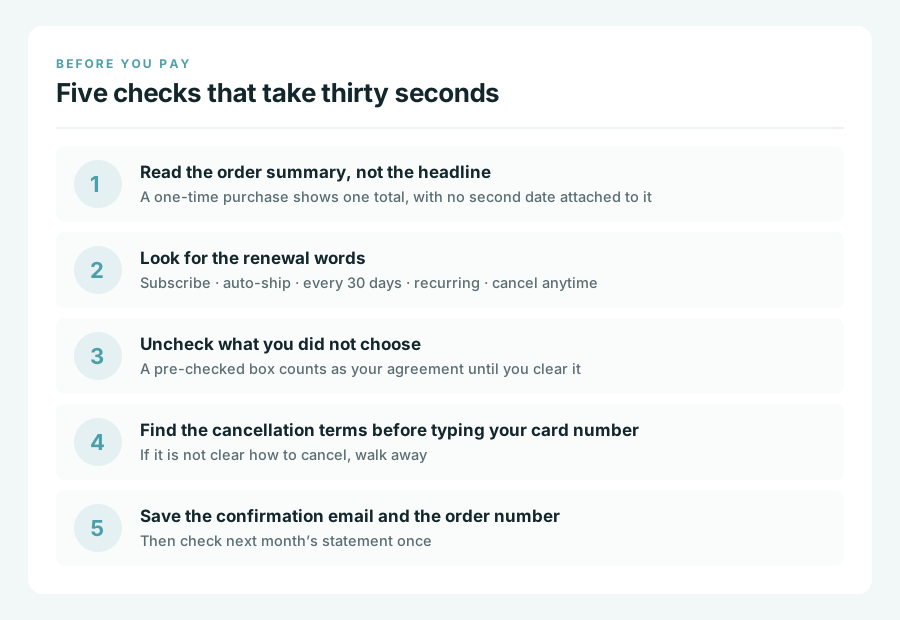
- Read the order summary, not the headline. The box beside the button is where a one-time purchase shows one total, with no second date attached to it. The FTC advises reading exactly what you are agreeing to before you buy.
- Look for the renewal words. Subscribe, auto-ship, auto-delivery, every 30 days, recurring, cancel anytime. Any of them means the charge repeats until you stop it. “Cancel anytime” is not the same as “one time”.
- Uncheck what you did not choose. The FTC puts this plainly: make sure to uncheck a box if you do not agree with what it says.
- Find the cancellation terms before you type your card number. They should be there, and the FTC says that if it is not clear to you how to cancel, walk away. That is the whole test, and it costs nothing to apply.
- Check the trial, if there is one. How long it lasts, what happens when it ends, and by when you would have to act. A free trial that becomes a plan is the most common version of this.
One more, from experience rather than from the FTC: the price that looks too low for one bottle is often the subscription price. Compare it with what the same page asks for a single pack.
What Should You Keep After You Buy?
Keep the confirmation email, the order number and, if you can, the page that showed the total — a screenshot or a photo of the screen is enough. The FTC advises keeping a copy of any cancellation request along with notes about conversations, and keeping letters, notes or emails related to what happened.
Then do the small thing almost nobody does: look at your statement the following month. The FTC’s advice to anyone who has cancelled something is to watch the bank or card statement for charges that appear afterwards. The same habit catches a charge you never agreed to in the first place.
What If You Are Charged Anyway?
Follow the steps the FTC and the Consumer Financial Protection Bureau publish, in the order they publish them.
- Tell the company you are withdrawing permission. The CFPB advises calling the company to say you are taking away its permission to take automatic payments from your account, and following up in writing.
- Tell your bank or credit union the same thing. The CFPB advises calling them to say you have revoked authorisation, following up in writing, and notes that they might also recommend a stop payment order — an instruction telling them not to pay a specified company from your account.
- Dispute a credit card charge in writing, quickly. The FTC advises writing to the issuer at the address for billing inquiries, not the payment address, so the letter arrives within 60 days after the first bill with the error was sent to you. Include your name, address, account number and a description of the error, and send it by certified mail. The issuer must acknowledge within 30 days and resolve the dispute within 90.
- Report it. The FTC asks people to report these practices at ReportFraud.ftc.gov, and to their state attorney general.
None of this is difficult. It is simply slower than the half minute it takes to read the order summary before paying.
What If You Are Buying For A Parent?
The checks above do not change when a son or daughter places the order for a mother or father, sometimes on the parent’s own card. What changes is that the statement, the confirmation email and any second charge may land somewhere you do not see.
- Place the order together. If it is your parent’s card, sit at the same screen, so they see the single total and know what the charge will look like on their statement.
- Run the five checks for both of you. One total, no renewal wording, no pre-checked box, cancellation terms you can find. If any of them fails, the FTC’s advice still holds: walk away.
- Keep the receipt where both of you can find it. Note which email address the confirmation went to, and save the order number and a photo of the order summary with your parent’s papers.
- Look at their next statement together. The FTC advises watching card statements for charges that appear afterwards. On a parent’s card, that means their statement, not yours.
If a repeat charge does appear on your parent’s card, the steps are the ones above, taken in the name on the account. To cancel, the FTC advises looking up the company that runs the subscription, following its instructions and keeping a copy of the cancellation request with notes about any conversation. The CFPB describes telling both the company and the bank that permission to charge is withdrawn, then following up in writing. The FTC’s credit card dispute letter carries the name, address and account number on the card, which here are your parent’s.
Which Formulas Are Sold As One-Time Packs?
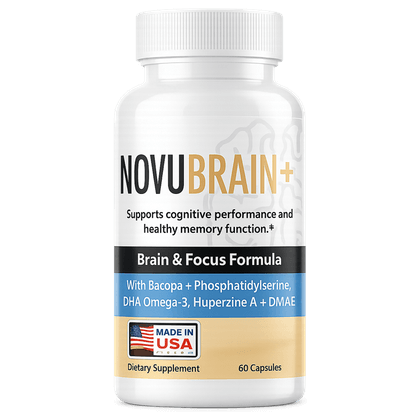
Two of the formulas reviewed on this site are sold as single packs rather than plans. NovuBrain+ is sold as a one-time purchase: its sales page states that there is no subscription and no auto-ship, and its checkout charges once for the pack you choose; it is two capsules a day, caffeine-free, with a 60-day money-back guarantee. NeuroVera can be bought one bottle at a time — 60 capsules, two a day, so a bottle is a month — with a 365-day money-back guarantee. Neither publishes the amount of each ingredient, which the full reviews explain. Whatever you buy, the checks above still apply at the checkout: read the order summary before you pay.
Two formulas worth a closer look
Two formulas sold as one-time packs
No plan to cancel later — one charge for the pack you choose, and a money-back guarantee on each.
NovuBrain+
Capsules
Sold as a one-time pack, with no subscription and no auto-ship on the sales page. Two capsules a day with breakfast, caffeine-free, built on bacopa, phosphatidylserine, DHA and huperzine A.
- Readers who want to try one pack and decide later
- A caffeine-free morning routine
Covered by a 60-day money-back guarantee
Before you start · Huperzine A is worth naming with a prescriber, and DHA if you take a blood thinner.
See NovuBrain+ on the official siteRead our NovuBrain+ review
NeuroVera
Capsules
Can be bought one bottle at a time: 60 capsules, two a day, so a bottle lasts a month. Built around bacopa and lion’s mane, with no stimulants.
- Readers who want a single bottle first
- A 365-day window to change your mind
Covered by a 365-day money-back guarantee
Before you start · Bacopa is the one to mention if you take thyroid medication or a sedative.
See NeuroVera on the official siteRead our NeuroVera reviewListed in no particular order. We publish no scores or rankings.
When Should You See A Doctor?
See a doctor when memory problems go beyond a word that arrives late, which is ordinary. The National Institute on Aging advises talking to a doctor when memory problems are getting worse, when they interfere with everyday activities, or when other people start noticing them, because finding the cause is what decides the next step.
No supplement on this site prevents, treats or reverses any condition, and no purchase decision replaces that appointment.
Ready to compare? Go back to the two formulas above, or read the full reviews of NovuBrain+ and NeuroVera.
Frequently asked
How do I know if a supplement is a subscription before I buy it?
Read the order summary next to the button, not the headline. A one-time purchase shows one total and no wording about renewing, subscribing or shipping again. The Federal Trade Commission advises reading exactly what you are agreeing to, checking how to cancel and any time limits before you hand over payment details, and unchecking any pre-checked box you do not agree with. If it is not clear how to cancel, the FTC says to walk away.
What is “negative option” or auto-ship?
It is any arrangement where staying silent counts as agreeing to another charge or another shipment. Free trials that roll into a paid plan and monthly refills both work this way. The Federal Trade Commission says it received nearly 70 complaints a day about negative option and recurring subscription practices in 2024, up from 42 a day in 2021.
Is the “click to cancel” rule in force?
No. The Federal Trade Commission announced that rule in October 2024, a federal appeals court vacated it in 2025, and in February 2026 the FTC put the earlier version of its Negative Option Rule back in place. A replacement is still at the public comment stage. What does apply is the Restore Online Shoppers’ Confidence Act, Section 5 of the FTC Act and state automatic renewal laws — and the FTC’s consumer page still states that businesses must make cancelling simple and that cancellation terms must be disclosed before you hand over payment details.
What should I keep after I buy?
The confirmation email, the order number and the page that showed the total. If you ever cancel something, the FTC advises keeping a copy of the cancellation request along with notes about any conversations, and keeping any letters, notes or emails related to what happened. Those records are what a card dispute runs on.
What if I am charged again anyway?
Tell the company you are withdrawing permission to charge you, then tell your bank or card issuer the same thing, and follow up in writing. The Consumer Financial Protection Bureau describes both steps and notes your bank may also suggest a stop payment order. For a credit card, the FTC advises disputing in writing so the letter reaches the issuer within 60 days after the first bill with the error was sent; the issuer must acknowledge within 30 days and resolve the dispute within 90 days.
How do I cancel a supplement auto-ship for a parent?
Sit down with your parent and the order confirmation. The FTC advises looking up the company that runs the subscription, following its cancellation instructions, and keeping a copy of the request with notes about any conversation. Then watch the statement of the card that was charged — your parent’s, if it was their card — and, if a charge appears after cancelling, dispute it with the card company in writing.
References
- Getting In and Out of Free Trials, Auto-Renewals, and Negative Option Subscriptions — Federal Trade Commission, consumer.ftc.gov — 2024
- Tried to cancel a service but couldn’t? Learn steps to take — Federal Trade Commission consumer alert — 2022
- Using Credit Cards and Disputing Charges — Federal Trade Commission, consumer.ftc.gov — 2022
- How do I stop automatic payments from my bank account? — Consumer Financial Protection Bureau — 2026
- Consumer Financial Protection Circular 2023-01: Unlawful negative option marketing practices — Consumer Financial Protection Bureau — 2023
- Federal Trade Commission Announces Final “Click-to-Cancel” Rule Making It Easier for Consumers to End Recurring Subscriptions and Memberships — Federal Trade Commission — 2024
- Revision of the Negative Option Rule, Withdrawal of the CARS Rule, Removal of the Non-Compete Rule To Conform These Rules to Federal Court Decisions — Federal Trade Commission, Federal Register — 2026
- FTC Seeks Public Comment in Response to Advance Notice of Proposed Rulemaking Regarding Negative Option Rule — Federal Trade Commission — 2026
- Memory Problems, Forgetfulness, and Aging — National Institute on Aging — 2023
Disclosure
All content is for informational purposes only and is not a substitute for professional medical advice, diagnosis, or treatment. Each product covered is a dietary supplement, not a prescription drug, and statements about it have not been evaluated by the U.S. Food and Drug Administration. Results vary with individual health status, consistency of use, and lifestyle. This page contains affiliate links — if you buy through them we may earn a small commission at no additional cost to you. Read our disclosure and our editorial policy.