
Tired Brain, No Caffeine: What Rhodiola and Citicoline Were Tested For
By the end of the workday your head feels spent, and another coffee now costs you the night. Here is what rhodiola, citicoline and creatine were actually tested for, what to try first, and where a formula fits.
Quick answer
The evidence is thinner than the labels suggest. Rhodiola’s fatigue trials were short and small, and an NIH center says the evidence is not reliable enough to judge. Citicoline was tested for memory and attention, not fatigue. Creatine helped sleep-deprived young adults. Start with breaks and sleep; two formulas with no caffeine on the label follow below.
It is not the morning that worries you. The morning is fine. It is four-thirty, with an hour of work still on the desk, when the words on the screen stop going in and a simple reply takes three drafts. By the drive home, your head feels like a phone at two percent.
You used to fix that with one more coffee. Now the late cup follows you to bed, and a short night makes tomorrow’s four-thirty arrive at two. So you are looking for something that is not a stimulant, and the same two names keep coming up: rhodiola and citicoline.
Both have research behind them, and it is narrower than their reputation. This guide sets out what each was tested for, in whom, and what to put in place before you spend anything.
Further down, we look at two formulas with no caffeine on their ingredient lists: Brain C-13 and CogniSurge — each with a money-back guarantee.
What Is Mental Fatigue, And What Feeds It?
MedlinePlus, the National Library of Medicine’s health encyclopedia, defines fatigue simply as a feeling of weariness, tiredness, or lack of energy. The tired-brain version at the end of a demanding day is common, and most of the time it has ordinary causes.
Some causes are worth ruling out. The same encyclopedia lists anemia and low iron, thyroid problems, sleep disorders such as sleep apnea and insomnia, depression or grief, chronic pain, alcohol, and medicines including sedatives and antidepressants among the common causes of fatigue. None of those is fixed by a supplement, and several are easy for a doctor to check.
Caffeine can feed the loop. The FDA cites 400 mg a day, about two to three 12-ounce cups of coffee, as an amount not generally associated with negative effects in most adults. It also notes wide variation in how sensitive people are and how fast they clear caffeine, that some medicines make people more sensitive, and that too much can bring insomnia, jitters and a racing heart. A cup that rescues the afternoon can cost the night, and a short night makes the next afternoon harder.
If the slump lands right after lunch rather than at the end of the day, our guide to afternoon brain fog at work covers the coffee cutoff, the lunch and the short nap in detail, so this page does not repeat them.
What Helps Mental Fatigue Before Any Capsule?
Three steps have research behind them, cost nothing, and work alongside anything you decide to take later.
1. Take short breaks before you need them
A 2022 meta-analysis in PLOS ONE pooled 22 study samples with 2,335 people and looked at micro-breaks, pauses of ten minutes or less. Breaks gave small but real boosts to vigor and reduced fatigue. They did not improve overall performance, and helped performance only on less demanding tasks. In other words, a break will not make hard work easier, but it can make you less drained by the end of it.
2. Protect the night
The CDC recommends 7 or more hours of sleep for adults up to 60, and 7 to 9 hours from 61 to 64. Its list of habits includes going to bed and getting up at the same time every day, turning off screens 30 minutes before bed, and avoiding caffeine in the afternoon or evening.
3. Ask about the usual suspects
If the tiredness is new or has been building for weeks, bring it up at your next checkup. A doctor can look at your medicine list and, where it makes sense, check thyroid levels, iron and sleep. Those answers change what, if anything, is worth adding.
Do Rhodiola, Citicoline And Creatine Help Mental Fatigue?
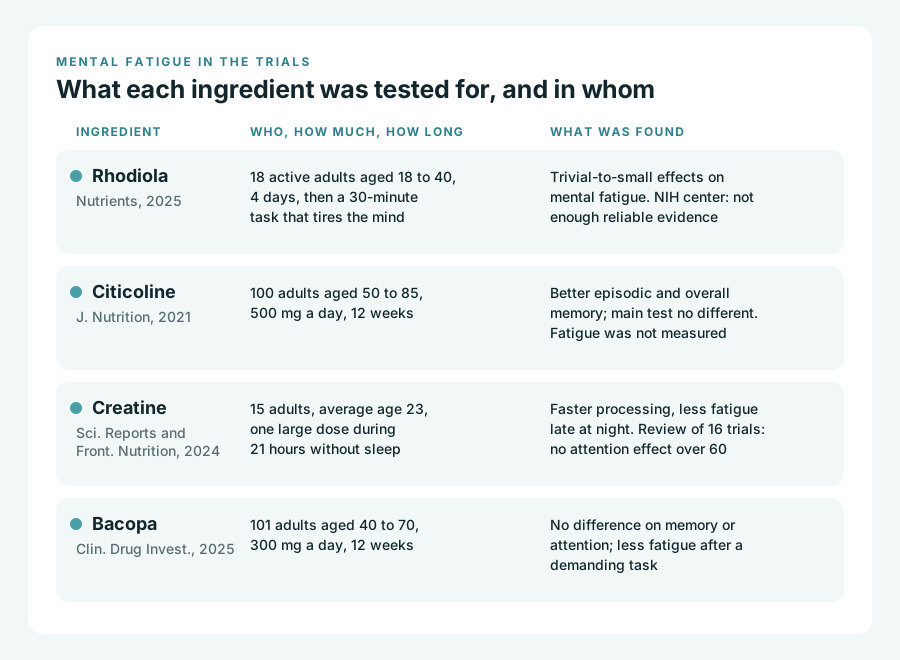
Few of these studies measured the end-of-day tiredness you actually feel. Here is what each ingredient was tested for, who took part, and what was found.
Rhodiola: an old reputation, short trials
Rhodiola is a plant root with a long history in traditional medicine, and it is promoted, in the words of the NIH’s National Center for Complementary and Integrative Health, for energy, stress, mood and thinking. That same center’s 2025 summary is plain: there is not enough reliable evidence to know whether rhodiola is useful for any health purpose.
A 2022 review in Molecules, written by authors who work for a botanical extract company, gathers the studies most often quoted for fatigue. The ones with a placebo group were short, from a single dose to six weeks, and mostly in students, doctors and military cadets; several reported less fatigue. The longer studies in people with persistent fatigue or burnout, running 8 to 12 weeks, were open-label, meaning everyone knew they were taking rhodiola and there was no placebo to compare against.
A more recent trial tested the question directly. In 2025, Nutrients published a placebo-controlled crossover trial in 18 resistance-trained adults aged 18 to 40, who took rhodiola for four days and then did a 30-minute task designed to tire the mind. Rhodiola had trivial-to-small effects on mental fatigue, and the authors concluded its main effects were on physical rather than mental performance.
Citicoline: tested for memory and attention, not fatigue
Citicoline, also called CDP-choline, is sold on its own and inside formulas. Its best-known trial, published in The Journal of Nutrition in 2021, gave 500 mg a day for 12 weeks to 100 healthy adults aged 50 to 85 whose memory had slipped with age. On the main test there was no difference from placebo; on episodic memory and an overall memory score, the citicoline group improved more. The study was sponsored by a citicoline maker, and it did not measure fatigue or energy.
The Alzheimer’s Drug Discovery Foundation’s report, updated in 2024, describes the trials on attention and reaction speed as small and mixed: some found faster responses, and one in middle-aged to older adults found a small effect on memory and none on attention. It lists typical amounts of 250 to 1,000 mg a day and reports no serious safety issues. The results we found that describe “mental energy” came from a conference presentation rather than a peer-reviewed paper, so this page does not rely on them. Our guide to citicoline or choline for memory covers the memory side in full.
Creatine: promising under strain, still early
Creatine is best known from the gym, and the brain uses it too. A 2024 meta-analysis in Frontiers in Nutrition pooled 16 trials with 492 people aged about 21 to 76. Memory improved, with moderate certainty; attention and processing speed got faster, with low certainty; overall thinking and executive function did not change. In the trials in people over 60, there was no significant effect on attention. A 2026 commentary in the same journal noted that the pooled analysis counted some participants more than once, so the result should be read with caution.
The study behind most headlines is smaller. In 2024, Scientific Reports described 15 healthy adults with an average age of 23 who were kept awake for 21 hours. After a single, very large dose sized to body weight, 0.35 grams per kilogram, they processed information faster and rated their fatigue lower late in the night than after placebo. The authors call it a small study and say the right dose still needs work. Creatine is not in either formula below.
Bacopa: a fatigue result nobody was looking for
Both formulas below contain bacopa, so one recent result matters here. A 2025 trial in Clinical Drug Investigation gave 300 mg of bacopa a day for 12 weeks to 101 adults aged 40 to 70 who reported memory and attention problems. It found no difference from placebo on memory or attention, its main questions. But the bacopa group reported greater drops in stress reactivity, and less fatigue and stress after a demanding computer task. The authors say that finding needs its own trial.
What Should You Look For Before You Buy?
If you have the breaks and the sleep in place and still want to try a formula, four checks make the choice easier.
- The whole ingredient list, not just the front. Caffeine can sit under other names, such as green tea, guarana or yerba mate. Our guide to stimulant-free nootropics explains what that label claim does and does not tell you.
- An amount per serving, if matching the trials matters to you. A printed amount lets you and your pharmacist set the label beside the research above.
- A routine you will keep for 12 weeks. The longer trials here ran that long. Twice or three times a day suits some workdays and not others.
- A refund window longer than the test. If the guarantee outlasts 12 weeks, you can give the formula the time its ingredients were studied over.
Which Formulas Have No Caffeine On The Label?
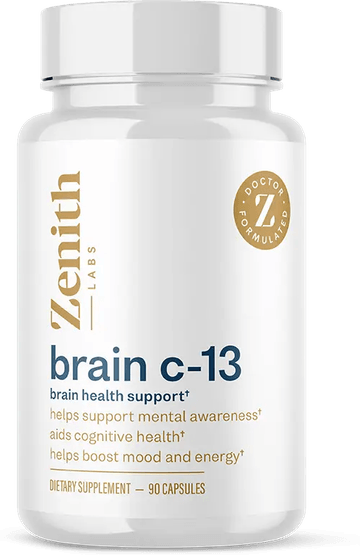
Two on this site have no caffeine on their ingredient lists, and the first, Brain C-13, comes from Zenith Labs, a company with a postal address and a phone number on the bottle. Its published Supplement Facts panel lists both ingredients this page is about, rhodiola 200 mg and citicoline 250 mg, with bacopa 300 mg, phosphatidylserine 100 mg, turmeric and rosemary; the sales page also names saffron and huperzine A. As its review explains, that panel describes a 60-capsule bottle at two a day, while the bottle shown holds 90 at three a day, so it appears to describe an earlier version. Read the panel on the bottle you receive. Neither list includes caffeine, and the guarantee runs 180 days.
CogniSurge is built around that same wish for no stimulant. The maker states plainly that it contains no stimulants, and it is built on five traditional botanicals: bacopa, lion’s mane, gotu kola, schisandra and shilajit, taken as two capsules a day. No amount is published for any ingredient. Its comparison page sets it beside coffee and caffeine pills, which is this article’s question from the other side. The guarantee runs 365 days.
Two formulas worth a closer look
Two formulas with no caffeine on the label
Once the breaks and the sleep are in place, these two fit a day without a late coffee — each with a money-back guarantee.
Brain C-13
Capsules
Its published Supplement Facts panel lists rhodiola 200 mg and citicoline 250 mg, with bacopa 300 mg and phosphatidylserine, from Zenith Labs, a company you can look up.
- Readers who want to see amounts on the label
- Anyone who wants six months to decide
Covered by a 180-day money-back guarantee
Before you start · Rhodiola is worth naming if you take blood pressure medicine or an antidepressant; huperzine A, named on the sales page, with heart-rate or memory medicines; turmeric with a blood thinner.
See Brain C-13 on the official siteRead our Brain C-13 review
CogniSurge
Capsules
Stimulant-free by the maker’s own description, built on five traditional botanicals including bacopa and lion’s mane, taken as two capsules a day.
- Readers who want no caffeine in the routine
- Anyone who wants a full year to decide
Covered by a 365-day money-back guarantee
Before you start · Bacopa is worth naming if you take thyroid medicine, or medicine for glaucoma or memory.
See CogniSurge on the official siteRead our CogniSurge reviewListed in no particular order. We publish no scores or rankings.
Who Should Check Before Starting?
Take the label, or a photo of it, to your pharmacist or doctor if any of these apply to you.
- You take blood pressure medicine. Memorial Sloan Kettering notes rhodiola may add to its effect, and the NIH’s complementary health center reports interactions with losartan.
- You take an antidepressant. Memorial Sloan Kettering notes rhodiola may increase serotonin-related side effects.
- You take a blood thinner such as warfarin, or a seizure medicine. Memorial Sloan Kettering asks people taking these to tell their doctor before using rhodiola, and advises against turmeric supplements with warfarin or other blood thinners.
- You take thyroid hormone. The Merck Manual notes that bacopa may raise thyroid hormone levels and advises people on thyroid hormone medicine not to take it.
- You take medicine for glaucoma, a prescription memory medicine, or an anticholinergic. The Merck Manual notes bacopa may add to the side effects of glaucoma and memory medicines that raise acetylcholine, and may weaken anticholinergic ones. Memorial Sloan Kettering advises against combining huperzine A with memory medicines such as donepezil, and notes it may slow the heart further with beta-blockers or calcium channel blockers.
The NIH center lists dizziness, headache, trouble sleeping and dry mouth among rhodiola’s possible side effects, which is worth knowing if sleep is already the problem. The Brain C-13 review also notes that its published panel lists soy. If you take several medicines, our checklist for several medicines shows what to bring. Never stop, reduce or change a prescription to make room for a supplement.
When Should You See A Doctor?
MedlinePlus suggests making an appointment if the fatigue comes with fever, weight loss or sweats; with constipation, dry skin, weight gain or feeling cold; with waking often at night; with low mood; or if you think a medicine may be causing it. Being tired at the end of a full day, on its own, is normal.
It advises getting help right away for confusion or dizziness, blurred vision, or little or no urine.
Ready to compare? Go back to the two formulas above, or read the full reviews of Brain C-13 and CogniSurge.
Frequently asked
Does rhodiola help with mental fatigue?
The evidence is thin. The NIH’s complementary health center says there is not enough reliable evidence to know whether rhodiola is useful for any health purpose. Its placebo-controlled fatigue trials were short and mostly in students, doctors or cadets, and a 2025 trial found only trivial-to-small effects on mental fatigue. If you try it, give it weeks, and mention it to your doctor if you take blood pressure medicine or an antidepressant.
Does citicoline help mental energy?
Citicoline has been tested for memory and attention rather than for fatigue. In a 2021 trial, 100 adults aged 50 to 85 took 500 mg a day for 12 weeks and improved more than placebo on episodic memory, though not on the main test. Trials on attention have been small and mixed. We did not find a peer-reviewed trial that measured mental fatigue itself.
Can creatine help with mental tiredness?
Possibly under strain, but the research is early. In a 2024 study, 15 young adults kept awake for 21 hours processed information faster and reported less fatigue after one large dose sized to body weight. A 2024 meta-analysis of 16 trials found better memory, and no significant effect on attention in people over 60; a 2026 commentary noted that it counted some participants more than once, so that result should be read with caution. Creatine is in neither formula on this page.
What is the best supplement for memory and energy?
No single supplement has been shown to do both for everyday tiredness. The ingredients with the most human research here were each tested for one thing: citicoline for memory and attention, bacopa for memory, creatine for performance under sleep loss. Pick by what you want to check, a printed amount or a routine without caffeine, and judge any formula over 4 to 12 weeks.
What is the downside of rhodiola?
The NIH’s complementary health center lists dizziness, headache, insomnia, and either dry mouth or excess saliva among rhodiola’s possible side effects, and its safety information covers use for up to 12 weeks. Insomnia is worth weighing if sleep is already part of the problem. The same center reports interactions with losartan, a blood pressure medicine, and says little is known about rhodiola during pregnancy or breastfeeding. If you take blood pressure medicine or an antidepressant, or you are pregnant, ask your doctor before starting; the section on who should check before starting lists the other medicines.
Can I take rhodiola with blood pressure medicine?
Ask the person who prescribes it first. Memorial Sloan Kettering notes that rhodiola may add to the effect of blood pressure medicines, and the NIH’s complementary health center reports interactions with losartan. Take the label with you. Never change or stop a prescription to make room for a supplement.
How long before a supplement for mental fatigue does anything?
Weeks, not days. The longer trials described here ran 12 weeks, and the honest window to judge a daily formula is 4 to 12 weeks. Decide before you start what you will watch, such as how the last hour of your workday feels, and check in with yourself at the halfway point.
References
- Fatigue — MedlinePlus Medical Encyclopedia — 2025
- Spilling the Beans: How Much Caffeine Is Too Much? — U.S. Food and Drug Administration — 2024
- "Give me a break!" A systematic review and meta-analysis on the efficacy of micro-breaks for increasing well-being and performance — PLOS ONE — 2022
- About Sleep — Centers for Disease Control and Prevention — 2024
- Rhodiola — NIH National Center for Complementary and Integrative Health — 2025
- Rhodiola — Memorial Sloan Kettering Cancer Center, About Herbs — 2026
- The Effectiveness of Rhodiola rosea L. Preparations in Alleviating Various Aspects of Life-Stress Symptoms and Stress-Induced Conditions — Encouraging Clinical Evidence — Molecules — 2022
- The Impact of Rhodiola Rosea Extract on Strength Performance in Alternative Bench-Press and Bench-Pull Exercises Under Resting and Mental Fatigue Conditions: A Randomized, Triple-Blinded, Placebo-Controlled, Crossover Trial — Nutrients — 2025
- Citicoline and Memory Function in Healthy Older Adults: A Randomized, Double-Blind, Placebo-Controlled Clinical Trial — The Journal of Nutrition — 2021
- Citicoline (CDP-choline) — Cognitive Vitality Reports, Alzheimer’s Drug Discovery Foundation — 2024
- The effects of creatine supplementation on cognitive function in adults: a systematic review and meta-analysis — Frontiers in Nutrition — 2024
- Commentary: The effects of creatine supplementation on cognitive function in adults: a systematic review and meta-analysis — Frontiers in Nutrition — 2026
- Single dose creatine improves cognitive performance and induces changes in cerebral high energy phosphates during sleep deprivation — Scientific Reports — 2024
- The Effects of a Bacopa monnieri Extract (Bacumen®) on Cognition, Stress, and Fatigue in Healthy Adults: A Randomized, Double-Blind, Placebo-Controlled Trial — Clinical Drug Investigation — 2025
- Bacopa — Merck Manual Professional Edition — 2025
- Turmeric — Memorial Sloan Kettering Cancer Center, About Herbs — 2026
- Huperzia serrata — Memorial Sloan Kettering Cancer Center, About Herbs — 2022
Disclosure
All content is for informational purposes only and is not a substitute for professional medical advice, diagnosis, or treatment. Each product covered is a dietary supplement, not a prescription drug, and statements about it have not been evaluated by the U.S. Food and Drug Administration. Results vary with individual health status, consistency of use, and lifestyle. This page contains affiliate links — if you buy through them we may earn a small commission at no additional cost to you. Read our disclosure and our editorial policy.