
Do Memory Supplements Actually Work After 60? What the Human Trials Show, Ingredient by Ingredient
If you have bought something for your memory before and noticed nothing, your skepticism is earned. Here is what human trials in older adults actually found — including the ones that found nothing.
Quick answer
Some do, modestly. A daily multivitamin has the strongest evidence after 60: three COSMOS studies found better memory or overall cognition over two to three years. Citicoline, phosphatidylserine, saffron and creatine have smaller positive trials. Vitamin D, B12 in people who are not low, and omega-3 DHA showed no benefit. None treats disease. If you want to try one, two formulas tied to rows in the evidence table are compared below.
There is a bottle at the back of the cupboard. You took it faithfully for a couple of months, because the page that sold it was very sure of itself. Then you ran out, and honestly, nothing had changed.
So now, when a new formula comes along, you ask the right question first: does any of this actually work? The answer is not a flat yes or a flat no. It depends on the ingredient, on who was studied and for how long — and some of the clearest results are for the least exciting thing on the shelf.
Further down, we look at two formulas tied to rows in the evidence table: NeuroZoom and MemoVolt — each with a money-back guarantee.
Why Is The Evidence On Memory Supplements So Mixed?
The evidence is mixed, starting with how supplements reach you. The FDA does not review dietary supplements for effectiveness before they go on sale. The NIH Office of Dietary Supplements adds that quality seals from groups such as USP or NSF show a product was properly made and contains what it lists, but do not guarantee that it is safe or effective. The evidence has to come from trials.
Those trials are uneven. A 2023 systematic review in Systematic Reviews looked at 21 randomized trials of herbal and nutritional products in older adults. Most lasted 12 weeks, and 14 of the 21 reported an improvement in at least one area of thinking. But the reviewers judged 14 of the 21 to be at high risk of bias, and rated the overall quality of evidence as low.
So the useful question is narrower than “does it work?” It is: which ingredient, tested in whom, for how long, and against what? That is what the rest of this page answers.
Does A Daily Multivitamin Help Memory After 60?
In the largest evidence after 60, an ordinary daily multivitamin gave small average gains on memory and thinking tests. It was tested within COSMOS, a trial of more than 21,000 adults aged 60 and older. Three separate studies inside it measured thinking, each in a different way.
COSMOS-Mind, published in Alzheimer’s & Dementia, followed 2,262 adults with an average age of 73 by telephone for three years. Those taking the multivitamin had better global cognition than those taking placebo, with benefits for memory and executive function too. The same trial found that cocoa extract did not help.
COSMOS-Web, in the American Journal of Clinical Nutrition, tested 3,562 older adults online each year. The National Institute on Aging’s summary puts the result in plain numbers: after one year, the multivitamin group went from recalling about 7.1 words out of 20 to 7.8, while the placebo group went from about 7.2 to 7.6. That advantage held but did not grow in years two and three, and other tests showed no difference. Most participants were white, and the National Institute on Aging notes that more diverse groups still need to be studied.
COSMOS-Clinic, published in 2024, gave 573 people detailed in-person tests over two years and found a better change in episodic memory, though not in attention or executive function. Pooling all three studies, the authors estimated the benefit on global cognition as equivalent to about two years of cognitive aging.
Two honest caveats. These are average differences between groups on cognitive test scores, and small ones in absolute terms, as the word-recall numbers show. And the trials used one specific multivitamin, with its amounts printed on the label; the result belongs to that product.
What the trials measured over two to three years
The COSMOS trials measured how memory and thinking test scores changed over two to three years, on the multivitamin or on placebo. In COSMOS-Clinic, the multivitamin group had a more favorable change in episodic memory over two years. That is an average difference between groups on tests, not a finding about how memory changes in any one person, and a multivitamin is not a treatment for any disease.
What Did Human Trials Find For Each Ingredient?
The table sets out the key human study for each common ingredient: who took part, for how long, and what happened — including the results that found no effect.
| Ingredient | Who was studied | How long | What the trial found |
|---|---|---|---|
| Daily multivitamin (COSMOS-Mind) | 2,262 adults, average age 73 | 3 years | Better global cognition, memory and executive function than placebo. |
| Daily multivitamin (COSMOS-Web) | 3,562 adults aged 60 and older, tested online | 3 years | Better immediate word recall at one year; no difference on the other tests. |
| Daily multivitamin (COSMOS-Clinic) | 573 adults aged 60 and older, tested in person | 2 years | Better episodic memory; no clear difference in attention or executive function. |
| Vitamin D (2,000 IU a day) | About 4,200 adults aged 60 and older, in two studies | 2 to 3 years | No difference in cognitive decline compared with placebo. |
| Vitamin B12 | 16 trials; people without a deficiency or advanced neurological disease, average ages 66 to 82 | 4 to 117 weeks | No improvement in any area of cognitive function. |
| Omega-3 DHA (2 g a day) | 365 adults aged 55 to 80 without dementia who ate little fish | 2 years | No difference in cognitive performance or brain volume compared with placebo. |
| Citicoline (500 mg a day) | 100 healthy adults aged 50 to 85 with age-related memory complaints | 12 weeks | Episodic memory improved more than with placebo; the main spatial memory test showed no difference. |
| Phosphatidylserine (100 to 300 mg a day) | 9 studies, 961 older adults with cognitive decline | 6 weeks to 6 months | Positive effect on memory. |
| Bacopa (300 mg a day) | 101 adults aged 40 to 70 with self-reported memory and attention problems | 12 weeks | No greater improvement in cognition than placebo; less self-reported stress. |
| Saffron | 46 trials; healthy people and people with various conditions | 4 to 48 weeks | More effective than placebo for cognition overall; generally well tolerated. |
| Creatine | 10 trials in healthy people aged 11 to 76 | 5 days to 24 weeks | Memory improved in adults aged 66 to 76; a corrected reanalysis found no significant effect across all ages. Trials were few and small. |
Sources, in order: Alzheimer’s & Dementia 2023; American Journal of Clinical Nutrition 2023 and 2024; Scientific Reports 2021; Nutrients 2021; eBioMedicine 2026; The Journal of Nutrition 2021; Korean Journal of Food Science and Technology 2022; Clinical Drug Investigation 2025; Phytotherapy Research 2024; Nutrition Reviews 2023. Full titles below.
Which Ingredients Helped, And Which Did Not?
The vitamins that did not help — and why that matters
Vitamin D and vitamin B12 did not improve thinking in their trials. That does not make them unimportant. The National Institute on Aging lists low vitamin B12 among the causes of memory problems, and the NIH Office of Dietary Supplements notes that between 3% and 43% of older adults living at home are deficient, depending on the definition. The B12 trials in the table were in people without a deficiency. If you might be low, the useful step is asking your doctor, not guessing.
Omega-3: one clear trial
In a 2026 randomized trial in eBioMedicine, adults aged 55 to 80 who ate little fish took 2 g of DHA a day or a placebo for two years. The DHA reached the fluid around the brain, but there was no difference in cognitive performance or brain volume. Cognition was a secondary measure, and 38% of participants dropped out, mostly during the COVID-19 pandemic.
The single ingredients with positive studies
Citicoline’s positive result comes from one 12-week trial of 100 people, funded by a citicoline maker. Phosphatidylserine’s meta-analysis was in older adults who already had cognitive decline, and most of its randomized trials used a cow-derived form. Creatine’s clearest result was in adults 66 to 76, from trials the authors describe as few and small.
Saffron has one of the larger bodies of human research among botanicals. A 2024 systematic review in Phytotherapy Research included 46 randomized trials lasting 4 to 48 weeks and found saffron more effective than placebo for cognition, with good tolerance. Those trials mixed healthy people with people who had neurological or psychiatric conditions. A 2026 review of 102 trials found saffron generally well tolerated, with mostly minor stomach complaints, and suggested clinical monitoring at higher doses or with long use.
Bacopa is genuinely mixed. A 2021 analysis in Scientific Reports found some improvements in healthy people that did not reach statistical significance, and modest improvements in people with memory loss. The 2025 trial in the table found no greater improvement in cognition than placebo after 12 weeks.
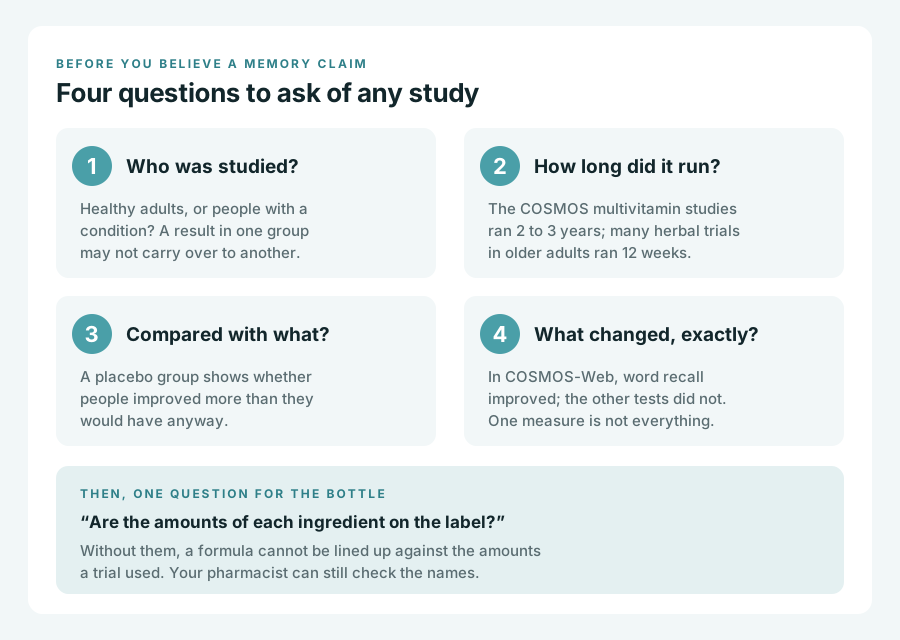
How Do You Read The Supplement Facts Panel?
Read the panel for the amount of each ingredient: that is what lets you set a bottle beside the amounts the trials in the table used. The FDA says the Supplement Facts panel must list the serving size, the number of servings per container and each dietary ingredient, with the amount per serving — by weight, as a percentage of the Daily Value, or both.
There is one exception. For ingredients that are part of a proprietary blend, the FDA does not require the amount of each one per serving.
That is what makes the panel useful. When an ingredient has its own amount, you or your pharmacist can set it beside the dose a trial used: 500 mg of citicoline, 300 mg of bacopa, 2 g of DHA. When it sits inside a blend, the panel shows the ingredient is there, but not how much.
What Everyday Steps Does Mayo Clinic List For Memory?
In their 2026 guide to improving memory, Mayo Clinic staff list seven everyday steps:
- Be physically active every day. Mayo cites the federal recommendation of at least 150 minutes a week of moderate aerobic activity, such as brisk walking.
- Stay mentally active with puzzles, reading, games, a musical instrument, a new hobby or volunteering.
- Spend time with others. Social contact helps ward off depression and stress, both of which can contribute to memory loss.
- Stay organized. Keep tasks in a notebook or calendar, and keep your keys, wallet and glasses in a set place.
- Sleep well — 7 to 9 hours a night for adults.
- Eat brain-friendly foods: fruits, vegetables and whole grains, low-fat protein such as fish, beans and skinless poultry, and alcohol only in moderation.
- Manage chronic health conditions such as high blood pressure, diabetes, depression and hearing loss, and review your medicines regularly with a health professional, because some medicines can affect memory.
These steps sit alongside any decision about a supplement, not instead of it.
Who Should Check Before Starting?
Anyone taking the medicines below should take the label to a pharmacist first, because multi-ingredient formulas carry more to check than a single vitamin. Reference sources flag these ingredients from the two formulas discussed next:
- Cholinesterase inhibitors or heart-rate medicines. NeuroZoom names huperzine A, which Memorial Sloan Kettering notes may increase side effects with drugs such as donepezil and may lower heart rate with calcium channel blockers or beta blockers.
- Thyroid hormone. NeuroZoom names bacopa, which a StatPearls review notes may lead to too much thyroid hormone, and iron, which the FDA-approved levothyroxine label says not to take within 4 hours of the medicine.
- Diabetes medicine or cyclosporine. MemoVolt contains berberine and cinnamon. The NIH’s complementary health center says cinnamon can cause unwanted side effects with diabetes drugs, and that berberine may interact with some medicines, including cyclosporine.
- Blood thinners. MemoVolt names fucoidan, which Memorial Sloan Kettering notes may increase bleeding risk with warfarin or heparin.
The FDA advises bringing a list of all your supplements and medicines to every visit, and our checklist for people on several medicines shows how to prepare it. Never stop, reduce or change a prescription to make room for a supplement.
What Should You Look For Before You Buy?
If you have decided a formula is worth trying, these are the things to confirm before you order.
- Ingredients with human trials in older adults. Use the table above: find the row for each ingredient on the label, and read who was studied.
- A published amount for each ingredient. It is the only way to read a label against the trials.
- Realistic timing. Most trials ran for months, so plan to judge a formula over months, not days.
- A guarantee that covers that time, and a pharmacist’s check. Read the refund terms, and bring the label and your medicine list to the pharmacy.
Which Formulas Draw On The Evidence In The Table?
Two formulas on this site connect to rows in the table. NeuroZoom contains a base of about nineteen everyday vitamins and minerals — the category of product behind the COSMOS results — alongside a nootropic group that includes phosphatidylserine, bacopa and huperzine A. It is not the multivitamin tested in COSMOS, and it publishes no amounts, so it cannot be lined up against that trial; its comparison page sets the two side by side.
MemoVolt contains saffron, the botanical with the 46-trial review above, together with berberine, Ceylon cinnamon, banaba and other ingredients studied for how the body handles blood sugar. It does not publish amounts either. Our guide to brain fog after meals explains that side of its formula.
Two formulas worth a closer look
Two formulas tied to rows in the table
If the table points you toward trying a formula, these two draw on its stronger rows — each with a money-back guarantee.
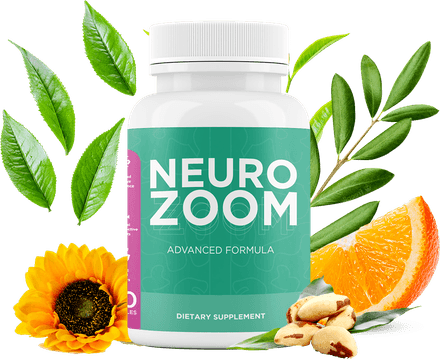
NeuroZoom
Capsules
A once-daily capsule with a base of about nineteen everyday vitamins and minerals, plus phosphatidylserine, bacopa and huperzine A.
- Readers who want vitamins and memory nutrients in one capsule
- Once-a-day routines
Covered by a 60-day money-back guarantee
Before you start · Huperzine A matters with cholinesterase inhibitors and heart-rate medicines. If you already take a multivitamin, compare the two labels.
See NeuroZoom on the official siteRead our NeuroZoom review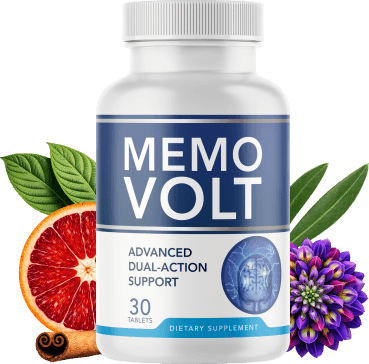
MemoVolt
Capsules
One capsule a day with food, containing saffron — a botanical with a 2024 review of 46 human trials on cognition — alongside berberine, Ceylon cinnamon and banaba.
- Anyone who wants one capsule a day
- Readers already watching their blood sugar
Covered by a 60-day money-back guarantee
Before you start · Berberine and cinnamon are worth raising if you take diabetes medicine, and fucoidan if you take a blood thinner.
See MemoVolt on the official siteRead our MemoVolt reviewListed in no particular order. We publish no scores or rankings.
When Should You See A Doctor About Memory?
Talk with a doctor if you are asking the same questions over and over, getting lost in places you know well, or becoming more confused about time, people and places, or if your memory is changing in ways that affect your day. That conversation comes before any bottle.
The National Institute on Aging notes that memory problems can come from treatable causes, including medication side effects, sleep problems, thyroid problems and low vitamin B12 — and that finding the cause is what determines the best course of action.
Ready to compare? Go back to the two formulas above, or read the full reviews of NeuroZoom and MemoVolt.
Frequently asked
Do any memory supplements actually work?
Some have positive trials, and the effects are modest. The strongest evidence in adults 60 and older is for a daily multivitamin: three studies within the COSMOS trial found better memory or overall cognition over two to three years. Citicoline, phosphatidylserine, saffron and creatine have smaller or shorter positive studies. Vitamin D, vitamin B12 in people who are not low, and omega-3 DHA showed no benefit in their trials.
Are memory supplements worth it?
It depends on what you expect and what you already take. The trial results are modest, the FDA does not review supplements for effectiveness before they are sold, and a 2023 systematic review rated most herbal and nutritional studies in older adults at high risk of bias. If you decide to try one, choose an ingredient with human research, give it the length of time the trials used, and check it with your pharmacist first.
What are the best brain supplements for elderly people?
This site does not rank supplements. What the research shows is that a daily multivitamin has the largest and longest trials in adults 60 and older, with benefits for memory in the COSMOS studies. Among single ingredients, citicoline, phosphatidylserine, saffron and creatine have positive human studies, each in a specific group and for a limited time. Vitamin B12 matters most if your levels are low.
Do multivitamins help brain health?
In the COSMOS trial they did, modestly. In COSMOS-Mind, 2,262 adults with an average age of 73 who took a daily multivitamin for three years had better global cognition than those on placebo, and two further COSMOS studies found better memory. The researchers call for studies in more diverse groups. A multivitamin is not a treatment for any disease.
What vitamins help memory in older adults?
In trials of adults 60 and older, a daily multivitamin is the one with the clearest result: the COSMOS studies found better memory or overall cognition over two to three years. Vitamin D at 2,000 IU a day made no difference in its trials, and vitamin B12 did not improve thinking in people who were not low. If you might be low in B12, ask your doctor for a check.
Is bacopa proven for memory?
Not consistently. A 2021 analysis in Scientific Reports found modest improvements in people with memory loss, and improvements in healthy people that did not reach statistical significance. A 2025 trial of 101 adults aged 40 to 70 found no greater improvement in cognition than placebo after 12 weeks. Bacopa is worth raising with your pharmacist if you take thyroid hormone.
What does Mayo Clinic recommend for memory?
Mayo Clinic staff list seven everyday steps: be physically active every day, stay mentally active, spend time with others, stay organized, sleep 7 to 9 hours, eat fruits, vegetables, whole grains and low-fat protein, and manage chronic conditions such as high blood pressure, diabetes, depression and hearing loss, including a regular review of your medicines.
Can I take a memory supplement with my medicines?
Ask your doctor or pharmacist first, and bring the label. The FDA notes that some supplements can change how a medicine is absorbed, broken down or cleared. Ingredients such as huperzine A, bacopa, berberine and cinnamon each have medicine types worth raising. Never stop or change a prescription to make room for a supplement.
References
- Effects of cocoa extract and a multivitamin on cognitive function: A randomized clinical trial — Alzheimer’s & Dementia — 2023
- Multivitamin Supplementation Improves Memory in Older Adults: A Randomized Clinical Trial — The American Journal of Clinical Nutrition — 2023
- Effect of multivitamin-mineral supplementation versus placebo on cognitive function: results from the clinic subcohort of the COcoa Supplement and Multivitamin Outcomes Study (COSMOS) randomized clinical trial and meta-analysis of 3 cognitive studies within COSMOS — The American Journal of Clinical Nutrition — 2024
- Daily multivitamin may enhance memory in older adults — National Institute on Aging — 2023
- Effect of vitamin D on cognitive decline: results from two ancillary studies of the VITAL randomized trial — Scientific Reports — 2021
- Effects of Vitamin B12 Supplementation on Cognitive Function, Depressive Symptoms, and Fatigue: A Systematic Review, Meta-Analysis, and Meta-Regression — Nutrients — 2021
- CNS target engagement of high-dose DHA supplementation in older adults at risk for dementia: a randomised, double-blind, placebo-controlled trial — eBioMedicine — 2026
- Citicoline and Memory Function in Healthy Older Adults: A Randomized, Double-Blind, Placebo-Controlled Clinical Trial — The Journal of Nutrition — 2021
- Effect of phosphatidylserine on cognitive function in the elderly: A systematic review and meta-analysis — Korean Journal of Food Science and Technology — 2022
- The Effects of a Bacopa monnieri Extract (Bacumen®) on Cognition, Stress, and Fatigue in Healthy Adults: A Randomized, Double-Blind, Placebo-Controlled Trial — Clinical Drug Investigation — 2025
- The effectiveness of Bacopa monnieri (Linn.) Wettst. as a nootropic, neuroprotective, or antidepressant supplement: analysis of the available clinical data — Scientific Reports — 2021
- New horizons for the study of saffron (Crocus sativus L.) and its active ingredients in the management of neurological and psychiatric disorders: A systematic review of clinical evidence and mechanisms — Phytotherapy Research — 2024
- Adverse Events of Saffron (Crocus sativus L.): Systematic Review of Current Evidence — Health Science Reports — 2026
- Effects of creatine supplementation on memory in healthy individuals: a systematic review and meta-analysis of randomized controlled trials — Nutrition Reviews — 2023
- Commentary: The effects of creatine supplementation on cognitive function in adults: a systematic review and meta-analysis — Frontiers in Nutrition — 2026
- A systematic review of the safety and efficacy on cognitive function of herbal and nutritional medicines in older adults with and without subjective cognitive impairment — Systematic Reviews — 2023
- Mixing Medications and Dietary Supplements Can Endanger Your Health — U.S. Food and Drug Administration — 2022
- Dietary Supplements: What You Need to Know — NIH Office of Dietary Supplements — 2023
- Questions and Answers on Dietary Supplements — U.S. Food and Drug Administration — 2026
- Memory loss: 7 tips to improve your memory — Mayo Clinic — 2026
- Vitamin B12: Fact Sheet for Health Professionals — NIH Office of Dietary Supplements — 2025
- Memory Problems, Forgetfulness, and Aging — National Institute on Aging — 2023
- Huperzia serrata (Huperzine A) — Memorial Sloan Kettering Cancer Center, About Herbs — 2022
- Fucoidan — Memorial Sloan Kettering Cancer Center, About Herbs — 2026
- Bacopa monnieri — StatPearls, NCBI Bookshelf — 2023
- SYNTHROID (levothyroxine sodium) Prescribing Information — U.S. Food and Drug Administration — 2024
- Diabetes and Dietary Supplements: What You Need To Know — NIH National Center for Complementary and Integrative Health — 2023
- Berberine and Weight Loss: What You Need To Know — NIH National Center for Complementary and Integrative Health — 2023
Disclosure
All content is for informational purposes only and is not a substitute for professional medical advice, diagnosis, or treatment. Each product covered is a dietary supplement, not a prescription drug, and statements about it have not been evaluated by the U.S. Food and Drug Administration. Results vary with individual health status, consistency of use, and lifestyle. This page contains affiliate links — if you buy through them we may earn a small commission at no additional cost to you. Read our disclosure and our editorial policy.