
HoneyBurn Review (2026): Eleven Ingredients In 550 mg, And Where The Berberine Sits
A spoonful of purple honey, sold on an enzyme and a famous ingredient. Here is what the panel prints, what the order of that list tells you, and what the checkout commits you to.
Quick answer
HoneyBurn is a liquid honey supplement taken from a dropper, 2 ml a day. Its panel prints one total: a 550 mg blend of eleven ingredients, from raspberry seed and bee products to kudzu and berberine. No single amount is published. The berberine extract is last of the eleven, which caps it at 50 mg a serving. Checkout is a one-time purchase with a 60-day guarantee.
Try it with the 60-day guarantee
You are eating less than you did at forty. You know you are, because you have counted. The bread went first, then the second glass of wine, then dessert on weeknights. And the scale has the nerve to sit exactly where it was in March.
Somebody at the table tells you it is your metabolism, as if that were a thing you could go and fetch. Your doctor says the same thing more kindly, and adds walking. You walk. The jeans you kept for when this works are still folded at the back of the drawer.
So you have read the pages — the ones with the enzyme nobody told you about, the ingredient that works like a prescription, the woman who lost twenty pounds without changing a thing. You close most of them halfway, and you are right to. Being tired of being sold to is not the same as being gullible.
So this page does the dull, useful thing. It reads the panel on the bottle, line by line. It sets each ingredient against the human research that exists, says plainly where that research is thin, and shows you one thing about the order of the list that most readers walk past. Then you decide, which is the part that ought to have been yours all along.
1. What Is HoneyBurn?
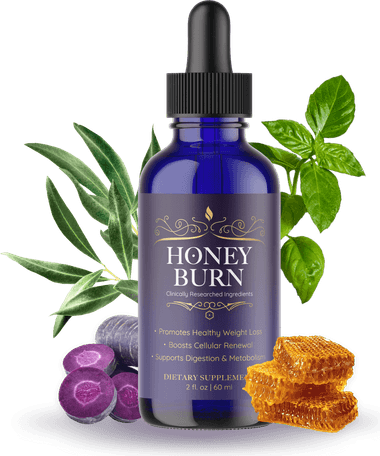
HoneyBurn is a liquid supplement built on honey, sold in a 2 fl oz (60 ml) dropper bottle. You fill the dropper and either squeeze it into your mouth or stir it into a drink. For anyone who has given up on a supplement because one more capsule felt like one too many, that is a real difference, and it is a pleasant one: the base is wildflower honey, sweetened further with stevia.
The bottle names its distributor — HoneyBurn, 285 Northeast Ave, Tallmadge, Ohio — with a contact email. It is sold through the maker's own site, with ClickBank as the retailer that handles the payment and the refund.
The story the maker tells is about lipase, the enzyme that breaks down fat. In the page's words, some people have lower lipase levels and so struggle to lose weight, and HoneyBurn is "the first and only purple honey designed to boost lipase levels". That is the maker's framing, reported here as the maker's claim. Lipase is real and does the job described; whether this honey raises it in the people who take it has not been tested in a published trial.
2. What Is In HoneyBurn?
We start here on every product, because it is the document you would read in a shop if you could hold the bottle. And this one gives you more to read than most: the maker publishes a full Supplement Facts panel.
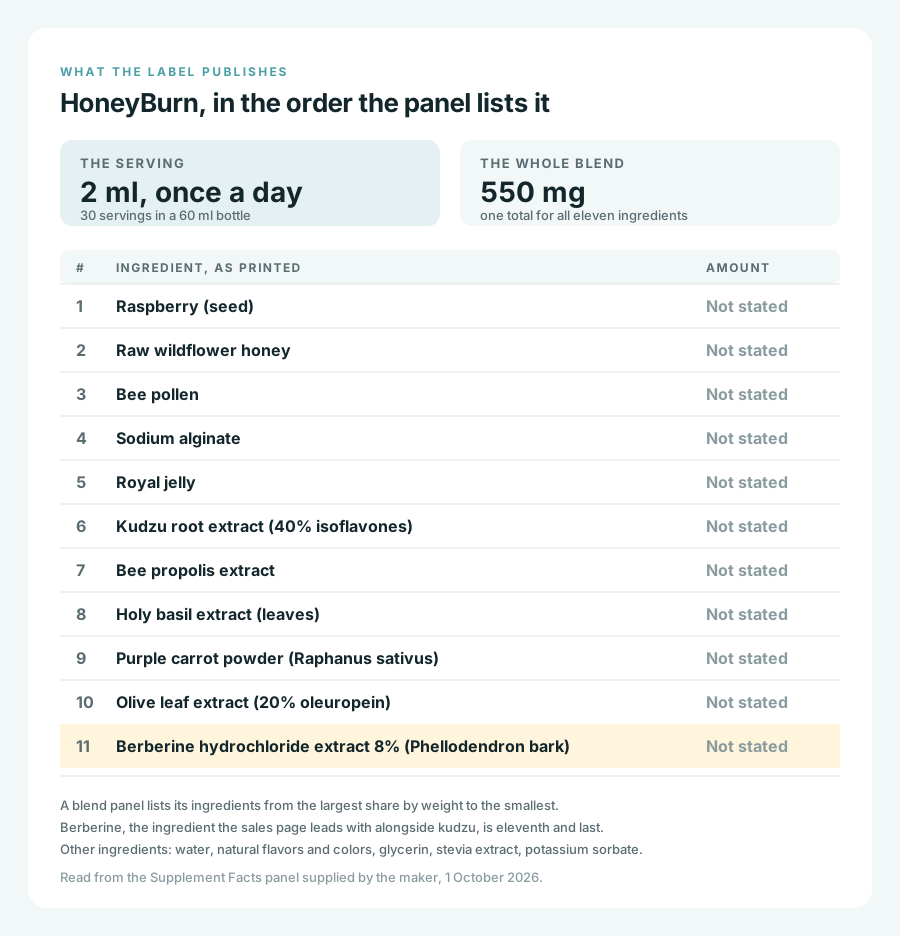
The serving is 2 ml, and the bottle holds 30 of them. That single fact is more useful than it looks, because it turns a bottle into a number of days and a price into a cost per day — section seven uses it.
Everything active sits inside one blend, which the panel calls the Royal Honey Blend: 550 mg per serving, eleven ingredients, one total. This is what a proprietary blend looks like. The law asks for the ingredients to be listed in order of weight, largest first, but not for the share of each. Our guide to proprietary blends explains how to read one.
The sales page and the panel agree on eleven. The last one is printed as a single ingredient: a berberine hydrochloride extract at 8%, from the bark of the Amur cork tree, Phellodendron amurense. Outside the blend come water, natural flavors and colors, glycerin, stevia leaf extract and potassium sorbate.
The label also carries a line printed by the maker that is worth reading before you order: "WARNING — The safety of this product has not been determined." Next to it, the usual advice to keep the bottle away from children, here under the age of twelve. We report it because it is on the bottle you would receive, and because it is exactly the kind of line a pharmacist would want to see if you take other medicines.
3. What Does The Research Say About The Ingredients In HoneyBurn?
Eleven ingredients, and the human research behind them is very uneven. Here it is grouped by how much exists.
Berberine — the most studied, at a specific amount
Berberine is a compound from several plants, Phellodendron bark among them, and it has more human trials on body weight than anything else on this label. A 2022 review that pooled 49 randomised trials found an average weight change of 0.84 kg against placebo, with a larger effect at more than 1000 mg a day and in studies running longer than eight weeks.
The NIH's complementary health centre, summarising the same body of research in 2023, adds the context that matters: many of those studies carried a high risk of bias, their results were inconsistent, and most participants had diabetes or fatty liver disease. In its words, more high-quality research is needed before firm conclusions can be drawn. Both halves of that belong in the record.
Royal jelly — a pooled analysis with a mixed answer
A 2023 meta-analysis of 10 randomised trials, 512 people in all, found no significant overall effect of royal jelly on body weight, BMI or fat mass. A subgroup taking under 3000 mg a day did show small reductions in weight and BMI, and the authors asked for more trials before drawing conclusions.
Kudzu — studied for other things
Kudzu root is the ingredient the sales page pairs with berberine for lipase. Its human trials, as Memorial Sloan Kettering's herb database summarises them, have looked mainly at alcohol intake in heavy drinkers and at menopausal symptoms, with mixed results. Body weight is not among the outcomes it lists.
The other eight
Raspberry seed, wildflower honey, bee pollen, sodium alginate, propolis, holy basil, the root powder and olive leaf each have literature of varying depth, mostly on measures other than weight. And as with nearly every finished formula sold direct, no trial of this exact blend is published — the evidence above is evidence about ingredients, taken on their own and at their own amounts.
4. How Is The HoneyBurn Formula Designed?
Here is the part most readers miss, and it is the most useful thing on this page.
The sales page leads with two ingredients for lipase: kudzu and berberine. On the panel, kudzu is sixth of eleven, and the berberine extract is eleventh — the last. Because a blend lists its ingredients from the largest share by weight to the smallest, every one of the ten above it weighs at least as much as it does. Eleven shares that size have to fit inside 550 mg.
That is simple arithmetic, and it gives a ceiling: no more than 50 mg of the berberine extract per serving. Nothing on the label says how far below that ceiling it is. The panel also describes the extract as 8%. If that figure refers to its berberine content, the way the 40% on the kudzu line refers to isoflavones, the berberine itself is a small part of those 50 mg.
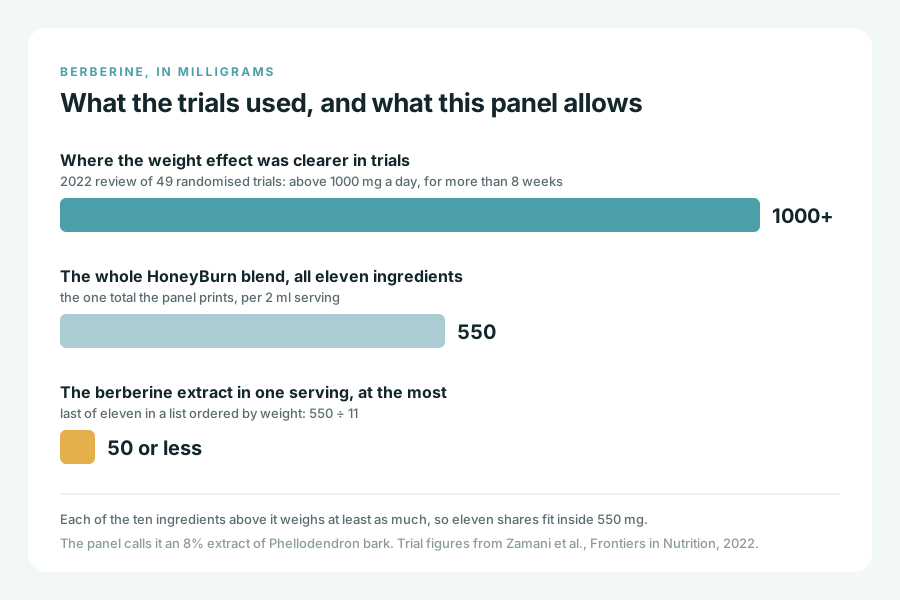
Set that beside the research in section three. The trials where berberine's weight effect was clearer used more than 1000 mg a day of berberine. A serving of HoneyBurn holds, by the label's own ordering, at most 50 mg of the extract — a twentieth of that amount before the 8% is even considered — and the label's optional second serving would still keep the day under 100 mg.
What that means depends on why the bottle caught your eye. If berberine is the reason, this is not a berberine dose in the sense the trials meant, and the next page sets out what buying it on its own involves. If what appeals is the whole thing — a daily spoonful of honey with bee pollen and royal jelly near the top of the list and ten more ingredients in one dropper — then that is exactly what the panel describes, and it describes it more openly than most labels in this aisle.
See HoneyBurn and decide for yourself5. How Do You Take HoneyBurn, And When Would You Notice A Change?
The bottle and the sales page do not quite agree on how often. The label says 2 ml once a day, preferably in the morning, with a second serving later in the day only "if tolerable". The sales page says one serving in the morning and one at night.
Where the two disagree we report the label, because it is the document that arrives with the product — and here the difference reaches your wallet. At one serving a day, a bottle lasts 30 days. At two, it lasts 15, and every figure in the price table below doubles.
On timing, the maker does not put a number on results, and we are not going to invent one. The berberine trials that showed a clearer effect ran for more than eight weeks; nothing on this label acts within days, and judging it after one bottle would tell you very little.
The guarantee is 60 days — roughly the length of those shorter trials. That is enough time to know whether the routine suits you, and worth marking on a calendar the day the bottle arrives.
6. What Do Buyers Say About HoneyBurn?
Independently verifiable feedback is limited, as it is for most supplements sold direct to consumers. The reviews that exist sit on the seller's own page, where nothing can be checked from outside — who wrote them, whether they bought the product, or when. We will not summarise them as evidence, and this site publishes no rating or review count.
What can be said fairly: for a honey base taken from a dropper, the things buyers of liquid supplements tend to mention are taste and whether the habit sticks. Both are worth knowing in advance, and neither needs a testimonial to establish.
What it does well
- A full Supplement Facts panel is published, with the serving and the blend total
- A honey base taken from a dropper or in a drink, with no capsules to swallow
- The distributor is named on the bottle, with a postal address and an email
- A one-time purchase, with US shipping free on every package
What to know before you buy
- No amount is published for any single ingredient inside the 550 mg blend
- The berberine extract is last of eleven, which caps it at 50 mg a serving
- The label carries the maker’s own warning that safety has not been determined
- The label says one serving a day; the sales page says two, which halves how long a bottle lasts
- No published trial on this exact blend
7. How Much Does HoneyBurn Cost, And Is There A Guarantee?
Read the price per bottle, not the total of the package. It is the only way to compare one order against another honestly. Prices are the maker's at the time of writing and can change.
| Package | Price per bottle | Per day | Shipping |
|---|---|---|---|
| 1 bottle | $69 per bottle | $2.30 | Free, US |
| 3 bottles | $59 per bottle | $1.97 | Free, US |
| 6 bottles | $49 per bottle | $1.63 | Free, US |
| Guarantee | 60 days, money back, handled through ClickBank | ||
Per-day cost uses the label's serving: 2 ml once a day, so one 60 ml bottle lasts 30 days. At the sales page's two servings a day, double it.
Order Now on the official siteWhat the checkout commits you to. We opened the payment form for all three packages on 1 October 2026. Each is billed once, in US dollars. There is no subscription, no auto-ship and no second charge attached, and shipping within the US showed as free on all three. It cannot be assumed, which is why we check it every time.
The guarantee is 60 days from purchase. The sales page says to get in touch within that window and send back all the bottles, even the empty ones, and the money is refunded. Keep the confirmation email, and check the first statement after you order.
Order Now on the official site
8. Who Is HoneyBurn For?
A question about you rather than about the bottle, so here it is answered that way.
It may suit you if capsules are the reason your last supplement ended up in a cupboard; if a spoonful of honey in the morning sounds like a habit you would actually keep; if you like being able to read a full panel before you buy; and if you are adding it to the walking and the smaller plates rather than hoping it replaces them.
It may not be for you if berberine is what you are really after, at the amounts the trials used; if you want to check the dose of each ingredient before you spend; or if you are allergic to bee products, have asthma, or take diabetes medicine, a blood thinner, cyclosporine or tamoxifen and have not yet shown this label to your doctor or pharmacist.
And if your weight has changed quickly without a reason you can name, that is a conversation for an appointment rather than a bottle. Nothing on this site treats or prevents any condition.
If that sounds like you, see HoneyBurn
Frequently asked
How do you take HoneyBurn?
The label says 2 ml by mouth once a day, preferably in the morning, straight from the dropper or stirred into a drink, with a second serving later in the day only if it is well tolerated. The sales page says one serving in the morning and one at night. At one serving a day the 60 ml bottle lasts 30 days; at two, it lasts 15.
Does HoneyBurn publish how much of each ingredient it contains?
Not one by one. The Supplement Facts panel prints a single total — a Royal Honey Blend of 550 mg per 2 ml serving — and lists the eleven ingredients inside it in order of weight, from raspberry seed first to the berberine extract last. The share of each ingredient is not stated.
How much berberine is in a serving of HoneyBurn?
The label does not say. What it does show is that the berberine extract is the last of eleven ingredients in a 550 mg blend listed by weight, which puts the extract at no more than 50 mg per serving. The panel describes it as an 8% extract of Phellodendron bark. In a 2022 review of 49 trials, the weight effect of berberine was clearer above 1000 mg a day taken for more than eight weeks.
Does HoneyBurn have side effects?
No trial of this exact blend is published, so what is known comes from ingredients studied on their own. For berberine, a 2023 review of placebo-controlled trials cited below found no serious side effects reported; digestive complaints were reported more often than on placebo, in 2 to 23 percent of people taking berberine against 2 to 15 percent on placebo. Royal jelly comes from bees, and who should avoid it is in the next question. If you are pregnant, take a prescription medicine every day, especially for blood sugar, or have surgery coming up, ask your doctor first.
Can I take HoneyBurn with my medicines?
Ask your doctor or pharmacist first, and bring the label. The NIH says berberine may interact with some medicines, including cyclosporine. Memorial Sloan Kettering lists kudzu with tamoxifen and diabetes medicines, and advises people allergic to bee products, or with asthma, to avoid royal jelly. The NIH also says berberine may be unsafe in pregnancy. Never stop or change a prescription to make room for a supplement.
Is HoneyBurn a one-time purchase or a subscription?
A one-time purchase. We opened the payment form for all three packages on 1 October 2026: each is billed once, in US dollars, with no subscription and no auto-ship attached, and shipping within the US showed as free on all three.
What is the guarantee?
Sixty days from purchase. The sales page says to contact the seller within that window and send back all the bottles, empty ones included, for a full refund. The order itself is handled by ClickBank as the retailer.
When should I speak to a doctor instead of trying a supplement?
If you are gaining weight you cannot explain, or losing weight you are not trying to lose — MedlinePlus puts the mark at more than 10 pounds, or 5 percent of your usual weight, in 6 to 12 months without a known reason — that is a conversation for your doctor. The same goes if you want to talk about prescription weight-loss medicine: the NIH says a doctor may prescribe it for adults with a BMI of 30 or more, or 27 or more with a weight-related health problem. Nothing on this page treats any condition.
References
- HoneyBurn — official product page: the ingredients named, the lipase explanation, the directions, the packages and the guarantee — honeyburn.com — 2026
- HoneyBurn order form — package prices and billing terms, read on the ClickBank secure checkout — 2026
- The effects of berberine supplementation on cardiovascular risk factors in adults: A systematic review and dose-response meta-analysis — Frontiers in Nutrition — 2022
- Overall and Sex-Specific Effect of Berberine for the Treatment of Dyslipidemia in Adults: A Systematic Review and Meta-Analysis of Randomized Placebo-Controlled Trials — Drugs — 2023
- Berberine and Weight Loss: What You Need To Know — National Center for Complementary and Integrative Health — 2023
- The effects of royal jelly supplementation on anthropometric indices: a GRADE-assessed systematic review and dose-response meta-analysis of randomized controlled trials — Frontiers in Nutrition — 2023
- Kudzu — About Herbs, Memorial Sloan Kettering Cancer Center — 2022
- Royal Jelly — About Herbs, Memorial Sloan Kettering Cancer Center — 2022
- Unexplained weight loss — MedlinePlus Medical Encyclopedia — 2025
- Weight gain - unintentional — MedlinePlus Medical Encyclopedia — 2025
- Prescription Medications to Treat Overweight & Obesity — National Institute of Diabetes and Digestive and Kidney Diseases — 2024
Disclosure
All content is for informational purposes only and is not a substitute for professional medical advice, diagnosis, or treatment. Each product covered is a dietary supplement, not a prescription drug, and statements about it have not been evaluated by the U.S. Food and Drug Administration. Results vary with individual health status, consistency of use, and lifestyle. This page contains affiliate links — if you buy through them we may earn a small commission at no additional cost to you. Read our disclosure and our editorial policy.