
How HoneyBurn Compares
This honey contains two ingredients you can also buy by themselves — so the comparison is not this or that, but a printed dose against a blend in a spoonful.
Quick answer
HoneyBurn contains berberine and kudzu, both sold on their own. A berberine capsule prints its dose, so you can match the 1000 mg a day or more where trials saw a clearer weight effect. HoneyBurn holds at most 50 mg of a berberine extract per serving, inside a honey base with ten other ingredients and a 60-day guarantee. That is the whole decision.
Most comparisons set one formula against another. This one is more useful than that, because of a fact from the review page: HoneyBurn contains two ingredients you can buy by themselves, and the sales page leads with exactly those two.
So the question is not which bottle is stronger. It is a real trade-off between two ways of getting at the same idea — and the honest answer depends on what you are actually after.
The Trade-Off, Stated Plainly
Buy berberine on its own and you control the amount. The label tells you how many milligrams are in each capsule, and you can line that up against the research. The trials where the weight effect was clearer used more than 1000 mg a day, for more than eight weeks. Nothing about that is hidden from you.
Buy HoneyBurn and you get something different. One dropper of honey a day, with bee pollen and royal jelly near the top of the list, kudzu in the middle and a berberine extract last. What you give up is the arithmetic for any single ingredient: the panel prints one total, 550 mg, for all eleven.
Both are reasonable. Neither is the clever choice. The question worth asking yourself honestly is whether berberine is the point, or the routine is. If it is berberine at the amounts studied, a single-ingredient product is the only way to get there. If it is a daily habit you will actually keep, in a format you enjoy, the honey makes a case of its own.
What The Trials Used
Before the table, the numbers that matter, because they are what a single-ingredient bottle lets you match and a blend does not.
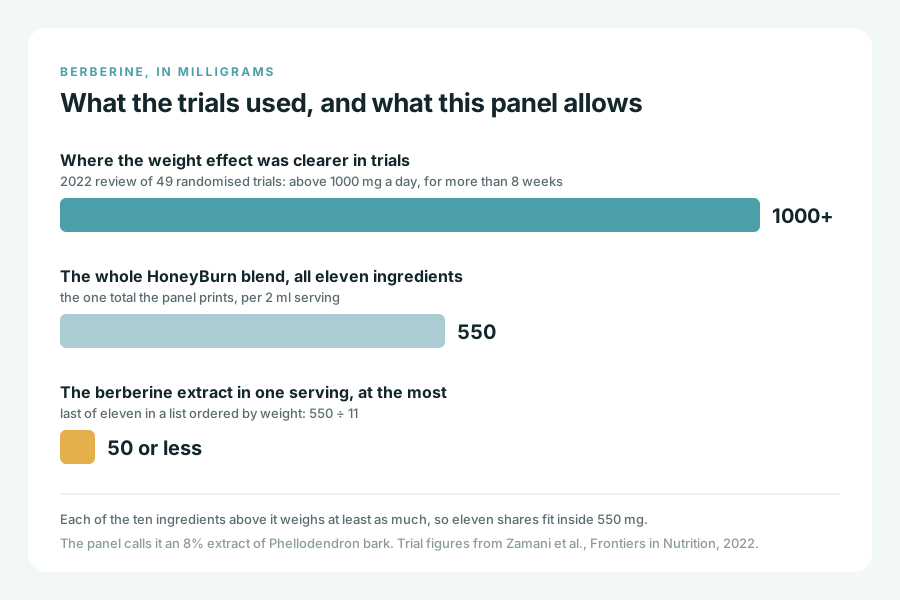
Kudzu does not get a bar, because there is no weight trial to draw one from. Its human research, as Memorial Sloan Kettering summarises it, has looked at alcohol intake and menopausal symptoms. Buying it on its own gives you a printed amount of an ingredient whose trials measured other things.
The Comparison
Read across a row rather than down a column. There is no score here and no order of merit — each cell describes what that option covers.
| Criteria | HoneyBurn | Berberine on its own | Kudzu on its own |
|---|---|---|---|
 | |||
| What you get | Eleven ingredients in a honey base, berberine and kudzu among them | One compound | One root extract |
| Amount printed on the label | 550 mg for the whole blend; none for each ingredient | Printed per serving, as standard | Printed per serving, as standard |
| What the research used | Cannot be matched ingredient by ingredient | Weight effect clearer above 1000 mg a day, for more than 8 weeks | Trials looked at alcohol intake and menopausal symptoms |
| Evidence on body weight | Inherited from its ingredients; the blend itself is not tested | Many trials, a small average effect, and a high risk of bias in many | Body weight is not among the outcomes summarised |
| Format | Honey liquid from a dropper | Usually capsules or tablets | Usually capsules |
| Bee products inside | Yes: honey, bee pollen, royal jelly, propolis | No | No |
| Refund window | 60 days | Varies by seller | Varies by seller |
| Where to buy | Official site → | Sold everywhere | Sold everywhere |
Prices are the maker's list price at the time of writing and change without notice. Every link goes through our own redirect and lands on the maker's official site.
Berberine, kudzu and bee products each have medicines and conditions worth raising with your doctor or pharmacist, whichever way you take them. The review page lists them by name.
What The Honey Brings That A Capsule Does Not
- A format, not another pill. 2 ml from a dropper or stirred into tea. If capsules are why your last supplement stopped, that is not a small thing.
- The bee products themselves. Wildflower honey, bee pollen, royal jelly and propolis make up much of the list. Royal jelly has its own trials on body weight, with a mixed overall result; none of that comes with a berberine capsule.
- A full panel and a named distributor. The serving, the blend total, the order of the ingredients and a postal address are all on the bottle.
- One routine and one refund window. A single daily habit, a one-time purchase and 60 days to ask for the money back.
Which One Fits Which Situation
- If you want berberine at the amounts the trials used, buy it on its own, and show the label to your doctor first, since berberine interacts with several medicines. That is the only route where the dose is yours to check.
- If capsules are the problem, the dropper settles it before any other argument gets a hearing.
- If you are allergic to bee products or have asthma, the honey is the option to raise with your doctor before anything else, because four of its ingredients come from the hive.
- If you want to learn how one ingredient affects you, a single compound tells you something a blend never can: which of them did anything.
See HoneyBurn on the official site
Frequently asked
If HoneyBurn contains berberine, why not just buy berberine on its own?
That is the real trade-off. A berberine capsule prints its amount, so you can match the 1000 mg a day or more at which the 2022 review saw a clearer weight effect. HoneyBurn holds at most 50 mg of a berberine extract per serving, by the order of its own label, inside a honey base with ten other ingredients. Which suits you depends on whether you want the berberine dose or the whole routine.
Is a blend better than a single ingredient?
That is not established, here or generally. No trial of the HoneyBurn blend is published, so the honest position is that a blend is a different design rather than a stronger one. What it does give you is one daily habit instead of several bottles, and a format that is easy to keep up.
Does kudzu help with weight on its own?
Memorial Sloan Kettering summarises kudzu trials as looking mainly at alcohol intake in heavy drinkers and at menopausal symptoms, with mixed results. Body weight is not among the outcomes it lists. The HoneyBurn sales page presents kudzu as a lipase booster; that is the maker’s explanation, not a tested result.
Which option is easiest to take every day?
That depends on you. HoneyBurn is 2 ml of honey from a dropper or stirred into a drink, once a day by the label. Berberine on its own is usually a capsule or tablet, and the amounts studied were above 1000 mg a day. If capsules are the reason supplements end up in your cupboard, the format may decide it.
References
- The effects of berberine supplementation on cardiovascular risk factors in adults: A systematic review and dose-response meta-analysis — Frontiers in Nutrition — 2022
- Berberine and Weight Loss: What You Need To Know — National Center for Complementary and Integrative Health — 2023
- Kudzu — About Herbs, Memorial Sloan Kettering Cancer Center — 2022
- The effects of royal jelly supplementation on anthropometric indices: a GRADE-assessed systematic review and dose-response meta-analysis of randomized controlled trials — Frontiers in Nutrition — 2023
Disclosure
All content is for informational purposes only and is not a substitute for professional medical advice, diagnosis, or treatment. Each product covered is a dietary supplement, not a prescription drug, and statements about it have not been evaluated by the U.S. Food and Drug Administration. Results vary with individual health status, consistency of use, and lifestyle. This page contains affiliate links — if you buy through them we may earn a small commission at no additional cost to you. Read our disclosure and our editorial policy.