
How Pineal Guardian X Compares
Unusually, this formula contains the ingredients most readers already tried separately — so the comparison is not this or that, but a known amount against a combination.
Quick answer
Pineal Guardian X contains bacopa, ginkgo and lion’s mane — the three things most people try on their own. Bought separately you get the exact amounts the trials used, at 300 mg of bacopa and 240 mg of ginkgo. Bought together you get one routine and a 365-day guarantee, at amounts the label does not publish. That is the whole decision.
Most comparisons in this category set one formula against another. This one is different, and more useful, because of a fact from the review page: Pineal Guardian X contains the very ingredients most readers have already tried on their own.
So the question is not which product is stronger. It is a real trade-off between two ways of buying the same compounds — and the honest answer depends on which kind of person you are.
The Trade-Off, Stated Plainly
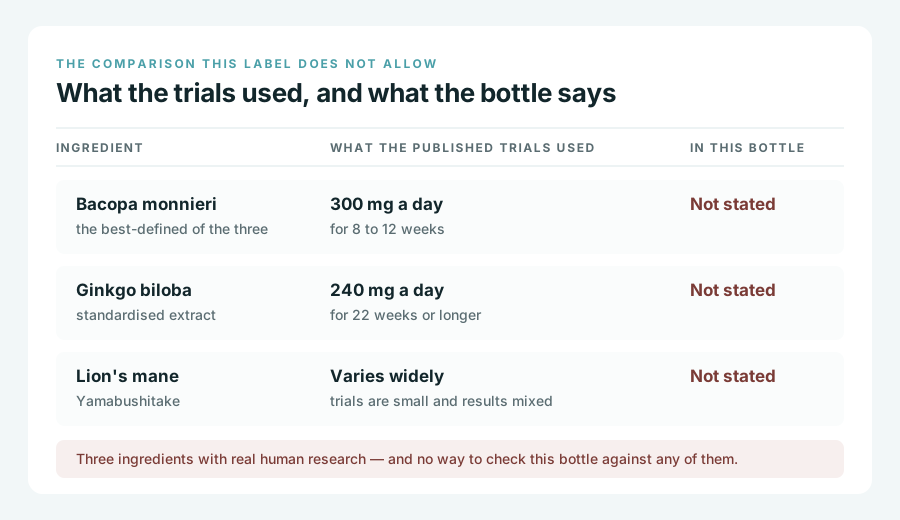
Buy them separately and you control the amounts. You can put 300 mg of bacopa on the counter and know it matches what the trials used. You can buy standardised ginkgo at 240 mg and run it for the 22 weeks the reviews call for. Nothing is hidden from you.
Buy them together and you get one bottle, one routine and one refund window — a full year of it. What you give up is the arithmetic: the label publishes no amounts, so you cannot line this bottle up against any trial.
Both are reasonable. Neither is the clever choice. Which suits you comes down to a question almost nobody asks themselves honestly: are you more likely to abandon three bottles or one? The evidence in this category needs eight to twenty-two weeks of consistency — and a regimen you keep beats a better-specified one you stop.
What The Trials Used
Before the table, the numbers that matter, because they are what a single-ingredient bottle lets you match.
The Comparison
Read across a row rather than down a column. There is no score here and no order of merit — each cell describes what that option covers.
| Criteria | Pineal Guardian X | Bacopa on its own | Ginkgo on its own | Lion’s mane on its own |
|---|---|---|---|---|
 | ||||
| What you get | Eleven ingredients, including all three of the others | One compound | One compound | One compound |
| Amount printed on the label | Not stated | Yes, as standard | Yes, as standard | Yes, as standard |
| What the trials used | Cannot be checked from the label | 300 mg a day, 8 to 12 weeks | 240 mg a day, 22 weeks or longer | Varies; trials are small |
| Strength of the evidence | Inherited from its ingredients, not tested as a formula | Substantial, with real disagreement in it | Positive, with conditions on amount and duration | Active and promising, not yet settled |
| Format | Liquid dropper | Usually capsules | Usually capsules | Capsules or powder |
| Bottles to run three ingredients | One | Three, bought separately | Three, bought separately | Three, bought separately |
| Refund window | 365 days | Varies by seller | Varies by seller | Varies by seller |
| Where to buy | Official site → | Sold everywhere | Sold everywhere | Sold everywhere |
Prices are the maker's list price at the time of writing and change without notice. Every link goes through our own redirect and lands on the maker's official site.
If you take a prescription, ask your prescriber before combining any of these with it. Ginkgo and bacopa are the two worth naming specifically, and that applies whether you take them as a blend or separately.
What The Blend Brings That Three Bottles Do Not
- One routine instead of three. Adherence is the quiet variable in a category whose evidence needs months. Three bottles is three chances to stop.
- A dropper rather than capsules. If swallowing capsules is a problem, or you already take several a day, that is not a small thing.
- A 365-day guarantee. Longer than every trial cited on this page, and longer than what you would typically get buying three separate products from three separate sellers.
- Eight further ingredients beyond the three — pine bark, spirulina, chlorella and the rest — which come along at no extra decision on your part.
Which One Fits Which Situation
- If you want to match the trials exactly, buy the single ingredients. That is the only route where you can verify the amount, and for bacopa and ginkgo the amount is the whole question.
- If you have already abandoned a supplement halfway, the blend is the honest choice. One bottle and a year to decide is built for the way people actually behave.
- If capsules are difficult, the dropper settles it before any other argument gets a hearing.
- If you only want to try one compound to see how you respond, a single ingredient tells you something a blend never can — which of them did anything.
See Pineal Guardian X on the official site
Frequently asked
If it contains bacopa and ginkgo, why not just buy those separately?
That is the real trade-off, and it is a fair question. Buying them separately lets you match the exact amounts the trials used — 300 mg of bacopa, 240 mg of standardised ginkgo. Buying them together in this bottle gives you one product, one routine and a 365-day guarantee, at amounts you cannot verify. Which matters more depends on whether you would rather check the arithmetic or keep the habit.
Is a combination better than a single ingredient?
That is not established, here or generally. There is no published trial on this combination, so the honest position is that a blend is a different design rather than a stronger one. What a blend does give you is one routine instead of three, and adherence is the quiet variable in a category where the evidence needs months.
Which of the three has the strongest evidence?
Bacopa has the largest and best-defined body of trials, converging on 300 mg a day over 8 to 12 weeks — though a 2025 trial at that same amount found no cognitive benefit over placebo, so the field disagrees with itself. Ginkgo is positive under conditions. Lion’s mane is the most active area of current research and the least settled.
Can I take any of these with prescription medication?
Ask your prescriber before combining. Ginkgo is the one to raise if you take a blood thinner or an antiplatelet, and bacopa is worth mentioning with thyroid medication or a sedative. That applies whether you take them as a blend or separately.
References
- The Effects of a Bacopa monnieri Extract (Bacumen®) on Cognition, Stress, and Fatigue in Healthy Adults: A Randomized, Double-Blind, Placebo-Controlled Trial — Clinical Drug Investigation — 2025
- The effect of plant active substances on cognitive function in healthy older adults: a systematic review and network meta-analysis of randomized controlled trials — Frontiers in Pharmacology — 2025
- Ginkgo biloba: a leaf of hope in the fight against Alzheimer’s dementia — clinical trial systematic review, Antioxidants — 2024
- A randomized, double-blind, placebo-controlled study evaluating the impact of Hericium erinaceus (Lion’s Mane) on cognitive performance and subjective wellbeing — medRxiv (preprint, not peer reviewed) — 2026
Disclosure
All content is for informational purposes only and is not a substitute for professional medical advice, diagnosis, or treatment. Each product covered is a dietary supplement, not a prescription drug, and statements about it have not been evaluated by the U.S. Food and Drug Administration. Results vary with individual health status, consistency of use, and lifestyle. This page contains affiliate links — if you buy through them we may earn a small commission at no additional cost to you. Read our disclosure and our editorial policy.