
How MemoVolt Compares
Set beside the omega-3, ginkgo and B-complex most readers have already tried — described by what each one covers, with no ranking and no winner.
Quick answer
MemoVolt and the supplements most people try first are answering different questions. B vitamins are studied for homocysteine. Ginkgo has positive trials, at 240 mg a day for 22 weeks or more. Omega-3 covers a broad range of endpoints. MemoVolt combines ten ingredients studied mainly for metabolism, plus saffron. Each covers different ground.
Most people arrive at a formula like MemoVolt having already tried something. Usually fish oil, a B-complex, or ginkgo — bought at a pharmacy, taken for a month or two, and quietly abandoned when nothing seemed to change.
That experience is the reason this page exists, and it deserves a better answer than "that one was no good". In at least one case there is a precise explanation for what happened, and it is not what most people assume.
What follows sets MemoVolt beside those three. It is not a ranking. Each column describes what that option covers and what its trials measured, and the right choice depends on which question you are actually asking.
What The Trials Actually Measured
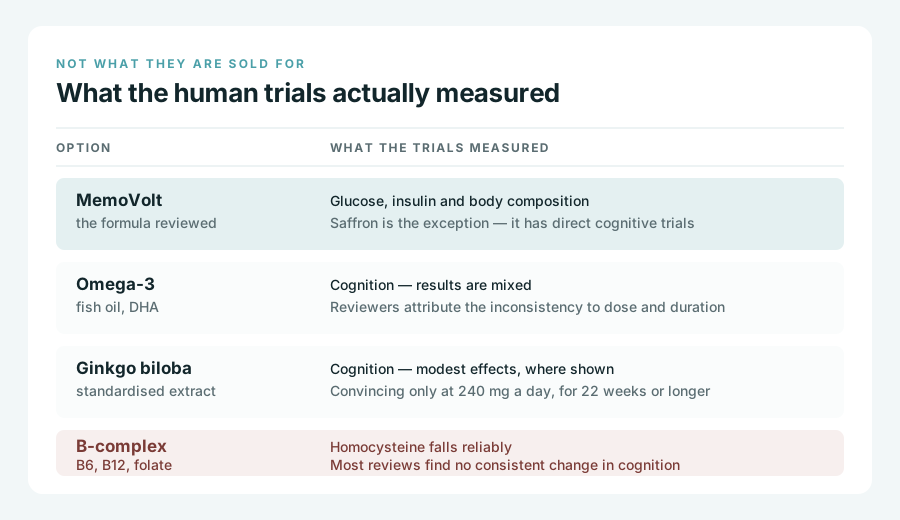
The most useful thing to know about any of these is not what it is sold for. It is what the researchers chose to measure.
The B-complex answer
This is the one worth reading twice. Trials consistently show that B6, B12 and folate lower homocysteine — that part works, and it is not in dispute. What the meta-analyses then find is that lowering homocysteine does not produce a matching change in memory or executive function in most populations studied.
So the B-complex you took did exactly what B-complex does. The effect it produced simply was not the one you were watching for. That is a different sentence from "it did nothing", and it is the accurate one.
The ginkgo condition
Ginkgo has real positive trials. The reviews attach a condition to them: the benefit was demonstrated convincingly at 240 mg a day of standardised extract, taken for 22 weeks or longer, and even then reviewers describe the effects as modest and the evidence as low to moderate quality.
Both halves of that condition matter — the amount and the duration. A course that ran for a few weeks was not the course that was tested.
Where omega-3 sits
Omega-3 has the widest range of findings of the three. Some reviews report benefit in early cognitive decline; across the general population the results vary. Reviewers attribute the variation to differences in dose, duration and who was studied. It remains a well-established thing to take for cardiovascular and general health; on cognition specifically, the honest summary is that the field has not yet converged.
The Comparison
Read across a row rather than down a column. There is no score here and no order of merit — each cell describes what that option covers.
| Criteria | MemoVolt | Omega-3 | Ginkgo biloba | B-complex |
|---|---|---|---|---|
 | ||||
| What it is built around | Ten botanicals and extracts | A single fatty acid pair | One standardised extract | Three vitamins |
| What the human trials measured | Glucose and body composition — saffron excepted | Cognition, with mixed results | Cognition, modest effects | Homocysteine, which falls reliably |
| What the positive trials used | No trial on this formula | Varies widely between trials | 240 mg a day, 22 weeks or longer | Doses that lower homocysteine |
| Amounts printed on the label | Not stated | Yes, as standard | Yes, as standard | Yes, as standard |
| Direct cognitive trial evidence in the bottle | Saffron | The fatty acids themselves | The extract itself | None found consistently |
| Capsules a day | One | Often two or more | One to two | One |
| Tends to suit | Someone whose picture includes metabolic markers | Someone eating little oily fish | Someone willing to run 22 weeks at full dose | Someone with a confirmed B12 or folate gap |
| Where to buy | Official site → | Sold everywhere | Sold everywhere | Sold everywhere |
Prices are the maker's list price at the time of writing and change without notice. Every link goes through our own redirect and lands on the maker's official site.
If you take a prescription, ask your prescriber before combining any of these with it. That applies to all four columns, and it is one short question at your next appointment.
What MemoVolt Brings That The Others Do Not
Three things are true of MemoVolt and not of the single-ingredient options, and they are worth stating plainly.
- It contains saffron. Of everything on this page, saffron is the ingredient with the most direct cognitive trial evidence — two systematic reviews looked at it specifically for cognitive function and for mild cognitive impairment. Neither the B-complex nor a plain fish oil contains it.
- It is a combination rather than a single compound. Whether combining helps is not established for this formula, and we said so on the main review. But it is a different design, and someone who has already run single compounds without result may reasonably want to try a different design.
- One capsule a day. Adherence is the quiet variable in all of this. The ginkgo evidence needs 22 weeks of consistent use; a regimen you actually keep for that long is worth something on its own.
Which One Fits Which Situation
This is the part that decides it, and it is about you rather than about any of the four.
- If your own picture already includes blood sugar or metabolic markers, MemoVolt's ingredient list is aimed at that territory, and the connection its maker draws to cognition is at least coherent with your situation.
- If you eat little oily fish, omega-3 covers a gap that has reasons beyond cognition, and those reasons stand on their own.
- If you want the single ingredient with the longest cognitive record and are prepared to run 240 mg a day for 22 weeks, ginkgo is that ingredient, on those terms.
- If a blood test has shown a B12 or folate gap, a B-complex addresses the gap itself — which is a real reason to take it, separate from the memory question.
- If you want to check each amount against published research before spending, the single-ingredient options print their amounts and MemoVolt does not. That is a difference in what you can verify, not a verdict on either.
See MemoVolt on the official site
Frequently asked
Why did the omega-3 and B-complex I already took not change anything?
For B vitamins there is a specific answer: the trials show they lower homocysteine reliably, and most reviews find that this does not translate into a measurable change in memory. The supplement did what it does; that effect simply is not the one you were hoping for. For omega-3 the picture is mixed rather than settled, and reviewers attribute the inconsistency largely to dose and duration.
Is ginkgo not the classic memory ingredient?
It is the best-known one, and it does have positive trials. What the reviews add is a condition: the effect was demonstrated convincingly at 240 milligrams a day of standardised extract, taken for 22 weeks or longer, and even then the effects are described as modest with low to moderate evidence quality. A lower amount taken for a few weeks is not the thing that was tested.
Does MemoVolt replace any of these?
It is a different approach rather than a substitute. MemoVolt combines ten ingredients whose research is mostly metabolic, plus saffron; the others are single compounds with their own separate literature. Which one fits depends on what you are trying to address, not on which is stronger.
Can I take MemoVolt alongside one of these?
That is a question about your full list, and it belongs with a pharmacist or prescriber who can see it. Several ingredients in this formula are studied for their effect on blood glucose, so it is worth raising specifically if you take diabetes medication. Ask before combining, not after.
References
- Ginkgo biloba: a leaf of hope in the fight against Alzheimer’s dementia — clinical trial systematic review, Antioxidants — 2024
- The preventive efficacy of vitamin B supplements on the cognitive decline of elderly adults: a systematic review and meta-analysis — 2021
- Efficacy of B vitamin supplementation on global cognitive function in older adults: a systematic review and meta-analysis — 2025
- A systematic review and dose-response meta-analysis of omega-3 supplementation on cognitive function — Scientific Reports — 2025
- Effects of saffron (Crocus sativus L.) on cognitive function: a systematic review of randomised controlled trials — Neurological Sciences — 2020
Disclosure
All content is for informational purposes only and is not a substitute for professional medical advice, diagnosis, or treatment. Each product covered is a dietary supplement, not a prescription drug, and statements about it have not been evaluated by the U.S. Food and Drug Administration. Results vary with individual health status, consistency of use, and lifestyle. This page contains affiliate links — if you buy through them we may earn a small commission at no additional cost to you. Read our disclosure and our editorial policy.