
Once-a-Day Memory Supplements: Why One Dose a Day Matters When You Already Take Several Pills
When the morning already starts with a row of tablets, the number of doses a supplement asks for is part of the decision. Here is why, how to read it on the label, and where to keep one bottle so it actually gets taken.
Quick answer
If you already take several pills, a memory supplement taken once a day is easier to keep: research in older adults links many tablets, or doses at different times, with mistakes and missed doses. Check the serving size and the directions on the label, keep the bottle beside a daily habit, and review it with your pharmacist. If you want to try one, two once-a-day formulas are compared below.
Breakfast comes with a small ritual now. The blood pressure tablet, the one for cholesterol, the vitamin the doctor suggested, something for the joints. You take them in the same order, with the same glass of water, and you rarely miss.
That routine took effort to build. So when a memory supplement asks for another handful, at another time of day, it is easy to understand why the bottle ends up in a drawer after a week.
This guide is about the number that decides whether a supplement fits into a day like yours: how many doses it asks for — how to find it on the label, and how to make one dose stick.
Further down, we look at two once-a-day formulas: MemoVolt and NeuroPrime — each with a money-back guarantee.
Why Does The Number Of Daily Doses Matter?
Each extra dose is one more chance to miss or mix one up, and the research on this comes from medicines rather than supplements. A 2026 scoping review in Frontiers in Aging gathered 41 studies of medication adherence in adults aged 60 and older with chronic conditions. It found that regimens that involve taking many tablets a day, or at different times, lead to mistakes and omissions.
The same review notes that between 23% and 39% of older adults take five or more medicines at the same time, and that the complexity of a regimen, frequent doses and multiple daily doses are critical factors that decrease adherence. Simplifying regimens and using reminders are among the strategies it describes.
Supplements add to that load. The CDC reports that 56.4% of adults aged 60 and older took two or more dietary supplements in 2021 to 2023.
Two honest limits. Those adherence studies were about prescription medicines, not supplements — the logic carries over, but the evidence was not gathered on supplements. And a single daily dose tells you about the routine, not about how much of each ingredient is inside.
How Do You Read Serving Size And Servings Per Container?
The number of doses is printed on the label, if you know where to look. Federal labeling rules for dietary supplements (21 CFR 101.36) set out the top of the Supplement Facts panel:
- Serving Size comes first, under the heading “Supplement Facts.” It is stated in a unit that fits the product, such as tablets, capsules, packets or teaspoonfuls. Under the rules it reflects the most the label recommends at one time, or one unit if there is no recommendation.
- Servings Per Container sits underneath. It can be left off when the front of the package already states the count — so check there, too.
The NIH Office of Dietary Supplements explains that the panel lists the active ingredients and the amount per serving. It also notes that the manufacturer suggests the serving size, but your health care provider might decide a different amount is right for you.
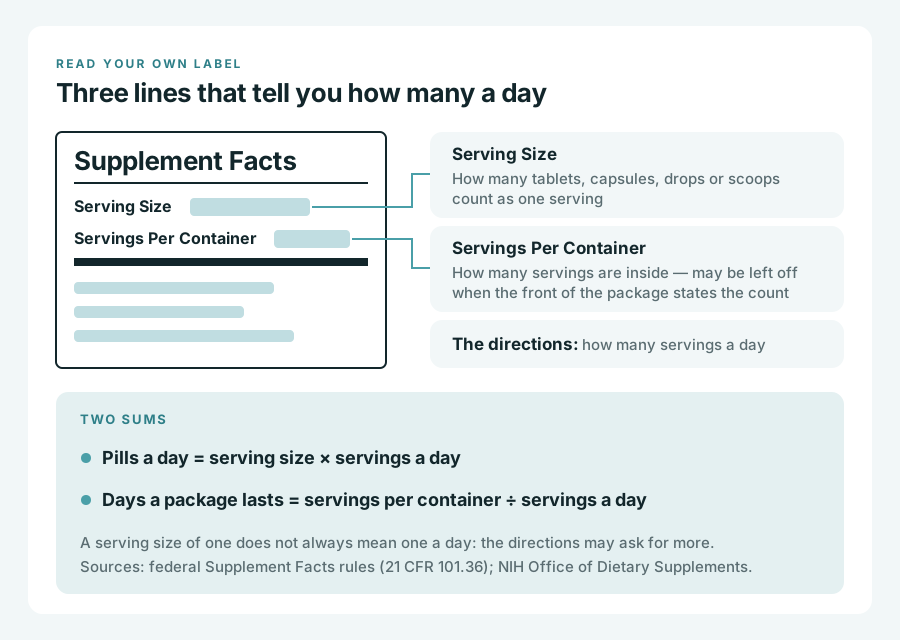
Then read the directions, because they add the part the panel does not: how many servings to take each day. A serving size of one capsule does not always mean one capsule a day, because the directions may ask for more than one serving. Two sums answer the practical questions:
- Pills a day = serving size × servings a day.
- Days a package lasts = servings per container ÷ servings a day.
The same sums work for drops and scoops. If a label does not publish a full panel, the count on the bottle and the directions still give you both numbers.
Where Should You Keep It So You Don’t Forget?
Keep it next to a meal or another daily habit, because one dose a day only helps if that dose happens. The National Institute on Aging notes that some people use meals or bedtime as reminders to take their medicine, while others use charts, calendars, timers or written reminders. A few practical choices follow from that:
- Pair it with a meal you never skip. If the label says to take it with food, breakfast or dinner is the natural anchor.
- Keep it close, but not by the stove or the sink. MedlinePlus advises storing medicines in a cool, dry place, such as a kitchen cabinet away from the stove, sink and hot appliances, and notes that heat and moisture from a bathroom can damage them. The same sense applies to a supplement.
- Leave it in its own bottle. MedlinePlus advises keeping medicines in their original containers. The label stays with the product, where you and your pharmacist can read it.
- Out of reach and sight of children. Worth remembering when grandchildren visit, as MedlinePlus and the National Institute on Aging both advise.
- Turn on a light. The National Institute on Aging advises not taking medicine in the dark, because you might make a mistake.
Finally, add the supplement to your written list of everything you take, with the amount and the time, as the National Institute on Aging suggests. The FDA advises bringing that list to every health care visit, because certain supplements can change how a medicine is absorbed, broken down or cleared. Ask your pharmacist whether your supplement needs to be taken apart from any of your medicines.
How Long Were These Ingredients Studied?
Several ingredients in the two formulas below were studied over weeks of daily use. That is why the routine matters as much as the bottle.
Saffron. A 2024 systematic review in Phytotherapy Research gathered 46 randomized trials lasting 4 to 48 weeks. Saffron was more effective than placebo for cognition and was well tolerated with few side effects. The trials included both healthy people and people with neurological and psychiatric conditions, so the result is not specific to healthy older adults.
Bacopa. A 2026 network meta-analysis in Phytomedicine pooled 29 randomized trials in 2,107 healthy adults: higher doses improved working memory compared with placebo, lower doses improved delayed memory, and there were no differences in attention or processing speed. In a 2025 trial of 101 adults aged 40 to 70 with self-reported memory and attention problems, 300 mg a day for 12 weeks did not improve cognitive scores more than placebo, though stress and fatigue measures improved.
Berberine. Its research is about blood sugar rather than memory. The NIH’s complementary health center notes berberine may lower glucose in people with type 2 diabetes, that results have varied, and that it may interact with some medicines.
The saffron trials ran from 4 to 48 weeks, and the bacopa trial above ran for 12. Each asked people to keep taking something, every day, for weeks.
Who Should Check Before Starting?
One dose a day is still one more thing for your pharmacist to check against your list. Bring the label if any of these apply to the formulas below:
- You take diabetes medicine. The NIH’s complementary health center says herbal supplements such as cinnamon can cause unwanted side effects with conventional diabetes drugs, and that berberine may interact with some medicines.
- You take a blood thinner, such as warfarin. Memorial Sloan Kettering notes fucoidan may increase the risk of bleeding with it, and the NIH’s complementary health center notes the same for ginkgo with anticoagulant drugs. A 2022 review in the Journal of Primary Health Care advises caution with saffron alongside antiplatelet or anticoagulant medicines.
- You take thyroid hormone. A StatPearls review notes bacopa taken with thyroid hormone may lead to too much thyroid hormone.
- You take tamoxifen. Memorial Sloan Kettering notes isoflavones in kudzu may interfere with its effects.
Not a complete list. Never stop, reduce or change a prescription to make room for a supplement.
Which Once-A-Day Formulas Could Fit This Routine?
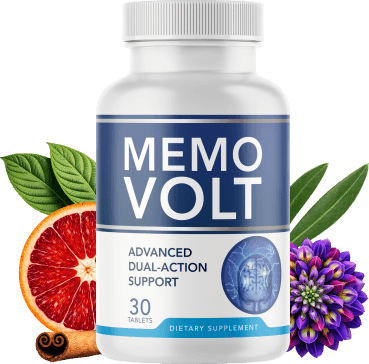
If a single daily step is what would make a memory supplement workable for you, two formulas on this site are built that way. MemoVolt is one capsule a day with food, and its label states 30 per bottle. It is stimulant-free and built on ten ingredients, including berberine, Ceylon cinnamon, banaba and saffron. NeuroPrime is one drop a day, preferably in the morning, taken straight or stirred into a drink, from a 2 fl oz bottle the maker sells as a one-month supply. It names nine botanicals, including bacopa, ginkgo and lion’s mane. Neither publishes the amount of each ingredient, which the full reviews explain.
Two formulas worth a closer look
Two once-a-day formulas
One step a day, each with a money-back guarantee — a capsule with a meal, or a drop in your morning drink.
MemoVolt
Capsules
One capsule a day with food, 30 per bottle — one step to pair with a meal. Built on berberine, Ceylon cinnamon and banaba, with saffron, which has human trials on cognition.
- Readers who already take several pills
- Readers already watching their blood sugar
Covered by a 60-day money-back guarantee
Before you start · Berberine and cinnamon are worth raising if you take diabetes medicine, and fucoidan if you take a blood thinner.
See MemoVolt on the official siteRead our MemoVolt review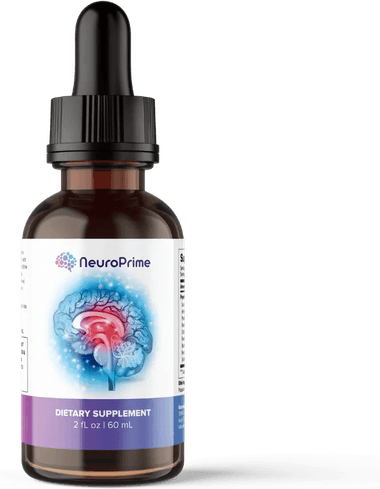
NeuroPrime
Drops
One drop a day, preferably in the morning, stirred into a drink you already have. Nine botanicals named, including bacopa, ginkgo and lion’s mane.
- Readers who would rather not add another capsule
- A morning routine: one drop in a drink
Covered by a 365-day money-back guarantee
Before you start · Ginkgo matters with a blood thinner, and bacopa with thyroid medicine or a sedative.
See NeuroPrime on the official siteRead our NeuroPrime reviewListed in no particular order. We publish no scores or rankings.
When Should You See A Doctor?
If you find you are missing or mixing up doses of your prescriptions, tell your doctor or pharmacist rather than adjusting anything yourself. The National Institute on Aging advises calling your doctor right away if you have any trouble with your prescriptions, over-the-counter medicines or supplements, and not stopping a medicine before talking with a provider.
If memory problems are getting worse, ask for an appointment. The National Institute on Aging lists medication side effects among the causes of memory problems, and notes that finding the cause is what determines the best next step.
Ready to compare? Go back to the two formulas above, or read the full reviews of MemoVolt and NeuroPrime.
Frequently asked
How many capsules a day should a memory supplement be?
There is no standard number. The Supplement Facts panel gives the serving size, and the directions say how many servings to take a day — multiply the two to get your daily total. If you already take several pills, fewer daily doses is easier to keep: a 2026 review of research in older adults found that regimens with many tablets a day, or doses at different times, lead to mistakes and omissions.
Is it better to take a supplement once a day?
For keeping a routine, fewer doses help. Research on medicines in older adults links frequent and multiple daily doses with lower adherence. Whether once a day suits a particular product is set by its label, and whether it suits you is a question for your pharmacist or doctor.
What does “serving size” mean on a supplement label?
It is the amount that counts as one serving, stated in a unit that fits the product, such as tablets, capsules, packets or teaspoonfuls. Federal labeling rules put it first on the Supplement Facts panel, with “Servings Per Container” underneath. The NIH Office of Dietary Supplements notes the maker suggests the serving size, but your health care provider might decide a different amount is right for you.
What time of day should I take a once-a-day supplement?
Follow the label first — some say to take it with food, others in the morning. Then tie it to something you already do: the National Institute on Aging notes that some people use meals or bedtime as reminders. Ask your pharmacist whether it needs to be taken apart from any of your medicines.
Can I keep my memory supplement with my prescription medicines?
Keep it in its own labeled bottle. MedlinePlus advises keeping medicines in their original containers, stored in a cool, dry place out of the reach and sight of children. Add the supplement to your written medicine list, with the amount and time, as the National Institute on Aging suggests, and show that list to your pharmacist.
References
- Medication adherence in older adults with chronic diseases: a scoping review of barriers, facilitators, and effective interventions — Frontiers in Aging — 2026
- Dietary Supplement Use: United States, August 2021–August 2023 — NCHS Data Brief No. 561, CDC — 2026
- 21 CFR 101.36, Nutrition labeling of dietary supplements — Electronic Code of Federal Regulations — 2022
- Dietary Supplements: What You Need to Know — NIH Office of Dietary Supplements — 2023
- Taking Medicines Safely as You Age — National Institute on Aging — 2022
- Storing your medicines — MedlinePlus Medical Encyclopedia — 2026
- Mixing Medications and Dietary Supplements Can Endanger Your Health — U.S. Food and Drug Administration — 2022
- New horizons for the study of saffron (Crocus sativus L.) and its active ingredients in the management of neurological and psychiatric disorders: A systematic review of clinical evidence and mechanisms — Phytotherapy Research — 2024
- Comparative effects of Bacopa monnieri and Ginkgo biloba on cognitive functions: A systematic review and network meta-analysis — Phytomedicine — 2026
- The Effects of a Bacopa monnieri Extract (Bacumen®) on Cognition, Stress, and Fatigue in Healthy Adults: A Randomized, Double-Blind, Placebo-Controlled Trial — Clinical Drug Investigation — 2025
- Diabetes and Dietary Supplements: What You Need To Know — NIH National Center for Complementary and Integrative Health — 2023
- Ginkgo: Usefulness and Safety — NIH National Center for Complementary and Integrative Health — 2025
- Bacopa monnieri — StatPearls, NCBI Bookshelf — 2023
- Fucoidan — Memorial Sloan Kettering Cancer Center, About Herbs — 2026
- Saffron — Journal of Primary Health Care — 2022
- Kudzu — Memorial Sloan Kettering Cancer Center, About Herbs — 2022
- Memory Problems, Forgetfulness, and Aging — National Institute on Aging — 2023
Disclosure
All content is for informational purposes only and is not a substitute for professional medical advice, diagnosis, or treatment. Each product covered is a dietary supplement, not a prescription drug, and statements about it have not been evaluated by the U.S. Food and Drug Administration. Results vary with individual health status, consistency of use, and lifestyle. This page contains affiliate links — if you buy through them we may earn a small commission at no additional cost to you. Read our disclosure and our editorial policy.